Many patients can. Same-day discharge has become common after both anatomic and reverse shoulder replacement, and for selected patients the large studies show no more complications or readmissions than after an overnight hospital stay. By late 2022, 36% of shoulder replacements in traditional Medicare patients went home the day of surgery.1 The important word is selected. Those results describe patients chosen for same-day surgery, and some patients are better served by staying at least one night. Your choice can also affect whether Medicare will pay for a rehabilitation stay.
This article covers what the safety data show, who tends to do well at home, who should plan on staying, how pain is managed after you leave, and how outpatient status affects your insurance coverage.
Why this matters to you
Many patients prefer to recover in their own home, and a shorter stay can reduce cost. Others are concerned about leaving the hospital within hours of major surgery with one arm in a sling, particularly if they live alone or care for a spouse. Family members want to know what will be expected of them. And patients with Medicare, especially those who have been told they may need rehab, need to understand how the plan for going home affects their coverage before surgery day.
What “outpatient” means
The word is used in two different ways. In everyday use, it means going home the same day. For insurance, it is a billing status: you are an outpatient unless a doctor orders your admission and the hospital formally admits you. According to Medicare, you might be an outpatient even if you stay overnight in a regular hospital bed.2 Studies also vary in their definitions. Some count only same-day discharge, and others include a stay of up to one night. Keep that distinction in mind when reading about “outpatient” results.
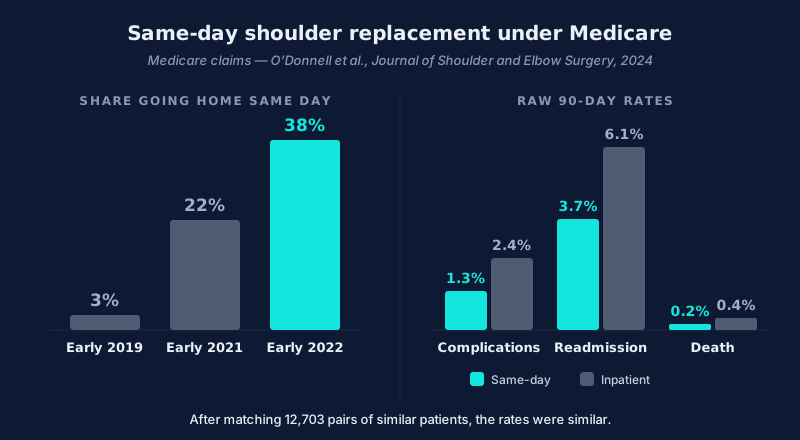
Medicare began paying for total shoulder replacement as an outpatient procedure in January 2021, and use grew quickly. Among traditional Medicare patients, the share going home the same day rose from 3% in early 2019 to 22% in early 2021 and 38% in early 2022.3
What the studies found
Complications and readmissions
The most useful study for US patients is a 2024 analysis of Medicare claims in the Journal of Shoulder and Elbow Surgery. Comparing 14,540 same-day patients with 40,576 inpatients, the raw 90-day rates favored the same-day group: complications 1.3% vs. 2.4%, readmissions 3.7% vs. 6.1% and deaths 0.2% vs. 0.4%. Same-day patients were healthier to begin with, however. When the researchers matched 12,703 pairs of similar patients, the rates were similar between the groups.3
Pooled analyses reach the same general conclusion. An updated review of 34 studies found no significant difference between outpatient and inpatient surgery in readmissions, surgical complications, revision surgery or emergency visits.4 A national surgical database found no difference in complications between going home the same day and going home the next day; patients who stayed 2 to 3 days did worse, but they were sicker from the start.5
How often the plan works
A planned same-day discharge usually happens as planned. In a pooled review of 990 outpatient shoulder replacements, only 0.9% of patients could not go home that day. Medical complications occurred in 1.7% and surgical complications in 5.4%.6 A prospective study applied preset criteria (under 85, with no or mild-to-moderate medical disease) and selected 51 of 163 patients; 94% of those selected went home the same day.7
Patients also appear to recover early function at least as well. In a European study, outpatients had better scores at 6 weeks, and scores were equivalent at 6 and 12 months.8 In a small series, 97% of those who answered a survey were satisfied with the outpatient experience.9
Reverse replacement and older patients
Reverse replacement patients tend to be older and sicker, and one large study found higher readmission rates after reverse than after anatomic replacement.10 Same-day surgery can still be appropriate. In a study from two surgery centers, 81 reverse and 117 anatomic replacements all went home the same day, with similar 90-day complications (7.4% and 7.7%). The patients were relatively young, however, averaging 61 and 56 years.11
Age alone does not settle the question. A Kaiser Permanente registry study focused on 1,814 patients with significant medical illness (ASA class 3 or higher). Same-day discharge was not worse than a hospital stay for readmissions or overall complications, but the data could not establish the same for emergency visits, heart events or blood clots.12 Older patients stay longer on average: in one series, the average stay was about 8 hours for patients 65 to 74 and about 26 hours for patients 80 and older.13
What this means for you: if you are in reasonable health and have help at home, the evidence does not suggest that an overnight stay would make you safer. If you have significant medical problems, the decision requires a more careful look at your specific risks.
Who should plan on staying
There is no universal checklist. A 2024 review of selection criteria concluded that no single accepted set exists, and identified difficulty walking independently and a history of congestive heart failure as the clearest reasons for at least one night in the hospital.14 Other studies add to this picture.
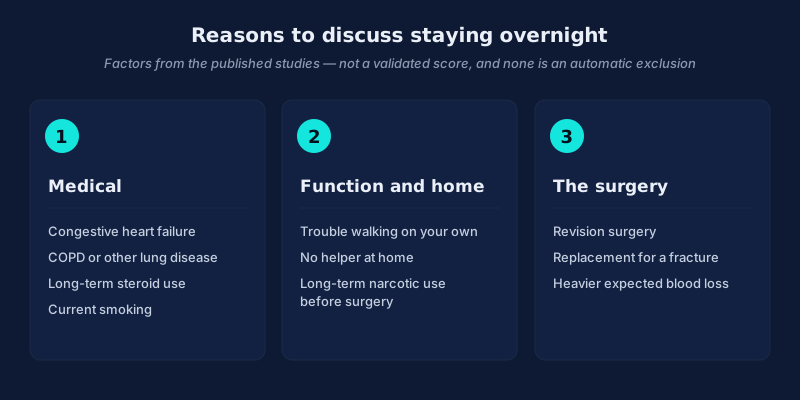
- Lung disease, steroids and smoking. In 2,431 outpatient shoulder replacements, 1.8% of patients were readmitted within 30 days, most often for lung problems. COPD tripled the odds of readmission; long-term steroid use and current smoking also raised them. In this study, an overnight stay appeared to reduce the added risk from steroid use and smoking, but not from COPD.15
- Support at home. Many published outpatient programs require anesthesia clearance and a named helper for the period around surgery.6
- Weight and mental health. In a program of 515 shoulder replacements, patients who could not go home as planned had a higher body mass index and more often had an active mental health condition. Women were also less likely to go home the same day.16
- Long-term pain medication. In one small study, the patients who had trouble with pain control at home were already taking narcotics before surgery.9
- Fractures and revisions. A 2026 review advises caution in these cases because they are less predictable and blood loss may be greater.17 A 2026 series of 131 reverse replacements for fractures found no significant difference in readmissions between outpatient and inpatient care (3.7% vs. 13.0%), but the choice was left to the surgeon, and the study was small.18
What this means for you: if you have heart failure, significant lung disease, or trouble walking safely, or no one to stay with you, expect to discuss a hospital stay, which is a reasonable plan for these patients.
Managing pain at home
A nerve block numbs the shoulder and arm for a period of time after surgery. In the surgery center study, patients who had an interscalene block before surgery spent less time in recovery and had far lower pain scores when they left (0.2 vs. 3.9 out of 10).11 The block wears off after you are home, usually within about a day, and pain can increase quickly when it does. A plan for starting oral pain medication before the block wears off, along with clear instructions on how to reach the office, is an important part of same-day surgery.
Medicare and rehab coverage
Outpatient status can determine whether a rehabilitation stay is covered, so it is worth checking before surgery. Under traditional Medicare, a stay in a skilled nursing facility is generally covered only after a medically necessary inpatient hospital stay of at least 3 days in a row. Time spent under observation does not count, even overnight.19 A patient who goes home the same day, or who stays one night as an outpatient, does not meet that requirement.
Medicare Advantage plans work differently. They may waive the 3-day requirement, but each plan sets its own rules.19,20 If rehab is part of your plan, call your insurer before surgery and ask whether a facility stay requires approval and what it would cost you. While you are in the hospital, Medicare advises asking each day whether you are an inpatient or an outpatient.2
The practical point for traditional Medicare patients is that if you expect to need a facility, a same-day plan may be the wrong one, and it is better to raise this before surgery. For a fuller look at what recovery at home involves, see my article on rehab after knee replacement and how much help you need at home. The sling and one-arm limits differ after shoulder surgery, but the planning questions are similar.
Strengths of this evidence
- The Medicare analysis reflects routine US care. It includes tens of thousands of patients treated across the country, not only those at specialty centers, and it matched patients on health status, surgeon volume and hospital characteristics.
- Sicker patients have been studied directly. The Kaiser registry addressed the question in patients with significant medical illness, rather than extrapolating from healthy patients.
- Different designs agree. Claims data, registries, prospective cohorts and pooled reviews all point in the same direction.
Where I’d push back on the data
- There is no randomized evidence in these studies. Patients were chosen for same-day surgery because their surgeons expected them to do well. Matching adjusts for what is recorded, but not for a surgeon’s judgment about frailty, home support or how the operation went.
- Pooled reviews are weaker than they look. The updated meta-analysis found that only its total-complication result had enough data to be considered conclusive, and it rated its own evidence at level IV.4 The lower complication rate it reports for outpatients is most likely a result of selection.
- Prediction tools have not proven reliable. When one center tested a published risk calculator on its patients, the calculator predicted next-day discharge about as well as chance (area under the curve 0.55).21 Clinical judgment still carries most of the weight.
- Similar readmissions do not capture everything. Few studies measure how hard the first days were for the patient and their family, how many calls were made to the office, or the burden on the person providing care.
- Older, frail patients remain underrepresented. The average outpatient in a major review was 66.6 years old.22 These results do not automatically extend to a frail patient in their 80s. See my article on shoulder replacement in older patients for the data on that group.
What this means in my practice
I do outpatient shoulder replacement in the right circumstances: when the patient meets discharge criteria and is in appropriate health. The choice is made for each patient, with these questions in mind.
1. Your health comes first
I look at your heart and lung health, blood thinners, diabetes control and how well you walk. If a patient has conditions in which a night of monitoring may help, I recommend the hospital stay.
2. Who will be at home
With one arm in a sling, you will need help with dressing, meals and getting safely in and out of a chair during the first days. I ask who will be there before we set a plan, and whether that person can stay at least through the first night.
3. How the operation is planned
I use Blueprint 3D CT-based planning with the Tornier Perform implant system to plan component position before surgery. A complex case, such as a revision or a fracture, is a reason to expect a hospital stay.
4. The plan can change
A same-day plan is conditional. If you are not ready that day because of pain, nausea, low blood pressure or difficulty getting up, you stay. Patients should pack and plan with that possibility in mind.
Who this evidence fits, and who it doesn’t
Closest fit: a patient in generally good health having a first anatomic or reverse replacement for arthritis or a worn rotator cuff, who walks independently and has a helper at home.
Less certain fit: a patient with heart failure or COPD; a patient having a revision or fracture surgery; a patient who is frail or lives alone; and a traditional Medicare patient who expects to need a skilled nursing facility.
The bottom line for the layperson
- Many patients can safely go home the same day after a shoulder replacement, including some who have a reverse replacement.
- For well-selected patients, large studies find similar complications and readmissions compared with an overnight stay.
- Heart failure, significant lung disease, trouble walking or no help at home are good reasons to plan on staying.
- Under traditional Medicare, a same-day or outpatient stay does not qualify you for covered skilled nursing care, so ask before surgery if you expect to need rehab.
- Have a plan for the night the nerve block wears off, and a person at home to help.
If you are planning a shoulder replacement, you can read more about how surgeons choose between reverse and anatomic replacement and life after a reverse shoulder replacement, or request a visit to talk it through.
Sources
- Fedorka CJ, Srikumaran U, Abboud JA, Liu H, Zhang X, Kirsch JM, et al. “Trends in the adoption of outpatient joint arthroplasties and patient risk: a retrospective analysis of 2019 to 2021 Medicare claims data.” J Am Acad Orthop Surg. 2024;32(15):e741–e749. DOI: 10.5435/JAAOS-D-23-00572 (PMID: 38452268)
- Medicare.gov. “Inpatient or outpatient hospital status affects your costs.” medicare.gov/coverage/inpatient-hospital-care/inpatient-outpatient-status (accessed October 31, 2026)
- O’Donnell EA, Best MJ, Simon JE, Liu H, Zhang X, Armstrong AD, et al. “Trends and outcomes of outpatient total shoulder arthroplasty after its removal from CMS’s inpatient-only list.” J Shoulder Elbow Surg. 2024;33(4):841–849. DOI: 10.1016/j.jse.2023.07.019 (PMID: 37625696)
- Al-Saadawi A, Tehranchi S, Benson R, Rose D, Nzeako OJ. “Outpatient shoulder arthroplasty: an updated systematic review, meta-analysis, and trial sequential analysis on clinical outcomes and cost-effectiveness.” Shoulder Elbow. 2026;18(2):203–224. DOI: 10.1177/17585732251349754 (PMID: 40584214)
- Kim M, Ling K, Tantone RP, Al-Humadi S, Wang K, VanHelmond TA, et al. “Investigating immediate postoperative medical complication risks relative to in-hospital length of stay after total shoulder arthroplasty.” JSES Int. 2023;7(6):2467–2472. DOI: 10.1016/j.jseint.2023.07.011 (PMID: 37969519)
- Sandler AB, Scanaliato JP, Narimissaei D, McDaniel LE, Dunn JC, Parnes N. “The transition to outpatient shoulder arthroplasty: a systematic review.” J Shoulder Elbow Surg. 2022;31(7):e315–e331. DOI: 10.1016/j.jse.2022.01.154 (PMID: 35278682)
- van Kampen DA, de Vries L, Jan Hillen R, La Guardia P, van Beek R. “Prospective cohort study of same-day discharge shoulder arthroplasty in patients of 85 years and younger.” Shoulder Elbow. 2023;15(1 Suppl):80–86. DOI: 10.1177/17585732221113503 (PMID: 37692875)
- Flurin PH, Abadie P, Lavignac P, Laumonerie P, Throckmorton TW. “Outpatient vs. inpatient total shoulder arthroplasty: complication rates, clinical outcomes, and eligibility parameters.” JSES Int. 2024;8(3):483–490. DOI: 10.1016/j.jseint.2023.06.029 (PMID: 38707575)
- Leroux TS, Zuke WA, Saltzman BM, Go B, Verma NN, Romeo AA, et al. “Safety and patient satisfaction of outpatient shoulder arthroplasty.” JSES Open Access. 2018;2(1):13–17. DOI: 10.1016/j.jses.2017.11.002 (PMID: 30675561)
- Goltz DE, Burnett RA, Wickman JR, Levin JM, Howell CB, Nicholson GP, et al. “Short stay after shoulder arthroplasty does not increase 90-day readmissions in Medicare patients compared with privately insured patients.” J Shoulder Elbow Surg. 2022;31(1):35–42. DOI: 10.1016/j.jse.2021.05.013 (PMID: 34118422)
- Calkins TE, Baessler AM, Throckmorton TW, Black C, Bernholt DL, Azar FM, et al. “Safety and short-term outcomes of anatomic vs. reverse total shoulder arthroplasty in an ambulatory surgery center.” J Shoulder Elbow Surg. 2022;31(12):2497–2505. DOI: 10.1016/j.jse.2022.05.010 (PMID: 35718256)
- Hachadorian M, Chang RN, Prentice HA, Paxton EW, Rao AG, Navarro RA, et al. “Association between same-day discharge shoulder arthroplasty and risk of adverse events in patients with American Society of Anesthesiologists classification ≥3: a cohort study.” J Shoulder Elbow Surg. 2023;32(11):e556–e564. DOI: 10.1016/j.jse.2023.04.026 (PMID: 37268285)
- Raji Y, Smith KL, Megerian M, Maheshwer B, Sattar A, Chen RE, et al. “Same-day discharge vs. inpatient total shoulder arthroplasty: an age stratified comparison of postoperative outcomes and hospital charges.” J Shoulder Elbow Surg. 2024;33(11):2383–2391. DOI: 10.1016/j.jse.2024.02.040 (PMID: 38604401)
- Root KT, Hones KM, Hao KA, Brolin TJ, Wright JO, King JJ, et al. “A systematic review of patient selection criteria for outpatient total shoulder arthroplasty.” Orthop Clin North Am. 2024;55(3):363–381. DOI: 10.1016/j.ocl.2023.12.002 (PMID: 38782508)
- Ling K, Tsouris N, Nazemi A, Komatsu DE, Wang ED. “Identifying risk factors for 30-day readmission after outpatient total shoulder arthroplasty to aid in patient selection.” JSES Int. 2023;7(6):2425–2432. DOI: 10.1016/j.jseint.2023.06.015 (PMID: 37969527)
- Lee YS, Wright MA, Murthi AM. “Patient satisfaction and clinical outcomes utilizing a patient care coordination team to support same-day discharge following shoulder arthroplasty.” J Shoulder Elbow Surg. 2026;35(2):e169–e177. DOI: 10.1016/j.jse.2025.05.040 (PMID: 40681087)
- Hussain ZB, Throckmorton TW, Garrigues GE. “Outpatient reverse total shoulder arthroplasty.” Curr Rev Musculoskelet Med. 2026;19(1). DOI: 10.1007/s12178-026-10055-6 (PMID: 42814273)
- Lorentz S, Rivera N, Hurley E, Henriquez A, Blaber O, Fox B, et al. “Reverse total shoulder arthroplasty for proximal humerus fractures as an outpatient procedure.” J Shoulder Elb Arthroplast. 2026;10(4):100075. DOI: 10.1016/j.jsea.2026.100075 (PMID: 42774517)
- Medicare.gov. “Skilled nursing facility care.” medicare.gov/coverage/skilled-nursing-facility-care (accessed October 31, 2026)
- Centers for Medicare & Medicaid Services. “Skilled Nursing Facility 3-Day Rule Billing.” MLN9730256, May 2026. cms.gov/files/document/skilled-nursing-facility-3-day-rule-billing.pdf
- Leape CP, Donaldson ST, Haislup BD, Wright MA, Murthi AM. “Predicting successful outpatient total shoulder arthroplasty.” J Shoulder Elbow Surg. 2023;32(7):1357–1363. DOI: 10.1016/j.jse.2023.02.131 (PMID: 36997152)
- Cimino AM, Hawkins JK, McGwin G, Brabston EW, Ponce BA, Momaya AM. “Is outpatient shoulder arthroplasty safe? A systematic review and meta-analysis.” J Shoulder Elbow Surg. 2021;30(8):1968–1976. DOI: 10.1016/j.jse.2021.02.007 (PMID: 33675972)
This article reflects Dr. Dewan's reading of the cited evidence at the time of publication. It is educational content, not medical advice. Your specific case may differ — schedule a consultation to discuss your imaging and history.