For most patients the answer is yes, but not the kind of caretaker they are picturing. What you need at home after a same-day knee replacement is not nursing care. It is a competent adult who can drive you home, wake you for your pain medicine, and walk with you to the bathroom for the first two nights.
Whether you have that person is one of four things that determine whether you can go home the same day, alongside your medical health, your anesthetic, and the complexity of your knee. It is the only one of the four that has nothing to do with medicine. It is also the one patients most often assume they can sort out later, and the one you can still change in the weeks before surgery.
This article covers what that support actually consists of, what happens when it is not there, and what the evidence says about the patient who lives alone.
Why this matters to you
A knee replacement is not a procedure you recover from lying still. The whole modern approach depends on you standing up within hours, walking with a walker the same afternoon, and repeating that every hour or two for the first several days. Every one of those attempts, in the first 48 hours, is a moment where a person who is medicated, swollen, and unsteady is putting weight on a leg that has just been operated on.
The single-institution data on falls after knee replacement are instructive about timing. In a review of 6,472 knee replacements, falls that happened in the hospital clustered on the first postoperative day (43.6%) and the second (30.8%), and the most common causes were loss of balance and the knee buckling. Patients who fell had longer stays and a higher revision rate later.1
Those are falls that happened with nurses in the building. The point is not that home is more dangerous — it is that the risky window is the first two days, which is exactly the window that same-day discharge relocates into your house.
What the job actually is
When I ask patients who is going to be at home, most of them hear it as a question about nursing. That misunderstanding costs them both ways: some recruit far more help than they need, and some conclude they cannot find any and give up on going home the same day.
Here is the real job.
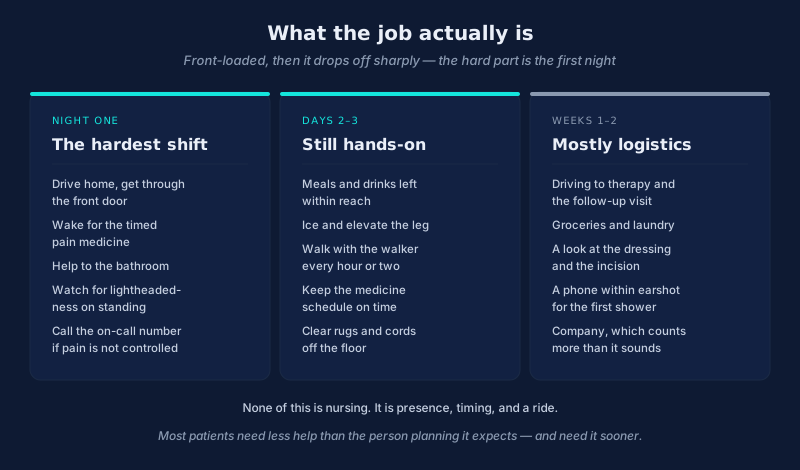
The day of surgery and that night. A licensed adult drives you home — you cannot drive yourself and a rideshare is not an acceptable substitute, because someone has to get you through your own front door. Overnight, the tasks are waking you for the timed pain medicine so you never start from behind, walking with you to the bathroom, watching for lightheadedness when you first stand, and making the phone call if pain or nausea is not coming under control. This is the shift that matters.
Days two and three. Meals and drinks left within reach. Ice and elevation. Walking with you every hour or two while you are awake. Keeping the medicine schedule on time. Getting the throw rugs and extension cords off the floor before you catch a walker leg on one.
The first two weeks. Mostly driving — to therapy, to the follow-up visit — plus groceries, laundry, a look at the dressing, and a phone within earshot for your first shower. By this point the help is logistical rather than physical.
None of that is nursing. It is presence, timing, and a ride. Recognizing that changes who qualifies as an acceptable helper: a neighbor, a friend from church, a sibling who takes a long weekend, an adult child who works from your kitchen table for three days.
What the evidence says about living alone
This is where patient expectation and published data diverge sharply.
The most important study on the subject followed 910 consecutive hip and knee replacements prospectively and compared 138 patients who went home to an empty house against 631 who went home to someone. The primary outcomes were 90-day complications and unplanned clinical events — readmissions, emergency and urgent-care visits, and unscheduled office visits.
There was no increase in complications or unplanned events for the patients living alone. Function, pain relief, and satisfaction at 90 days were equivalent as well. What did differ: those patients more often stayed an additional night in the hospital, and they used more home health services.2 The authors' conclusion was that extending the stay slightly and adding home health on a selective basis is a better and cheaper approach than routing these patients into a rehabilitation facility.
That is a genuinely reassuring result, and it is the one I would want a patient who lives alone to hear first. It is also, notably, a study of patients who stayed in the hospital at least one night — not a study of same-day discharge.
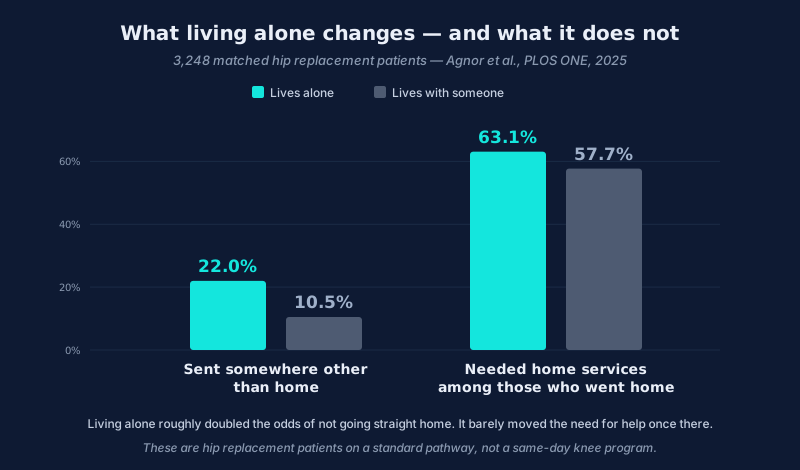
A 2025 analysis of national surgical data illustrates how much the assumption still drives the outcome. Among 3,248 propensity-matched hip replacement patients, those living alone were sent somewhere other than home 22.0% of the time versus 10.5% for patients living with someone — an adjusted odds ratio of 2.84, after accounting for the medical differences between the groups.3 Yet among those who did go home, the difference in needing home services was modest: 63.1% versus 57.7%.
Read those two numbers together. Living alone roughly doubled the odds of being routed away from home. It barely moved how much help people actually needed once they got there.
A smaller study makes the same point more bluntly. Among 127 patients who lived alone, the strongest predictor of ending up in a skilled nursing facility was not age, not medical health, and not how the surgery went. It was whether the patient expected to go to one — an odds ratio of roughly 29, dwarfing every clinical variable in the model.4
What you plan for is, to a striking degree, what happens.
The person doing the helping
Almost all of this literature treats the caregiver as a checkbox — a variable that predicts the patient's discharge and then disappears from the analysis. In a review of 482 hip and knee replacements in patients aged 80 to 89, having a caregiver lined up for after surgery was one of the factors that separated patients discharged early from those who stayed longer, alongside being married, not smoking, and walking independently beforehand.7
A study published this year finally measured what the job costs the person doing it: 185 patient-caregiver pairs after hip and knee replacement, assessed four weeks out. The caregivers averaged 64 years old, 72% were spouses, and 60% were women.5
Measured strain was substantial, and three factors predicted more of it: being a woman, spending more hours per day on the task, and feeling less prepared beforehand. Caregivers who went in unprepared also reported a greater sense of threat about the experience as a whole.5
That is an actionable result rather than a descriptive one. Preparation is something a practice controls. It is why I would rather your helper come to the preoperative visit than hear the instructions relayed secondhand.
One more piece of context, because it cuts against an assumption people make. A study of 140 caregivers compared those caring for a patient discharged the same day against those whose patient was discharged later. Caregiver burden and stress were not significantly different between the two groups.6 Sending a patient home earlier did not measurably transfer more load onto the family. The study was small and single-center, and the same-day group's burden score did run numerically higher, so I would not lean on it hard. But the feared effect did not appear.
Where I would push back
- Almost none of this evidence is about same-day discharge specifically. The reassuring living-alone study enrolled patients who stayed at least one night, and the 2025 matched analysis is a study of hip replacement on a conventional pathway. Applying either to a patient walking through their own front door six hours after surgery is an extrapolation. A reasonable one, and still an extrapolation.
- "Living alone" is not the variable that matters. It is a crude proxy for something more specific: whether anyone will be physically present during the first 48 hours. A patient who lives alone but has a sister staying for three nights is in a completely different situation from one who lives with a spouse who works nights. Every study cited here measures the household, not the plan.
- The falls data are from inpatients, and I am using them to make a point about home. Nobody has published a good study of fall rates in the first 48 hours after same-day discharge, because falls at home go unrecorded unless they generate a hospital visit. The timing signal is real; the transfer to the home setting is my inference, not a finding.
- The caregiver-burden comparison is underpowered. A total of 140 caregivers split across two groups cannot detect anything but a large difference, and the same-day group scored numerically higher on burden. "No significant difference" in a study that size means the question is open.
- The expectation finding should make everyone uncomfortable. If what a patient expects predicts their discharge destination roughly 29 times more strongly than their clinical variables, then a meaningful share of skilled-nursing placements after joint replacement are being driven by assumption rather than need. That is a failure of preoperative counseling, and the responsibility for it sits with surgeons and hospitals, not with patients.
How I think about this in my practice
I ask a specific question at the preoperative visit, and I ask for a name: who is sleeping in your house on the night of surgery, and who is driving you to your first follow-up? Not "do you have support" — that question gets a yes from everyone.
Alongside it, three practical items. Can you get from your car to your bed without stairs you cannot manage? Is there a bathroom you can reach on the level where you will be sleeping? Is there a phone within reach of the chair you will spend the first two days in?
Where same-day discharge likely fits. A patient with a competent adult in the house for the first two or three nights, a reachable bathroom, and a plan for rides. That patient does not need a nurse at home and does not need a facility. Evidence suggests they do as well as anyone.
Where it likely does not. A patient who will be alone overnight on day one, or whose only bathroom is up a flight of stairs, or whose helper is themselves frail. That is not a reason to cancel an operation or to plan on a nursing facility. It usually means one night in a bed with a nurse in the building, then home — which is exactly what the living-alone data suggest works.
And if you genuinely have nobody, say so early rather than at the preoperative visit. Home health can be arranged, a paid caregiver can be hired for two or three nights, and an overnight stay can be planned deliberately instead of discovered at 6 p.m. on the day of surgery. What does not work is deciding to improvise. The published evidence says patients who live alone do fine after a knee replacement — but every one of those patients had a plan, and most of them had help arranged before they ever went to sleep the night before surgery.
The bottom line for the layperson
- The job is presence, timing, and a ride — waking you for medicine, walking with you to the bathroom, and driving you to therapy. It is not nursing, so more people qualify to do it than you think.
- The first two nights are what matter. Falls after knee replacement cluster on the first and second day, and the help you need drops off sharply after that.
- Living alone does not make you unsafe. In a study of 910 joint replacements, patients who went home to an empty house had no increase in complications, readmissions, or emergency visits — they just used more home health and sometimes stayed an extra night.
- What you expect is what tends to happen. Among patients living alone, expecting to go to a nursing facility predicted going to one far more strongly than any medical factor did.
- Prepare the person helping you, not just yourself. Caregivers who felt unprepared reported significantly more strain — bring them to the preoperative visit.
If you're planning a knee replacement and are not sure your home situation works, that's worth sorting out well before the surgery date. You can request a visit or call the office at (281) 690-4678. You may also want to read what the same-day discharge safety data show and why most patients go home instead of to a rehab facility.
Sources
- Lawrence KW, Link L, Lavin P, Schwarzkopf R, Rozell JC. “Characterizing patient factors, perioperative interventions, and outcomes associated with inpatient falls after total knee arthroplasty.” Knee Surg Relat Res. 2024;36(1):11. DOI: 10.1186/s43019-024-00215-8 (PMID: 38459532)
- Fleischman AN, Austin MS, Purtill JJ, Parvizi J, Hozack WJ. “Patients Living Alone Can Be Safely Discharged Directly Home After Total Joint Arthroplasty: A Prospective Cohort Study.” J Bone Joint Surg Am. 2018;100(2):99–106. DOI: 10.2106/JBJS.17.00067 (PMID: 29342059)
- Agnor BK, Knio ZO, Zuo Z. “Living alone predicts non-home discharge post elective hip arthroplasty: A matched-pair cohort study.” PLoS One. 2025;20(1):e0316024. DOI: 10.1371/journal.pone.0316024 (PMID: 39746111)
- Fang C, Lim SJ, Tybor DJ, Martin J, Pevear ME, Smith EL. “Factors Determining Home Versus Rehabilitation Discharge Following Primary Total Joint Arthroplasty for Patients Who Live Alone.” Geriatrics (Basel). 2020;5(1):7. DOI: 10.3390/geriatrics5010007 (PMID: 32059537)
- Sontag-Milobsky IL, Selph TJ, Madhan A, Pagadala MS, Adelani MA, Edelstein AI, Schwarzkopf R, Suleiman LI. “Caring for the Caregiver: Caregiver Preparation and Stress Following Total Joint Arthroplasty.” J Arthroplasty. 2026;41(9):2674–2679. DOI: 10.1016/j.arth.2025.11.053 (PMID: 41318038)
- Fidan Ö, Buker N, Savkin R, Sanlialp Zeyrek A. “Does early or late discharge after total knee replacement affect the burden and stress of caregivers?” Int J Orthop Trauma Nurs. 2024;52:101036. DOI: 10.1016/j.ijotn.2023.101036 (PMID: 37423810)
- Kay AB, Ponzio DY, Bell CD, Orozco F, Post ZD, Duque A, Ong AC. “Predictors of Successful Early Discharge for Total Hip and Knee Arthroplasty in Octogenarians.” HSS J. 2022;18(3):393–398. DOI: 10.1177/15563316211030631 (PMID: 35846269)
- AAHKS — “Position Statement on Outpatient Joint Replacement” (2024), issued with the Hip Society, the Knee Society and the AAOS.
This article reflects Dr. Dewan's reading of the cited evidence at the time of publication. It is educational content, not medical advice. Your specific case may differ — schedule a consultation to discuss your imaging and history.