For most patients today, robotic shoulder replacement is a promising tool rather than a proven upgrade. The first robotic system for shoulder replacement in the US was cleared by the FDA in November 2024 and reached full release in 2026, for reverse shoulder replacement only.1,2 The early studies, almost all from a small number of surgeons, show that the robot reduces large misses when placing the socket part of the implant. None has yet shown that patients have less pain, better motion or a longer-lasting shoulder. A study published on October 7 in International Orthopaedics is typical: it found the robot made operating times more predictable, but it did not measure how patients did.3
This article explains what “robotic” means in shoulder replacement, how it relates to the 3D planning many surgeons already use, what the studies show, and how to weigh it if a surgeon offers it.
Why this matters to you
Patients search for “robotic shoulder replacement” because robotic knee and hip replacement are now widely advertised. A national survey published in August found that two out of three US adults believe robotic assistance leads to better results in shoulder replacement.4 When a technology is new, the marketing usually arrives before the outcome data. Knowing what the robot does, and what it has and has not been shown to do, helps you ask better questions and avoid choosing a surgeon for the wrong reason.
What a shoulder replacement has to get right
A shoulder replacement has two parts: a ball on the upper arm bone (humerus) and a socket on the shoulder blade (the glenoid, the shallow cup of the shoulder blade). In an anatomic replacement, the ball and socket are rebuilt in their natural positions. In a reverse replacement, they are switched, with the ball fixed to the shoulder blade and the cup on the arm bone. Reverse replacement is used for arthritis with a damaged rotator cuff and for many other conditions.
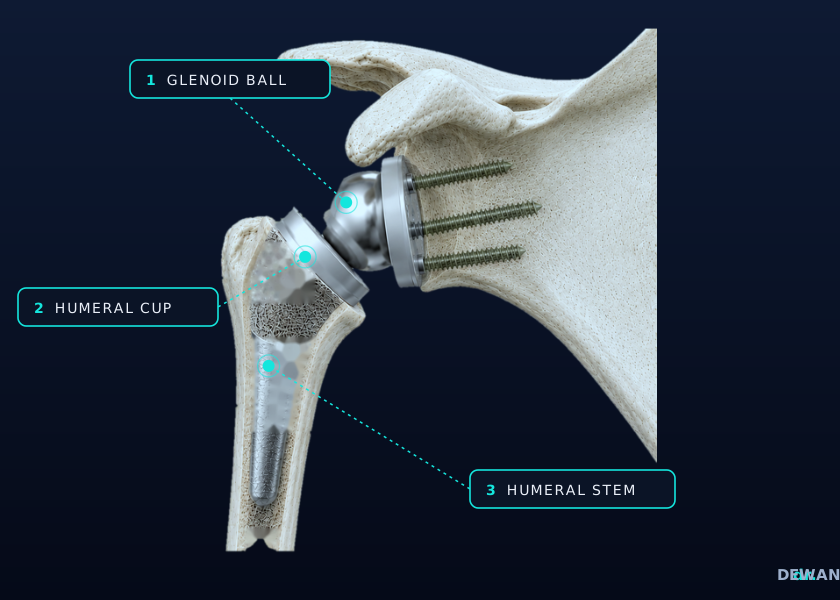
The hardest step is placing the socket side. The glenoid is small, it is often worn unevenly by arthritis, and much of it is hidden from the surgeon’s view during the operation. The angle at which that part is placed matters. In anatomic replacements, a socket left tilted too far backward has been linked to bone loss around the implant.5 In reverse replacements, a baseplate placed too high or tilted upward has been linked to scapular notching, wear of the shoulder blade bone where the arm-bone component rubs against it, which was associated with lower strength and less overhead motion in a large French series.6
Every technology described below is aimed at this one step: getting the socket where the surgeon planned to put it.
From standard instruments to a robotic arm
Shoulder replacement technology has developed in steps, each building on the one before.
3D CT planning
Before surgery, a CT scan of the shoulder is loaded into planning software that builds a 3D model of the shoulder blade. The surgeon measures the wear pattern and chooses the implant type, size and position on the model. Three-dimensional planning measures the glenoid more accurately than standard two-dimensional CT images. In one study of 50 patients, 3D planning changed the surgeon’s implant decision in 7 cases (14%).7
Patient-specific guides and navigation
A plan has to be carried into the operating room. A patient-specific guide is a small plastic jig made from your CT to fit the surface of your shoulder blade, showing the surgeon exactly where to drill. Navigation uses tracking markers and a camera to show the drill’s position against the plan on a screen in real time.
Robotic arm
The robotic system cleared in the US uses the same 3D plan. During surgery, a robotic arm guides preparation of the glenoid along the planned path and depth. According to the manufacturer, it is currently limited to primary reverse shoulder replacement.2
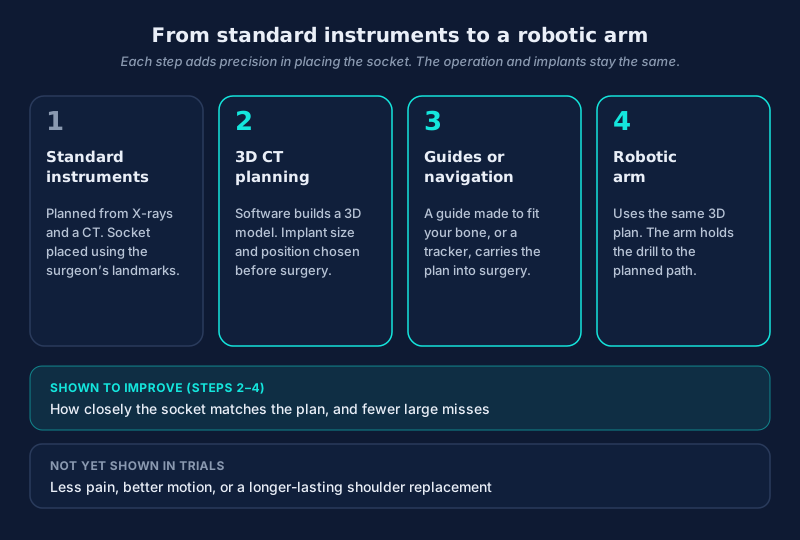
What this means for you: “robotic” is the last step on a ladder that most of the benefit may already reach at the planning stage. Asking whether a surgeon uses 3D planning is at least as useful as asking whether they use a robot.
What the studies show
3D planning predicts the implant well, but plans can change
In a study of 200 shoulder replacements, the implant planned on 3D software matched the implant actually used in 85% of anatomic and 90% of reverse replacements, with a complete mismatch in only 2% to 3%.8 That leaves some cases in which the plan changed during surgery, usually because bone quality or soft tissue looked different in person than on the scan. Patients in online forums sometimes report surprise that their “planned” implant was not the one used. A 3D plan is a strong starting point, not a promise, and the surgeon has to be ready to adjust.
There is a second caution. In a study of 6,483 cases from 417 surgeons using one company’s planning software, surgeons kept the initial plan prepared by the company’s technicians for both key socket angles in 55% of cases.9 The authors warned that a ready-made plan can anchor a surgeon’s judgment. Planning software helps most when the surgeon reviews and changes the plan, rather than accepting it.
Guides and navigation improve position, especially in difficult shoulders
An early randomized trial of 31 patients found that patient-specific guides reduced the average error in socket tilt from 11.6 degrees with standard instruments to 2.9 degrees. The benefit was largest in badly worn shoulders.10 Later work clarified where that gain comes from. In 173 anatomic replacements that all had 3D CT planning, adding patient-specific guides of various types did not consistently improve accuracy over standard instruments.11 A 2026 randomized trial of 106 reverse replacements at seven centers found no difference in baseplate angles between guides and freehand placement after planning, though guides improved screw placement.12 Taken together, much of the accuracy gain appears to come from detailed planning itself.
For navigation in reverse replacement, a meta-analysis of 10 studies and 667 shoulders found better control of baseplate tilt, no improvement in its rotation, and operations about 12 minutes longer. The authors described the clinical impact as still unknown.13
Better position has not yet meant better shoulders
A 2025 meta-analysis of patient-specific guides in shoulder replacement found no difference in complications, reoperation or shoulder function scores compared with standard instruments.14 A randomized trial of 47 reverse replacements found more accurate placement with guides but no difference in patient-reported results at two years.15 Even the link between position and long-term results is not settled. The study that tied a backward-tilted socket to bone loss found no difference in shoulder scores or reoperation.5 A separate two-year study found no difference in function or revision between patients whose socket ended up tilted back 15 degrees or more and those with better position.16
The robotic data so far
The largest robotic accuracy study, published in July, compared 61 robotic and 42 conventional reverse replacements by one surgeon, all planned with the same 3D software.17 The average gap between planned and achieved baseplate tilt was 2.7 degrees with the robot and 3.9 degrees without, a difference that was not statistically significant. The robot did eliminate large misses: no robotic case was more than 10 degrees off the plan, compared with 4 of 42 conventional cases (10%).
The study published on October 7 compared 39 robotic and 38 conventional reverse replacements by the same surgeon after excluding the first 23 robotic cases as a learning period.3 Average operating time was the same (about 74 versus 79 minutes), but robotic operations were more predictable in length. The robot’s learning curve was real: in another series, the first 10 robotic cases averaged about 106 minutes, falling to about 68 minutes by cases 21 to 30.18
Early users have also reported practical problems. In a survey of 14 surgeons who used the system during its limited release, 6 (43%) had at least one case in which they stopped using the robot and finished by hand, all because of problems registering the bone or fixing the tracking markers. The surgeons rated the robot as useful, and the authors described its clinical benefits as “yet to be realized.”19
Finally, an economic analysis asked how many revisions the robot would need to prevent to pay for itself. Assuming $1,500 in added cost per case and a 2.1% early revision rate, the robot would need to prevent about one revision for every 15 patients, which the authors concluded cannot be achieved under typical conditions.20
What this means for you: the robot appears to make socket placement more consistent. Whether that consistency leads to a better or longer-lasting shoulder is not known, and it will take years of follow-up to find out.
Strengths of this evidence
- The accuracy findings agree across methods. 3D planning, guides, navigation and robotics all reduce large errors in socket placement compared with standard instruments in difficult anatomy.
- Several of the guide studies are randomized trials, including a seven-center trial published this year.
- The robotic studies compared cases planned with the same software, so the difference measured is the robot itself, not the planning.
Where I’d push back on the data
- The robotic evidence comes mostly from one group. Most published robotic shoulder studies share an author who is a consultant for the manufacturer. The studies disclose this, and the findings are measured and cautious, but independent replication is still needed.
- No robotic study reports patient outcomes. The measured endpoints are angles on X-rays, operating time and surgeon workload. Those are surrogate measures, not pain, function or implant survival.
- The sample sizes are small. Ten percent of 42 conventional cases is four patients. A difference that size can shift with a few more cases.
- The robot is limited to reverse replacement. The anatomic replacements, where socket tilt has the clearest link to bone loss, are not yet part of the robotic option in the US.
- Large misses can be avoided without a robot. Experienced surgeons using 3D planning with or without guides also achieve low outlier rates. The robot’s added value over careful planning is the open question.
What this means in my practice
For shoulder replacement, I use Blueprint 3D planning with the Tornier Perform implant system. The CT model of the shoulder blade lets me measure the wear pattern and choose the implant type, size and position before surgery. As the studies above show, a 3D plan is a starting point, and the final decision is made in the operating room once the bone and soft tissue can be seen directly.
Questions worth asking any shoulder surgeon
- Do you plan my surgery on a 3D model from a CT scan?
- How many shoulder replacements do you perform each year?
- If you use a robot or navigation, how many cases have you done with it?
- Will I have an anatomic or reverse replacement, and why?
- What happens if the plan needs to change during surgery?
The same national survey that found strong public belief in robotics also found that 62% of respondents would choose a higher-volume surgeon without a robot over a lower-volume surgeon with one.4 That instinct is consistent with the evidence.
Who this evidence fits, and who it doesn’t
It fits most patients with shoulder arthritis or a rotator cuff problem considering replacement. For them, planning and surgeon experience appear to matter more than the specific tool used to place the implant.
It is less settled for patients with severe glenoid wear, deformity or prior surgery. These are the shoulders where large placement errors are most likely, and where enabling technology, including robotics, has the strongest rationale.
The bottom line for the layperson
- Robotic shoulder replacement is new in the US and is currently available only for reverse shoulder replacement.
- Early studies show the robot reduces large misses in placing the socket, but the average accuracy is similar to careful conventional surgery.
- No study yet shows that robotic surgery gives patients less pain, better motion or a longer-lasting shoulder.
- Much of the accuracy benefit comes from 3D CT planning, which is available without a robot.
- Ask about 3D planning and your surgeon’s experience rather than choosing on the word “robotic.”
If you are considering shoulder replacement, you can read more about reverse versus anatomic shoulder replacement and how I plan shoulder replacement in 3D, or request a visit to review your own imaging.
Sources
- US Food and Drug Administration. 510(k) Premarket Notification K242373: Mako Shoulder Application (1.0). Decision date November 7, 2024. FDA 510(k) database
- Stryker. “Stryker showcases continued innovation across orthopaedics at AAOS 2026 Annual Meeting.” March 3, 2026. stryker.com
- Frederickson M, Singh D, Menendez ME. “Robotic assistance reduces operative time variability in reverse shoulder arthroplasty: a retrospective single-surgeon study.” Int Orthop. Published online October 7, 2026. DOI: 10.1007/s00264-026-07056-y (PMID: 42839054)
- Zabiba A, Menendez ME. “Public perceptions of robotic-assisted shoulder arthroplasty in the United States.” J Shoulder Elbow Surg. Published online August 21, 2026. DOI: 10.1016/j.jse.2026.08.012 (PMID: 42628628)
- Ho JC, Sabesan VJ, Iannotti JP. “Glenoid component retroversion is associated with osteolysis.” J Bone Joint Surg Am. 2013;95(12):e82. DOI: 10.2106/JBJS.L.00336 (PMID: 23783213)
- Lévigne C, Garret J, Boileau P, et al. “Scapular notching in reverse shoulder arthroplasty: is it important to avoid it and how?” Clin Orthop Relat Res. 2011;469(9):2512–2520. DOI: 10.1007/s11999-010-1695-8 (PMID: 21116754)
- Werner BS, Hudek R, Burkhart KJ, Gohlke F. “The influence of three-dimensional planning on decision-making in total shoulder arthroplasty.” J Shoulder Elbow Surg. 2017;26(8):1477–1483. DOI: 10.1016/j.jse.2017.01.006 (PMID: 28162884)
- Raiss P, Walch G, Wittmann T, Athwal GS. “Is preoperative planning effective for intraoperative glenoid implant size and type selection during anatomic and reverse shoulder arthroplasty?” J Shoulder Elbow Surg. 2020;29(10):2123–2127. DOI: 10.1016/j.jse.2020.01.098 (PMID: 32340791)
- Hartzler RU, Denard PJ, Griffin JW, et al. “Surgeon acceptance of an initial 3D glenoid preoperative plan: rates and risk factors.” J Shoulder Elbow Surg. 2021;30(4):787–794. DOI: 10.1016/j.jse.2020.06.032 (PMID: 32650080)
- Hendel MD, Bryan JA, Barsoum WK, et al. “Comparison of patient-specific instruments with standard surgical instruments in determining glenoid component position: a randomized prospective clinical trial.” J Bone Joint Surg Am. 2012;94(23):2167–2175. DOI: 10.2106/JBJS.K.01209 (PMID: 23224387)
- Iannotti JP, Walker K, Rodriguez E, et al. “Accuracy of 3-Dimensional Planning, Implant Templating, and Patient-Specific Instrumentation in Anatomic Total Shoulder Arthroplasty.” J Bone Joint Surg Am. 2019;101(5):446–457. DOI: 10.2106/JBJS.17.01614 (PMID: 30845039)
- Kim H, Lee H, Lim TK, et al. “Patient-specific instrumentation vs. a free-hand technique for glenoid baseplate and peripheral screw placement in reverse total shoulder arthroplasty using the Exactech implant system: a multicenter randomized controlled trial.” J Shoulder Elbow Surg. 2026;35(6):1420–1433. DOI: 10.1016/j.jse.2025.11.014 (PMID: 41407028)
- Velasquez Garcia A, Abdo G, Sanchez-Sotelo J, Morrey ME. “The Value of Computer-Assisted Navigation for Glenoid Baseplate Implantation in Reverse Shoulder Arthroplasty: A Systematic Review and Meta-Analysis.” JBJS Rev. 2023;11(8). DOI: 10.2106/JBJS.RVW.23.00038 (PMID: 37616447)
- Daher M, Parmar T, Boufadel P, et al. “Patient-specific instrumentation in primary total shoulder arthroplasty: a meta-analysis of clinical outcomes.” Clin Shoulder Elb. 2025;28(2):129–136. DOI: 10.5397/cise.2024.01095 (PMID: 40340231)
- Boekel P, Rikard-Bell M, Grant A, et al. “Image-derived instrumentation vs. conventional instrumentation with 3D planning for glenoid component placement in reverse total shoulder replacements: a randomized controlled trial.” JSES Int. 2023;7(4):614–622. DOI: 10.1016/j.jseint.2023.03.004 (PMID: 37426909)
- Service BC, Hsu JE, Somerson JS, et al. “Does Postoperative Glenoid Retroversion Affect the 2-Year Clinical and Radiographic Outcomes for Total Shoulder Arthroplasty?” Clin Orthop Relat Res. 2017;475(11):2726–2739. DOI: 10.1007/s11999-017-5433-3 (PMID: 28681354)
- Singh D, Hamawandi M, Menendez ME. “Robotic assistance improves reproducibility of planned glenoid baseplate inclination in reverse shoulder arthroplasty.” Int Orthop. Published online July 27, 2026. DOI: 10.1007/s00264-026-06969-y (PMID: 42507191)
- Buac NP, Chhokar M, Menendez ME. “Robotic-assisted reverse shoulder arthroplasty achieves operative time neutrality after an initial learning period.” Int Orthop. 2026;50(4):853–857. DOI: 10.1007/s00264-026-06774-7 (PMID: 41820603)
- Menendez ME, Entezari V, Costouros JG, et al. “Early adopter surgeon experience with Mako robotic-assisted reverse shoulder arthroplasty: perceived utility, workload, and workflow reliability.” J Shoulder Elbow Surg. 2026;35(11):2756–2762. DOI: 10.1016/j.jse.2026.05.016 (PMID: 42208673)
- Menendez ME, Moverman MA, Schiffman CJ, Matsen FA 3rd. “Is robotic-assisted reverse shoulder arthroplasty economically justified? A break-even analysis.” J Shoulder Elbow Surg. 2026;35(9):2313–2317. DOI: 10.1016/j.jse.2026.03.010 (PMID: 41903676)
This article reflects Dr. Dewan's reading of the cited evidence at the time of publication. It is educational content, not medical advice. Your specific case may differ — schedule a consultation to discuss your imaging and history.