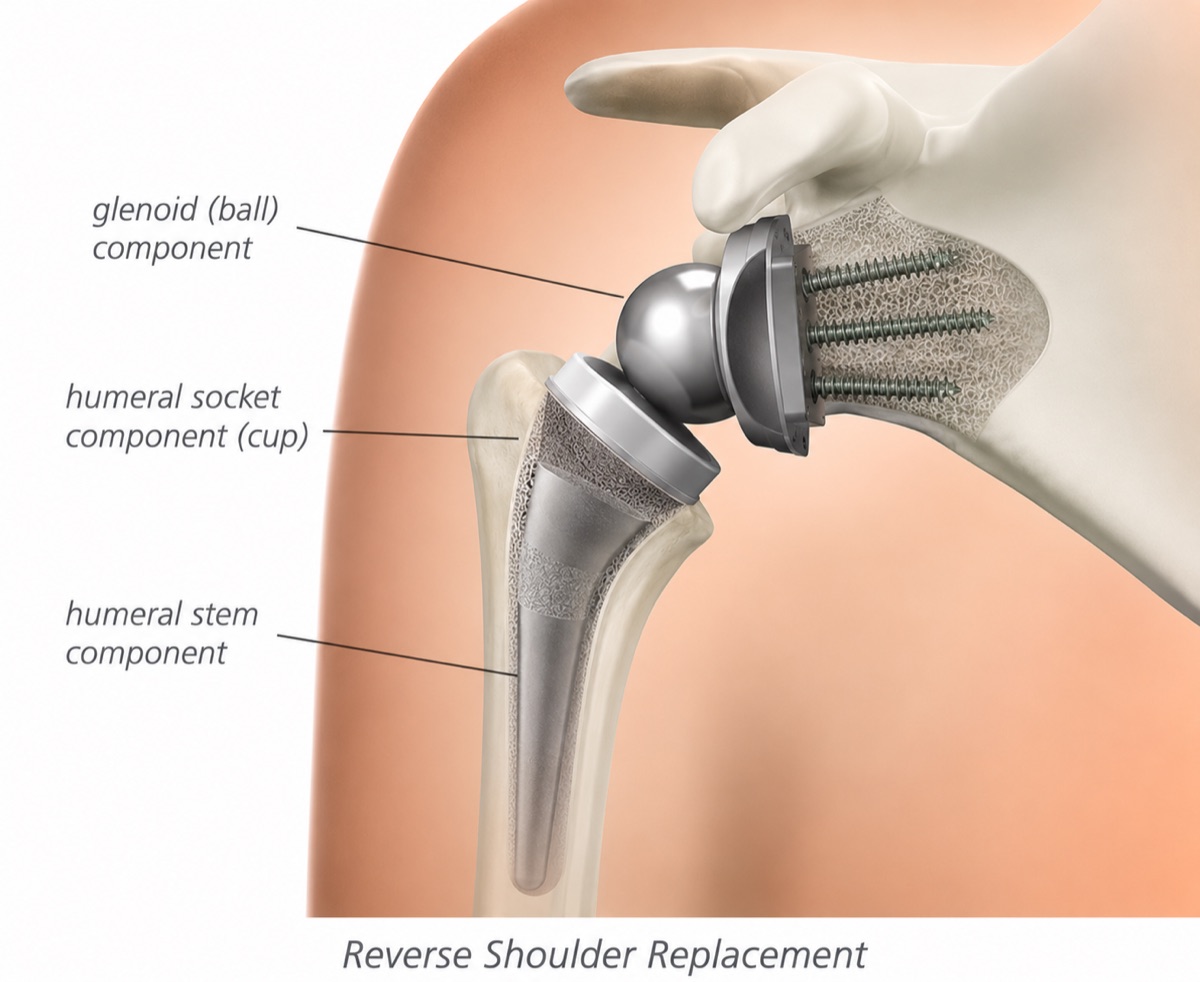
Patients ask how long a knee replacement lasts far more often than they ask about a shoulder, and the answer for the shoulder is less widely known — including among patients who are already scheduled for one. The short version, drawn from national joint registries and long-term follow-up studies: roughly 90% of shoulder replacements are still in place at 10 years. The number that should actually shape your decision is what happens after that, and how much it moves if you are having the operation young.1,2
Why this matters to you
A shoulder replacement is not a permanent part. It is a mechanical bearing implanted into living bone, and it has a service life. If you are 72 when you have it done, the durability question is mostly academic — the implant will very likely outlast you. If you are 54, it is the central question of the entire decision, because the difference between an implant lasting 12 years and lasting 22 years determines whether you face a revision operation in your sixties or never face one at all.
Revision shoulder surgery is meaningfully harder than the first operation. Bone stock is reduced, soft tissue is scarred, and the functional results are not as good as a well-done primary replacement. So the goal is not simply "get a shoulder replacement." It is "get the right shoulder replacement, at the right time, so you need as few of them as possible."
What the data actually are
There is no single randomized trial that answers this. Implant durability is measured through joint registries — national databases that record every replacement performed in a country and track how many come back for revision — and through long-term institutional follow-up series. Both have characteristic weaknesses, which I will come to.
The strongest available sources for the shoulder are:
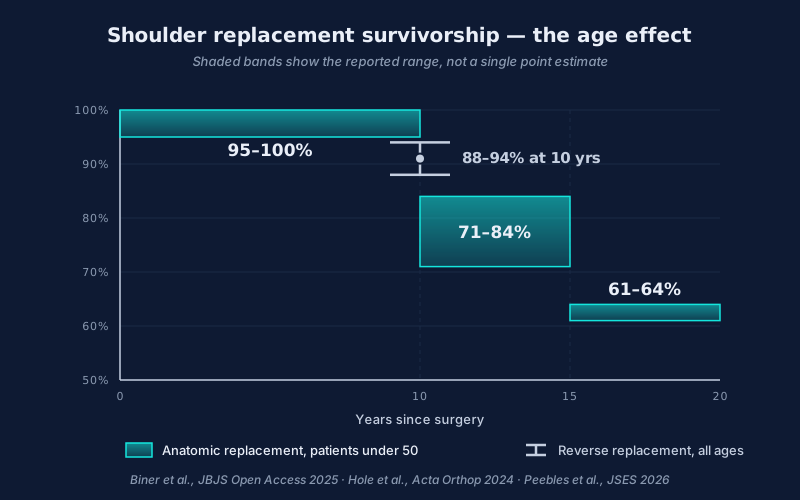
- The Norwegian Arthroplasty Register. Hole and colleagues reported on 5,494 reverse shoulder replacements performed between 2007 and 2022, with follow-up out to 15 years. Ten-year implant survival was 94% (95% CI 93–95).2
- A 2025 systematic review of long-term follow-up series. Biner and colleagues pooled seven studies covering 469 reverse replacements with a minimum of 10 years and a mean of 12 years of follow-up. Weighted mean revision-free survivorship at 10 years was 88%, ranging from 73% to 93% across the individual studies.1
- A review of anatomic total shoulder replacement survivorship. Piper and Neviaser put the most recently reported 10-year survival for anatomic implants at 96%.3
- The Australian registry, in young patients. Khoriati and colleagues analyzed 1,564 shoulder replacements in patients under 55 with osteoarthritis. Resurfacing hemiarthroplasty and stemmed metallic hemiarthroplasty both carried higher revision rates than reverse replacement; glenoid erosion caused 28.6% of resurfacing revisions and 50% of stemmed metallic hemiarthroplasty revisions.4
- A 2026 systematic review in patients under 50. Peebles and colleagues pooled nine studies covering 184 shoulders that received anatomic total shoulder replacement at a mean age of 33 to 44. Survivorship was 95–100% at 0–10 years, 71–84% at 11–15 years, and 61–64% beyond 15 years.5
What the numbers mean in plain terms
For an average patient — typically in their late sixties or seventies, having the operation for arthritis or for arthritis with a torn rotator cuff — around 9 in 10 shoulder replacements are still working at 10 years. That is a good number, and it is the one most patients need.
The picture changes for younger patients. In the under-50 anatomic replacement data, survivorship holds near 95–100% for the first decade, then falls to roughly 71–84% at 11–15 years and 61–64% past 15 years.5 Read that as: a 45-year-old having an anatomic total shoulder replacement should plan on a meaningful chance — somewhere around one in three — of needing a revision by their early sixties.
That is not an argument against operating on a 45-year-old with a destroyed shoulder. It is an argument for that patient understanding what they are signing up for, and for choosing the implant and the timing deliberately rather than by default.
Why shoulder replacements fail
The reasons differ from the knee, and they matter because some of them are influenced by choices made before the operation.
In the pooled long-term reverse replacement data, the leading causes of revision were infection (8%), instability (7%), and glenoid-side complications (3%), with an overall complication rate of 36% and 23% of shoulders requiring revision over a mean 12 years.1 The Norwegian registry found the same two leaders — instability and deep infection — with instability predominating in shoulders replaced after fracture, and infection more common in degenerative cases and with certain implant brands.2
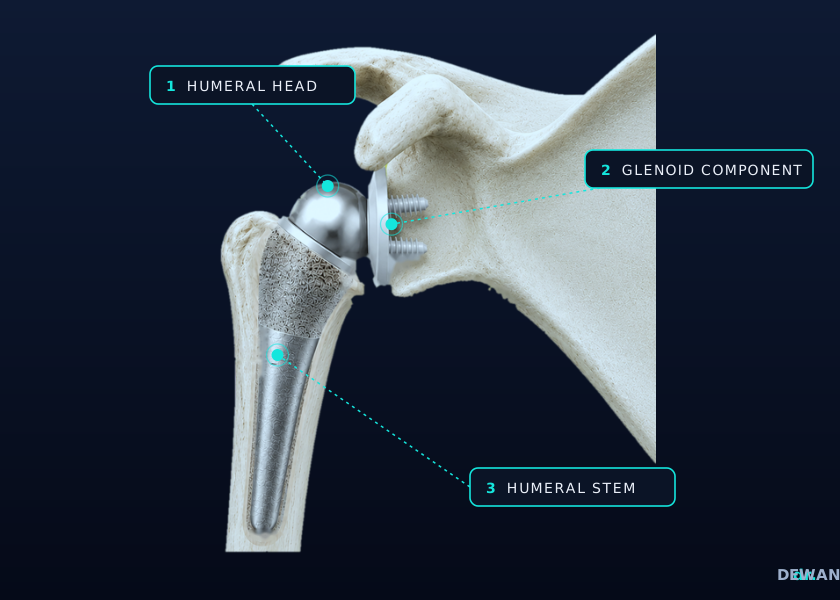
In anatomic total shoulder replacement, the characteristic long-term failure is different: glenoid component loosening, the socket side gradually working loose from the bone, and rotator cuff failure over time, which converts a well-functioning anatomic replacement into a painful one. Those are the mechanisms driving the drop-off between year 10 and year 15 in the young-patient series.
Where I would push back on these numbers
- "Revision" is a floor, not a ceiling, for failure. Registries count reoperations. A patient whose replacement hurts, whose function is poor, or who was never satisfied but who has not had a second operation is scored as a success. The true rate of unsatisfactory shoulders is higher than the revision rate, and no registry can tell you how much higher.
- The long-term review lost most of its patients. Biner and colleagues report a 63% loss to follow-up, with only 70% of the remaining patients actually seen in clinic. When most of a cohort disappears, the ones who come back are not a random sample. Patients doing well move on with their lives; patients doing poorly may seek care elsewhere. That cuts in both directions, and it means the 88% figure carries wide real uncertainty regardless of how precise it looks.
- Older data describe older implants. Anything with 15-year follow-up necessarily reports on implants and techniques from 2011 or earlier. Glenoid fixation, component design, and preoperative planning have all changed since. Long-term survivorship data are inherently a report on the past, and today's implants may do better — or, less comfortably, may not, since some design changes have historically made things worse.
- Registry data cannot separate the implant from the surgeon. A brand that performs poorly in a registry may be a poor design, or may be the one favored by lower-volume surgeons doing harder cases. Australian registry work has found revision rates differ by surgeon and hospital volume independent of implant. Registries rarely disentangle those.
- The under-50 review is small. Nine studies and 184 shoulders is a thin evidence base to support a decision as consequential as replacing a young person's shoulder. The revision rates across individual studies ranged from 3.8% to 41.2% — a spread that wide means the pooled figure conceals more than it reveals.5
How I think about this in my practice
The durability conversation is the one I spend the most time on with patients under about 60, and it usually reduces to three practical points.
Timing is a real lever, and it cuts both ways. Every year a patient can reasonably defer the operation is a year of implant life they do not spend. That argues for exhausting non-operative management first — activity modification, therapy, injections. It does not argue for waiting until the shoulder is destroyed, because severe glenoid bone loss and long-standing cuff failure make the eventual replacement technically harder and its result less predictable. The window is real, and it is wide, but it does close.
Implant choice is not one-size-fits-all, and durability is only one input. The Australian registry data are clear that in younger patients with osteoarthritis, resurfacing and stemmed metallic hemiarthroplasty carried higher revision rates than reverse replacement, largely from glenoid erosion.4 That is worth knowing. It does not make reverse replacement automatically correct for a 50-year-old with an intact rotator cuff — anatomic replacement preserves rotation the reverse design cannot fully reproduce, and that trade-off matters a great deal to an active patient. This is exactly the discussion I want to have with imaging in hand rather than in the abstract. I have written separately about how that choice gets made.
Planning accuracy is where I think the durability curve gets improved. The two mechanisms that drive late anatomic failure — glenoid loosening and component malposition — are both influenced by how precisely the socket component is placed. That is the case for computer-guided planning and patient-specific instrumentation, which I use in shoulder replacement. Evidence suggests better component positioning; whether that translates into measurably longer implant survival is not yet established, because proving it requires the 15-year follow-up that current technology has not existed long enough to generate.
For patients over about 65 with a shoulder that has stopped responding to non-operative care, I do not think durability should be the factor that holds up the decision. The data say the implant will very likely outlast the need for it, and the years lost to a painful shoulder are not recoverable.
Bottom line for the layperson
- About 9 in 10 shoulder replacements are still in place at 10 years — 94% in the largest reverse replacement registry, 88% in pooled long-term series, and around 96% for anatomic replacements.
- Age at surgery is the single biggest factor. In patients under 50, anatomic replacement survivorship falls to roughly 71–84% at 11–15 years and 61–64% beyond that.
- Infection and instability are the leading reasons a reverse replacement gets revised; glenoid loosening and late rotator cuff failure are what limit anatomic replacements.
- Revision counts undercount real failure — a shoulder that hurts but has not been reoperated on still shows up as a success in the registries.
- If you are under 60, ask specifically about durability and implant choice before scheduling. If you are over 65 and non-operative care has stopped working, durability is unlikely to be the thing that should change your decision.
References
- Biner M, Klotz S, Andronic O, Karczewski DC, Zingg L, Karl W, Kriechling P. Long-Term Outcomes Following Reverse Total Shoulder Arthroplasty: A Systematic Review with a Minimum Follow-Up of 10 Years. JBJS Open Access. 2025;10(2):e25.00025. doi:10.2106/JBJS.OA.25.00025 (PMID 40313685)
- Hole RM, Fenstad AM, Gjertsen JE, Hallan G, Furnes ON. Influence of design features and brand of reverse shoulder arthroplasties on survivorship and reasons for revision surgery: results of 5,494 arthroplasties with up to 15 years' follow-up reported to the Norwegian Arthroplasty Register 2007–2022. Acta Orthopaedica. 2024;95:463–471. doi:10.2340/17453674.2024.41344 (PMID 39189259)
- Piper C, Neviaser A. Survivorship of Anatomic Total Shoulder Arthroplasty. Journal of the American Academy of Orthopaedic Surgeons. 2022;30(10):457–465. doi:10.5435/JAAOS-D-21-00302 (PMID 35511506)
- Khoriati AA, McBride AP, Ross M, Duke P, Hoy G, Page R, Holder C, Taylor F. Survivorship of shoulder arthroplasty in young patients with osteoarthritis: an analysis of the Australian Orthopaedic Association National Joint Replacement Registry. Journal of Shoulder and Elbow Surgery. 2023;32(10):2105–2114. doi:10.1016/j.jse.2023.03.024 (PMID 37178962)
- Peebles LA, Akamefula RA, Weinerman J, DeFoor MT, Dekker TJ. Anatomic total shoulder arthroplasty indications, outcomes, and survivorship in patients younger than 50 years of age: a systematic review. Journal of Shoulder and Elbow Surgery. 2026;35(5):1360–1369. doi:10.1016/j.jse.2025.09.005 (PMID 41115569)
This article reflects Dr. Dewan's reading of the cited evidence at the time of publication. It is educational content, not medical advice. Your specific case may differ — schedule a consultation to discuss your imaging and history.