
One of the most common surprises in my preoperative visits is the discharge plan. A patient has pictured the week after surgery as a stay somewhere with nurses and a therapy gym, and instead hears that the plan is to go home. Sometimes they have a sibling or a neighbor who went to a rehab facility a decade ago and cannot understand why they are not being offered the same thing.
The reason is not cost-cutting, at least not entirely. In 2017, JAMA published a randomized trial that tested exactly this question — ten days of inpatient rehabilitation after a knee replacement versus going straight home with a monitored home program — and found no difference in walking ability, pain, function, or quality of life at six months.1 That finding, and the observational data that came after it, changed what a normal discharge looks like.
What "rehab" actually means
The word covers four different things, and patients and surgeons often are not talking about the same one.
- Inpatient rehabilitation facility (IRF). A hospital-level program with several hours of daily therapy and physician oversight. Historically reserved for stroke, spinal cord injury, and major trauma.
- Skilled nursing facility (SNF). A residential facility with nursing care and a lower daily dose of therapy. This is what most people mean when they say "rehab."
- Outpatient physical therapy. You travel to a clinic and work with a therapist. In my practice this is the standard route, and it starts early — commonly on the second day after surgery.
- Home health. A physical therapist, and sometimes a nurse, who come to your house. This is the fallback for patients who cannot reliably get to a clinic, not the default.
Going home is not going without rehabilitation. In my practice the plan is home and straight into outpatient physical therapy, usually starting on the second postoperative day; home therapy is reserved for patients who cannot get to a clinic. The question the evidence answers is narrower: does the residential piece in the middle add anything?
What the randomized trial found
The HIHO trial, run at two high-volume arthroplasty hospitals in Sydney and published in JAMA, randomized 165 patients having a knee replacement for osteoarthritis. Eighty-one received ten days of inpatient hospital rehabilitation followed by an eight-week clinician-monitored home program. Eighty-four received the home program alone. A further 87 patients who declined randomization were followed as an observational group, also on the home program.1
The primary outcome was mobility at 26 weeks, measured by the six-minute walk test — literally, how far you can walk in six minutes.
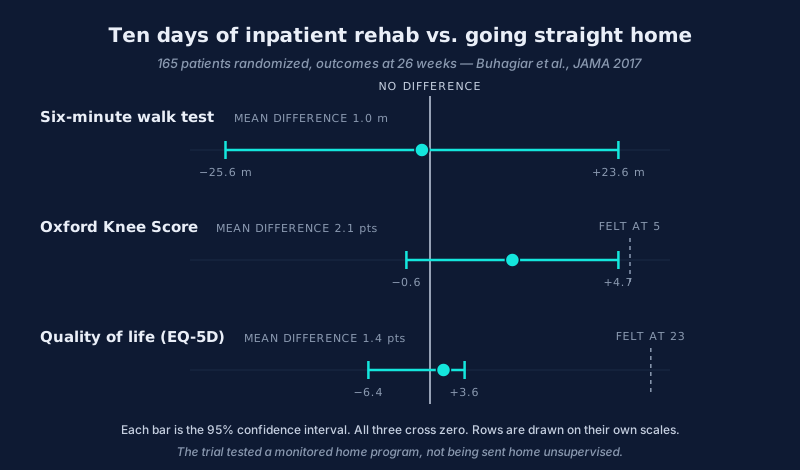
The difference in six-minute walk distance was 1.01 meters — about one long stride — in favor of the home group, with a confidence interval running from 25.6 meters worse to 23.6 meters better. In other words, the trial could not distinguish the two groups, and the true difference is small in either direction.1
The secondary outcomes tell the same story with a useful twist. The Oxford Knee Score difference was 2.06 points favoring inpatient rehabilitation, against a threshold of 5 points for a difference a patient can actually feel. The quality-of-life score difference was 1.41 points, against a threshold of 23 points. Neither reached statistical significance, and neither would have mattered if it had.1
Complications ran 12 in the inpatient group against 9 in the home group — a difference too small to interpret in a trial this size, but pointing in the direction of no benefit rather than a hidden one.
What the large observational data show
Randomized trials in surgery are usually small. This one enrolled 165 patients. The database studies are enormous and much weaker, and they point the same way.
A 2024 analysis in the Journal of Orthopaedic Surgery and Research pulled 352,824 knee replacements from the American College of Surgeons NSQIP registry between 2015 and 2020 — 303,375 discharged home, 31,635 to a skilled nursing facility, and 17,814 to an inpatient rehabilitation facility. The authors propensity-matched 5,000 patients in each group to balance age, sex, body mass index, and comorbidity. Patients discharged home had a significantly lower readmission rate and a significantly lower rate of any adverse event than either facility group, and the inpatient rehabilitation group fared worst of the three.2
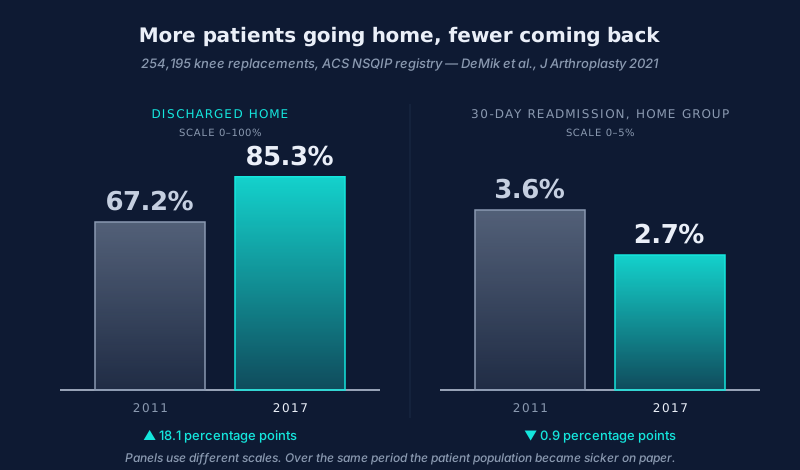
Meanwhile the practice pattern shifted underneath all of this. In the same NSQIP registry, home discharge after knee replacement rose from 67.2% in 2011 to 85.3% in 2017. In a separate Humana claims database it rose from 62.1% in 2007 to 74.7% in 2016. Over the same window, 30-day readmissions among home-discharged patients fell — from 3.6% to 2.7% in NSQIP and from 4.0% to 2.4% in Humana — even though the patients were getting older and sicker on paper.3
On the therapy itself, a meta-analysis of 11 randomized trials in Knee Surgery, Sports Traumatology, Arthroscopy compared unsupervised home exercise against individualized supervised outpatient physical therapy after knee replacement. Pooled differences in knee range of motion and function fell within the non-inferiority margin — meaning the home programs were not measurably worse.4
That finding is what makes the choice between a clinic and a home therapist a practical one rather than a clinical one. Neither route has been shown to beat the other on range of motion or function, so the deciding factor is which one you can actually get to and attend consistently.
Where I would push back
- The matched database studies almost certainly overstate the case against facilities. Patients who go to a skilled nursing facility are frailer, live alone more often, and walk worse before surgery than patients who go home. Propensity matching balances what NSQIP records — age, body mass index, comorbidity codes — and cannot balance baseline frailty, gait speed, cognition, or whether anyone is at home. The higher complication rate in the facility groups is partly the facility and partly the patients who needed one. Reading that study as "rehab facilities make you sicker" is a mistake.
- The randomized trial studied one specific comparison, and it was a generous one. HIHO tested a monitored home program — a clinician following the patient for eight weeks — not "go home and figure it out." Its conclusion supports monitored home rehabilitation. It does not support discharging a patient home with a photocopied exercise sheet and no follow-up.
- The trial enrolled patients having uncomplicated knee replacements. Its own conclusion says so. It cannot tell you what happens to a patient with a complex knee, a wound problem, or a fall risk.
- The therapy meta-analysis is weaker than its headline. Eleven trials, all of moderate quality, all small, with significant statistical heterogeneity acknowledged by the authors. "Not measurably different" in that context reflects real uncertainty as much as real equivalence.
- The strongest counterargument is a policy study, and it deserves airtime. A 2019 simulation modeled what happened when Medicare's bundled payment program pushed patients away from facility rehabilitation. Discharge to inpatient rehabilitation after knee replacement fell by 16.9 percentage points — a 58.9% relative decline — and skilled nursing use fell by 24.0 percentage points, with a 36.7 percentage point increase in home health.5 Readmissions barely moved. But the need for further assistive care rose by 8.0 percentage points, and the reduction in therapy received amounted to an estimated 30% reduction in recovered motor gains.
- That last number is the real tension in this subject. The outcomes we measure best — readmission, complication, mortality — show no penalty for going home. The outcomes we measure worst — how much function a patient actually regains, and how much help they still need at three months — may have taken a hit. The authors' conclusion was that the "reduced cost at no harm" framing does not survive scrutiny. I think they have a point, and I do not think the randomized evidence answers it.
Who does still go to a facility
None of the above means facility rehabilitation is obsolete. It means it stopped being the default. Patients for whom a facility remains the right plan generally have one or more of the following:
- No one at home, and a home that cannot be made safe with equipment and a few visits.
- Both knees replaced at once, or a hip and knee close together, so there is no good leg to lead with.
- A neurologic condition — prior stroke, Parkinson disease, significant neuropathy — that makes balance the limiting factor rather than the knee.
- Substantial medical complexity requiring daily nursing: wound care, intravenous antibiotics, complex anticoagulation, or oxygen.
- A postoperative complication that changes the plan after the fact.
- Stairs with no first-floor bathroom, and no way to work around them.
If one of these describes you, say so out loud at the preoperative visit rather than on the day of discharge. Facility placement arranged in advance is a very different experience from facility placement negotiated from a hospital bed on a Friday afternoon.
How I think about this in my practice
My starting assumption for a patient having a straightforward knee replacement is home with outpatient therapy, and in some circumstances home therapy when outpatient therapy is not viable due to access or transportation. That is not a cost decision. It is consistent with evidence showing that facility rehabilitation offers no benefit over discharge home for the significant majority of patients.
The early start matters more to me than the setting. Most of my patients begin outpatient physical therapy on the second day after surgery, which is well before a facility program would have handed them off to outpatient care.
There is also a mechanism behind the finding that patients tend to accept once they hear it. Recovery from a knee replacement is driven by how many times a day you stand up, walk to the kitchen, sit back down, and bend the knee — not by how many hours you spend in a therapy gym. Home is dense with those repetitions. A facility often is not, because someone brings you your meals.
Where the evidence likely fits. A patient with one knee replaced, a workable home, an adult around for the first week or two, and outpatient therapy booked before surgery with a ride lined up to get there. Evidence suggests that patient does as well at home as anywhere, and probably better on the practical measures nobody randomizes: sleep, appetite, and infection exposure.
Where it likely does not fit. A patient who lives alone, has balance problems that predate the knee, or has a home with a bathroom they cannot reach. A patient with no way to get to a clinic falls in a narrower category — that is usually an argument for home therapy, not for a facility. For that patient the studies above are describing someone else. Being sent home because the population data favor home discharge, when your own situation is the exception, is a real failure mode and worth pushing back on.
What I would ask is that this be a planned conversation, not a discharge-day negotiation. If your insurance denies a facility placement your care team believes you need, that decision can be appealed, and the appeal is far more likely to succeed when the clinical reasoning was documented before surgery rather than after.
The bottom line for the layperson
- A randomized trial found that ten days of inpatient rehabilitation after a knee replacement produced no better walking, function, or quality of life at six months than going straight home with a monitored program.
- Going home is not going without therapy — my standard plan is outpatient physical therapy starting about two days after surgery, with home therapy reserved for patients who cannot get to a clinic.
- Large database studies show lower readmission and complication rates for patients discharged home, but those patients were healthier to begin with, so the gap is exaggerated.
- There is a real counterargument: when payment reform pushed patients out of facilities, readmissions held steady but the amount of function patients regained appears to have fallen by roughly 30%.
- Facility rehabilitation is still right for some patients — nobody at home, both knees done, balance problems, complex nursing needs, or stairs you cannot manage. Raise it before surgery, not on discharge day.
If you have been told to plan on going home after your knee replacement and you are not sure that is right for your situation, that's a conversation worth having before surgery rather than on discharge day. You can request a visit or call the office at (281) 690-4678. You may also want to read whether you are a candidate for same-day discharge and how long the pain really lasts.
Sources
- Buhagiar MA, Naylor JM, Harris IA, Xuan W, Kohler F, Wright R, Fortunato R. “Effect of Inpatient Rehabilitation vs a Monitored Home-Based Program on Mobility in Patients With Total Knee Arthroplasty: The HIHO Randomized Clinical Trial.” JAMA. 2017;317(10):1037–1046. DOI: 10.1001/jama.2017.1224 (PMID: 28291891)
- Whitaker S, Cole S, Peri M, Ernst B, O'Neill C, Satalich J, Satpathy J. “Higher complication and readmission rates after total knee arthroplasty with discharge to inpatient facility vs. home: a propensity score matched analysis.” J Orthop Surg Res. 2024;19(1):806. DOI: 10.1186/s13018-024-05294-7 (PMID: 39609918)
- DeMik DE, Carender CN, Glass NA, Callaghan JJ, Bedard NA. “More Patients Are Being Discharged Home After Total Knee Arthroplasty, However Rates Vary Between Large Databases.” J Arthroplasty. 2021;36(1):173–179. DOI: 10.1016/j.arth.2020.07.059 (PMID: 32843255)
- Florez-García M, García-Pérez F, Curbelo R, Pérez-Porta I, Nishishinya B, Rosario Lozano MP, Carmona L. “Efficacy and safety of home-based exercises versus individualized supervised outpatient physical therapy programs after total knee arthroplasty: a systematic review and meta-analysis.” Knee Surg Sports Traumatol Arthrosc. 2017;25(11):3340–3353. DOI: 10.1007/s00167-016-4231-x (PMID: 27401004)
- Zogg CK, Falvey JR, Dimick JB, Haider AH, Davis KA, Grauer JN. “Changes in Discharge to Rehabilitation: Potential Unintended Consequences of Medicare Total Hip Arthroplasty/Total Knee Arthroplasty Bundled Payments, Should They Be Implemented on a Nationwide Scale?” J Arthroplasty. 2019;34(6):1058–1065.e4. DOI: 10.1016/j.arth.2019.01.068 (PMID: 30878508)
This article reflects Dr. Dewan's reading of the cited evidence at the time of publication. It is educational content, not medical advice. Your specific case may differ — schedule a consultation to discuss your imaging and history.