After a reverse shoulder replacement, the motion most patients have the most trouble with is reaching behind the back. That affects tasks such as washing your back, reaching a back pocket, tucking in a shirt and fastening a bra. Most patients regain the ability to lift the arm overhead, drive, play golf and return to the gym. The lifelong lifting limits many patients are given vary widely, and a study published this August found that no research supports any particular weight limit.1
This article covers what a reverse shoulder replacement changes, which everyday tasks are harder and why, what the evidence says about lifting, sports and driving, and how I talk through these trade-offs with patients before surgery.
Why this matters to you
Patients are often surprised by the list of “don’ts” they receive after a reverse shoulder replacement, and the lists differ from one surgeon, hospital and website to the next. Some patients are told never to lift more than a gallon of milk. Others are told there are no permanent limits. Knowing which restrictions rest on evidence, and which motions are likely to be limited for anatomical reasons, helps you set realistic expectations and plan for daily life before surgery rather than after.
What a reverse shoulder replacement changes
A normal shoulder is a ball-and-socket joint. The ball sits on top of the arm bone, and the shallow socket (the glenoid) is on the shoulder blade. Four tendons called the rotator cuff hold the ball centered and rotate the arm.
A reverse shoulder replacement switches the parts. A metal ball is attached to the shoulder blade and a cup is attached to the top of the arm bone. Moving the center of rotation lets the large deltoid muscle on the outside of the shoulder lift the arm even when the rotator cuff no longer works. That is why the reverse design is used for shoulders with a large, irreparable rotator cuff tear, arthritis caused by a failed cuff, some fractures, and, increasingly, arthritis in older patients with an intact cuff.
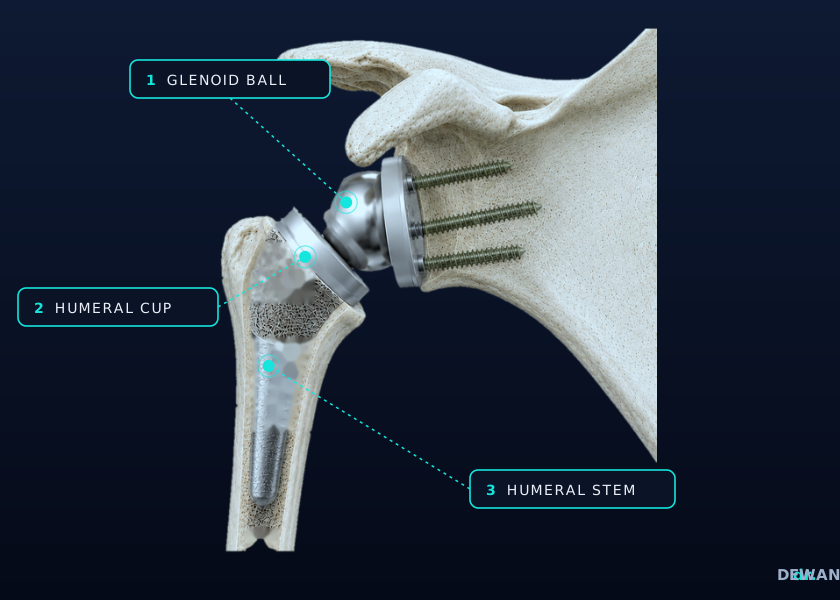
The design trade-off follows from the anatomy. Lifting the arm forward and overhead depends mostly on the deltoid, and it usually improves a great deal. Rotating the arm inward behind your back depends on the rotator cuff (especially the subscapularis tendon in front) and on how the implant parts move past each other. That motion, called internal rotation, is the least predictable after a reverse replacement.
Which everyday tasks are harder
Surgeons usually measure internal rotation by asking a patient to reach behind the back and noting the highest point on the spine the thumb reaches. A thumb at the lower back is enough for most toileting and back-pocket tasks. Reaching higher is needed to wash between the shoulder blades or fasten a bra in back.
Reaching behind your back
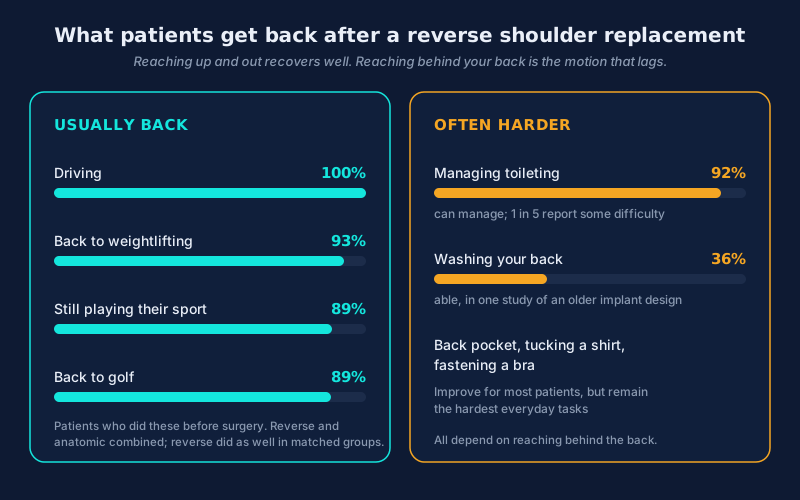
A Korean study of 77 patients followed for 3 to 10 years after a reverse replacement compared the operated shoulder with the other one. Forward lifting recovered to about 93% of the other side, and outward rotation to about 80%. Reaching behind the back recovered to only about 48%. The tasks patients found hardest were washing the opposite shoulder and armpit, using a back pocket, managing the toilet and washing the back. Only 36% of patients could wash their back.2 This study used an older implant design that sits closer to the body (a medialized design), which is associated with less rotation than many current designs.
A larger US study of 443 patients followed for an average of four years found a more encouraging picture. Reaching behind the back improved, on average, from the lowest part of the lower back before surgery to the upper part of the lower back after surgery. The share of patients who found it “very difficult” or impossible to tuck in a shirt, wash their back or fasten a bra, and to use a back pocket, fell after surgery.3
Toileting and personal hygiene
This is one of the most common worries patients raise and one of the least reported in research. A systematic review pooled six studies with 183 patients and found that 92% could manage toileting after a reverse replacement, although about one in five reported some difficulty. Patients who had both shoulders replaced were able to manage with at least one arm in 97% of cases.4 In the larger US study, fewer than 2% of patients were unable to manage personal hygiene after surgery, about the same share as before it.3
What predicts how well you can reach behind your back
- How far you could reach before surgery. In a 2025 study of patients whose rotation got worse after surgery, those who started with better rotation, and lost less of it, were more likely to manage these tasks. Patients who could still reach the lower back at about the level of the belt line (L4–L5) were likely to be satisfied, while those who could reach no higher than the tailbone usually could not manage behind-the-back tasks. Women were less likely than men to manage three of the four tasks studied.5
- Implant position. A multicenter study of 455 patients found that placing the ball slightly farther out from the shoulder blade (6 to 8 millimeters of lateralization) was associated with better internal rotation, with no difference in lifting or outward rotation. That study looked at one implant system.6 Lateralization has a trade-off: a systematic review of 90 studies found stress fractures of the acromion (the bony roof of the shoulder) in 2.8% of reverse replacements, and more often with lateralized designs.7
What this means for you: most patients can manage toileting and dressing after a reverse shoulder replacement, but reaching behind the back is unlikely to return to normal. If you can reach your lower back now, you are more likely to keep that ability. Simple aids such as a long-handled sponge, a front-closing bra, or keeping a wallet in a front pocket solve many of the remaining problems.
Lifting: evidence vs. convention
Lifting restrictions after a reverse replacement exist because of two concerns: the joint dislocating, and the plastic liner in the cup wearing out sooner under heavy loads. Dislocation after a first-time reverse replacement is uncommon. A review of 17 studies and 7,885 reverse replacements found a dislocation rate of 2.5% overall, between 1% and 5% after primary surgery, and higher after revision surgery or surgery for fractures.8
How much weight is safe has never been tested directly. The study published in August reviewed 50 surgeon, practice and hospital websites that describe restrictions after a reverse replacement.1 Forty percent set a lifelong weight limit, averaging about 26 pounds below shoulder height and about 20 pounds above it. Ten percent set no lifelong limit, and half did not address it. The authors noted that no published data support a specific weight limit. A 2011 survey of experienced shoulder surgeons in North America and Europe recommended against weightlifting after a reverse replacement, but that reflected expert opinion, not outcome data.9
More recent outcome data are reassuring. A 2026 study from the American Shoulder and Elbow Surgeons (ASES) research group followed 175 people who lifted weights before a shoulder replacement. About two years after surgery, 93% had returned to weightlifting and 79% said their performance was the same or better. In a matched comparison of patients with arthritis, the return rate after a reverse replacement was 98%, similar to the anatomic replacement.10
What this means for you: the lifting limit you are given reflects your surgeon’s judgment, not a proven safe threshold. Two years of follow-up shows that most lifters return to the gym, but it cannot tell us how heavy lifting affects the implant over 10 or 15 years. Ask your surgeon which limits are temporary, which are lifelong, and why.
Sports, golf and driving
Sports
In the ASES group’s largest study, 961 patients completed a sports questionnaire one to three years after shoulder replacement. Of the 537 who played a sport before surgery, 89% were still playing, and 80% said they played as well or better. Return rates were highest for running, tennis and weightlifting, each above 90%. Most patients returned within three to six months. Among patients with arthritis, those who had a reverse replacement returned at a similar rate to those with an anatomic replacement and were somewhat more likely to report stable or improved performance.11
Golf
The same group studied 208 golfers. 89% returned to golf, most within three to six months and another third within a year. In the matched comparison, 96% of reverse replacement patients returned, and handicap and driving distance did not differ from anatomic replacement.12
Driving
In a study of 406 shoulder replacement patients, every patient returned to driving. Reverse replacement patients tended to return later than anatomic patients; 20% were driving within two weeks. Driving before or after the two-week mark made no difference in the rate of car accidents.13 Driving while wearing a sling or taking prescription pain medication is a separate safety question, and your surgeon will give you specific guidance.
Satisfaction over the long term
A US study followed reverse shoulder replacement patients for at least 10 years. Of 93 patients, 82% were satisfied or very satisfied, and of the 68 who were asked, 94% said they would have the operation again. Pain and function scores held steady between the middle and long-term follow-up.14 These patients had an older implant design, and the group included revision surgeries, so results with current implants may differ.
Strengths of this evidence
- The sports studies are large and recent. The ASES studies drew on 24 surgeons at 17 US institutions, which makes them more representative than a single surgeon’s results.
- The research asks about real tasks. Several studies asked patients directly about toileting, dressing and back pockets rather than relying only on degrees of motion.
- The findings point in the same direction. Studies from different countries and designs agree that overhead function recovers well and reaching behind the back is the limiting motion.
Where I’d push back on the data
- The sports figures combine reverse and anatomic replacements. The headline return rates include both operations. The matched reverse-only comparisons look as good, but they involve smaller groups of patients with arthritis and an intact cuff, who tend to be healthier than patients who need a reverse replacement for a failed cuff.
- The patients who play sports are a selected group. Only about half of the patients surveyed played a sport before surgery. A 90% return rate among active patients does not mean 90% of all patients will be playing tennis.
- Follow-up is short for lifting questions. Two years is long enough to show that lifters return to the gym, but not long enough to measure liner wear or late loosening from heavy loads.
- Surgeon-measured and patient-reported rotation don’t always agree. The US study of 443 patients found that some patients gained measured rotation without feeling more capable, and others felt more capable without a measured gain.3 What matters is whether you can do the tasks you care about.
What this means in my practice
Before a reverse shoulder replacement, I want patients to know what the operation reliably gives back and what it may not.
1. I ask about the tasks that matter to you
Getting dressed, personal hygiene, reaching a back pocket, the sport you play, and the work you do with your arms all shape the conversation. I check how far you can reach behind your back before surgery, because that is one of the better predictors of how you will do afterward.
2. I plan the implant position before surgery
I use 3D CT-based planning to measure the bone and plan where each implant component will sit before the operation. Implant position affects motion, including rotation behind the back, as well as stability. The plan is tailored to the shoulder in front of me rather than a single default.
3. Restrictions should be specific to you
Early after surgery, the shoulder needs protection while the tissues heal, and that phase is not negotiable. Over the long term, the evidence suggests that many patients can return to golf, the gym and other activities they enjoyed. The right limits depend on why you needed a reverse replacement, the quality of your bone and tissue, and what you want to do. Patients should discuss with their surgeon which restrictions apply to them, and for how long.
Who this evidence fits, and who it doesn’t
Closest fit: a patient in their late 60s or 70s having a first reverse replacement for arthritis or a failed rotator cuff, who was reasonably active before surgery.
Less certain fit: a patient having a revision operation or a reverse replacement for a fracture, who faces a higher risk of dislocation; a patient with very limited rotation before surgery; and a younger patient planning decades of heavy lifting, for whom long-term data do not yet exist.
The bottom line for the layperson
- After a reverse shoulder replacement, most patients regain overhead reach, drive, and return to activities such as golf.
- Reaching behind your back is the motion most likely to stay limited, which affects tasks such as washing your back and fastening a bra.
- About nine in ten patients can manage toileting, and simple aids help with the remaining tasks.
- No research supports a specific lifelong lifting limit, and most patients who lifted weights before surgery return to it.
- Ask your surgeon which of your restrictions are temporary, which are permanent, and why.
If you are considering a shoulder replacement, you can read more about how surgeons choose between reverse and anatomic replacement and how long a shoulder replacement lasts, or request a visit to talk through what you want to get back to.
Sources
- Obana KK, Winward JD, Luzzi AJ, et al. “Publicly available online activity restrictions after reverse total shoulder arthroplasty demonstrate marked variability.” J Shoulder Elb Arthroplast. 2026;10(4):100076. Published online August 11, 2026. DOI: 10.1016/j.jsea.2026.100076 (PMID: 42774556)
- Kim MS, Jeong HY, Kim JD, et al. “Difficulty in performing activities of daily living associated with internal rotation after reverse total shoulder arthroplasty.” J Shoulder Elbow Surg. 2020;29(1):86–94. DOI: 10.1016/j.jse.2019.05.031 (PMID: 31427227)
- Hao KA, Kakalecik J, Cueto RJ, et al. “Discordance between patient-reported and objectively measured internal rotation after reverse shoulder arthroplasty.” J Shoulder Elbow Surg. 2023;32(10):2051–2058. DOI: 10.1016/j.jse.2023.03.033 (PMID: 37178957)
- Rojas J, Joseph J, Liu B, et al. “Can patients manage toileting after reverse total shoulder arthroplasty? A systematic review.” Int Orthop. 2018;42(10):2423–2428. DOI: 10.1007/s00264-018-3900-4 (PMID: 29572639)
- Cueto RJ, Hao KA, Janke RL, et al. “Predictors of Internal Rotation-Dependent Activities of Daily Living Performance and Favorable Satisfaction Despite Loss of Objective Internal Rotation After Reverse Shoulder Arthroplasty.” J Am Acad Orthop Surg. 2025;33(20):1141–1150. DOI: 10.5435/JAAOS-D-24-00267 (PMID: 39637411)
- Werner BC, Lederman E, Gobezie R, Denard PJ. “Glenoid lateralization influences active internal rotation after reverse shoulder arthroplasty.” J Shoulder Elbow Surg. 2021;30(11):2498–2505. DOI: 10.1016/j.jse.2021.02.021 (PMID: 33753271)
- King JJ, Dalton SS, Gulotta LV, et al. “How common are acromial and scapular spine fractures after reverse shoulder arthroplasty? A systematic review.” Bone Joint J. 2019;101-B(6):627–634. DOI: 10.1302/0301-620X.101B6.BJJ-2018-1187.R1 (PMID: 31154841)
- Olson JJ, Galetta MD, Keller RE, et al. “Systematic review of prevalence, risk factors, and management of instability following reverse shoulder arthroplasty.” JSES Rev Rep Tech. 2022;2(3):261–268. DOI: 10.1016/j.xrrt.2022.02.009 (PMID: 37588866)
- Magnussen RA, Mallon WJ, Willems WJ, Moorman CT. “Long-term activity restrictions after shoulder arthroplasty: an international survey of experienced shoulder surgeons.” J Shoulder Elbow Surg. 2011;20(2):281–289. DOI: 10.1016/j.jse.2010.07.021 (PMID: 21051242)
- Diestel DR, Sudah S, Veale N, et al. “Return to weightlifting after shoulder arthroplasty: an ASES multicenter study predicting performance after reverse shoulder arthroplasty and anatomic shoulder arthroplasty.” J Shoulder Elbow Surg. 2026;35(7):1667–1676. DOI: 10.1016/j.jse.2026.02.015 (PMID: 41763290)
- Corban J, Kirsch JM, Bowler A, et al. “Return to sport after shoulder arthroplasty: an ASES multicenter analysis of sport-specific predictors of performance in reverse shoulder arthroplasty and total shoulder arthroplasty.” J Shoulder Elbow Surg. 2026;35(9):2110–2119. DOI: 10.1016/j.jse.2026.03.014 (PMID: 41932675)
- ASES Multicenter Research Group. “Return to golf after shoulder arthroplasty: an American Shoulder and Elbow Surgeons multicenter study predicting performance after reverse total shoulder arthroplasty and anatomic total shoulder arthroplasty.” J Shoulder Elbow Surg. 2026;35(10):e947–e957. DOI: 10.1016/j.jse.2026.03.021 (PMID: 41967629)
- DeBernardis DA, Lynch JC, Radack T, Austin LS. “Return to driving following anatomic and reverse shoulder arthroplasty: a comparative analysis.” J Shoulder Elbow Surg. 2023;32(5):e191–e199. DOI: 10.1016/j.jse.2022.11.003 (PMID: 36528223)
- Sheth MM, Heldt BL, Spell JH, et al. “Patient satisfaction and clinical outcomes of reverse shoulder arthroplasty: a minimum of 10 years' follow-up.” J Shoulder Elbow Surg. 2022;31(4):875–883. DOI: 10.1016/j.jse.2021.09.012 (PMID: 34656776)
This article reflects Dr. Dewan's reading of the cited evidence at the time of publication. It is educational content, not medical advice. Your specific case may differ — schedule a consultation to discuss your imaging and history.