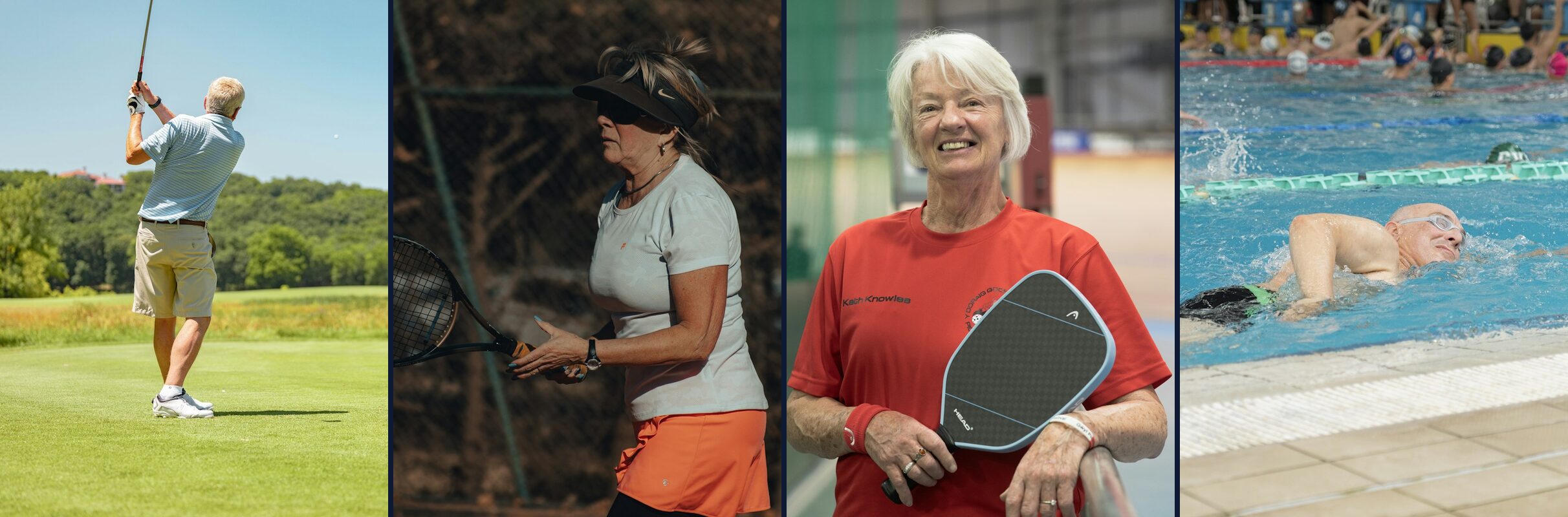
Most patients can. In the largest recent study, published in 2026 in the Journal of Shoulder and Elbow Surgery, 89% of patients who played a sport before their shoulder replacement were still playing 1 to 3 years later, and 80% said they played as well as or better than before. Most returned within 3 to 6 months.1 Return rates vary by sport and by the type of replacement, and the activities that carry the most risk are those with a chance of falling or a heavy load on the arm.
This article covers what the studies show for golf, tennis, pickleball, swimming and the gym, how anatomic and reverse replacements compare, how long the return usually takes, and how I plan it with patients.
Why this matters to you
Shoulder replacement is now performed on younger and more active patients than in the past, and for many of them getting back to a sport is the reason for having surgery. In one study of patients aged 55 or younger, 68% said that returning to sports was a reason they chose the operation.2 Pickleball has added a new group of players, many of them in their 60s and 70s, the age range of most shoulder replacement patients.
The advice patients receive varies widely. Surveys of shoulder surgeons show that recommendations on which sports are allowed vary, especially after a reverse replacement.3,4
Two types of shoulder replacement
An anatomic shoulder replacement reproduces the normal ball-and-socket shape and relies on a working rotator cuff, the group of tendons that moves and stabilizes the shoulder. A reverse shoulder replacement swaps the ball and socket so that the deltoid muscle can lift the arm when the rotator cuff is torn or not working. You can read more about how surgeons choose between the two. The type of replacement affects some of the numbers below.
What the studies did
No randomized trial has tested which sports are safe after a shoulder replacement. The evidence comes from questionnaires sent to patients 1 or more years after surgery, systematic reviews that pool those studies, and surveys asking surgeons what they recommend.
The main study is a 2026 multicenter analysis by the American Shoulder and Elbow Surgeons (ASES) research group. Twenty-four surgeons at 17 US institutions sent a sports questionnaire to patients 1 to 3 years after an anatomic or reverse replacement. Of 961 patients who responded, 537 had played at least one of seven sports before surgery: golf, pickleball, tennis, running, weightlifting, yoga or swimming. The average age was 68.1
What the studies found
Overall return rates
In the ASES study, return rates were highest for weightlifting (93%), running (93%) and tennis (92%), and the rate of continued play did not differ significantly between sports. Among patients with shoulder osteoarthritis, matched for age and sex, those who had a reverse replacement returned at a similar rate to those who had an anatomic replacement (93% vs. 89%) and were more likely to report stable or improved performance.1
Earlier reviews found a larger gap between the two types. A 2018 review of 13 studies found that 93% of athletes returned after an anatomic replacement, compared with 75% after a reverse replacement.5 A 2025 review of 31 studies reported 91% and 80%.6 A 2026 review of 19 studies and 3,092 reverse replacement patients, with an average age of 72, found that 85% returned to a sport and 70% returned at the same level or higher.7
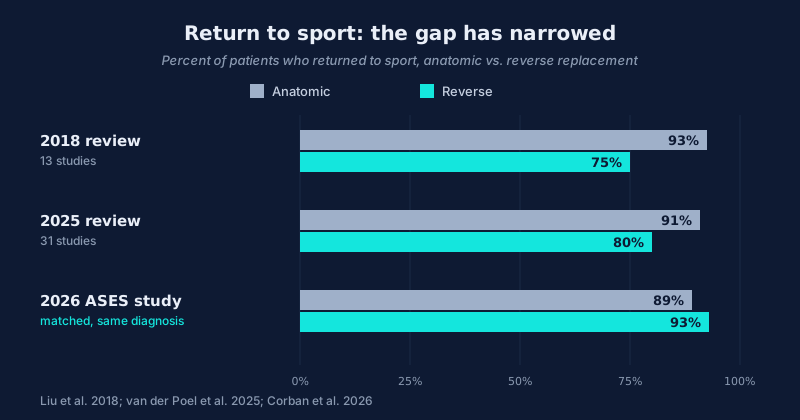
Part of the gap in the older reviews likely reflects who receives each operation. Reverse replacements are often done for older patients with a torn rotator cuff, a fracture or a failed earlier surgery, who would be less likely to return to sport whatever implant they received. When the 2026 study compared patients with the same diagnosis, the gap disappeared.1
Golf
Golf is one of the most common sports among shoulder replacement patients. A 2024 review of 10 studies found that 76% of golfers returned overall, with lower rates after reverse replacement in the older studies.8 Most returned to a full 18 holes at 5 to 6 months, and one study reported that patients began putting at about 20 weeks, chipping at about 22 weeks and playing on the course at about 27 weeks.8 A 2026 ASES study of 208 golfers found a higher rate: 89% returned overall.9 The results for reverse replacement are covered in more detail in what you can and can’t do after a reverse shoulder replacement.
Tennis
Tennis places more demand on the shoulder, especially the overhead serve. In the ASES study, 92% of tennis players were still playing after either type of replacement.1 Among patients aged 55 or younger who had an anatomic replacement, 88% returned to singles tennis.2 Earlier results after reverse replacement were less encouraging: a 2021 review found that only half of tennis players returned.10 In surgeon surveys, tennis was generally allowed for experienced players after an anatomic replacement, while surgeons were divided or advised against it after a reverse replacement.3
Pickleball
Pickleball has less published data. A 2025 study followed 23 recreational pickleball players, average age 66, who had shoulder surgery. All returned to play, and most returned at the same level. Patients who had a shoulder replacement returned more slowly than those who had arthroscopic surgery: 57% were back within the first year, compared with 88% after arthroscopy.11 Pickleball was one of the seven sports in the ASES study, which found no significant difference in return rates between sports.1
The main concern with pickleball is falling. Pickleball injuries treated in US emergency departments rose from an estimated 1,313 in 2014 to 24,461 in 2023. Most injured players were aged 60 to 79, and players in that age group were twice as likely to be injured in a fall and more likely to have a fracture.12 That study was not limited to patients with a shoulder replacement, but a fall onto an outstretched arm can break the bone around an implant or dislocate the shoulder.
Swimming, running and the gym
Swimming was the most common sport in the 2018 review.5 Reported return rates for swimming range from 74% after reverse replacement in one review to 78% among younger anatomic replacement patients.2,10 Running places little load on the shoulder, and surveyed surgeons allowed it after any type of replacement.3 Weightlifting had a 93% return rate in the ASES study,1 but the surgeons surveyed in 2011 were undecided about weightlifting after an anatomic replacement and advised against it after a reverse replacement.3
How long it takes
Most patients return in 3 to 6 months. The average time was 3.4 months after reverse replacement in one review,10 and 6.7 months among younger, more active anatomic replacement patients, many of whom played more demanding sports.2 Patients usually return first to lower-demand versions of a sport, such as putting and chipping before a full swing.8
What surgeons recommend
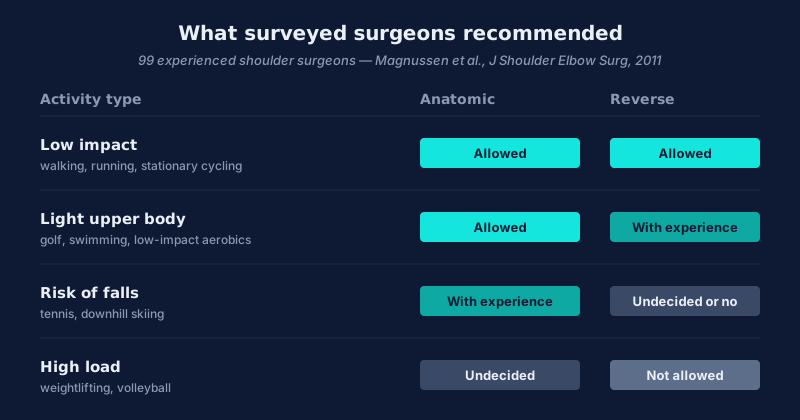
Two surveys of shoulder surgeons, from 2011 and 2012, remain the most widely cited guidance. Surgeons allowed low-impact activities, such as walking, running and stationary cycling, after any shoulder replacement. Golf and swimming were generally allowed after an anatomic replacement and allowed for experienced players after a reverse replacement. Sports with a risk of falls or collisions, and heavy weightlifting, drew the most caution, particularly after a reverse replacement.3,4
Why some patients do not return
When patients stop playing, the shoulder is often not the reason. In a 2025 review, the shoulder was the cause in about half of the cases after anatomic replacement in which a reason was reported, and in about a third after reverse replacement. The remaining reasons were unrelated to the shoulder.6
What this means for you: if you played a sport before surgery, the evidence suggests you have a good chance of playing it again, usually within 6 months. Sports with a risk of falling or heavy loads on the arm call for a more careful discussion, especially after a reverse replacement.
Strengths of this evidence
- The main study is large and multicenter. The 2026 ASES study included 961 patients from 17 US institutions, which makes it more representative than a single surgeon’s results.1
- It compared like with like. Matching patients by diagnosis, age and sex separates the effect of the implant from the effect of the underlying shoulder problem.1
- The findings are consistent. Several reviews, from different groups and countries, report that most patients return to sport.
Where I’d push back on the data
- The follow-up is short. The ASES study looked at patients 1 to 3 years after surgery. It cannot show whether years of tennis, pickleball or heavy lifting affect how long the implant lasts. One study of younger patients found no revisions for loosening of the socket component at about 5 years despite a high rate of return to demanding sports, but that study was small.2
- The patients who play sports are a selected group. Only about half of the patients surveyed played a sport before surgery. A 90% return rate among active patients does not mean that 90% of all patients will play tennis.
- Questionnaires depend on memory. Patients reported their own return and performance, sometimes years later. “Still playing” can mean anything from weekly matches to an occasional game.
- The surgeon surveys are dated. Fewer than a third of the surgeons invited responded, and both surveys predate most current reverse replacement designs and the rise of pickleball.3,4
- The pickleball data are thin. Twenty-three players at one center is too few to estimate a reliable return rate or to detect uncommon problems such as fracture after a fall.11
What this means in my practice
The evidence suggests that most patients can expect to return to the sports they played before surgery, with some caution about falls and heavy loads. That is how I frame the conversation with patients who want to get back to playing.
1. We discuss your sport before surgery
I ask which sports you play, how often and at what level. That affects the conversation about which type of replacement suits your shoulder and what to expect afterward. I plan shoulder replacements with Blueprint 3D planning and the Tornier Perform implant system, and the choice of an anatomic or reverse design depends on the condition of your rotator cuff and bone.
2. The early phase is about healing
For the first several weeks, the shoulder needs protection while the tissues heal. That phase is not the time to test the shoulder with sport. Physical therapy then rebuilds motion and strength, and the return to sport is gradual, starting with lower-demand activities.
3. We plan around the riskiest moments
For most sports, the main risk is not the swing or the stroke. It is a fall onto the arm or a sudden heavy load. For pickleball and tennis, that means attention to footwork, court surface and playing at a level that matches your fitness. Patients should discuss with their surgeon which activities fit their implant, their bone quality and their goals, and for how long any limits apply.
Who this evidence fits, and who it doesn’t
Closest fit: a recreational golfer, tennis or pickleball player in their 60s or 70s with shoulder arthritis, having a first anatomic or reverse replacement.
Less certain fit: a patient having a reverse replacement for a fracture or a failed earlier surgery, a competitive or high-level athlete, and a patient interested in contact sports or heavy weightlifting, for whom the evidence is limited.
The bottom line for the layperson
- About 9 in 10 patients who played a sport before a shoulder replacement are playing again 1 to 3 years later.
- Most return within 3 to 6 months, starting with lower-demand activity such as putting before a full golf swing.
- With current implants, anatomic and reverse replacements show similar return rates when patients have the same diagnosis.
- The main risk in sports like pickleball and tennis is a fall onto the arm, not the stroke itself.
- Tell your surgeon which sports you play before surgery, so the plan and the recovery can be built around them.
If you are considering shoulder replacement, you can read more about anatomic and reverse replacement and how long a shoulder replacement lasts, or request a visit to talk it through.
Sources
- Corban J, Kirsch JM, Bowler A, et al. “Return to sport after shoulder arthroplasty: an ASES multicenter analysis of sport-specific predictors of performance in reverse shoulder arthroplasty and total shoulder arthroplasty.” J Shoulder Elbow Surg. 2026;35(9):2110–2119. DOI: 10.1016/j.jse.2026.03.014 (PMID: 41932675)
- Garcia GH, Liu JN, Sinatro A, Wu HH, Dines JS, Warren RF, et al. “High satisfaction and return to sports after total shoulder arthroplasty in patients aged 55 years and younger.” Am J Sports Med. 2017;45(7):1664–1669. DOI: 10.1177/0363546517695220 (PMID: 28319426)
- Magnussen RA, Mallon WJ, Willems WJ, Moorman CT 3rd. “Long-term activity restrictions after shoulder arthroplasty: an international survey of experienced shoulder surgeons.” J Shoulder Elbow Surg. 2011;20(2):281–289. DOI: 10.1016/j.jse.2010.07.021 (PMID: 21051242)
- Golant A, Christoforou D, Zuckerman JD, Kwon YW. “Return to sports after shoulder arthroplasty: a survey of surgeons’ preferences.” J Shoulder Elbow Surg. 2012;21(4):554–560. DOI: 10.1016/j.jse.2010.11.021 (PMID: 21393018)
- Liu JN, Steinhaus ME, Garcia GH, Chang B, Fields K, Dines DM, et al. “Return to sport after shoulder arthroplasty: a systematic review and meta-analysis.” Knee Surg Sports Traumatol Arthrosc. 2018;26(1):100–112. DOI: 10.1007/s00167-017-4547-1 (PMID: 28409200)
- van der Poel WJ, Macken AA, Eygendaal D, Buijze GA, van den Bekerom MPJ. “Why do patients not return to sports or work after anatomical or reverse total shoulder arthroplasty? A systematic review and meta-analysis.” JSES Int. 2025;9(5):1713–1722. DOI: 10.1016/j.jseint.2025.05.028 (PMID: 41049633)
- Singh A, Cho V, Abdel Khalik H, Dagher D, Sheth U, Khan M. “Return to sport after reverse shoulder arthroplasty: a systematic review.” Sports Health. 2026;18(2):457–465. DOI: 10.1177/19417381251343083 (PMID: 40538058)
- Galal Y, Sheth M, Lederman E, Shah A. “Return-to-golf rate after shoulder arthroplasty: a systematic review and meta-analysis.” Orthop J Sports Med. 2024;12(2):23259671241230080. DOI: 10.1177/23259671241230080 (PMID: 38405011)
- ASES Multicenter Research Group. “Return to golf after shoulder arthroplasty: an American Shoulder and Elbow Surgeons multicenter study predicting performance after reverse total shoulder arthroplasty and anatomic total shoulder arthroplasty.” J Shoulder Elbow Surg. 2026;35(10):e947–e957. DOI: 10.1016/j.jse.2026.03.021 (PMID: 41967629)
- Davey MG, Davey MS, Hurley ET, Gaafar M, Pauzenberger L, Mullett H. “Return to sport following reverse shoulder arthroplasty: a systematic review.” J Shoulder Elbow Surg. 2021;30(1):216–221. DOI: 10.1016/j.jse.2020.08.006 (PMID: 32858195)
- Parhar K, Caruso B, Al-Humadi S, Kohut K, Phillips C, Nugent M, et al. “The rate of return to play for pickleball is high following shoulder surgery.” JSES Rev Rep Tech. 2025;5(4):611–615. DOI: 10.1016/j.xrrt.2025.06.009 (PMID: 41179433)
- McMillan P, Lake LP, Burkhart A, Reddy E, Hale IC, Grawe BM. “The epidemiology of pickleball injuries presenting to US emergency departments.” Sports Health. 2026;18(4):749–755. DOI: 10.1177/19417381251350671 (PMID: 40653665)
This article reflects Dr. Dewan's reading of the cited evidence at the time of publication. It is educational content, not medical advice. Your specific case may differ — schedule a consultation to discuss your imaging and history.