In most cases the shoulder that causes the most pain and limits you the most goes first. No study has tested a rule for which side to do first, so the choice rests on your symptoms, your X-rays and your daily needs rather than on data. What the studies do answer is more useful: the second shoulder usually does about as well as the first, and the timing between the two operations matters. In a study of 1,764 patients, having the second shoulder replaced within three months of the first was linked to more complications, while waiting three months or longer was not.3 A study published in the Journal of Shoulder and Elbow Surgery in December 2026 suggests that after a reverse replacement, a longer wait may lower the risk further.1
This article covers how the first side is chosen, how the second shoulder tends to turn out, how long to wait between operations, whether both can be done on the same day, and what life is like with a replacement in each shoulder.
Why this matters to you
Shoulder arthritis often affects both sides. Patients with arthritis in both shoulders, or with a large rotator cuff tear on each side, face a set of practical questions that a single replacement does not raise. Which shoulder should go first? Will the second one turn out as well? How long will I be relying on one arm, and how will I manage at home? Will I be able to take care of myself with two artificial shoulders? Patients often find conflicting answers online. The research on these questions is smaller than for knees, but it is consistent on the main points.
How often both shoulders are replaced
Most patients who have one shoulder replaced never need the other one done. In a New York State database, about 12% of patients who had a first shoulder replacement had the other shoulder replaced within five to eight years.2 In two large US insurance databases, about 6% of shoulder replacement patients had both sides done, and about half of them waited more than a year before the second operation.3
The second side tends to come sooner when the problem is osteoarthritis rather than a rotator cuff tear with arthritis, when X-rays already show arthritis in the other shoulder, and when the first operation was an anatomic replacement.4
What this means for you: having arthritis in both shoulders does not mean you will need two replacements. Some patients find the other shoulder stays manageable with activity changes, injections or therapy for years.
Which shoulder goes first?
No study has compared doing the worse shoulder first with doing the dominant shoulder first, and none has tested any other rule for choosing the order. In practice, surgeons and patients usually choose the side that causes the most pain or loss of function. That is a convention based on common sense, not on trial data.
The limited evidence we have suggests the choice does not change the result. In a registry study of 60 patients who had both shoulders replaced, function and satisfaction were similar for the dominant and non-dominant sides, and for the first and second operations.5 That study was small and drew on one implant company’s registry, with two company employees among the authors, so it is a signal rather than proof.
Several practical factors usually shape the decision:
- Pain and sleep. The shoulder that keeps you up at night is often the one patients most want fixed.
- Function. If one arm can no longer reach your head or a shelf, restoring it can make daily life much easier during the wait for the second side.
- The type of damage. One shoulder may have arthritis with a healthy rotator cuff, suited to an anatomic replacement, while the other has a torn cuff, suited to a reverse replacement. The X-rays and CT scan for each side guide this.
- Dominance and daily needs. Restoring the dominant arm first helps some patients, but others prefer to keep their good dominant arm free while the first shoulder recovers. Both approaches are reasonable.
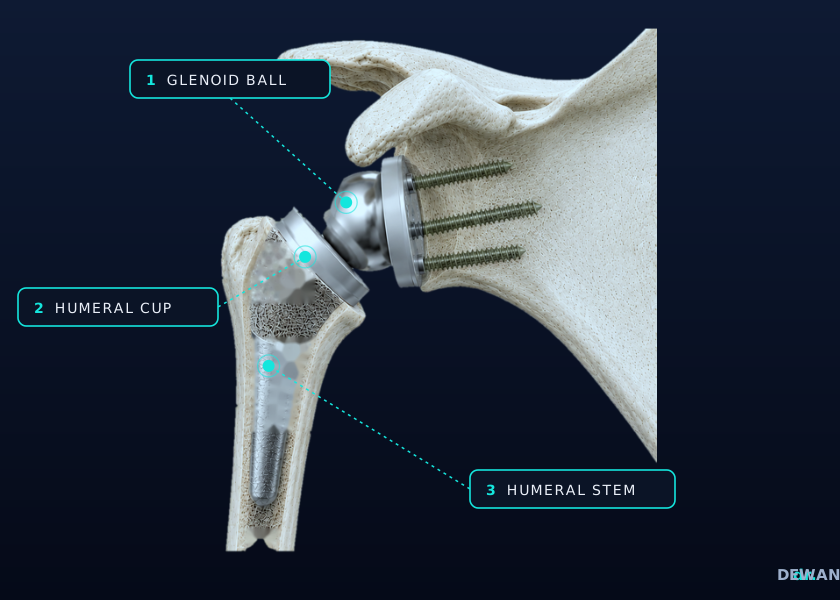
What this means for you: there is no wrong first side as long as each shoulder gets the right operation. Tell your surgeon which arm limits you most and what you need it for.
Does the second shoulder do as well as the first?
In most studies it does. A 2023 systematic review pooled 19 studies with 2,729 patients who had both shoulders replaced, at an average age of 72 and an average follow-up of almost four years.6 Patients improved substantially on both sides. The average time between operations was about 20 months.
A 2025 study from the University of Florida followed 180 patients for at least two years, grouped by the type of replacement on each side.7 Differences between the first and second shoulder were almost never large enough to matter to patients. The one exception favored the second side: in patients who had an anatomic replacement first and a reverse replacement second, the reverse side scored somewhat better. Complications were similar across groups.
The best predictor of how the second shoulder will do is how the first one did. In a related study of 134 patients, those who reached a satisfactory result after the first replacement had about six times the odds of reaching it on the second side: 71% compared with 29% of those whose first result was not satisfactory.8
What this means for you: if your first shoulder recovers well, that is a good sign for the second one. If it does not, that is worth discussing in detail before planning the second operation.
How long should you wait between shoulders?
Two large US database studies looked at this. Both found that operating on the second shoulder too soon raises the risk of complications. They differ on whether waiting longer than three months adds further safety.
- Under three months is too soon. In a 2021 study of 1,764 patients from two insurance databases, doing the second side within three months was linked to more revision surgery (11.6% compared with 5.4%), more fractures around the implant (4.7% compared with 1.2%), more blood clots (8.1% compared with 2.2%) and more transfusions (9.3% compared with 1.7%) than waiting more than a year. Waiting three months or longer was not linked to any increase in complications, and the authors recommended waiting at least three months.3
- After reverse replacement, a longer wait may lower risk further. The 2026 study used a US hospital database to compare 3,152 staged reverse replacements with 9,456 single reverse replacements.1 A second side done within six months carried about 2.4 times the odds of a surgical complication in the first 90 days, and one done at six to twelve months about 1.8 times the odds, mostly from fractures and infections. After twelve months, the risk was no different from having a single shoulder replaced. The authors estimated the extra risk faded at about 390 days. The study reports relative odds, and it could not account for why some patients had the second side done early, so it does not establish a required one-year wait.
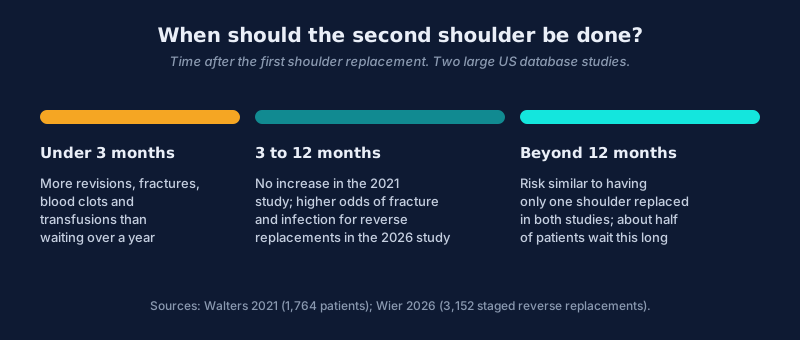
A longer wait does not appear to cost function. In the Florida study, the interval between operations, whether under a year, one to five years or more than five years, did not change the results.7 The systematic review found that patients who waited 20 months or more had somewhat better rotation and satisfaction than those who waited less.6
What this means for you: plan on at least three months between shoulders. One database study suggests a longer wait may lower risk further after a reverse replacement, which is weighed against how much the second shoulder is limiting you.
Can both shoulders be done on the same day?
It is possible, but it is uncommon and the evidence is limited to small series from specialized centers. A 2026 matched study from a single surgeon in France compared 16 patients who had both shoulders replaced on the same day with 32 similar patients who had them done separately.9 Neither group had complications, function and satisfaction were the same, and the same-day group spent fewer total days in the hospital (3.4 compared with 7.5). Those patients were carefully selected: all were under age 80, in good general health and with strong support at home.
Sixteen patients cannot measure the risk of uncommon complications. Both arms are in slings at once, which makes eating, dressing and toileting dependent on another person for several weeks. For most patients, staged surgery remains the standard.
Life with a replacement in each shoulder
A common concern, particularly with two reverse replacements, is whether a patient will still be able to manage personal hygiene. Reverse replacement reliably restores the ability to lift the arm, but rotation behind the back is more variable.
In a Rush University study of 50 patients with a reverse replacement in each shoulder, followed for an average of about five years, pain scores fell from 5.7 to 1.0 on a 10-point scale, the ability to raise the arm improved from 71 to 136 degrees, and every patient remained independent with hygiene and daily activities.10 Reoperation was needed in 5% of shoulders.
A Mayo Clinic survey of 31 patients with two reverse replacements added detail on the hardest tasks.11 All of them managed toileting easily and 87% could reach a back pocket. Reaching high up the back was harder: 29% had difficulty washing their back or fastening a bra, and 39% were unable to do so.
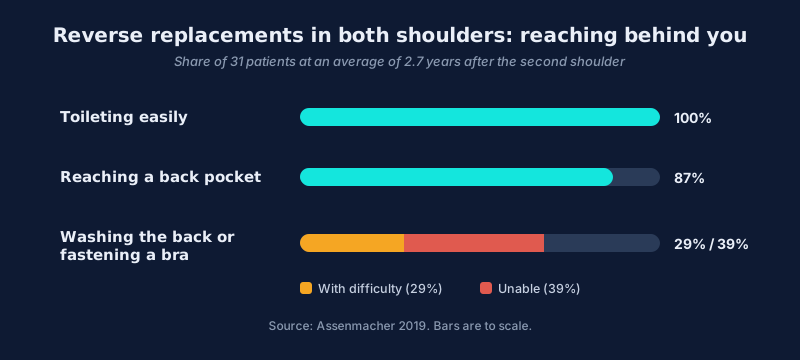
Patients with two reverse replacements were also more likely to rate their two shoulders differently. In the registry study, about 32% of patients with two reverse replacements were more satisfied with one side than the other, compared with about 9% of patients with two anatomic replacements.5
What this means for you: two reverse replacements are compatible with independent self-care. Tasks that require reaching high behind the back may need an adaptive tool or a change in routine, such as a front-fastening bra or a long-handled sponge.
Strengths of this evidence
- The timing studies are large. The two database studies include about 1,800 and 3,200 staged patients, enough to detect differences in uncommon complications such as fractures and clots.
- The outcome findings are consistent. The systematic review, the Florida cohorts and the reverse-specific series all show the second shoulder doing about as well as the first.
- The daily-function data are practical. The Mayo and Rush studies report specific tasks such as toileting and reaching behind the back, which are the questions patients ask.
Where I’d push back on the data
- The question of which side goes first has not been studied. The only direct data come from 60 patients in a manufacturer-linked registry.5 Any confident rule about dominant side versus worse side goes beyond the evidence.
- The two timing studies disagree. One found no extra risk after three months, and the other found extra risk up to a year for reverse replacement. The newer study is limited to reverse replacements and uses a different database, so the consistent finding is that under three months is too soon. Whether waiting longer than three months adds safety is less certain.
- Database studies cannot see the reasons for timing. A patient whose second shoulder was done quickly may have been sicker or had a more urgent problem. Billing codes do not capture that, and it could inflate the apparent risk of early surgery.
- The outcome studies come from high-volume shoulder centers. Florida, Rush, Mayo and the French series are specialized programs. Results may differ elsewhere.
- Same-day bilateral data are very thin. Zero complications in 16 patients is encouraging, but it says little about the risk of rare events.
What this means in my practice
When a patient has arthritis in both shoulders, I evaluate each shoulder as its own problem. I use Blueprint 3D CT-based planning with the Tornier Perform implant system, so each side is planned from its own CT scan. That planning decides whether a shoulder needs an anatomic or a reverse replacement, and the two sides do not have to match.
Choosing the first side
The conversation starts with which shoulder is limiting the patient’s life the most: pain at night, trouble reaching overhead, or difficulty with work or hobbies. Because the evidence does not favor dominant or non-dominant, I weigh the patient’s own priorities, including how they will manage daily tasks with the other arm during recovery.
Timing the second side
The first shoulder’s recovery is the best guide. A patient who is comfortable, sleeping well and regaining motion is a better candidate for the second operation than one who is still struggling. I usually wait at least three months between shoulders, which is the interval the 2021 study supports.3 The 2026 database study suggests the risk may keep falling with a longer wait after a reverse replacement, but it cannot show why some patients had the second side done early, and a year of living with a painful second shoulder is a real burden for the patient. When the first shoulder has recovered well and the second is limiting daily life, I do not ask patients to wait a year.
Planning the one-arm period
After each operation the arm is in a sling for several weeks, and the other shoulder is already painful. Planning for help at home with dressing, bathing and meals is part of preparing for surgery.
Who this evidence fits, and who it doesn’t
Likely fits: patients with arthritis or rotator cuff tear arthropathy in both shoulders who are planning staged replacements and want to know what to expect from the second side.
Likely doesn’t fit: patients with a fracture or a failed previous replacement on one side, and patients considering both shoulders on the same day, for whom the evidence is limited to small, highly selected series.
The bottom line for the layperson
- The shoulder that limits you most usually goes first; no study shows that dominant or non-dominant matters.
- The second shoulder usually does about as well as the first, and a good first result is a good sign for the second.
- Plan on at least three months between shoulders; having the second one done sooner raises the risk of complications.
- Each shoulder is planned on its own, so one anatomic and one reverse replacement is a common and successful combination.
- Patients with two reverse replacements stay independent with self-care, though reaching high up the back can remain difficult.
If both of your shoulders are bothering you, you can read more about reverse versus anatomic shoulder replacement and life after a reverse shoulder replacement, or request a visit to talk through a plan for both sides.
Sources
- Wier J, Mayfield CK, Mouchawar AC, et al. “Operative timing predicts postoperative complications after staged reverse total shoulder arthroplasty.” J Shoulder Elbow Surg. 2026;35(12):2805–2812. DOI: 10.1016/j.jse.2026.05.035 (PMID: 42248343)
- Lamplot JD, Bansal A, Nguyen JT, Brophy RH. “Risk of Subsequent Joint Arthroplasty in Contralateral or Different Joint After Index Shoulder, Hip, or Knee Arthroplasty: Association with Index Joint, Demographics, and Patient-Specific Factors.” J Bone Joint Surg Am. 2018;100(20):1750–1756. DOI: 10.2106/JBJS.17.00948 (PMID: 30334885)
- Walters JD, Denard PJ, Brockmeier SF, Werner BC. “The relationship of bilateral shoulder arthroplasty timing and postoperative complications.” J Shoulder Elbow Surg. 2021;30(2):317–323. DOI: 10.1016/j.jse.2020.06.010 (PMID: 32621979)
- Lee A, Christmas KN, Simon P, et al. “Influence of preoperative factors on timing for bilateral shoulder arthroplasty.” J Shoulder Elbow Surg. 2021;30(7S):S116–S122. DOI: 10.1016/j.jse.2020.12.023 (PMID: 33571653)
- Suttmiller AMB, Elwell JA, Roche C, Carofino BC. “Side-to-side differences in postoperative function and patient satisfaction after bilateral total shoulder arthroplasties.” J Shoulder Elbow Surg. 2022;31(9):1789–1795. DOI: 10.1016/j.jse.2022.02.014 (PMID: 35331855)
- Polascik BA, Chopra A, Hurley ET, et al. “Outcomes after bilateral shoulder arthroplasty: a systematic review.” J Shoulder Elbow Surg. 2023;32(4):861–871. DOI: 10.1016/j.jse.2022.11.010 (PMID: 36567015)
- Bindi VE, Hao KA, Turnbull LM, et al. “Clinical Outcomes of Bilateral Total Shoulder Arthroplasty.” J Am Acad Orthop Surg. 2025;33(4):e224–e233. DOI: 10.5435/JAAOS-D-24-00325 (PMID: 39637405)
- Turnbull LM, Hao KA, Srinivasan RC, et al. “Does achieving clinically important thresholds after first shoulder arthroplasty predict similar outcomes of the contralateral shoulder?” J Shoulder Elbow Surg. 2024;33(4):880–887. DOI: 10.1016/j.jse.2023.08.004 (PMID: 37690587)
- Pina G, Lacouture JD, Shi BY, Boileau P. “Simultaneous versus staged bilateral shoulder replacement: a matched cohort study.” J Shoulder Elbow Surg. Published online August 6, 2026. DOI: 10.1016/j.jse.2026.06.022 (PMID: 42398665)
- Mellano CR, Kupfer N, Thorsness R, et al. “Functional results of bilateral reverse total shoulder arthroplasty.” J Shoulder Elbow Surg. 2017;26(6):990–996. DOI: 10.1016/j.jse.2016.10.011 (PMID: 28094191)
- Assenmacher AT, Alentorn-Geli E, Aronowitz J, et al. “Patient-reported activities after bilateral reverse total shoulder arthoplasties.” J Orthop Surg (Hong Kong). 2019;27(1):2309499018816771. DOI: 10.1177/2309499018816771 (PMID: 30526285)
This article reflects Dr. Dewan's reading of the cited evidence at the time of publication. It is educational content, not medical advice. Your specific case may differ — schedule a consultation to discuss your imaging and history.