Robotic Knee Replacement
Mako robotic-arm assisted total and partial (unicompartmental) knee replacement. The procedure replaces worn cartilage and damaged bone with precisely positioned metal and polyethylene components — and the robotic arm helps Dr. Dewan execute a 3D plan customized to your specific anatomy.
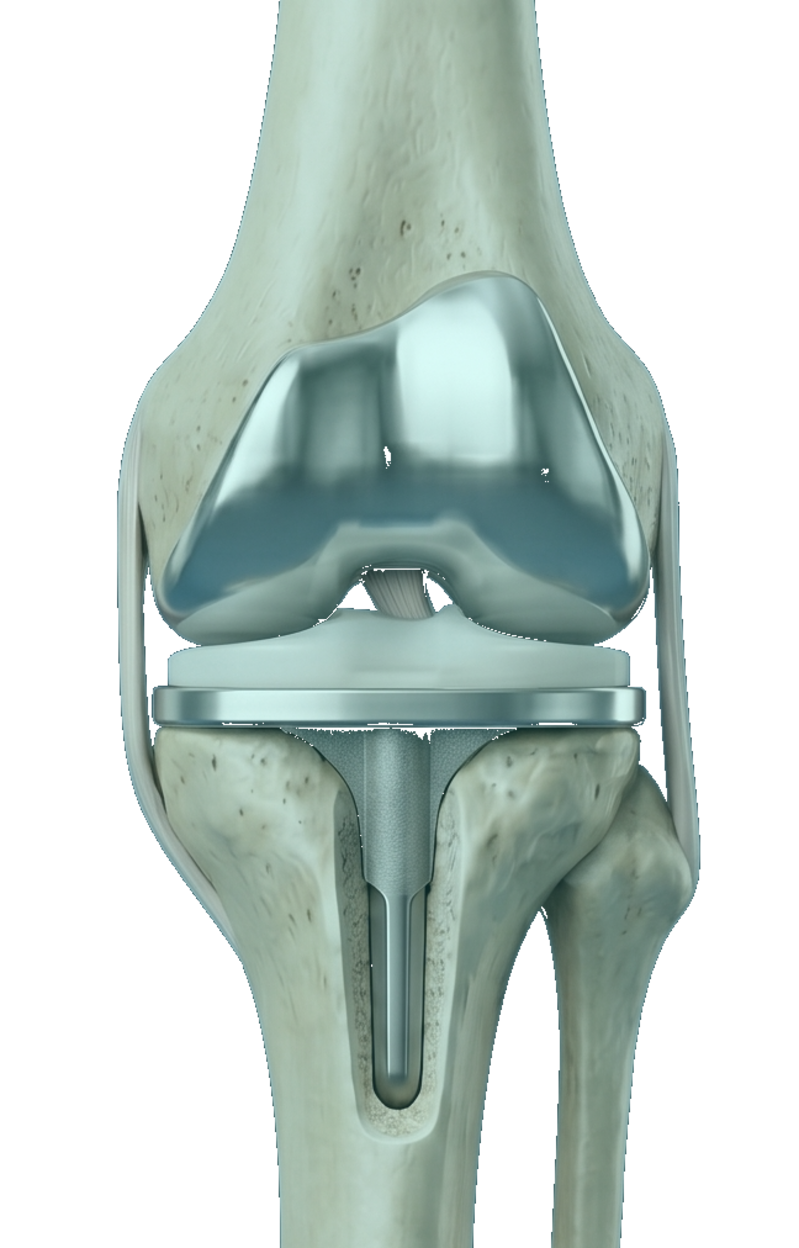
Knee replacement removes damaged cartilage and bone from the knee joint and resurfaces it with metal components and a high-grade plastic (polyethylene) bearing. The result is a smooth-gliding artificial joint that recreates the geometry of a healthy knee.
When only one compartment of the knee is worn (most often the medial side), a partial knee replacement preserves the healthy compartments and ligaments. Dr. Dewan offers both total and partial procedures using the Mako robotic platform — the choice depends on which parts of your knee are still healthy.
A 3D plan, executed within sub-millimeter tolerances
Before surgery, a CT scan of your knee is converted into a 3D virtual model. Dr. Dewan plans implant size, alignment, rotation, and soft-tissue balance on that model — accounting for your specific bone shape and the way your leg loads.
In the operating room, the Mako system tracks your bone position in real time and constrains the cutting tool to the planned boundaries. Bone cuts that would otherwise rely on visual judgment alone are executed within sub-millimeter tolerances. The end result is implant placement that more closely matches what was planned, with less soft-tissue disruption around the joint.
For patients undergoing partial (unicompartmental) replacement, robotic guidance is especially valuable: it helps preserve the healthy compartments and the cruciate ligaments, which is critical to the natural feel many partial-knee patients describe.
Robotic Knee Replacement is most often considered for the following — though every situation is individualized.
- ▸End-stage knee osteoarthritis
- ▸Inflammatory arthritis (rheumatoid, psoriatic)
- ▸Post-traumatic arthritis after old fractures or ligament injuries
- ▸Avascular necrosis of the knee
- ▸Failed prior conservative treatment (PT, injections, NSAIDs, bracing)
- ▸Significant pain that limits walking, sleep, or daily activities
A typical timeline.
Recovery varies by patient — these milestones are typical for an uncomplicated case. Dr. Dewan personalizes the plan to your starting point, goals, and surgical specifics.
- Day of surgeryWalk with assistance the same day, often discharged home
- Week 1Outpatient physical therapy begins; range-of-motion focus
- Week 2–3Stationary bike and progressive walking; sutures/staples removed
- Week 6Most patients off all walking aids; back to driving (right knee may take longer)
- 3 monthsReturn to most low-impact activities — hiking, golf, doubles tennis
- 6–12 monthsFinal functional gains; majority of swelling resolved
What patients ask most.
How long does a knee replacement last?+
Modern total knee replacements have excellent long-term durability — large registry data shows the majority are still functioning well at 15 to 20 years. Robotic-assisted placement aims to optimize alignment and balance, both of which correlate with implant longevity.
Read the full article→Am I a candidate for partial vs. total knee replacement?+
Partial knee replacement is appropriate when only one compartment of the knee is worn and the cruciate ligaments are intact. It preserves more of your native bone and ligament structure, which often results in a more natural-feeling knee. Dr. Dewan reviews your X-rays, exam, and sometimes an MRI to determine which procedure fits your anatomy.
Read the full article→Will surgery be inpatient or outpatient?+
Many healthy patients now go home the same day, especially for partial knee replacement. Whether you stay overnight depends on your medical history, anesthesia recovery, and home support — the goal is the safest, most comfortable path back to your own bed.
When can I drive again?+
Most patients return to driving 4–6 weeks after a right-knee replacement. After a left-knee replacement (with an automatic transmission) the return is typically 1–2 weeks, once you're off narcotic pain medication and feel safe operating the vehicle.
What activities can I do after a knee replacement?+
Most low-impact activities — walking, hiking, biking, swimming, golf, doubles tennis, doubles pickleball — are well-tolerated long-term. Repetitive high-impact running and competitive single-court racquet sports are generally discouraged because of accelerated polyethylene wear.
I'm looking for a knee pain specialist in Sugar Land — is replacement the only option?+
No, and it isn't where most visits end up. Most people arrive with knee pain and no clear diagnosis, so the first appointment is an evaluation — history, exam, and imaging — not a surgical plan. Treatment runs from activity changes, physical therapy, and injections through arthroscopy, and only reaches partial or total replacement when the joint surface is genuinely worn out and simpler measures have stopped working. Dr. Dewan evaluates knee pain at the Sugar Land office on the Southwest Freeway; call (281) 690-4678 to be seen.
Read the full article→Where does Dr. Dewan perform robotic knee replacement?+
Surgery is performed at Houston Methodist Sugar Land Hospital, 16655 Southwest Freeway. Consultations and follow-up visits happen at Methodist Orthopaedic Specialists of Texas, 16811 Southwest Freeway, Suite 200, Sugar Land — one exit apart on US-59/I-69, a short drive from Missouri City, Richmond, Rosenberg, Stafford, and Katy. Call (281) 690-4678 or book through Houston Methodist MyChart.
Robotic Knee Replacement in Sugar Land.
Consultations, imaging review, and follow-up visits happen at Methodist Orthopaedic Specialists of Texas — just off US-59/I-69 at the Sugar Land–Missouri City line. Surgery is performed at Houston Methodist Sugar Land Hospital, one exit away on the same freeway.
Dr. Dewan grew up in Fort Bend County — valedictorian at Hightower High School in Missouri City — and has practiced in Sugar Land since 2015. He serves as team physician for Fort Bend ISD’s Dulles and Crawford High School football programs.
The office is a short drive from Missouri City, Richmond, Rosenberg, Stafford, Katy, and the rest of southwest Houston.
Sugar Land, TX 77479
- Tuesday1:00 PM – 9:00 PM
- Thursday1:00 PM – 9:00 PM
- Friday8:00 AM – 5:00 PM
Insights from sports medicine and orthopedic surgery.
Long-form patient education on the conditions and decisions related to robotic knee replacement.
Knee Replacement
21 articlesOther operations Dr. Dewan does often.
Have a specific question about your case?
Every patient’s situation is different. The fastest way to know whether robotic knee replacementis right for you is a consultation — bring your imaging and a list of what you’ve already tried.