No age is too old for a shoulder replacement on its own. Patients in their 80s, and even their 90s, gain about as much pain relief and motion as younger patients, and their implants rarely need to be redone. What rises with age is the medical risk of the operation and the chance of recovering in a rehabilitation facility before going home. A large 2026 study in the Journal of Shoulder and Elbow Surgery followed 6,988 patients aged 80 and older in England’s national joint registry. It concluded that age alone should not rule out a reverse shoulder replacement, but that the medical risks should be central to the decision.1
This article covers what older patients get back from a shoulder replacement, what the risks look like at 80 and at 90, why health matters more than the number of birthdays, and how I work through the decision with patients and their families.
Why this matters to you
Many of the people who ask this question are not the patient. They are adult children watching a parent in their 80s stop dressing without help, stop sleeping through the night, or give up the garden because one shoulder hurts too much to use. They worry that surgery at that age is too dangerous, or that their parent has “too few years left” to make it worthwhile. Others have been told by a friend, or even a clinician, that they are simply too old. Knowing what the evidence says about both the benefit and the risk lets a family weigh the decision on facts.
Which shoulder replacement older patients usually get
A shoulder replacement replaces the worn ball at the top of the arm bone and the shallow socket (the glenoid) on the shoulder blade. In an anatomic replacement, the new parts keep the normal shape. In a reverse replacement, the ball goes on the shoulder blade and the cup goes on the arm bone, which lets the large deltoid muscle lift the arm even when the rotator cuff tendons are torn or worn out.
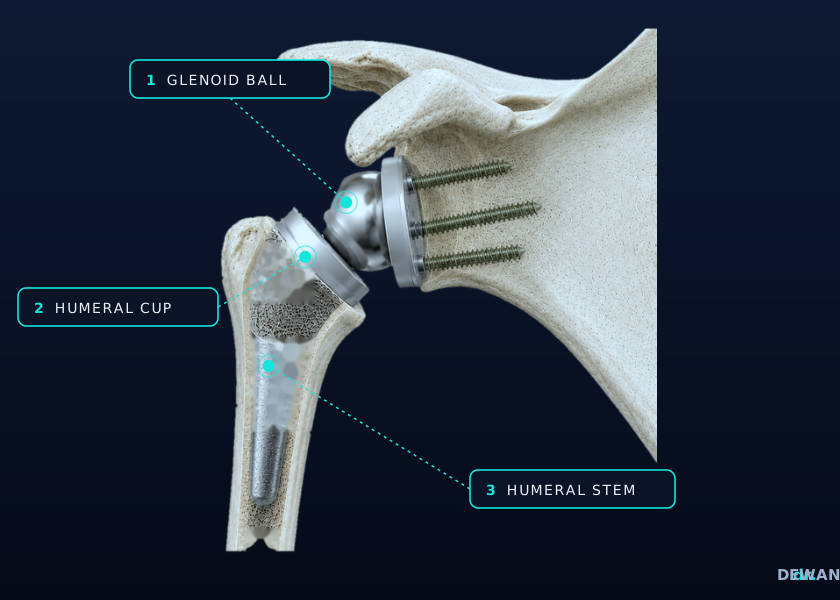
Rotator cuff tears become more common with age, and so does thin, osteoporotic bone. For those reasons, most of the research on patients over 80 is about the reverse replacement. A 2026 analysis of eight studies and 1,716 patients over 70 who had arthritis with an intact cuff found similar pain and function scores after either design. The anatomic design allowed more rotation, but carried nearly four times the risk of revision surgery.2 Some older patients with a healthy cuff and good bone still do well with an anatomic replacement, and the choice depends on the individual shoulder.
What older patients get back
Pain relief and function
A Swiss study compared 42 patients aged 85 or older (average age 87) who had a reverse replacement with a matched group of younger patients (average age about 70). After an average of nearly four years, the older patients’ shoulder function score, measured against what is normal for their age and sex, rose from 41% to 83% of normal, and their own rating of the shoulder rose from 38% to 80%. The results did not differ meaningfully from those of the younger group, and one of the 42 older shoulders (2.4%) needed revision.3
An earlier French and Swiss study of the anatomic replacement compared 32 patients over 80 with 32 patients under 70, all with arthritis and an intact cuff, for an average of seven years. Function scores were nearly identical (65 vs. 67 on the Constant score), patients in both groups rated their shoulders at 81% of normal, and three in four were very satisfied in each group.4
At the far end of the age range, a 2026 Columbia University series described 13 patients with an average age of 92 who had a reverse replacement, about half of them for a fracture and half for arthritis with a failed rotator cuff. The average patient could lift the arm forward to only 35 degrees before surgery, well below shoulder height, and to 144 degrees a year later, enough to reach a high shelf.5 Thirteen patients is a small group, but the direction matches the larger studies.
How long the implant lasts
For a younger patient, the main long-term worry is the implant wearing out. For a patient over 80, that concern largely falls away. In the English registry, only 2.3% of reverse replacements in patients 80 and older had been revised at five years, and each additional year of age lowered the risk of revision.1 A Mayo Clinic series of 242 reverse replacements in patients over 80 found 98.3% of implants still in place at five years.6 In the Danish registry, anatomic replacements in patients 75 and older were revised no more often than in patients aged 55 to 74.7
What this means for you: the benefit of a shoulder replacement does not shrink with age. A patient in their late 80s can expect about the same improvement in pain and use of the arm as a patient in their late 60s, and the implant is very likely to last for the rest of their life.
What rises with age
Medical complications and mortality
The risks that increase with age are the medical ones: pneumonia, urinary infection, kidney strain, blood clots and, rarely, death. In the English registry, 8.9% of patients 80 and older had a medical complication within 30 days, rising to 16.4% in those 90 and older. Each additional year of age raised the odds slightly, and patients with significant heart, lung or other medical disease (classified as ASA III or IV by the anesthesia team) were at substantially higher risk. Within one year, 3.3% of patients 80 and older had died, compared with 8.2% of those 90 and older.1
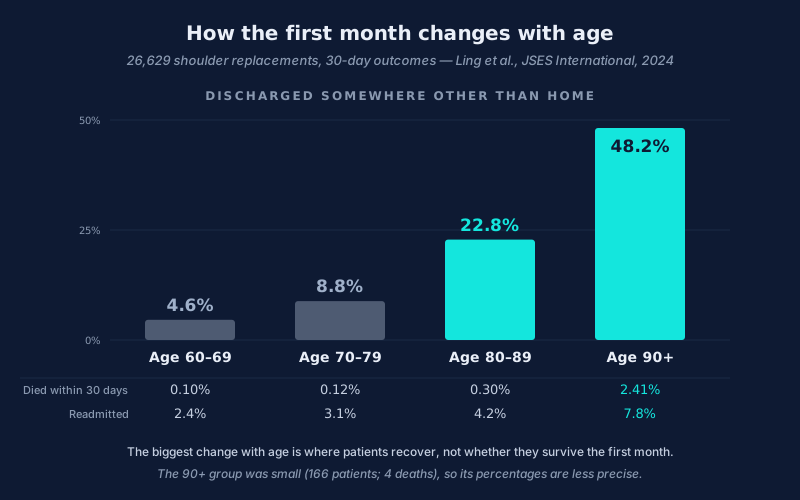
A US study of 26,629 shoulder replacements in a national surgical database broke the first 30 days down by decade. Death within 30 days was rare through the 80s: 0.10% in the 60s, 0.12% in the 70s and 0.30% in the 80s. In the 90-and-older group it rose to 2.41%, although that group was small.8 A separate US insurance database found a 90-day mortality of 2.7% in patients 80 and older, compared with 1.5% in younger patients, along with higher rates of blood clots, kidney failure and pneumonia. Older patients in that study had fewer dislocations and implant problems at one year.9
Where recovery happens
The largest difference between older and younger patients is where they recover. In the national study, 22.8% of patients in their 80s and 48.2% of patients 90 and older went to a rehabilitation or skilled nursing facility after the hospital, compared with fewer than 10% of patients in their 60s and 70s.8 A 2026 Duke University study found the same pattern: 32.7% of patients in their 80s went to a facility, compared with 12.7% of patients in their 70s, and they stayed in the hospital about half a day longer. Their rates of emergency visits and readmission within 90 days were no different.10
A short facility stay is not necessarily a bad outcome. In the Columbia series of patients around age 92, more than half had lived alone before surgery and about half went to rehabilitation first, but all 13 eventually returned to their previous living arrangement.5
What this means for you: for most patients in their 80s, the chance of a serious medical problem is real but small, and it depends heavily on their other health conditions. The practical question for many families is not whether their parent will survive the operation, but who will help with the first few weeks, when one arm is in a sling.
Health matters more than age
Two people of the same age can carry very different risks. Surgeons and researchers use frailty scores to capture this. A common one, the five-item modified frailty index, counts conditions such as diabetes, heart failure, lung disease, high blood pressure requiring medication, and needing help with daily activities. In 18,957 shoulder replacement patients, each additional point on this index roughly doubled the odds of death within 30 days, and the score also predicted medical complications, longer hospital stays, readmission and discharge to a facility.11 In a 2025 study of 86,356 patients, 29.9% of patients who were both frail and had several other medical conditions went to a skilled nursing facility, the highest rate of any group, and patients who were frail had higher rates than patients who had other medical conditions but were not frail.12
What this means for you: a fit, independent 85-year-old may face a lower risk than a frail 72-year-old with heart and lung disease. The useful questions are about heart and lung health, kidney function, memory, how well the patient walks, and what help is available at home.
Strengths of this evidence
- The registry data are large and population-based. The English study captured nearly every elective reverse replacement in patients 80 and older over a decade, not just those done by specialists at academic centers.
- The function studies used matched younger groups. Comparing older patients with similar younger patients, done in the same way, shows that age itself does not blunt the benefit.
- Different study designs agree. Registries, insurance databases and single-surgeon series from the US, England, Switzerland and Denmark point the same way: good function, low revision, and medical risk that climbs with age and illness.
Where I’d push back on the data
- The older patients in these studies were selected. Surgeons offer a shoulder replacement to the 85-year-olds they think can handle it. The good results describe healthy older patients, not every older patient.
- One-year mortality is not the same as surgical mortality. None of these studies compared patients with people of the same age and health who did not have surgery. Some of the deaths in the first year after surgery at age 90 would have happened anyway, so these figures likely overstate the risk the operation itself adds.
- The nonagenarian numbers are small. The 90-and-older group in the US database had 166 patients and four deaths, and the Columbia series had 13. These percentages could move considerably with more data.
- Function scores miss what families ask about. Few studies report whether an older patient regained the ability to dress, bathe or live independently, which is often what the decision hinges on.
- The findings on revision are not unanimous. The US insurance study found slightly more revisions at two years in patients 80 and older (5.1% vs. 3.1%), while the much larger English registry found that older age lowered the risk.1,9 Database coding differences may explain part of the gap.
What this means in my practice
The evidence suggests that the decision for an older patient should rest on health, function and support rather than on age. That is how I approach the conversation.
1. I start with what the shoulder is costing you
Pain at night, needing help to dress, not being able to lift a cup to the top shelf or hold a grandchild: these are the reasons to consider surgery at any age. If injections, therapy and activity changes still keep the pain manageable, there is no deadline to operate.
2. Medical clearance is part of the plan
For an older patient, I work with the primary care physician, and with the cardiologist or other specialists when needed, to understand the heart, lungs, kidneys and blood thinners before scheduling surgery. Patients and families should expect this step and ask about their specific risk.
3. I plan the operation to the patient’s bone
Older shoulders often have thinner bone and a worn socket. I use Blueprint 3D CT-based planning with the Tornier Perform implant system to measure the bone and plan where each component will sit before the operation.
4. We plan the recovery before the surgery
For some patients who meet discharge criteria and are in appropriate health, a shoulder replacement can be done as an outpatient. Many older patients are better served by a hospital stay, and some by a short stay in rehabilitation. I ask early who will be at home, whether the home has stairs, and whether a family member can stay for the first week or two, so that the plan fits the patient rather than being decided at discharge.
Who this evidence fits, and who it doesn’t
Closest fit: a patient in their 80s with severe shoulder arthritis or a worn-out rotator cuff, who walks independently, has stable heart and lung health, and has a family member or friend to help for the first few weeks.
Less certain fit: a patient in their 90s; a patient with advanced heart, lung or kidney disease or significant memory problems; and a patient who would have no help at home. For these patients the operation may still be the right choice, but the risk discussion is longer and the recovery plan matters more.
The bottom line for the layperson
- No age is too old for a shoulder replacement on its own; health and function matter more than the birth date.
- Patients in their 80s and 90s gain about as much pain relief and motion as younger patients, and their implants rarely need to be redone.
- The risk of a medical complication rises with age and with heart, lung and other health problems, and it is higher still after 90.
- Many patients over 80 spend a short time in a rehabilitation facility before going home, so plan the recovery before the surgery.
- Bring a family member to the visit and ask your surgeon about your specific risks, not the average for your age.
If you are weighing a shoulder replacement for yourself or a parent, you can read more about how surgeons choose between reverse and anatomic replacement and what life is like after a reverse shoulder replacement, or request a visit to talk it through.
Sources
- O’Malley O, Davies A, Rangan A, Sabharwal S, Reilly P. “‘Am I too old for a shoulder replacement?’ The association between age and comorbidities on the outcomes following reverse shoulder arthroplasty.” J Shoulder Elbow Surg. Published online June 24, 2026. DOI: 10.1016/j.jse.2026.06.013 (PMID: 42342101)
- Gupta MS, Krishan A, Rashid A, Lee MH. “Reverse versus anatomic total shoulder arthroplasty in patients over 70 with a competent rotator cuff and glenohumeral osteoarthritis: a meta-analysis.” J Shoulder Elbow Surg. 2026;35(5):1370–1386. DOI: 10.1016/j.jse.2025.10.015 (PMID: 41276069)
- Selman F, Moreira B, Perry NPJ, Kriechling P, Gressl M, Wieser K. “Reverse total shoulder arthroplasty outcomes in elderly patients.” JSES Int. 2025;9(3):815–822. DOI: 10.1016/j.jseint.2025.01.006 (PMID: 40486772)
- Iriberri I, Candrian C, Freehill MT, Raiss P, Boileau P, Walch G. “Anatomic shoulder replacement for primary osteoarthritis in patients over 80 years: outcome is as good as in younger patients.” Acta Orthop. 2015;86(3):298–302. DOI: 10.3109/17453674.2015.1006036 (PMID: 25586167)
- Obana KK, Weiss DL, Luzzi AJ, LeVasseur MR, Knudsen ML, Jobin CM, Levine WN. “Reverse total shoulder arthroplasty is safe and effective in patients ≥90 years old.” JSES Int. 2026;10(1):101374. DOI: 10.1016/j.jseint.2025.08.011 (PMID: 41737262)
- Clark NJ, Samuelsen BT, Alentorn-Geli E, et al. “Primary reverse shoulder arthroplasty in patients older than 80 years of age: survival and outcomes.” Bone Joint J. 2019;101-B(12):1520–1525. DOI: 10.1302/0301-620X.101B12.BJJ-2018-1571.R2 (PMID: 31787000)
- Queitsch CJ, Nyring MRK, Nielsen AF, Jensen ML, Olsen BS, Rasmussen JV. “Anatomic total shoulder arthroplasty for osteoarthritis in patients who are 75 years or older.” JSES Int. 2026;10(1):101401. DOI: 10.1016/j.jseint.2025.10.003 (PMID: 41737260)
- Ling K, Fassler RP, Nicholson AJ, Komatsu DE, Wang ED. “A comprehensive analysis of age and 30-day complications following total shoulder arthroplasty: nonagenarians, octogenarians, and septuagenarians.” JSES Int. 2024;8(1):176–184. DOI: 10.1016/j.jseint.2023.08.025 (PMID: 38312289)
- Testa EJ, Yang D, Steflik MJ, et al. “Reverse total shoulder arthroplasty in patients 80 years and older: a national database analysis of complications and mortality.” J Shoulder Elbow Surg. 2022;31(6S):S71–S77. DOI: 10.1016/j.jse.2022.01.146 (PMID: 35247576)
- Lorentz S, Hurley ET, Levin JM, et al. “Length of stay, discharge disposition, and 90-day emergency department visits and readmissions following primary shoulder arthroplasty in octogenarians vs septuagenarians.” Shoulder Elbow. Published online August 26, 2026. DOI: 10.1177/17585732261483462 (PMID: 42661951)
- Traven SA, McGurk KM, Reeves RA, et al. “Modified frailty index predicts medical complications, length of stay, readmission, and mortality following total shoulder arthroplasty.” J Shoulder Elbow Surg. 2019;28(10):1854–1860. DOI: 10.1016/j.jse.2019.03.009 (PMID: 31202629)
- Mayfield CK, Wier J, Liu KC, et al. “Frailty and comorbidity burden independently predict higher healthcare costs and nonhome discharges after total shoulder arthroplasty.” JSES Int. 2025;9(5):1698–1704. DOI: 10.1016/j.jseint.2025.05.024 (PMID: 41049654)
This article reflects Dr. Dewan's reading of the cited evidence at the time of publication. It is educational content, not medical advice. Your specific case may differ — schedule a consultation to discuss your imaging and history.