“You're bone on bone.” Few phrases send a patient toward the operating room faster. It sounds like a verdict — the cartilage is gone, the bones are grinding, so the knee must be replaced. It's one of the most common reasons people come to see me, X-ray in hand, already half-convinced the decision is made. And almost as often, my first job is to slow that conversation down.
Here's the thing the X-ray doesn't tell you: a knee replacement is not something you do because of how the joint looks. It's something you do because of how the knee is affecting your life — and only after the non-surgical options have had a fair chance. There is no X-ray grade that automatically earns you a new knee, and there is no rule that says you have to wait until you can't walk. This article walks through what “bone on bone” actually means, what the evidence says about trying non-surgical care first, and the real questions that decide when it's time.
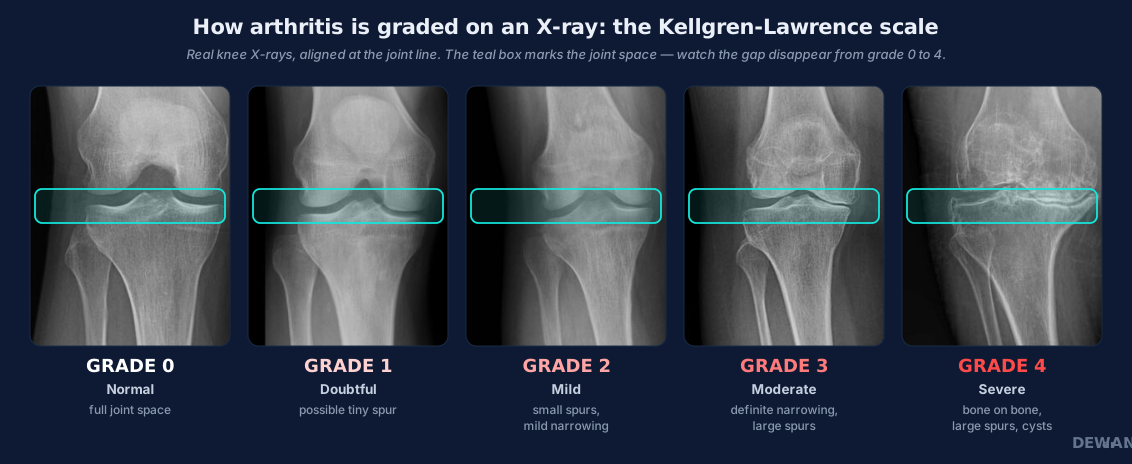
What “bone on bone” actually means
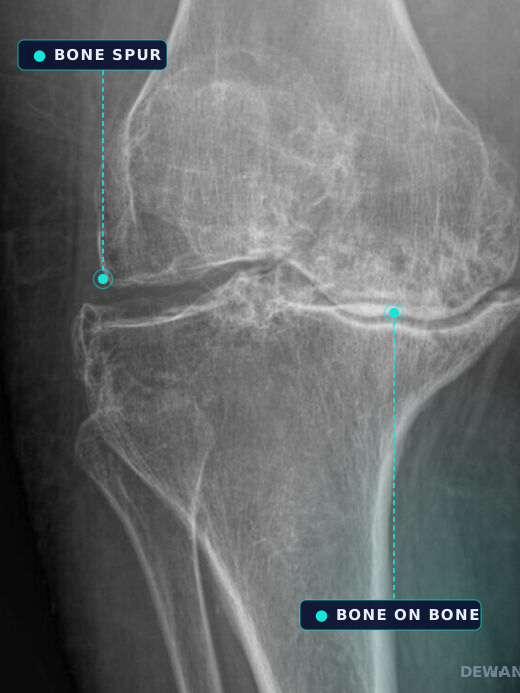
When a doctor points to your X-ray and says “bone on bone,” they're usually describing the most advanced stage on a scale orthopedic surgeons use to grade knee arthritis: the Kellgren-Lawrence grade, a 0-to-4 rating first described in 1957 and still the standard today.1 Grade 0 is a normal knee with a full cushion of cartilage. As arthritis progresses, that cushion — which shows up on an X-ray as the gap between the thighbone and shinbone — narrows, and the body lays down bony ridges called spurs. By grade 4, the gap is essentially gone and the ends of the bones sit against each other. That's the “bone on bone” picture.
So the phrase is real and it means something. What it does not mean is that your pain, or your need for surgery, is fixed by that grade. This is the single most important idea in the whole conversation, and it's backed by a large body of evidence.
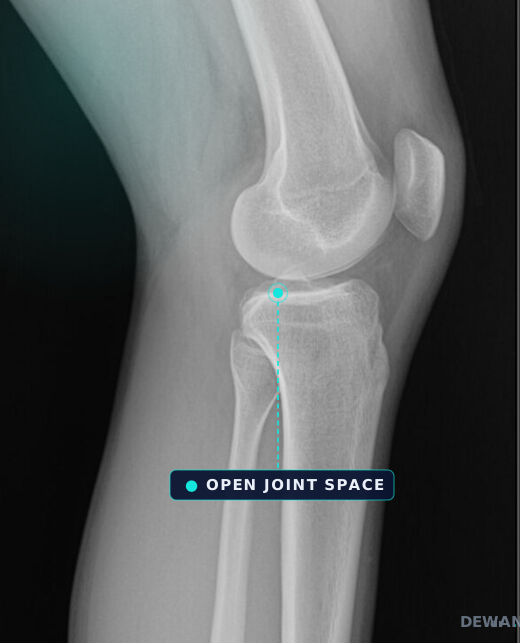
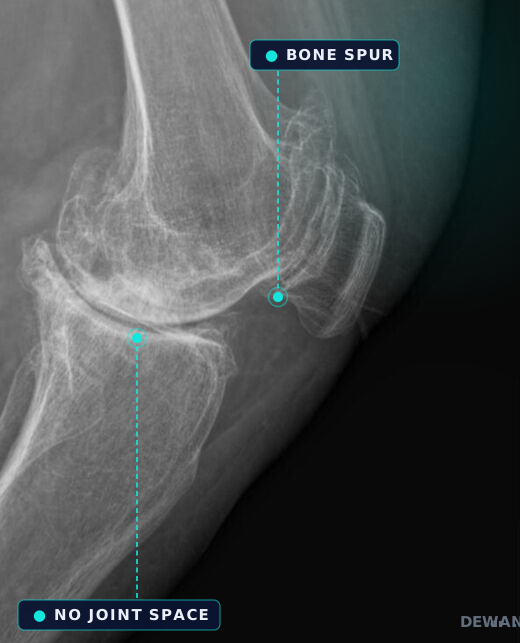
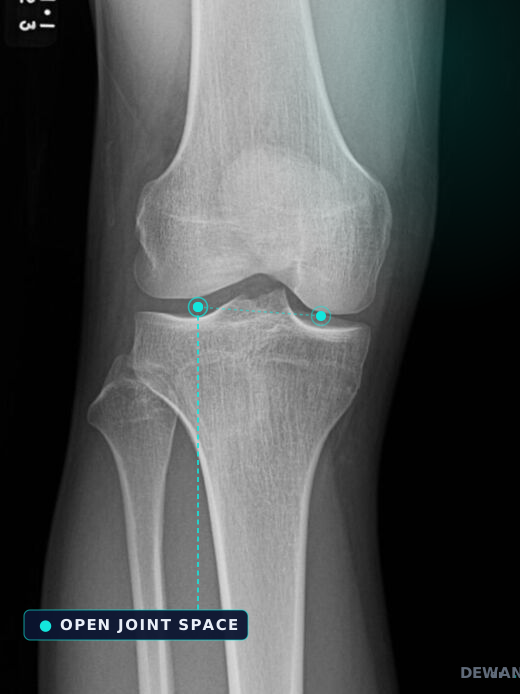
The scale above shows the front (AP) view. Here are the two ends of that spectrum from the side instead — a healthy knee and a severely arthritic one, side by side. Notice the clear, even gap in the healthy joint, and how it has collapsed to bone-on-bone in the arthritic one, with a bone spur at the margin:
The X-ray and the pain don't track together as closely as you'd think
A careful review of the research pulled together every study it could find comparing what a knee looks like on X-ray with how much it actually hurts. The mismatch is striking. Among people with knee pain, the share who had clear arthritis on X-ray ranged from about 15% to 76% across studies. And among people whose X-rays showed clear arthritis, the share who actually had knee pain ranged from about 15% to 81%.2 In plain terms: plenty of people with ugly X-rays feel fine, and plenty of people with modest-looking X-rays hurt a lot. The authors' conclusion was blunt — an X-ray should not be used on its own to judge an individual patient's knee.
I see both ends of this in clinic every week. A patient with a grade-4, textbook “bone on bone” knee who golfs twice a week and only came in because a scan for something else flagged it. And a patient with a grade-2 knee whose pain is genuinely wrecking their sleep and their work. The first patient does not need surgery scheduled tomorrow. The second one deserves an aggressive treatment plan even though the picture isn't dramatic. The knee that gets replaced is the one that has stopped letting you live your life — not the one that photographs the worst.
The evidence says: try non-surgical care first
Every major orthopedic guideline agrees on the starting point, and it isn't surgery. The American Academy of Orthopaedic Surgeons (AAOS) published an updated clinical practice guideline on managing knee arthritis without a joint replacement in 2021, and the international Osteoarthritis Research Society (OARSI) published its own guideline in 2019. Read side by side, they point the same direction.3,4
The treatments with the best evidence
- Exercise and physical therapy. This is the closest thing to a universally recommended treatment. Supervised exercise, home programs, and water-based exercise all reduce pain and improve function, with strong evidence behind them. Strengthening the muscles around the knee genuinely offloads the joint.
- Weight management. For anyone carrying extra weight, sustained weight loss reduces pain and improves function — and the mechanical math is dramatic. Each pound of body weight translates to several pounds of force across the knee with every step, so even a modest, durable loss changes the load the joint carries all day.
- Anti-inflammatory medication. Topical anti-inflammatory gels and, where appropriate, oral NSAIDs can meaningfully control day-to-day pain. Which one fits depends on your other medical conditions — a conversation worth having rather than guessing at.
- Injections, selectively. A cortisone injection into the joint can calm a flare and buy real relief. It's not a cure and it's not something to repeat endlessly, but as part of a plan it has a role.
None of this is glamorous, and none of it reverses arthritis — the cartilage doesn't grow back. But for a great many knees, a real, structured trial of these measures controls symptoms well enough that surgery either isn't needed or can be comfortably postponed for years. “I tried some exercises and took Advil a few times” and “I did twelve weeks of a progressive, supervised program, lost fifteen pounds, and had an injection” are very different things — and only the second one counts as a fair trial. For more on the non-surgical side, our piece on 5 strategies for joint pain goes deeper.
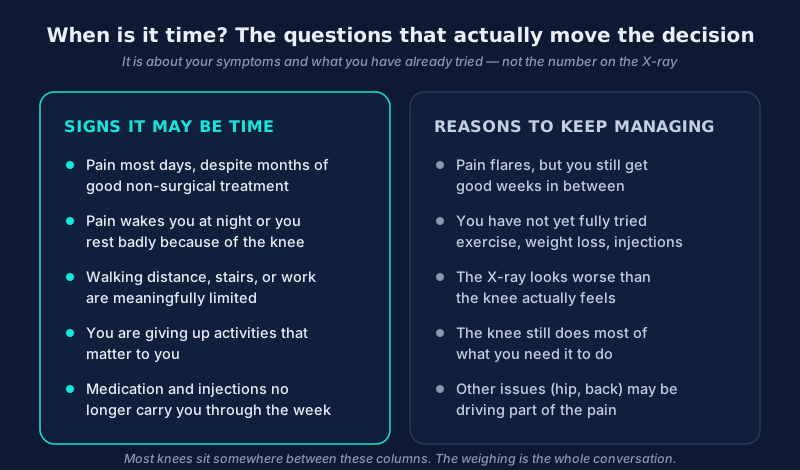
When the scale tips toward replacement
So when is it time? A knee replacement becomes the right conversation when two things are both true: your symptoms are limiting the life you want to live, and a fair trial of non-surgical care hasn't kept up with them. The signals I weigh most heavily are practical, not radiographic — pain most days of the week, pain that wakes you at night, a walking distance that keeps shrinking, stairs and getting out of a chair becoming a production, and activities you care about quietly dropping off your calendar. When medication and injections stop carrying you through the week and the good weeks get rarer, the balance has usually shifted.
You don't have to wait until you're “bad enough” on the X-ray
A common worry is that a knee isn't “ready” until it hits grade 4. The evidence doesn't support forcing that wait. A 2023 study in the Journal of Arthroplasty compared patients who had a knee replacement at grade 3 (moderate arthritis) against those done at grade 4 (bone on bone) and found they improved essentially the same amount from the operation.5 In other words, if your symptoms and your failed non-surgical trial justify a replacement, a grade-3 knee benefits just as much as a grade-4 knee — the “wait until it's bone on bone” rule is more insurance-policy than science. The decision is driven by how you're doing, not by holding out for a worse picture.
But waiting isn't automatically wrong, either
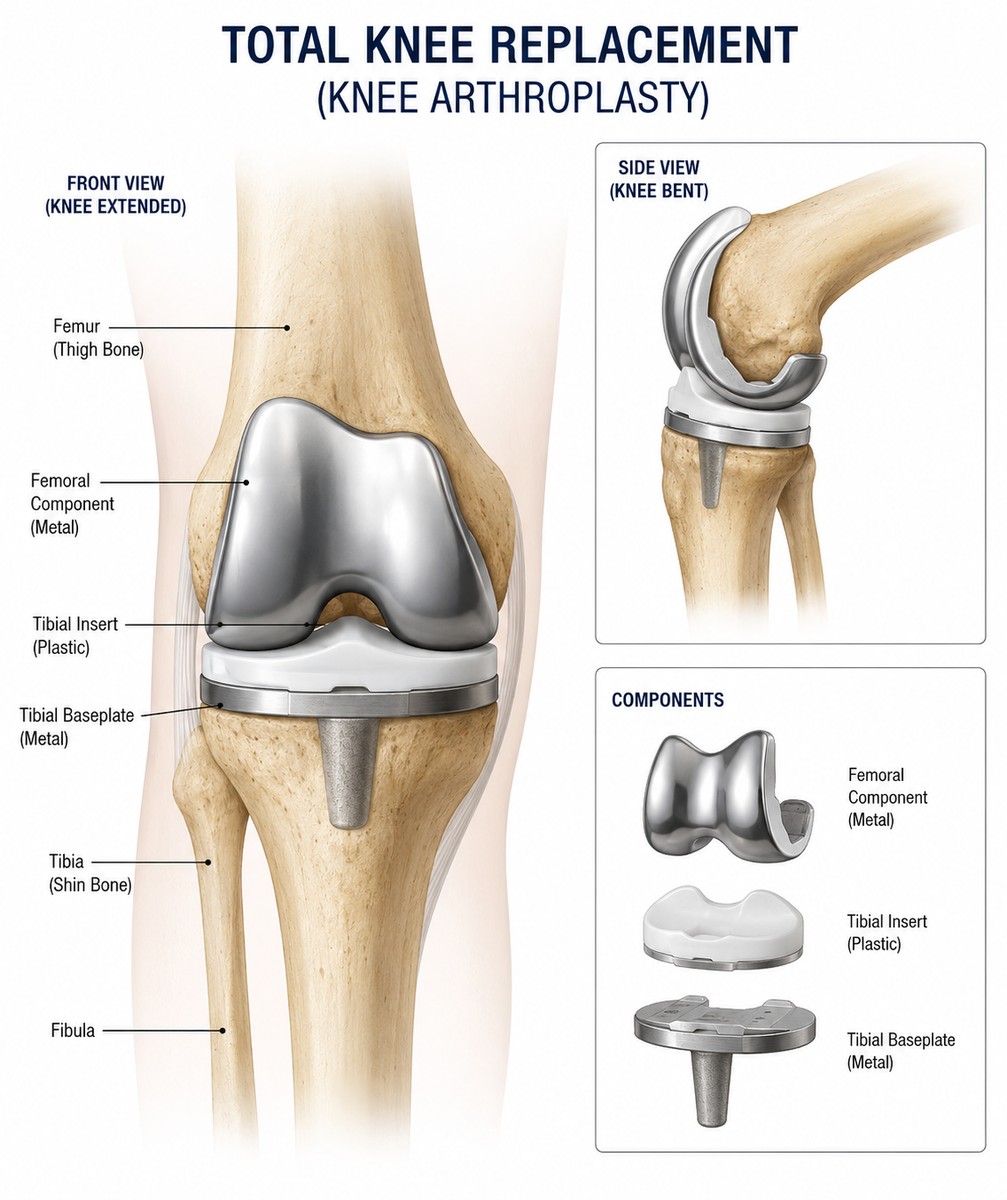
The flip side matters just as much. Surgery done too early — before you've given non-surgical care a genuine chance, or while the knee is still doing most of what you need — means taking on the risks and recovery of a major operation for a problem that hadn't yet earned it. Studies applying formal “appropriateness” criteria have found that a meaningful share of knee replacements are performed in patients whose symptoms were relatively mild, where the benefit is smaller and less certain.6 A knee replacement is a genuinely excellent operation for the right patient at the right time — and the same operation is a poor trade for the wrong one. The art is in the timing.
What I weigh in clinic
When a patient sits down with an X-ray and the words “bone on bone” already ringing in their ears, here's the sequence I actually run through with them out loud.
1. Is the arthritis really what's causing your pain?
It sounds obvious, but knee pain has more than one source. Referred pain from the hip or the back, a pinched nerve, or a soft-tissue problem can all masquerade as “knee arthritis,” especially when there's an arthritic X-ray sitting there to blame. A careful exam — sometimes with a diagnostic injection — makes sure we're aiming at the right target before anyone talks about replacing the joint.
2. How much is this actually limiting your life?
Not “how bad is the X-ray,” but: are you sleeping? Working? Walking the distances you want to? Still doing the things that make your life yours? This is the axis that matters most, and it's the one you get the biggest vote on.
3. Have we given non-surgical care a real, honest trial?
Structured physical therapy, weight management where it applies, the right anti-inflammatory, a well-timed injection — done properly, for long enough to know. If we haven't done that yet, that's usually where we start, and surgery goes on the table only if it doesn't hold.
4. What do the standing X-rays and your exam actually show?
The grade still matters as one input — I want to know how much cartilage is left, how the knee is aligned, and whether one compartment or the whole joint is involved (which shapes whether a partial or total replacement is even a question). It's part of the picture. It just isn't the whole picture, and it isn't the deciding vote. Standing (weight-bearing) X-rays are taken from the front — here is a healthy knee beside an arthritic one:
5. Are you a candidate for a good result, and is this the right time for you?
Your overall health, your other joints, and what you need your recovery to look like all factor in. A knee replacement asks for months of rehab work. Timing it when you can commit to that — and when the knee has genuinely earned it — is part of getting a great outcome. When we do proceed, I use robotic-arm-assisted technique to place the implant precisely to your anatomy, but the technology is the how, not the whether.
None of this is a formula. Two of those answers can point toward surgery and three away from it, and the recommendation lives in the weighing. What I try never to do is let a single phrase on a radiology report — “bone on bone” — make a decision that a full picture of you should make.
The bottom line for the layperson
- “Bone on bone” describes your X-ray (usually the most advanced arthritis grade) — it does not automatically mean you need surgery. Plenty of people with that picture live well without a replacement.
- The X-ray and the pain don't track together closely: some severe-looking knees barely hurt, and some mild-looking knees hurt a lot. Your symptoms lead the decision, not the grade.
- Every major guideline says to try non-surgical care first — exercise and physical therapy, weight management, anti-inflammatories, and selective injections. Done properly, this controls many knees for years.
- It's time to seriously consider a replacement when your symptoms are limiting your life and a fair trial of non-surgical care hasn't kept up — night pain, shrinking walking distance, and giving up activities that matter are the signals that count.
- You don't have to wait until you're “bone on bone” — a moderately arthritic knee benefits just as much when surgery is warranted — and you don't have to rush, either. The right timing is a decision to make with a surgeon who knows your knee and your life, not from the X-ray alone.
If you've been told you're “bone on bone” and you're not sure whether it's time, that uncertainty is reasonable — the honest answer really does depend on the specifics of your knee and your life. You can read about what to expect from how long a knee replacement lasts, what recovery actually looks like, or request a visit to review your imaging and your options together.
Sources
- Kellgren JH, Lawrence JS. “Radiological Assessment of Osteo-Arthrosis.” Ann Rheum Dis. 1957;16(4):494–502. PMID: 13498604
- Bedson J, Croft PR. “The discordance between clinical and radiographic knee osteoarthritis: a systematic search and summary of the literature.” BMC Musculoskelet Disord. 2008;9:116. DOI: 10.1186/1471-2474-9-116
- American Academy of Orthopaedic Surgeons. “Management of Osteoarthritis of the Knee (Non-Arthroplasty), 3rd Edition.” Adopted August 31, 2021. AAOS CPG (PDF)
- Bannuru RR, Osani MC, Vaysbrot EE, et al. “OARSI guidelines for the non-surgical management of knee, hip, and polyarticular osteoarthritis.” Osteoarthritis Cartilage. 2019;27(11):1578–1589. DOI: 10.1016/j.joca.2019.06.011
- Goh GS, Schwartz AM, Friend JK, et al. “Patients Who Have Kellgren-Lawrence Grade 3 and 4 Osteoarthritis Benefit Equally From Total Knee Arthroplasty.” J Arthroplasty. 2023;38(9):1714–1717. DOI: 10.1016/j.arth.2023.03.068
- Riddle DL, Jiranek WA, Hayes CW. “Use of a validated algorithm to judge the appropriateness of total knee arthroplasty in the United States: a multicenter longitudinal cohort study.” Arthritis Rheumatol. 2014;66(8):2134–2143. DOI: 10.1002/art.38685
This article reflects Dr. Dewan's reading of the cited evidence at the time of publication. It is educational content, not medical advice. Your specific case may differ — schedule a consultation to discuss your imaging and history.