dr.DEWAN
Book
Knee Replacement · Robotic Knee Replacement

Total Knee Replacement Recovery: A Patient Video Journal

What the first weeks after total knee replacement actually look like — narrated through a real patient's recovery.

By Ashvin K. Dewan, MDPublished Reviewed

Patients considering a total knee arthroplasty are naturally nervous about recovery. The surgery itself is invasive — it involves manipulation of the bones, ligaments, and muscles surrounding the knee — but more challenging than the operation is the commitment to rehabilitation afterwards. Consistent therapy prevents scar tissue buildup and stimulates muscle recovery.
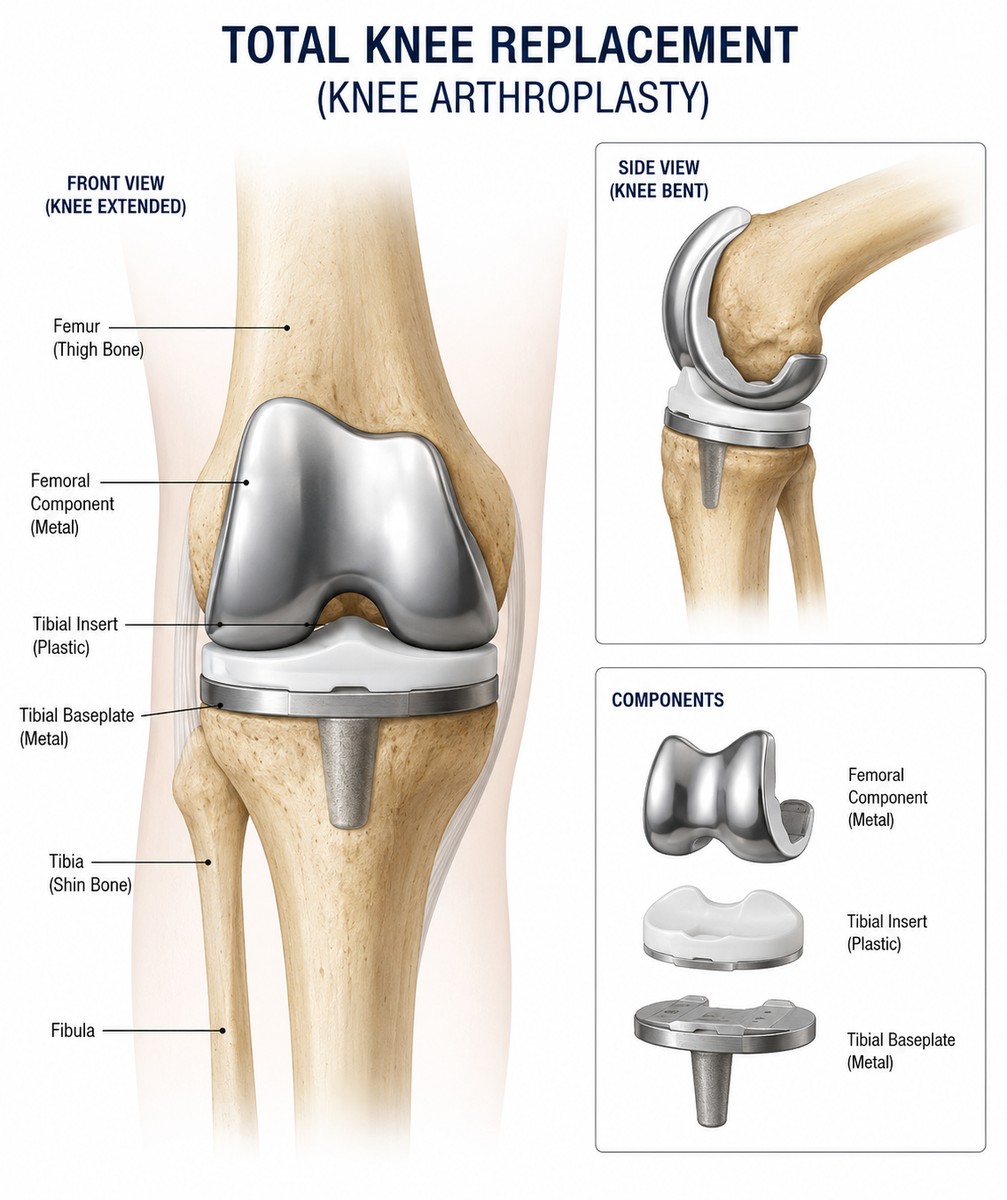
Total knee replacement prosthesis components — femoral and tibial implants
Total knee replacement prosthesis — femoral and tibial implant components.

To facilitate a smoother recovery, we have patients begin physical therapy before surgery. Many patients don’t realize how weak their knees have become from long-standing arthritis. A gait pattern that favors one knee results in progressive deterioration and atrophy of the surrounding muscles. The stronger your muscles are before surgery, the easier the recovery.

At our institution we have a rapid recovery and rehabilitation protocol. All patients are familiarized with the post-operative exercise regimen in a mandatory class we call “joint camp.” Hours after surgery, our patients are already working with physical therapy — “test-driving” their new knee. Most patients can immediately distinguish the post-operative pain from the excruciating arthritic pain they used to live with.

Upon discharge, patients meet their outpatient physical therapists, who supervise the rest of their recovery. As they progress, therapists incorporate more advanced rehabilitation techniques. Below is the recovery of one of our exemplary patients — severe arthritis going in, determined to get back to golf and recreational sport. Within hours of his surgery he was up and walking with minimal pain.

Want to know more?

Related procedure
Robotic Knee Replacement
Total & partial knee replacement
See how Dr. Dewan performs it
Educational content, not medical advice. This article is provided for patient education and does not replace individualized evaluation by a board-certified orthopedic surgeon. For a personalized opinion on your imaging and symptoms, request a visit with Dr. Dewan or call (281) 690-4678.
More on knee replacement

Continue reading.

Knee Replacement
Do I Actually Need a Knee Replacement? When Is It Time?
“Bone on bone” on an X-ray does not automatically mean it's time for a knee replacement. A surgeon's plain-language read on what the evidence says about timing — and the questions that actually decide it.
Read
Knee Replacement
How Long Does Pain Really Last After a Knee Replacement?
Most of the sharp pain after a knee replacement settles within about 6 weeks, and most day-to-day pain by 3 months — with slower gains out to a year. A surgeon's honest, week-by-week read on what the evidence actually shows.
Read
Knee Replacement
Cemented vs. Cementless Knee Replacement: Which Is Right for You?
Cementless knee replacements are marketed as the more durable, “biologic” option — but the registry data says the right answer depends on your bone, your age, and your sex. A surgeon's plain-language read on how the implant should attach to your bone.
Read
Knee Replacement
When Can I Kneel Again After a Knee Replacement? What the Evidence Actually Says
Kneeling is the single worst-rated activity after a knee replacement — but the research shows most patients who say they can't kneel actually can. A surgeon's plain-language read on what's really stopping you, and how to get it back.
Read
Knee Replacement
How Long Does a Knee Replacement Actually Last? The Honest Numbers Behind the Question
About 4 in 5 modern total knee replacements are still working at 25 years — but the headline number hides large differences by age, weight, and how the implant is put in. A surgeon's plain-language read on what to actually expect from your knee.
Read
Knee Replacement
The Implantable Knee Shock Absorber: A Surgeon's Honest Read on the MISHA System
An FDA-cleared device sits outside the knee joint and offloads 30% of the force on the inner cartilage with every step. The marketing is loud and the evidence is real, but a careful read shows where the gaps still are — and which patients should actually consider it.
Read