It is the first question I get asked in clinic, and it is the most-searched question about this surgery on Google: “If I get a knee replacement, how long is it going to last me?” The Reddit threads under r/TKR are full of versions of the same question — a 56-year-old whose surgeon offered surgery and is wondering if they'll need a redo in their 70s; a daughter asking whether her 82-year-old mother's 15-year-old knee is on borrowed time.
We have unusually good data on this for an orthopedic operation, and the data tells a clear two-part story: the headline number is reassuring, and the patient-level number can be very different depending on who you are. I want to walk through both.
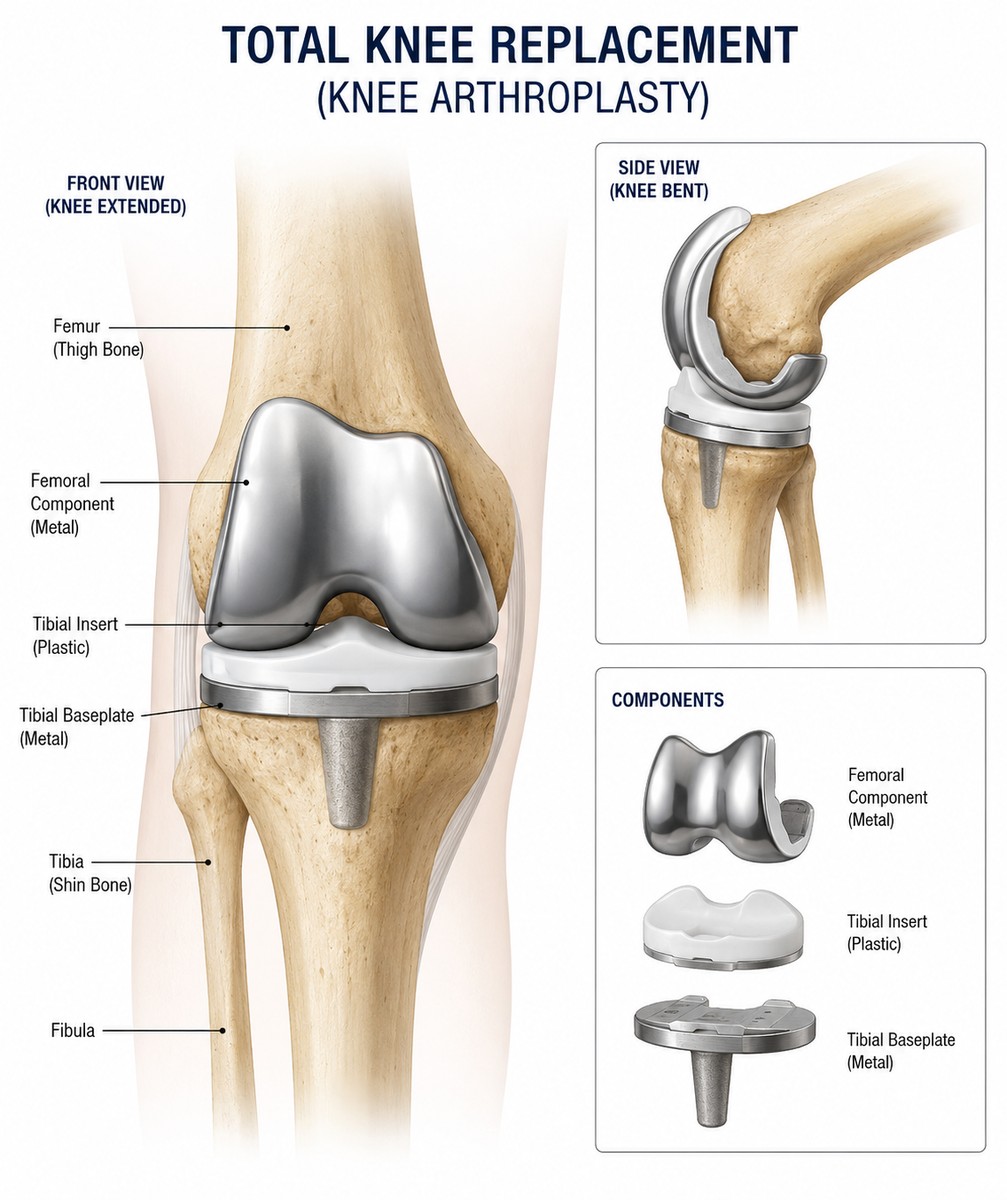
The headline number: about 4 in 5 knees last 25 years
The single best summary of knee replacement longevity in the world literature comes from a 2019 Lancet meta-analysis led by Jonathan Evans at the University of Bristol. The investigators pooled outcomes from 47 case series — about 300,000 total knee replacements — together with results from national joint registries in Australia, the UK, New Zealand, Sweden, Norway, Denmark, and Finland.1
The pooled answer:
- 10-year survival: ~95%. Nineteen out of twenty knee replacements are still in place and working a decade out.
- 20-year survival: ~90%. Nine out of ten are still going at 20 years.
- 25-year survival: ~82%. Roughly four out of five make it a quarter-century.
For context, “survival” in this literature means the implant has not been revised — i.e., no second surgery has been done to replace any part of it. That's a hard, unambiguous endpoint that registries actually capture, which is why the number is trustworthy in a way most surgical outcome statistics are not.
If you came in expecting to hear “a knee replacement lasts 10 to 15 years” — the figure that circulated in the 1990s and that still shows up in older patient pamphlets — the modern data is meaningfully better than that. Implants have improved, surgical technique has improved, and the curve has shifted to the right.
The catch: your age at surgery changes the math more than anything else
The pooled 82% number is a population average. The individual number can be much higher or much lower, and the single biggest driver is age at the time of surgery.
The cleanest data on this comes from a separate 2017 Lancet study by Bayliss and colleagues, which used UK general-practice records linked to the National Joint Registry to follow more than 60,000 patients out to 20 years and modeled lifetime risk of needing a revision.2 The numbers below the curve are sobering for younger patients and reassuring for older ones:
- Men in their early 50s at the time of surgery have a lifetime revision risk of roughly 35%.
- Women in their early 50s have a lifetime risk that is about 15 percentage points lower than men — roughly 20%.
- By age 70, lifetime revision risk has dropped to around 5% in men and is lower still in women.
- By age 80, lifetime revision risk is essentially trivial — most patients will live with the same implant for the rest of their life.

Two things are happening at once to drive that pattern. First, younger patients simply have more years left for the implant to fail in. A 52-year-old who lives to 85 is asking the implant to survive 33 years; an 80-year-old who lives to 90 is asking it to survive 10. Second, younger patients tend to put more mechanical demand on the implant — they walk more, work more, recreate more, and weigh on average more.
So when a 56-year-old asks me, “Will this last me the rest of my life?” — the answer is: probably, but the odds are notably worse than for the 76-year-old asking the same question, and you should plan with that in mind.
Beyond age: what else moves the curve
Age is the biggest single factor, but it is not the only one. A handful of other things show up consistently in the registry data as drivers of earlier failure.
Body weight
The cartilage in your native knee has to carry your body weight; the polyethylene insert in a knee replacement has to do the same job. More weight equals more wear, and a knee replacement implanted in a patient with a BMI above 40 has a measurably higher revision rate over time than one implanted at a healthier weight. This is one of the few longevity factors a patient can actually move pre-operatively. A 20-pound weight loss before surgery is not just an anesthesia and infection benefit — it is a durability benefit for the implant itself.
Activity level
Patients ask me whether they need to give up their tennis game or their pickleball league after a knee replacement. The answer is mixed: low-impact activity is fine and probably protective (it keeps the muscles around the knee strong); high-impact repetitive activity — running marathons, competitive singles tennis, jumping sports — measurably wears the implant faster. It does not mean you can never run a mile to catch a flight. It does mean that a knee replacement is not designed for the load profile of a 25-year-old's athletic life, and patients who treat it as if it is tend to use up the wear allowance faster.
Infection
The biggest non-mechanical reason a knee replacement gets revised is infection, and most of the registry-level “survival” gap that exists is driven by it. Infection risk is concentrated in patients with diabetes (especially when blood sugar is poorly controlled), active smokers, BMI > 40, and patients on immunosuppressive medications. The good news is that almost all of these are modifiable factors before surgery, and modern protocols at high-volume centers have driven the infection rate down to around 1% in primary cases.
Alignment and surgical technique
How accurately the implant is positioned at the time of surgery has been one of the most-studied predictors of long-term survival. Implants put in within a few degrees of the planned mechanical alignment last longer than implants that are 5+ degrees off. This is the mechanical case for technology that helps with alignment accuracy — patient-specific cutting guides, computer navigation, and robotic-arm-assisted systems like Mako. Whether that translates into a meaningful long-term survival gain is still an active question, which I'll address below.
What the “25-year survival” number does and does not mean
A few clarifying points, because patients (and quite a few internet articles) over-interpret these survival numbers in both directions.
It is not a guarantee for any one knee
An 82% pooled 25-year survival number means that across a large population of patients, 82% of implants were still in service at 25 years. It does not mean any individual patient has an 82% chance of getting 25 years. Some implants fail at 5 years; some are still going at 35. Your individual probability depends on the factors above.
It is not the same as “you'll be pain-free for 25 years”
“Survival” in this literature means the implant has not been formally revised. A patient can have a working but uncomfortable knee, mild persistent pain, or stiffness — all without ever crossing the threshold for a revision operation. About 15–20% of patients in long-term cohorts report some degree of residual pain or dissatisfaction even when the implant is technically “successful.” So “does it last?” and “does it feel great?” are related but separate questions.
Revision is itself an option, not a catastrophe
If a knee replacement does fail at 18 or 22 years, the next step is a revision knee replacement — a more involved operation but a routine one at high-volume centers. The outcomes are good, though not quite as good as a primary. The framing patients sometimes carry into the consultation — that needing a revision is a disaster — is not how I think about it. The real framing is: most patients will not need one; some will; if you do, it is manageable.
The robotic question — does the technology change the curve?
I perform the majority of my total knee replacements with robotic-arm assistance (the Mako system). The mechanical argument for robotic assistance is straightforward: it improves the accuracy of bone cuts and implant positioning, and decades of registry data have shown that better alignment correlates with longer implant survival.3
The harder question is whether that mechanical accuracy has yet translated into a measurable long-term survival difference between robotic and conventional total knee replacement. Two pieces of evidence sit in productive tension with each other, and patients should hear both.
On one side, a 2025 systematic review and meta-analysis in Arthroplasty pooled 20 comparative studies — about 5,400 patients across robotic and conventional cohorts — and found no statistically significant difference in implant survivorship at 2 years (~98% vs. 98%), 5 years (~97% vs. 97%), or 10+ years (~97% vs. 97%) between the two approaches.4 Taken at face value, “robotic vs. conventional” as a broad category looks like parity on survival.
On the other side, the 2024 Australian Orthopaedic Association National Joint Replacement Registry — a population-level dataset that follows essentially every knee replacement in Australia — broke the data out by specific implant and specific robotic system. For the Triathlon CR (the implant most commonly paired with Mako), six-year revision rates were 19% lower when implanted with Mako vs. manual instruments, and 30% lower when the kneecap was also resurfaced. Notably, Mako was the only robotic system in the 2024 Australian registry that showed a measurable revision-rate difference vs. manual technique.3
My editorial read on that finding: the fact that Mako is the only robotic platform in a national registry to so far show a measurable survival signal is not a coincidence, and it's not just a quirk of the data. Mako has been on the market the longest, has by a wide margin the largest installed base and case volume of any orthopedic robotic system, holds the deepest patent portfolio in the space (including the haptic boundary control and bone-registration technology that other platforms have had to engineer around), and is the most mechanically sophisticated of the available systems — the only one currently using a true haptically constrained robotic arm rather than a software-guided handpiece or a passive jig. None of that automatically makes it better, but it does mean that the platform with the most maturity, the most surgeon-hours behind it, and the most precise execution is also the one starting to show a registry-level durability advantage. That's the pattern you'd expect to see if the technology is genuinely doing what it claims, and it's why I think this is the early edge of a real signal — not a statistical artifact.
How to reconcile the meta-analysis and the registry: pooled meta-analyses average across many different robotic platforms, surgeon experience levels, and follow-up windows, which dilutes a real signal from any one system. Registry-level data on the specific implant/robot combination most patients actually receive shows a survival advantage that is starting to emerge at 5–7 years. The long-term (15+ year) comparison hasn't had time to mature, because robotic systems didn't reach widespread use until the mid-2010s.
My read: the biomechanical case for accurate alignment is strong, the early registry signal for the specific implant/robot combination I use is encouraging, and the case keeps getting stronger as follow-up matures. But anyone who tells you the robot guarantees an extra 5 years on your implant is overselling what the data currently shows. I use it because I think it makes the operation more reproducible and the long-term durability case is moving in the right direction — not because I can promise you it will outlast a knee placed by a careful surgeon using manual instruments.
What I tell patients in clinic
When a patient asks me “how long will this last,” my answer depends mostly on how old they are.
If you are in your mid-70s or older at the time of surgery, this is very likely the only knee replacement you'll ever need. Lifetime revision risk in this age band is in the single digits. Plan accordingly — do not delay surgery indefinitely waiting for “the right implant” or “the next-generation polyethylene.” The implants we have right now are excellent, and the more important variable is how long you have to enjoy the knee before other limitations on your life kick in.
If you are in your mid-60s, you are squarely in the wheelhouse for this surgery. Roughly nine out of ten patients in your age band will live with the same implant for the rest of their lives. Some will need a revision in their 80s; most won't. The math is on your side.
If you are in your 50s, the conversation is more nuanced. The implant is statistically likely to outlive several of your major activities — but the lifetime revision risk is real (one in three for men in their early 50s; one in five for women). I will spend more time talking with you about whether non-operative care, weight optimization, and an injection-and-activity-modification program might let you postpone surgery by a few years, because every year of delay is a year of younger demand the implant doesn't have to absorb. For some patients in this age band, a partial knee replacement may be worth discussing first.
If you are in your 40s or younger, I will counsel you carefully against a primary total knee replacement unless there is no reasonable alternative. The lifetime revision risk in this band is high enough that I would much rather buy you time with other strategies and do your knee replacement when the durability math is more favorable.
Above all, what makes the biggest difference in how long your implant lasts is also what makes the biggest difference in everything else about the surgery: get it done by a surgeon who does a lot of them, in a center that has the infrastructure and the volume to support modern alignment technology, infection prevention, and structured rehabilitation. The technology matters. The technique matters more.
Bottom line for the layperson
- The population numbers are reassuring. About 95% of modern total knee replacements are still in place at 10 years, 90% at 20 years, and 82% at 25 years.
- Your age at surgery moves the math more than anything else. Lifetime revision risk runs from roughly 35% for men in their early 50s down to about 5% by age 70.
- You can shift the curve a little before surgery. Lose weight if you can, get your blood sugar under control, stop smoking, and pick a high-volume surgeon. Each one is worth real durability.
- “Lasts” isn't the same as “feels great.” Roughly 1 in 5 patients report some lingering discomfort even when the implant is technically successful, so don't conflate the two questions.
- If it does fail at 20+ years, revision works. It's a more involved operation than the first one, but the outcomes are good and it is not the catastrophe patients sometimes imagine.
If you'd like a personalized read on what to expect from a knee replacement in your specific situation — your age, your activity level, your imaging, your other health factors — you can request a consultation or call the office at (281) 690-4678. The best version of this conversation is one I have looking at your standing X-rays with you.
Sources
- Evans JT, Walker RW, Evans JP, Blom AW, Sayers A, Whitehouse MR. “How long does a knee replacement last? A systematic review and meta-analysis of case series and national registry reports with more than 15 years of follow-up.” Lancet. 2019;393(10172):655–663. DOI: 10.1016/S0140-6736(18)32531-5
- Bayliss LE, Culliford D, Monk AP, Glyn-Jones S, Prieto-Alhambra D, Judge A, Cooper C, Carr AJ, Arden NK, Beard DJ, Price AJ. “The effect of patient age at intervention on risk of implant revision after total replacement of the hip or knee: a population-based cohort study.” Lancet. 2017;389(10077):1424–1430. DOI: 10.1016/S0140-6736(17)30059-4
- Australian Orthopaedic Association National Joint Replacement Registry. Hip, Knee & Shoulder Arthroplasty: 2024 Annual Report. AOA. aoanjrr.sahmri.com/annual-reports-2024 — six-year revision rates for the Triathlon CR with Mako vs. manual technique.
- Chen J, Loke RWK, Lim KKL, Tan BWL. “Survivorship in robotic total knee arthroplasty compared with conventional total knee arthroplasty: A systematic review and meta-analysis.” Arthroplasty. 2025 Apr 8;7:21. DOI: 10.1186/s42836-025-00304-3
- American Joint Replacement Registry. 2024 Annual Report. American Academy of Orthopaedic Surgeons. aaos.org/registries
- AAOS OrthoInfo — Total Knee Replacement
This article reflects Dr. Dewan's reading of the cited evidence at the time of publication. It is educational content, not medical advice. Your specific case may differ — schedule a consultation to discuss your imaging and history.