
Once the early recovery is behind them, almost every patient asks some version of the same question: “What can I actually go back to?” For one person that means eighteen holes of golf. For another it's doubles on Saturday morning, or a hiking trip, or the treadmill they've run on for thirty years. The question sounds simple. The answer has two halves that pull against each other, and a good conversation is about weighing them — not reciting a list of banned sports.
Here's the short version. Low-impact activity after a knee replacement is not just allowed; it's encouraged, and the durability data are reassuring. High-impact, repetitive-pounding activity — distance running chief among it — sits in a genuinely gray zone, where the concern isn't that you'll break something next week but that decades of pounding may wear the plastic faster. This article lays out where the mainstream surgeon consensus draws its lines, what the wear evidence really says, and how I think about it with patients.
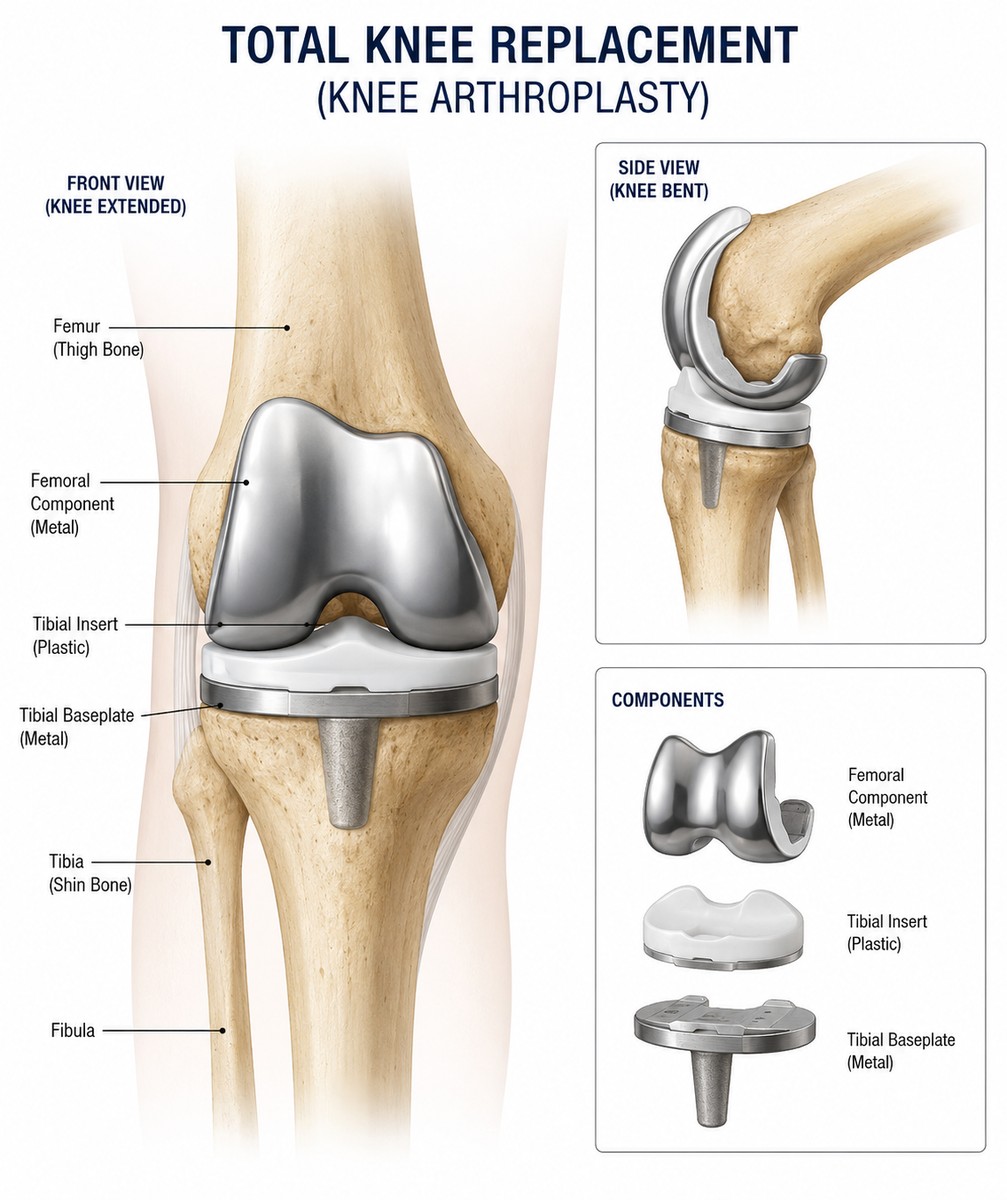
Why this question matters
For a lot of people, the whole reason to have the surgery was to get back to a life that arthritis took away. Telling a patient the operation was a “success” means little if they still feel exiled from the tennis court or the walking group. Activity is not a luxury add-on to recovery — for many patients it is the recovery, the thing that makes the new knee feel like their own. At the same time, a replacement is a mechanical device with a finite lifespan, and how you use it is one of the few levers you control. Getting this balance right is one of the more consequential conversations we have.
What the surgeon consensus actually says
We are not guessing in the dark here. Professional societies have surveyed their members on exactly which activities to green-light, and the agreement on the low-impact end is striking. In a survey of the American Association of Hip and Knee Surgeons, more than 95% of surgeons placed no restriction at all on walking, stair climbing, level cycling, swimming, and golf after a knee replacement.1 Those are not “maybe” activities — they are unambiguous green lights.
A European consensus group took it further and mapped out a graded return, recommending 21 different sports by six months after surgery — including golf, doubles tennis, hiking, Nordic walking, weight training, and low-impact aerobics — with only squash left off the list entirely.2 The recurring theme across both is the middle tier: intermediate-impact sports like singles tennis and downhill skiing are considered reasonable if you already have the skill, but not a good time to take up as a brand-new hobby. The consensus is far more cautious about high-impact, repetitive activities — distance running, basketball, competitive contact sports.
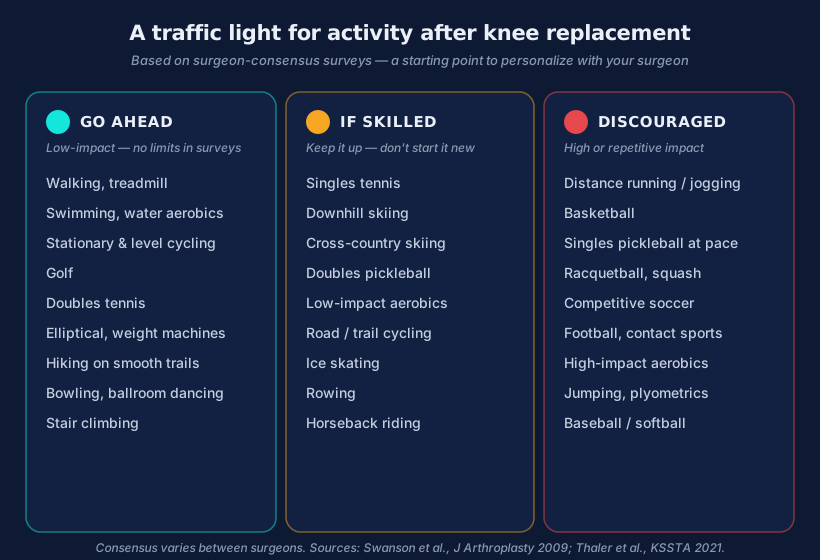
One caveat about this kind of evidence: it is expert consensus, not a randomized trial. In the same AAHKS survey, no responding surgeon claimed there was strong scientific proof behind their recommendations — they were pooling collective judgment.1 That's worth knowing. It means the green-light list is trustworthy because thousands of surgeons watching millions of knees converge on it, not because a trial proved each sport safe.
The running question, and the wear math
Running is the activity patients push back on hardest. The worry has never been that a jog will snap the implant. It's that running drives up polyethylene wear — the slow erosion of the plastic spacer — and that wear particles, over many years, can loosen an implant and force an earlier revision. Every footstrike while running sends several times your body weight through the joint, thousands of times per run, and the plastic pays that bill.
So what does the actual data show? More reassuring than the theory feared, with a real caveat. A large study following more than 1,600 patients for an average of 11 years found that higher-activity patients did not have worse implant survival — if anything, theirs was slightly better (about 98% of implants surviving at 12 years in the high-activity group versus roughly 95% in the low-activity group).3 The likeliest explanation isn't that pounding is good for plastic; it's that active patients tend to be leaner, more muscular, and better-conditioned, and that those advantages outweigh the extra wear from the activity itself.
The caveat is that studies which specifically image the plastic in very active patients do sometimes see more measurable wear on X-ray — it just hasn't translated into more revisions in the timeframes we've followed so far. In plain terms: the wear worry is real physics, but modern, highly cross-linked polyethylene is far more wear-resistant than the plastic that earned running its bad reputation decades ago, and the doomsday version of the concern has not shown up in the survival numbers.
Where I'd push back on both extremes
There are two oversimplified messages out there, and I disagree with both.
“Never run again” is stricter than the evidence
The blanket ban on all impact is a holdover from older implants and softer plastic. For a healthy, well-conditioned patient who ran for years, an occasional light jog on a soft surface is not the reckless act it's sometimes made out to be, and the survival data don't support treating it as catastrophic. Some patients do return to running — the literature includes case reports of people back to distance events after a replacement — and pretending it's impossible would be misleading.
“Do whatever you want, the data says it's fine” oversells it
The flip side is just as wrong. The survivorship study compared people who were generally more active to those who were less — it did not prove that taking up competitive singles tennis or marathon training after a replacement is free of consequences. Association is not permission. A younger, heavier, or highly active patient who plans on decades of high-impact use is exactly the person for whom the wear math matters most, because they have both the years and the loading to run the plastic down. For them, the trade-off is real and personal.
What this means in my practice
When a patient asks what they can go back to, I don't hand them a list — I try to have the two-sided conversation the evidence actually supports.
1. Low-impact is a green light, and I mean it
Walking, cycling, swimming, golf, doubles tennis, hiking, the elliptical, weight machines — go, and go with confidence. The consensus is overwhelming and the durability data are reassuring. For the large majority of my knee-replacement patients, staying active in this tier is one of the best things they can do for the knee, the heart, and the waistline — and a leaner, stronger patient tends to get more life out of the implant, not less.
2. Intermediate sports: keep them, ease into them
If you skied or played singles tennis before, you can generally get back to them — but do it once the knee is strong and the swelling has settled (usually by three to six months), and ramp up rather than jumping straight to your old intensity. This isn't the moment to pick up a brand-new high-skill impact sport for the first time.
3. High-impact and running: a real trade-off, decided together
Here I lay the two halves out plainly. On one side is your quality-of-life math — what a given activity means to you, and what it costs you to give it up. On the other is the wear math — your age, your weight, and how many decades and how much pounding you're asking the plastic to absorb. A 68-year-old who wants to jog a gentle mile twice a week is a very different calculation from a 55-year-old training for marathons. I won't make that decision for you with a reflexive “no,” and I won't wave you through with a careless “sure.” We decide it together, with the real numbers on the table.
4. Where robotic technique fits
I perform knee replacement with robotic-arm assistance (see robotic knee replacement), and precise alignment and soft-tissue balancing genuinely matter for how a knee feels through a golf swing or a hike — a well-balanced knee tolerates activity more comfortably. No surgical technique repeals the wear math, though. The robot helps me give you a knee that's well-positioned to handle the activity you choose; it doesn't turn a high-impact plan into a free lunch.
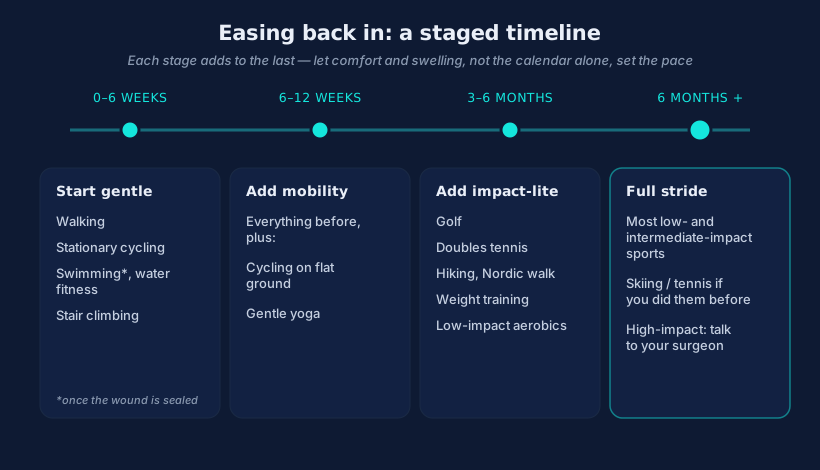
Most patients are pleasantly surprised by how much is on the green list. The activities that send people to a surgeon in the first place — walking without pain, a round of golf, keeping up with grandchildren — are almost all firmly in the “yes” column. The genuinely hard call, running, affects a smaller group, and even there the answer is a personalized trade-off rather than a flat no.
The bottom line for the layperson
- Low-impact activity is a clear green light: over 95% of surgeons place no restriction on walking, cycling, swimming, and golf after a knee replacement — and doubles tennis, hiking, and weight training join the list by six months.
- Intermediate sports like singles tennis and skiing are reasonable if you already have the skill — ease back into them once the knee is strong, rather than taking them up brand new.
- High-impact, repetitive activity like distance running is the real gray zone. The worry is long-term wear of the plastic spacer, not an immediate injury.
- The durability data are reassuring: over 11 years, more-active patients did not wear out their implants faster — likely because staying fit and lean protects the knee too.
- Running after a replacement is a personal trade-off between your quality-of-life math and your wear math — age, weight, and years of use. It's a decision to make with your surgeon, not a reflexive yes or no.
If you're weighing a knee replacement and worried it means giving up the activities you love — or you've had one and want a clear answer about getting back to a specific sport — that's a good conversation to have in person. You can request a visit or call the office at (281) 690-4678.
Sources
- Swanson EA, Schmalzried TP, Dorey FJ. “Activity recommendations after total hip and knee arthroplasty: a survey of the American Association for Hip and Knee Surgeons.” J Arthroplasty. 2009;24(6 Suppl):120–126. DOI: 10.1016/j.arth.2009.05.014 (PMID: 19698910)
- Thaler M, Khosravi I, Putzer D, Hirschmann MT, Kort N, Tandogan RN, Liebensteiner M. “Twenty-one sports activities are recommended by the European Knee Associates (EKA) six months after total knee arthroplasty.” Knee Surg Sports Traumatol Arthrosc. 2021;29(3):694–709. DOI: 10.1007/s00167-020-06400-y (PMID: 33404817)
- Crawford DA, Adams JB, Hobbs GR, Berend KR, Lombardi AV Jr. “Higher Activity Level Following Total Knee Arthroplasty Is Not Deleterious to Mid-Term Implant Survivorship.” J Arthroplasty. 2020;35(1):116–120. DOI: 10.1016/j.arth.2019.07.044 (PMID: 31471181)
- Lawrence KW, Bloom DA, Rajahraman V, Schwarzkopf R, Rozell JC, Aggarwal VK. “Return to athletics after total knee arthroplasty: a survey study of 784 recreational athletes across 12 sports.” Arch Orthop Trauma Surg. 2024;144(9):4115–4124. DOI: 10.1007/s00402-024-05364-9 (PMID: 38777908)
This article reflects Dr. Dewan's reading of the cited evidence at the time of publication. It is educational content, not medical advice. Your specific case may differ — schedule a consultation to discuss your imaging and history.