Most patients don't know partial knee replacement exists until someone tells them they might be a candidate. The default assumption — reinforced by decades of marketing and most people's mental picture of the operation — is that a worn-out knee gets a whole new knee. But if your arthritis is confined to just one part of the joint, there's a smaller operation that resurfaces only the worn section and leaves the rest of your knee, including your own ligaments, in place. It's called a partial (or unicompartmental) knee replacement, and for the right patient it can mean a faster recovery and a knee that feels more like the one you were born with.
It also comes with a genuine tradeoff that the enthusiastic version of this pitch tends to skip: partial knees are revised — meaning they need a second operation — at a noticeably higher rate than total knees. So this isn't a case of “newer and obviously better.” It's a real decision, with a real upside and a real downside, and the right answer depends heavily on whether you're actually a candidate.
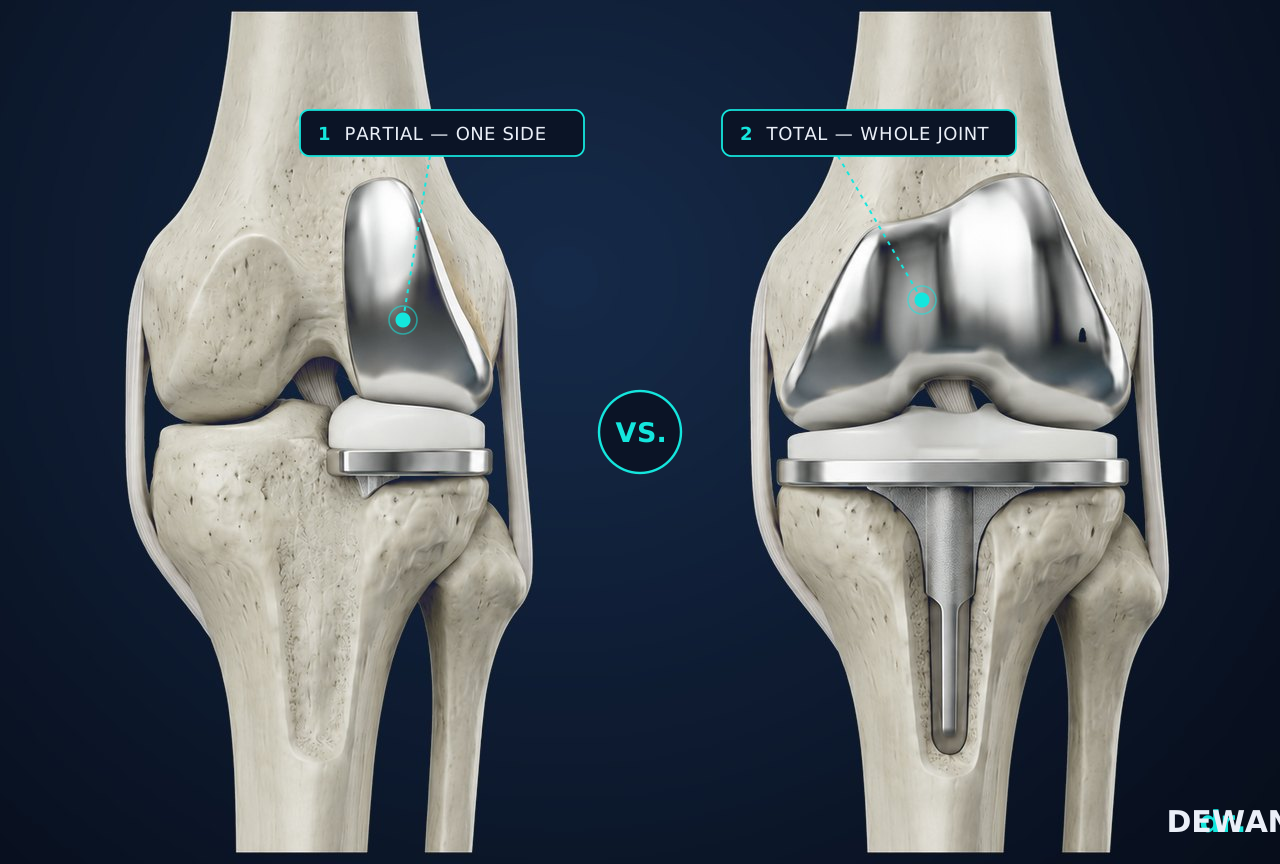
The knee has three compartments — and arthritis doesn't always hit all three
Think of your knee as having three “rooms”: the inner (medial) compartment, the outer (lateral) compartment, and the kneecap (patellofemoral) compartment. In a lot of people, osteoarthritis wears out just one of these — most often the medial compartment, which is why medial partial knee replacement is by far the most common version. If the other two compartments still have healthy cartilage and your ligaments are intact, there's a strong argument for fixing only what's broken and leaving the healthy parts alone.
A total knee replacement resurfaces all of it regardless — the ends of the thigh bone and shin bone are capped with metal, a plastic spacer goes between them, and in most designs the anterior cruciate ligament (ACL) is removed to make room. A partial knee replacement resurfaces only the worn compartment and preserves both cruciate ligaments and the healthy cartilage. That ligament preservation is a big part of why partial knees often feel more natural: the ACL and PCL are part of how your knee senses its own position and moves through a smooth arc.
What the best evidence actually shows
This is a question we have unusually good data on, because someone ran the trial that most surgical debates never get. The TOPKAT trial (Total or Partial Knee Arthroplasty Trial) randomly assigned 528 patients with isolated medial-compartment arthritis across 27 UK hospitals to either a partial or a total knee replacement, then followed them for years. Randomized head-to-head surgical trials are rare and expensive; a randomized trial with long follow-up is rarer still.
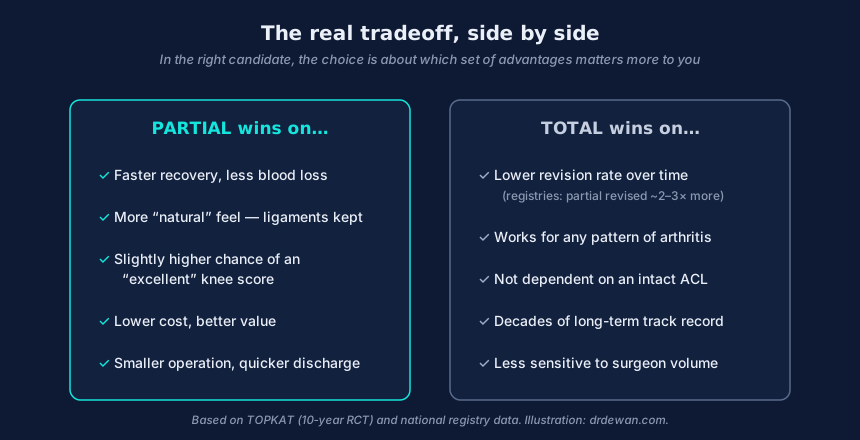
The 10-year results, published in The Lancet Rheumatology in 2025, are about as clear as orthopedic evidence gets. On the Oxford Knee Score — the standard patient-reported measure of knee pain and function — the two groups were essentially identical a decade out (a difference of 0.27 points, well within the range of “no meaningful difference”). Reoperations were similar. And partial replacement came out more cost-effective, delivering slightly more quality-adjusted life years at lower overall cost. The authors' conclusion: both operations are effective, offer similar clinical outcomes, and have similar reoperation and complication rates.1 The earlier 5-year results, in The Lancet in 2019, went a step further and suggested partial replacement should be considered the first choice for suitable patients on cost-effectiveness grounds.2
There's a second, softer signal worth knowing. When researchers matched 38,716 knee replacements in the UK National Joint Registry against patient-reported outcomes, partial-knee patients were somewhat more likely to rate their result “excellent” (47% vs. 36%) and less likely to rate it poor, with slightly higher quality-of-life scores.3 It's registry data, not a randomized trial, so it can't fully rule out that healthier patients get partial knees in the first place — but it lines up with what patients often tell me: a well-selected partial knee can feel remarkably normal.
The catch: partial knees are revised more often
Here's the downside, stated plainly. When you look at national joint registries — which capture nearly every operation in a country, including the failures that tidy trials can miss — partial knee replacements are revised at roughly two to three times the rate of total knees. That's a consistent finding across the Australian, UK, and other registries, and it's the single most important number on the “con” side of the ledger.
Two things make that number less alarming than it first sounds, though neither erases it. First, a partial knee is often easier to revise than a total knee — converting a well-done partial to a total is frequently a more straightforward operation than revising a failed total, with outcomes closer to a primary replacement. Second, the registry gap is heavily driven by surgeon and center volume. Surgeons who do partial knees frequently, and who select patients carefully, report revision rates far closer to total-knee territory — and the randomized TOPKAT patients, operated on by experienced surgeons, showed similar revision rates between the two. In other words, a chunk of that 2-3× registry signal reflects partial knees being done occasionally, by surgeons who don't do many, on patients who weren't ideal candidates.
So — are you a candidate?
This is where the whole decision actually lives, because partial knee replacement only makes sense for a specific kind of knee. The classic candidacy criteria, first laid out by Kozinn and Scott and refined heavily since, come down to a few essentials:4
- Arthritis confined to one compartment. On standing X-rays, the worn compartment is bone-on-bone, but the other two still have preserved cartilage. If two or three compartments are worn, a partial won't fix your pain — the arthritis you left behind keeps hurting.
- An intact, functioning ACL. This is the big one. A partial knee relies on your own ligaments for stability. A torn or absent ACL has traditionally been a contraindication (though some experienced centers are now challenging this in selected patients).
- A deformity that isn't fixed. A bow-legged or knock-kneed deformity that passively corrects — the alignment straightens when gently pushed — suggests the ligaments are healthy and the wear is one-sided. A large, rigid deformity points toward a total.
- A reasonable range of motion without a large fixed bend (flexion contracture) in the knee.
Notice what's not on the modern list. For years, patients were told they were disqualified for being too young, too heavy, too active, or having some kneecap arthritis. Long-term series from high-volume centers have challenged most of those absolute cutoffs — age, weight, and activity level are no longer automatic disqualifiers the way they once were. The compartment pattern and the ligaments are what really decide it. The bottom line on candidacy: roughly a quarter to a half of knees headed for replacement could be candidates for a partial on paper, but the right number for any individual depends entirely on their imaging and exam.
What's genuinely strong about this evidence
- We have a randomized trial with 10-year follow-up. TOPKAT is exactly the study surgical decisions usually lack — randomized, multicenter, and followed long enough to see revisions. That it shows equivalence on patient-reported outcomes is powerful.
- The registries and the trial disagree in an informative way. The trial (expert surgeons, selected patients) shows similar revision; the registries (everyone) show partial revised more. Read together, they tell you candidate selection and surgeon experience are doing real work.
- The patient-experience signal is consistent. Faster recovery, less blood loss, and a more natural feel show up repeatedly for partial knees. Those aren't nothing to a patient trying to get back to life.
Where I'd push back on the hype
- “Partial is just better” overstates it. The randomized data shows equivalence on function at 10 years, not partial superiority. The advantages are real but specific — recovery and feel — not a better knee score down the road.
- The revision gap is real, not a myth. Anyone who waves away the higher registry revision rate is selling. It's genuine, and it's the price of the smaller operation. The right response is careful candidate selection, not denial.
- Candidacy is doing the heavy lifting. A partial knee in the wrong knee — multi-compartment arthritis, a bad ACL — is a setup for early failure. The operation is only as good as the selection.
- Surgeon experience matters more here than for a total. Partial knee results are more volume-dependent. If a surgeon does two of these a year, the registry average is closer to your reality than the expert-center numbers.
How I think about it in my practice
When a patient comes in with knee arthritis, my first job is to figure out where the arthritis actually is. That means good standing X-rays, sometimes additional views, and a careful exam of the ligaments and alignment — occasionally an MRI to check the other compartments. If the wear is genuinely confined to the medial compartment, the ACL is intact, and the deformity corrects, I'll bring up partial replacement as a real option, because for that patient the faster recovery and preserved ligaments are a meaningful advantage, and the evidence says the long-term function holds up.
I also lay the tradeoff out exactly as I have here: you're trading a somewhat higher chance of needing a second operation down the line for a smaller operation and a more natural-feeling knee now. Some patients weigh that and want the partial; others would rather have the lower-revision option and choose a total. Both are defensible, and I don't push. What I won't do is offer a partial to a knee that isn't a candidate — if two compartments are worn, or the ACL is gone, a partial is the wrong operation no matter how much someone wants the smaller scar. I use robotic-arm assistance for partial knees as well as total ones, because the precise bone preparation it allows is genuinely useful in the tighter margins of a partial — but the robot doesn't change who is or isn't a candidate. The imaging and the exam decide that.
For the broader question of whether it's time to replace the knee at all — partial or total — that's a separate conversation, and I've written about when a knee replacement is actually warranted and about the recovery timeline you can expect either way.
Bottom line for the layperson
- Partial replacement fixes only the worn part. If your arthritis is confined to one compartment and your ligaments are intact, you may be able to keep two-thirds of your own knee.
- Function is equivalent long-term. A 10-year randomized trial found partial and total knees score about the same on patient-reported function — with partial being more cost-effective.
- The tradeoff is revision rate. Registries show partial knees revised roughly 2–3× more often — the real price of the smaller operation, and heavily reduced by careful selection and an experienced surgeon.
- Candidacy is everything. One-compartment arthritis, an intact ACL, and a correctable deformity are the essentials. Age and weight are no longer automatic disqualifiers.
- Get the imaging read carefully. Whether you're a candidate is decided by your standing X-rays and your exam — not by preference. Ask a surgeon who does enough partials to judge honestly.
If you've been told you need a knee replacement and want to know whether you're a candidate for the partial version, you can request a consultation or call the office at (281) 690-4678. Bring your standing X-rays — whether a partial is right for you is a question we answer with your imaging in front of us.
Sources
- Beard DJ, Davies L, Cook JA, et al. “Assessing clinical and cost effectiveness of total versus partial knee replacement (TOPKAT): 10-year follow-up of a multicentre, randomised controlled trial.” Lancet Rheumatol. 2025. DOI: 10.1016/S2665-9913(25)00250-4
- Beard DJ, Davies LJ, Cook JA, et al. “The clinical and cost-effectiveness of total versus partial knee replacement in patients with medial compartment osteoarthritis (TOPKAT): 5-year outcomes of a randomised controlled trial.” Lancet. 2019;394(10200):746–756. DOI: 10.1016/S0140-6736(19)31281-4
- Mohammad HR, Judge A, Murray DW. “A matched comparison of the patient-reported outcome measures of 38,716 total and unicompartmental knee replacements: an analysis of linked data from the National Joint Registry.” Acta Orthop. 2021;92(6):701–708. DOI: 10.1080/17453674.2021.1956744
- Kozinn SC, Scott R. “Unicondylar knee arthroplasty.” J Bone Joint Surg Am. 1989;71(1):145–150. PubMed: 2643607 — original candidacy criteria, since substantially refined.
- AAOS OrthoInfo — Unicompartmental Knee Replacement
This article reflects Dr. Dewan's reading of the cited evidence at the time of publication. It is educational content, not medical advice. Your specific case may differ — schedule a consultation to discuss your imaging and history.