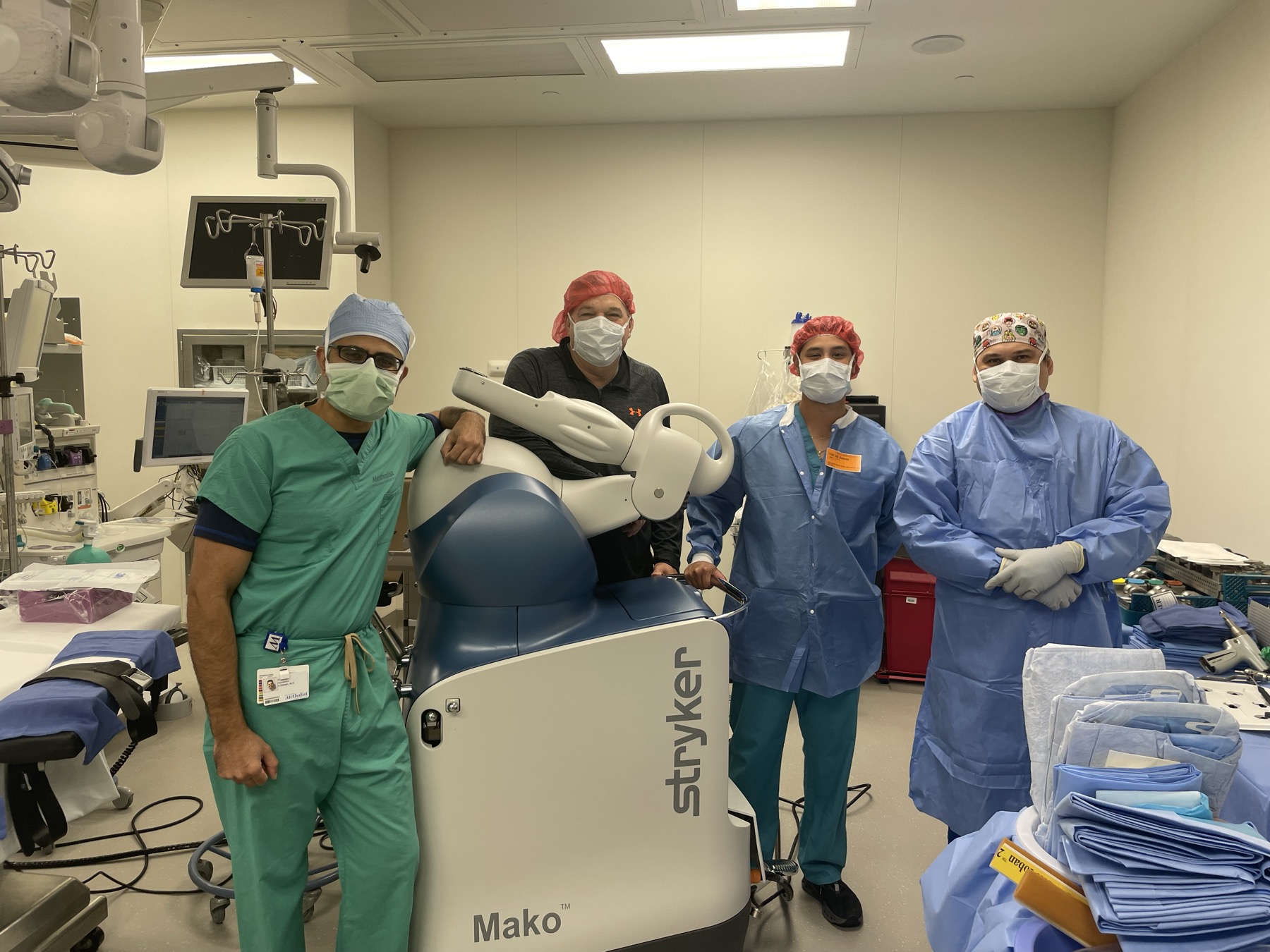
“Do you use the robot?” It's one of the most common questions I get before a knee replacement, and I understand why. Patients have seen the billboards and the TV spots. “Robotic” sounds like the newer, safer, more precise choice — the upgrade you'd be foolish to pass up. I perform robotic-arm-assisted knee replacement with the Mako system, so you might expect me to lean into that pitch. Instead I want to do something more useful: walk you through what the actual evidence says, including the parts that are less flattering than the marketing.
The short version, which I'll spend the rest of this article earning: robotic assistance genuinely makes one thing more precise — the alignment of your new knee — and it probably buys you a slightly smoother first few weeks. What it has not been shown to do is give you a meaningfully better-functioning knee five or ten years down the road. The robot is a good tool. It is not a different, better operation, and it is not a substitute for the judgment and experience of the surgeon holding it.
What “robotic” actually means — and what it doesn't
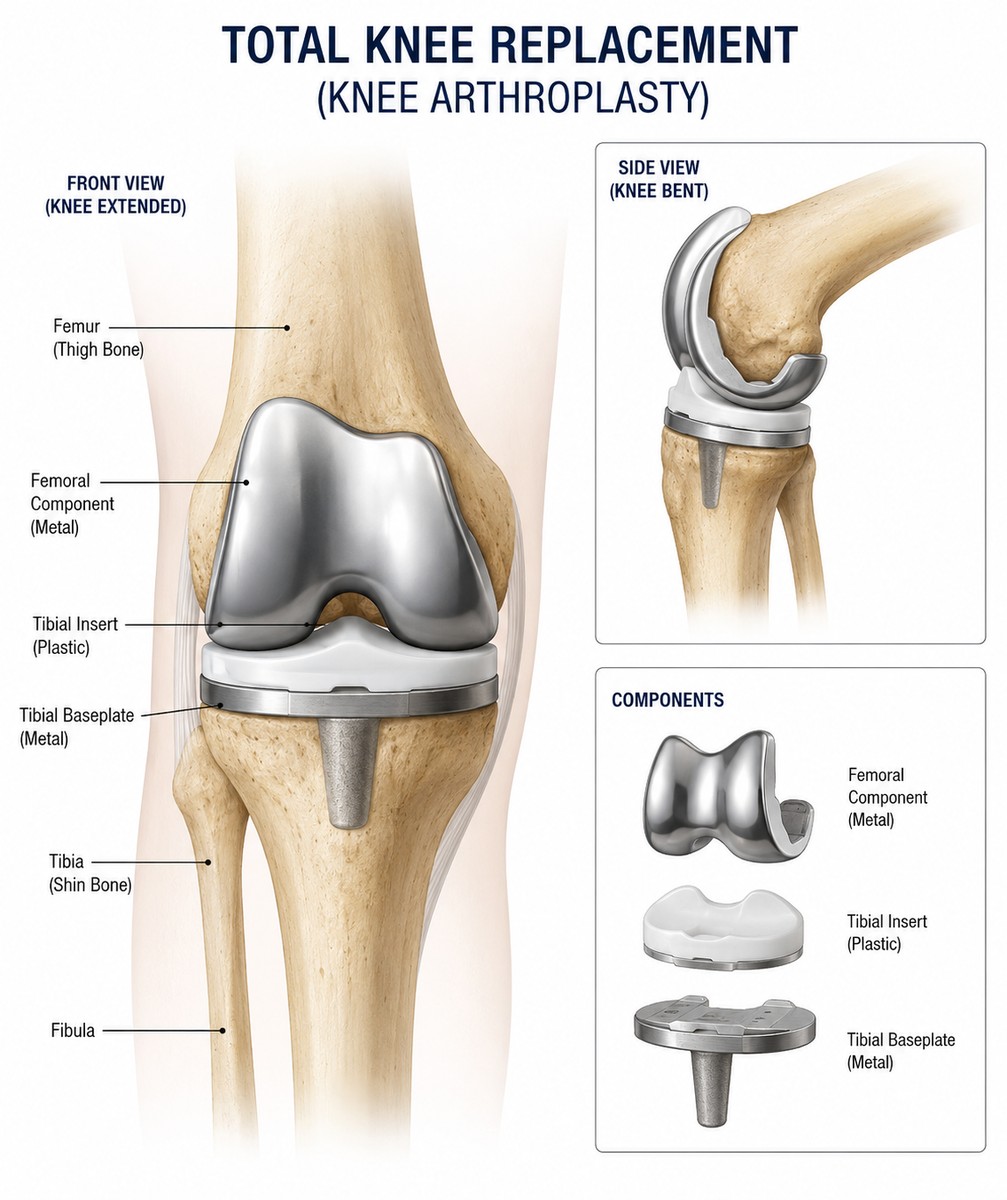
First, let's clear up the biggest misconception. A robot does not perform your knee replacement. There is no machine operating on its own while the surgeon watches. What the Mako and similar systems do is much narrower and much more specific.
Before surgery, a CT scan of your knee is turned into a 3-D model. The surgeon uses that model to plan exactly where the worn bone will be cut, what size implant will fit, and how the soft tissues around the knee should be balanced. In the operating room, a robotic arm holds the cutting instrument and provides a boundary — a kind of precise guardrail — that keeps the saw within the plan the surgeon set. The surgeon still makes every decision, still does the exposure, still balances the ligaments, still checks the result. The robot's job is to help execute the plan accurately and to keep the cuts inside the intended zone.
So the honest framing is this: robotic assistance is a precision-and-planning tool bolted onto the same operation. The implant is the same implant. The incision is the same. What changes is how tightly the actual result matches the target the surgeon aimed for.
Why alignment is the thing patients are really being sold
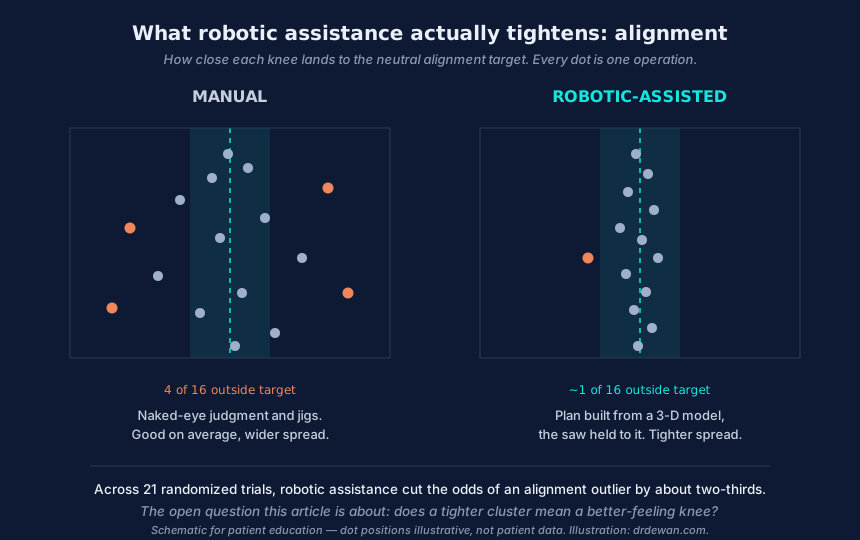
The central promise of robotic knee replacement is alignment accuracy — getting the leg's mechanical axis and the implant position to land on the intended target, consistently, with fewer “outliers.” An outlier is a knee that ends up more than a few degrees off the planned alignment. The long-standing theory in orthopedics is that a well-aligned knee should wear more evenly and last longer, so reducing outliers should, in principle, reduce failures.
And on the narrow question of alignment, the data is genuinely favorable. A 2025 systematic review and meta-analysis in Annals of Medicine and Surgery pooled 21 randomized controlled trials with 2,692 patients and found that robotic assistance cut the rate of alignment outliers dramatically — the odds of an outlier were roughly a third of those with manual technique (relative risk 0.33) — and produced less deviation from the neutral axis (a mean difference of about 0.93 degrees).1 That is a real, reproducible engineering advantage. The robot does what it claims to do.
Here's the catch: better alignment hasn't clearly meant a better-feeling knee
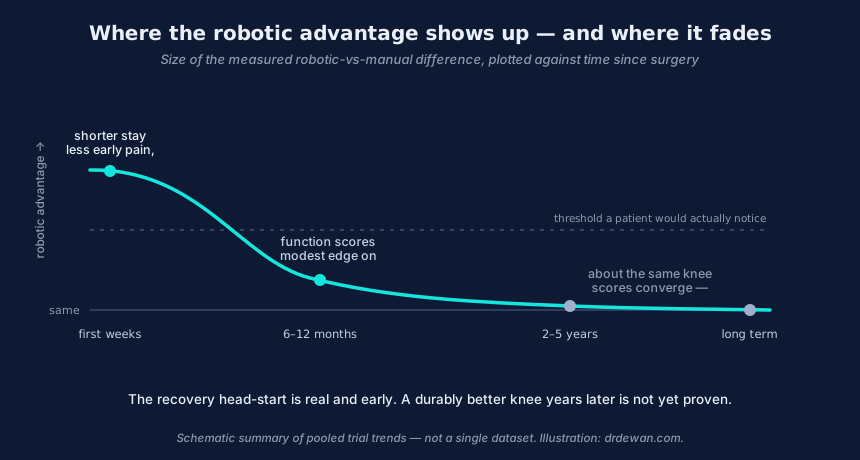
This is where a careful reading matters, because it's exactly the part the marketing skips. Precision on an X-ray is not the same thing as a knee that feels better to the person walking on it. And when researchers measure what patients actually report — pain, function, satisfaction — the robotic advantage gets much smaller, and in the long run it mostly disappears.
That same 21-trial meta-analysis found no significant difference in WOMAC or Oxford Knee Scores (two standard patient-reported function measures) at any follow-up point out to three years. The Knee Society Score was statistically higher with robotics by about one point — a difference the authors themselves flagged as too small to be clinically meaningful. Robotic surgery also took about 20 minutes longer on average. Their conclusion was measured and, I think, correct: robotic assistance “offers improved mechanical alignment accuracy but does not demonstrate superior short- to medium-term functional outcomes,” and should be adopted cautiously.1
A 2025 umbrella review in the Journal of Clinical Medicine — a study of studies, pooling ten separate systematic reviews — reached a similar bottom line. It did credit robotics with some real short-term wins: shorter hospital stays (about 77 hours vs. 105 hours) and less early pain (a visual analog pain score of 3.6 vs. 6.3 in the first days). But those benefits “didn't persist beyond six-month follow-up,” satisfaction rates were comparable (95% vs. 91%), and the authors concluded plainly: “While rTKA improves surgical precision and may offer short-term advantages, its long-term superiority over conventional TKA remains unproven.”2
The most robot-favorable read — and why I still hold it loosely
I want to be fair to the other side of this, because the evidence isn't entirely one-directional. The strongest recent case for robotics comes from a 2025 meta-analysis in Bone & Joint Open focused specifically on the Mako system, pooling 3,738 knee replacements. It found that on the Forgotten Joint Score — a measure of how often you're simply not aware of your artificial knee, which is arguably the outcome patients care most about — the robotic group did better at medium-term follow-up, and pooled patient-reported outcomes favored robotics at both medium and long-term follow-up.3
That's a genuinely encouraging signal, and I don't dismiss it. But I read it with two caveats the authors themselves raise. First, the whole analysis rested on very few high-quality trials — most of the underlying evidence was rated at a modest level, and there were only two studies at long-term follow-up (where, notably, the difference was not statistically reliable). Second, it wasn't clear whether surgeons' early learning-curve cases were included, which can cut either way. A promising trend built on thin high-level data is a reason for optimism, not a reason to tell you the question is settled. It isn't.
What's genuinely strong about the evidence
- The alignment finding is rock-solid. Twenty-one randomized trials agreeing that robotics reduces alignment outliers is about as reproducible as orthopedic evidence gets. If your specific situation makes precise alignment especially important, that's a real, documented benefit.
- The early-recovery signal is consistent. Shorter stays and less early pain show up across multiple reviews. For the first few weeks — the part of recovery patients dread most — robotics plausibly smooths the path.
- The honest studies report both arms. The best of this literature doesn't oversell. It says precisely where robotics wins (alignment, early recovery) and where it doesn't (long-term function), which is exactly what you want from evidence you're betting your knee on.
Where I'd push back on the hype
This is the section the billboards will never show you.
- “Robotic lasts longer” is not established. The theory that fewer alignment outliers means fewer failures is reasonable, but we do not yet have the long-term revision data to prove robotic knees actually outlast manual ones. Anyone promising you a longer-lasting knee because it's robotic is ahead of the evidence.
- Precision is not the same as feeling better. A tighter cluster of alignment numbers on an X-ray has repeatedly failed to translate into function scores patients can actually feel. This is the single most important thing to understand, and it's the thing marketing most reliably blurs.
- Robotics adds its own small risks. The umbrella review noted complications specific to the technology — pin-site fractures and pin-site infections from the tracking pins, and the potential for soft-tissue injury — even though overall complication rates were similar.2 Every added piece of hardware adds a small failure mode.
- It costs more, and that cost is real. Robotic systems are expensive, and analyses suggest they're cost-effective mainly in high-volume centers. That cost has to be justified by benefit — and for the average patient, the benefit is early, not lifelong.
- The trial we most need isn't finished. The RACER-Knee trial — a well-designed UK randomized trial using the Forgotten Joint Score as its primary outcome — is exactly the head-to-head we need, and its full results aren't in yet.4 Until high-quality trials like it report, honest surgeons should hold their conclusions loosely.
How I think about it in my practice
I use the Mako robot, and I use it for a specific reason: precision. When I set an alignment and balancing plan, the robot helps me execute it reproducibly and keeps my cuts inside the boundary I intend. That consistency is worth having, and the early-recovery data suggests it may make your first few weeks a little easier.
What I will not tell you is that the robot is why your operation will succeed. The evidence simply doesn't support that, and I'd rather you trust me because I level with you than because I sold you a machine. The things that genuinely drive whether a knee replacement turns out well are less glamorous: a surgeon who does a high volume of these operations, accurate soft-tissue balancing, meticulous infection prevention, appropriate patient selection, and structured rehabilitation afterward. Those matter more than whether a robotic arm held the saw. A skilled high-volume surgeon operating manually will reliably beat an inexperienced surgeon with the best robot in the building.
So when a patient asks whether they should seek out robotic surgery, my answer is: choose the surgeon first. Pick someone experienced, high-volume, and straight with you about tradeoffs. If that surgeon uses robotic assistance — as I do — that's a reasonable and modern choice with a real precision benefit. But don't switch to a surgeon you trust less just to get the robot, and don't pay a premium expecting a lifelong difference the data can't yet promise. If you'd like to talk through whether robotic-arm-assisted replacement fits your knee specifically, you can read more about robotic knee replacement or come in and we'll look at your imaging together.
Bottom line for the layperson
- The robot doesn't operate — it guides. Your surgeon still makes every decision. Robotic assistance is a precision tool bolted onto the same operation, with the same implant.
- It genuinely improves alignment. Twenty-one randomized trials agree robotics cuts alignment outliers by about two-thirds. That part of the pitch is true.
- Better alignment hasn't clearly meant a better-feeling knee. Patient-reported function scores are about the same by a year or two out. Precision on an X-ray isn't the same as a knee you can feel the difference in.
- The clearest win is the first few weeks. Shorter hospital stays and less early pain are real — but those advantages fade by around six months.
- Pick the surgeon, not the machine. Experience, volume, and honesty matter more than whether a robot was in the room. Robotic assistance is a reasonable modern choice — not a reason to leave a surgeon you trust.
If you're weighing a knee replacement and want a straight answer about whether robotic-arm assistance would actually change anything for your knee, you can request a consultation or call the office at (281) 690-4678. Bring your standing X-rays — the most useful version of this conversation happens with your imaging in front of us.
Sources
- Mostafa O, Malik M, Qayum K, et al. “Robotic-assisted versus conventional total knee arthroplasty: a systematic review and meta-analysis of alignment accuracy and clinical outcomes.” Ann Med Surg (Lond). 2025;87(2):867–879. DOI: 10.1097/MS9.0000000000002919
- García-Sanz F, et al. “Redefining Knee Arthroplasty: Does Robotic Assistance Improve Outcomes Beyond Alignment? An Evidence-Based Umbrella Review.” J Clin Med. 2025;14(8):2588. DOI: 10.3390/jcm14082588
- Sodhi K, Eaton-Brown J, Kumar PR, et al. “Robotic-assisted total knee arthroplasty with MAKO is associated with improved functional outcomes.” Bone Joint Open. 2025;6(11):1382–1393. DOI: 10.1302/2633-1462.611.BJO-2025-0180.R1
- Metcalfe A, et al. “Robotic Arthroplasty Clinical and cost Effectiveness Randomised controlled trial (RACER-knee): a study protocol.” BMJ Open. 2023;13(6):e069176. DOI: 10.1136/bmjopen-2022-069176
- AAOS OrthoInfo — Total Knee Replacement
This article reflects Dr. Dewan's reading of the cited evidence at the time of publication. It is educational content, not medical advice. Your specific case may differ — schedule a consultation to discuss your imaging and history.