
Some of the most anxious phone calls my office gets are not about pain. They are about sensations — the ones nobody quite warned the patient about. The knee makes a clicking sound every time they stand up. There is a patch of skin below the scar that feels like it belongs to someone else. The knee is warm to the touch and still puffy at eight weeks, and a worried spouse has started asking whether it might be infected.
Here is the reassuring headline, and it is true for the large majority of people: most of the strange new sensations after a total knee replacement are normal features of healing, not signs that something has gone wrong. A well-done replacement is a large operation on the most mechanically complex joint in the body, and the knee announces its recovery in ways that feel foreign. The goal of this article is to tell you which of those signals are expected — so you can stop bracing every time your knee clicks — and, just as importantly, to give you the short, specific list of symptoms that genuinely warrant a call.
Why this matters more than it sounds
Uncertainty is its own kind of suffering. A patient who knows that a clicking knee is expected hears the click and moves on. A patient who does not spends three months interpreting every click as the implant coming loose — and that fear changes behavior. They stop doing their exercises, they guard the leg, they sleep badly. Some of the worst early recoveries I see are not driven by the surgery at all; they are driven by a patient who was never told what normal feels like and assumed the worst. Naming the expected sensations ahead of time is one of the cheapest, most effective things I can do for a recovery.
The clicking and clunking
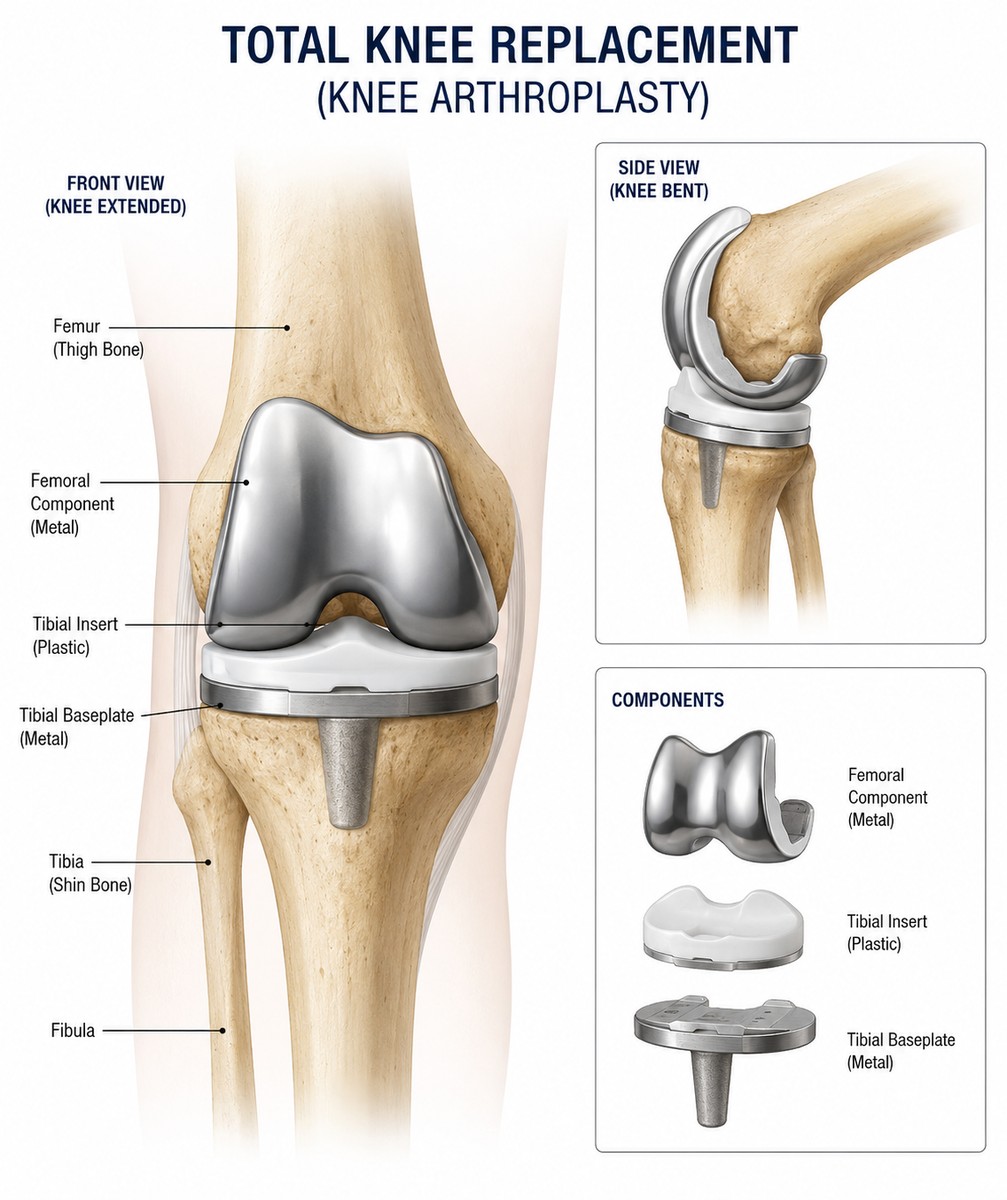
This is the single most common “is this normal?” question, and the answer is almost always yes. Your natural knee was cartilage gliding on cartilage — nearly silent. A replacement is polished metal articulating on a polyethylene (plastic) spacer, and that pairing is simply louder. As the post-surgical swelling recedes and the soft tissues tighten up around the new joint, many patients notice clicking, snapping, or a soft clunk when they bend or straighten. It typically settles over the first three months as the knee quiets down, and by itself — without pain — it is not a warning sign.
There is one named version worth knowing about, because it behaves differently. Patellar clunk syndrome is a distinct, often louder clunk that happens as the knee straightens out from a deeply bent position, caused by a small nodule of scar tissue catching at the top of the kneecap groove. It is uncommon and design-dependent — in one direct comparison it occurred in 1.8% of one implant design versus 11.7% of another.1 The reason to know the term is not to worry about it, but to recognize the difference: everyday quiet clicking is background noise; a repeated, painful, mechanical clunk that catches at the same point every time is worth mentioning, because when it is a nuisance it can be cleaned up with a short arthroscopic procedure.
The numb patch of skin
Run your hand over the outer side of your scar and you may find an area — sometimes as big as a playing card — that feels numb, tingly, or oddly distant, as if the skin has been to the dentist. This is one of the most predictable consequences of the operation, and it is not a nerve injury in the way patients fear.
The incision for a knee replacement runs down the front of the knee, and it inevitably crosses tiny sensory skin nerves — chiefly the infrapatellar branch of the saphenous nerve, which fans across the front of the knee from the inner side. These are cut in essentially every standard knee replacement because they sit directly in the surgical path. In a classic study that specifically looked for this, 70% of patients had a measurable patch of altered sensation afterward.2 It is so common that I consider it part of the operation rather than a complication of it.
Two things reassure patients once I explain them. First, this is a skin-sensation problem, not a muscle or joint problem — it has nothing to do with your ability to walk, bend, or trust the knee. Second, the numb area usually shrinks over the first year as neighboring nerves take over the territory, though a small patch of permanent numbness to the outer side of the scar is common and harmless. The main practical consequence is that kneeling on that spot can feel strange — a subject I cover in detail in the kneeling article.
The warmth and the swelling
A replaced knee that stays warm and swollen for months alarms families more than almost anything else, because warmth and swelling are exactly what we all associate with infection. So it is worth being precise about what the evidence actually shows, because the timeline is longer than most people expect.
Researchers have tracked the temperature of the operated knee against the patient's other knee, month by month, in people whose recoveries were completely uncomplicated. The pattern is remarkably consistent. The operated knee is warmest in the first two weeks — on average about 2.8°C hotter than the other side — then cools in a slow, predictable glide: roughly 1.4°C warmer at three months, 0.9°C at six months, and only about 0.6°C at a year, essentially back to baseline.3 In other words, a knee that is still faintly warm at six months is following the textbook, not defying it.
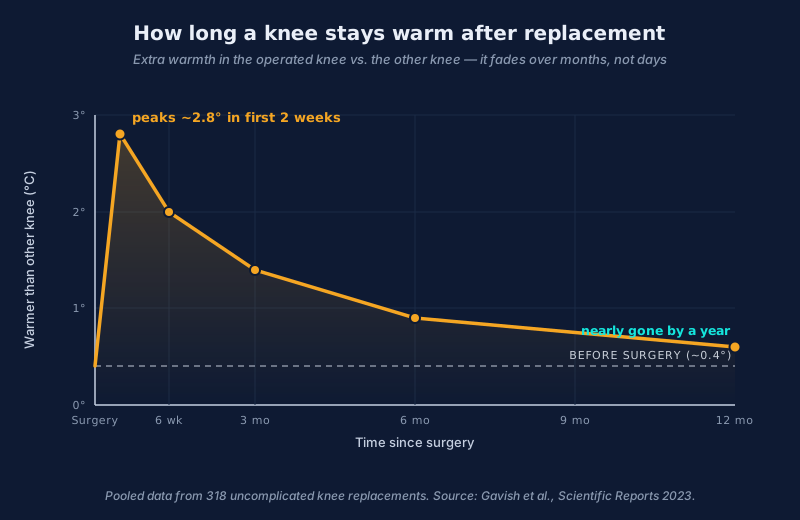
Swelling follows its own long arc. It usually peaks in the first week or two, drops noticeably by six to twelve weeks, and then trails off over the better part of a year. A useful rule of thumb: normal swelling fluctuates with activity — it puffs up after a day on your feet or a hard therapy session and settles overnight with elevation and ice. It is the swelling that keeps rising day after day, rather than cycling up and down, that changes the story.
Bruising, stiffness, and sleep
A few more expected companions of early recovery, so they don't catch you off guard. Bruising often appears late and travels: a dramatic purple-green wash can spread down the shin into the calf and ankle over the first week or two, pulled downward by gravity. It looks alarming and is almost always benign. Stiffness is worst first thing in the morning and after sitting, and it is the reason your therapy matters so much. And disrupted sleep is nearly universal for the first several weeks — the knee is an uncomfortable bedfellow, and a good night's rest is one of the last things to return. None of these mean the operation is failing.
Where I'd push back on false reassurance
“Everything is normal, don't worry” is the wrong message as a blanket. A small number of symptoms genuinely are not normal, and every patient should know them cold. My reassurance about clicking, numbness, and warmth holds up only because it comes paired with a short, specific list of what to watch for.
Infection does not always announce itself with a fever
Patients watch for a fever as the sign of infection, but a low-grade prosthetic joint infection can be quiet. The more reliable signals are a wound that is still draining fluid beyond about ten days, redness and warmth that are spreading and worsening rather than fading, and a knee that was getting better and then started going backward — more pain, more swelling, more stiffness in a joint that had been improving.4 Any of those deserves a same-week call, fever or no fever.
A blood clot is a different pattern entirely
The one that genuinely needs urgent attention is a deep vein thrombosis — a clot in the leg veins. The tell is that the symptoms are in the calf, not the knee: new pain, tenderness, or swelling in one calf that does not ease with elevation.5 And if a clot travels to the lungs it becomes an emergency — sudden shortness of breath, chest pain, or coughing. That is not a “call the office tomorrow” symptom; that is a call-911 symptom. I would rather see a hundred patients with a harmless swollen knee than miss the one with a clot.
What this means in my practice
When a patient calls worried about a sensation, my job is to sort it into one of two buckets quickly — expected healing, or something to look at — and I use a few principles to do it.
1. The direction of travel matters more than the symptom
A knee that clicks, is warm, and is swollen but is a little better each week is almost always a knee that is healing. The same three symptoms that are getting worse week over week are the ones I want to see. I tell patients to watch the trend, not the snapshot. Recovery is not linear — a big therapy day can set you back for forty-eight hours — but the overall trajectory across two or three weeks should point down.
2. Warmth and swelling are the last symptoms to leave — and that's expected
I tell people to plan for a knee that is measurably warmer and puffier than the other side for the better part of a year, and that this is not a sign the implant is unhappy. Knowing the timeline in advance is what keeps a normal six-month knee from being read as a failing one.
3. Where robotic technique fits — and where it doesn't
I perform knee replacement with robotic-arm assistance (see robotic knee replacement), and precise implant positioning and soft-tissue balancing are things I care about deeply — they influence how a knee feels and tracks over the long run. Those normal healing sensations — the clicking, the numb patch, the months of warmth — come from the incision and from metal-on-plastic mechanics, and no surgical technique, robotic or manual, makes them disappear. What good technique buys you is a well-aligned, well-balanced knee underneath those sensations, not a knee that heals without them.
4. When a symptom earns a visit, I'd rather see you
The whole point of a clear list of red flags is that it lets patients relax about everything not on it. So when something does land on the list — spreading redness, persistent drainage, a calf that's newly painful and swollen, pain that is climbing instead of easing — I don't want you talking yourself out of calling. Most of those calls end in reassurance too. But the few that don't are exactly the ones where catching it early changes everything.
The bottom line for the layperson
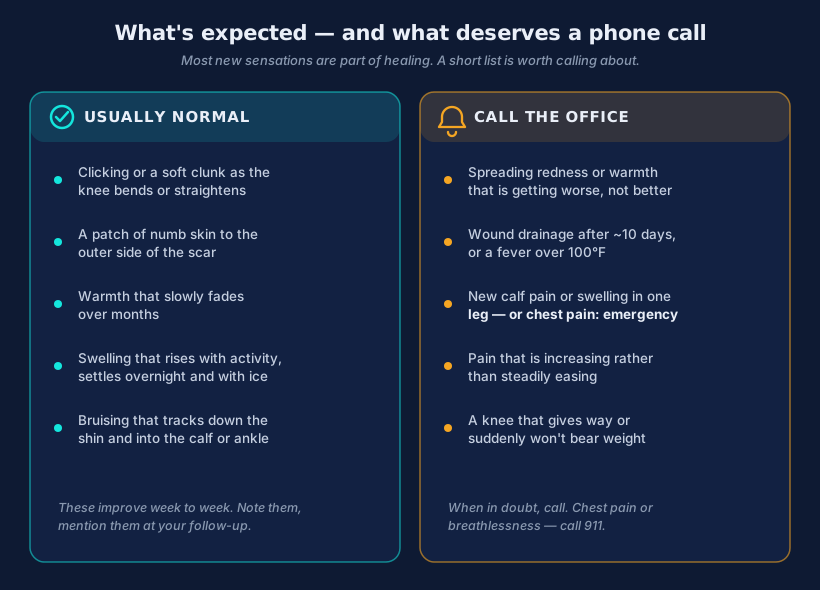
- Most new sensations after a knee replacement — clicking, a numb patch of skin, warmth, swelling, dramatic bruising — are normal healing, not signs of failure.
- A replaced knee clicks because it is metal on plastic instead of cartilage on cartilage. Painless clicking usually quiets down over the first three months.
- A numb patch to the outer side of the scar happens in about 7 in 10 people because small skin nerves are crossed by the incision. It is harmless and usually shrinks over the first year.
- Warmth and swelling fade over months, not days — a knee that is still faintly warm at six months is on schedule. Watch the trend: normal symptoms ease week to week.
- Call promptly for spreading redness, wound drainage after ~10 days, pain that is increasing, or new calf pain and swelling. Treat sudden chest pain or breathlessness as a 911 emergency.
If you've had a knee replacement and you're not sure whether what you're feeling is normal, that's exactly the kind of question the office is happy to answer — a two-minute call can save weeks of worry. You can request a visit or call the office at (281) 690-4678.
Sources
- Snir N, Schwarzkopf R, Diskin B, Takemoto R, Hamula M, Meere PA. “Incidence of patellar clunk syndrome in fixed versus high-flex mobile bearing posterior-stabilized total knee arthroplasty.” J Arthroplasty. 2014;29(10):2021–2024. DOI: 10.1016/j.arth.2014.05.011 (PMID: 24961894)
- Mistry D, O'Meeghan C. “Fate of the infrapatellar branch of the saphenous nerve post total knee arthroplasty.” ANZ J Surg. 2005;75(9):822–824. DOI: 10.1111/j.1445-2197.2005.03532.x (PMID: 16174002)
- Gavish L, Kandel L, Rivkin G, Gertz SD, Hoffer O. “Natural history of changes in knee skin temperature following total knee arthroplasty: a systematic review and meta-analysis.” Sci Rep. 2023;13:6810. DOI: 10.1038/s41598-023-33556-7 (PMID: 37100814)
- American Academy of Orthopaedic Surgeons (OrthoInfo). “Joint Replacement Infection.” orthoinfo.org
- American Academy of Orthopaedic Surgeons (OrthoInfo). “Deep Vein Thrombosis.” orthoinfo.org
- AAOS OrthoInfo — Total Knee Replacement (recovery and warning signs)
This article reflects Dr. Dewan's reading of the cited evidence at the time of publication. It is educational content, not medical advice. Your specific case may differ — schedule a consultation to discuss your imaging and history.