Patients almost never walk into clinic asking whether their new knee should be cemented or cementless. Then they read one forum thread — or hear one sales-flavored line about “biologic fixation” and an implant that “bonds with your own bone” — and suddenly it's the thing they're most anxious about. The Reddit threads under r/TKR are full of it: a 58-year-old told the press-fit implant will “last longer because it grows into the bone,” wondering if a cemented knee means a worse result.
So let me take the question seriously, because it's a real decision I make for every knee I replace — and the answer is more interesting than either marketing pitch. The best evidence does not say one type of fixation is better for everyone. It says the right choice depends on who you are: your age, your sex, and above all the quality of your bone.
What “cemented” and “cementless” actually mean
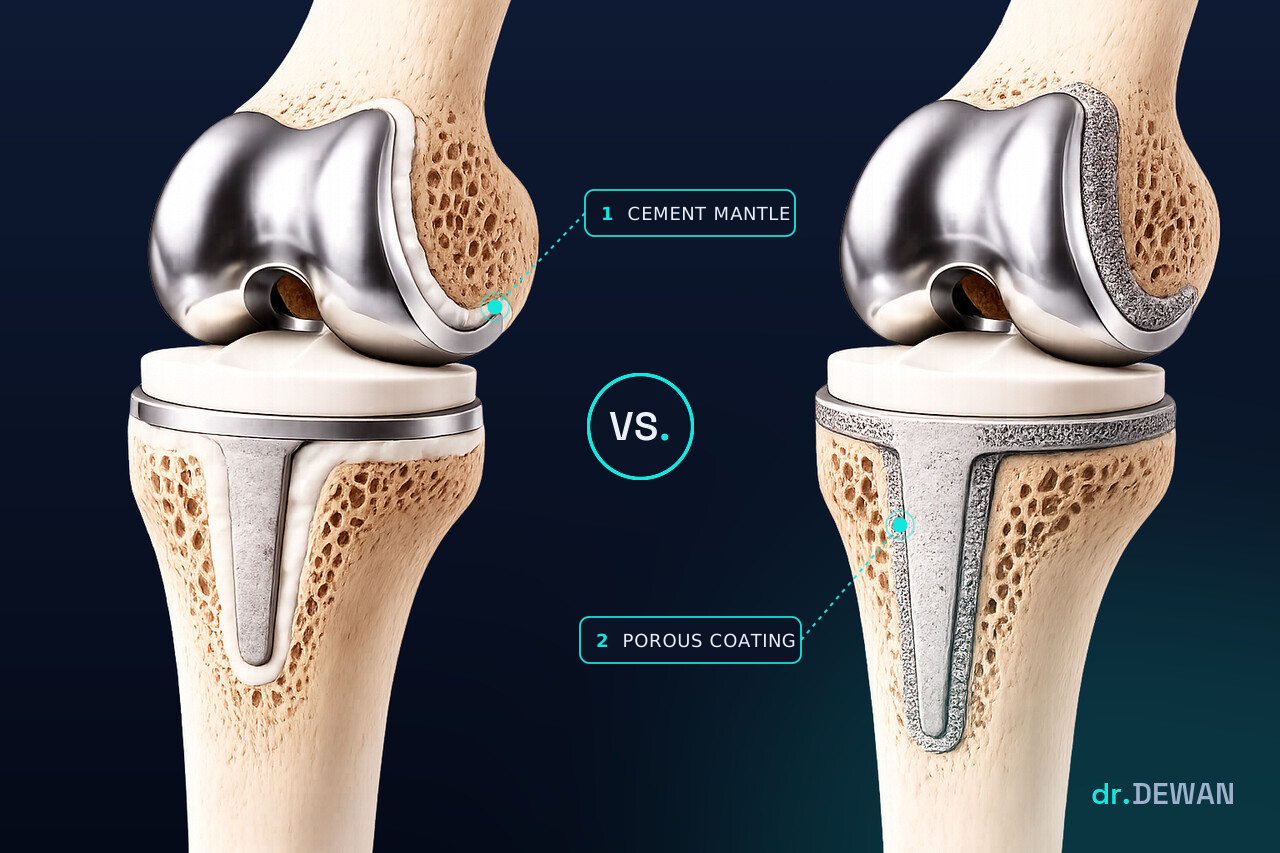
A knee replacement resurfaces two bones — the bottom of the thigh bone (femur) and the top of the shin bone (tibia) — with metal components, and slots a plastic spacer between them. The only thing that differs between “cemented” and “cementless” is the glue layer between that metal and your living bone.
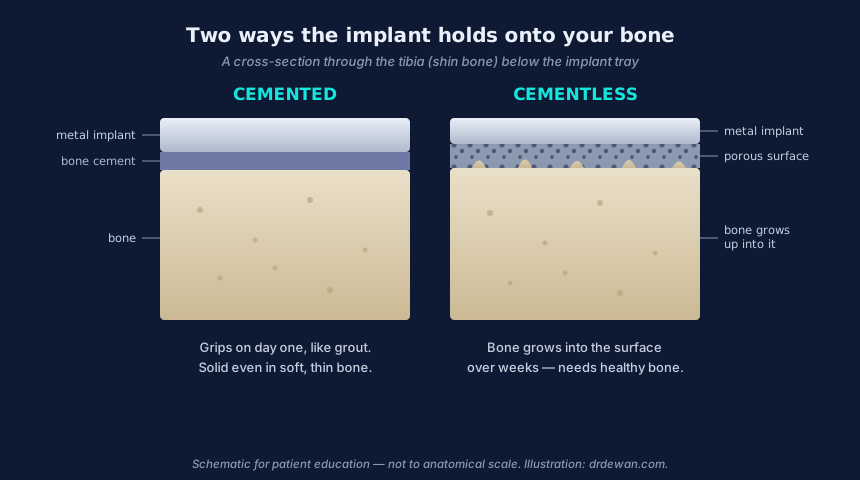
Cemented fixation uses a thin layer of bone cement — a fast-setting acrylic called polymethylmethacrylate — between the implant and the bone. It is not really a glue; it is a grout that interlocks with the surface of the bone and hardens in minutes on the operating table. The implant is solidly fixed the moment you wake up. This has been the standard of care for more than forty years, and the long-term data behind it is enormous.
Cementless (or “press-fit”) fixation skips the cement. Instead, the underside of the implant has a deliberately rough, porous, sponge-like metal surface. The implant is press-fit tightly into precisely cut bone, and over the next several weeks your own bone grows up into that porous surface and locks it in — “biologic fixation.” The pitch is intuitive: living bone bonded to the implant should, in theory, outlast a layer of cement that could one day crack or loosen.
Why this matters to you
This isn't an abstract engineering debate. Cementless fixation has gone from a niche choice to about one in five primary knee replacements in the United States as of 2023, and the share is still climbing.1 If you're scheduling a knee replacement in the next few years, there's a real chance the question will come up — and a real chance you'll be marketed the press-fit option as the premium upgrade. You deserve to know what the data actually supports before you treat one as obviously better than the other.
What the evidence shows
Two kinds of evidence matter here, and they tell a consistent story when you read them together: randomized trials, which give the cleanest head-to-head comparison; and national joint registries, which capture what happens to hundreds of thousands of real patients outside the tidy conditions of a trial.
The randomized trials: a draw on durability
The strongest head-to-head evidence comes from trials that take the same implant design, make it in both a cemented and a cementless version, and randomly assign patients to one or the other. That design is powerful because it isolates the one variable we care about — the fixation — and holds everything else constant.
A randomized controlled trial from Washington University, reported in JBJS in 2023, did exactly this with 141 knees using a single cruciate-retaining design (the Triathlon, by Stryker). At a mean of six years, survivorship free of revision was 100% in both groups, and there was no difference in any functional score or in X-ray signs of loosening. Interestingly, slightly more patients in the cementless group rated themselves “extremely or very satisfied” (84% vs. 66%) — a soft endpoint, but not nothing.2
A separate prospective randomized study followed patients out even further — a full ten years — comparing cemented and cementless versions of a trabecular-metal design. Its conclusion, published in the Journal of Arthroplasty in 2025: “equivalent patient-reported outcomes and survivorship at 10-year follow-up.” If anything, the cemented group in that particular study had slightly more loosening and osteolysis, which the authors attributed to plastic-wear debris rather than to the cement itself.3
The trial-level takeaway is straightforward: in the hands of experienced surgeons using a modern, well-designed implant, cemented and cementless knees perform about the same out to ten years. Neither is the durability winner the marketing implies.
The registries: the same average, hiding a real split
Registries capture every knee replacement in a country, not just the carefully selected patients who enroll in trials — so they catch the failures that trials are too small and too clean to see. And here the picture gets more textured.
The Canadian Joint Replacement Registry analyzed more than 200,000 knee replacements. Looked at as one big bucket, cementless implants had a slightly higher revision rate at eight years (4.49% vs. 3.14%) — but once the analysis adjusted for the fact that cementless tends to go into younger, more active patients, that gap disappeared (hazard ratio 0.87, not statistically significant). And when they zoomed in on the single most popular modern cementless design, it actually had a lower revision risk than its own cemented twin at four years.4 The lesson hiding in that data: the specific implant matters more than the cement-versus-no-cement label.
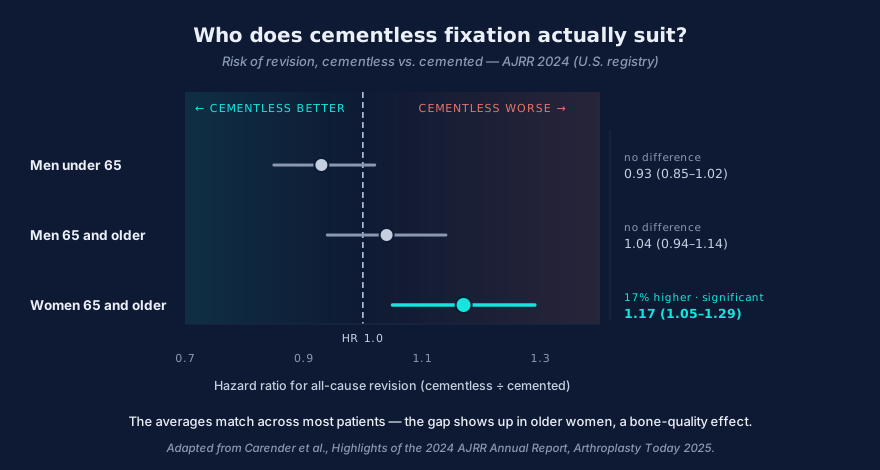
The most patient-useful breakdown comes from the 2024 American Joint Replacement Registry report. It split the data the way that actually matters — by age and sex:1
- Men under 65: no meaningful difference between cementless and cemented (hazard ratio 0.93).
- Men 65 and older: no meaningful difference either (hazard ratio 1.04).
- Women 65 and older: cementless fixation had a 17% higher rate of revision — a difference that was statistically significant (hazard ratio 1.17).
That single row — older women — is the one that drives the decision, and it is consistent with what's seen across international registries. Older women have a higher rate of aseptic loosening — the implant working loose without infection — with cementless fixation; the UK's National Joint Registry has shown this pattern for years, even as cementless infection rates run a touch lower.5 The most likely explanation is the obvious one. Cementless fixation depends on your bone growing into the implant and holding it there. That requires bone strong enough to grip the implant in the first weeks before ingrowth happens. Osteoporosis — thin, soft bone — is far more common in women over 65, and soft bone is exactly the setting where a press-fit implant can micro-loosen before your body ever fuses it in place. Cement doesn't care about your bone density; it grips on day one regardless.
What's genuinely strong about this evidence
- Same-implant randomized trials are the gold standard, and we have them. Comparing a cemented and cementless version of the identical design removes the biggest confounder in this whole debate.
- The registries are huge and population-based. Hundreds of thousands of knees means the data can detect a 17% difference in a subgroup — something no single trial is large enough to do.
- The trial and registry data agree. When a clean randomized signal and a messy real-world signal point the same direction — parity on average, with a bone-quality caveat — you can trust the conclusion more than either alone.
Where I'd push back on the hype
This is the section that matters most, because the cementless pitch outruns the evidence in a few specific ways.
- “Cementless lasts longer” is not what the data says. The randomized trials show equivalence, not superiority, out to ten years. Anyone selling press-fit as the more durable option for the average patient is ahead of the evidence.
- “Cementless” is not one thing. The registry winner was a specific, mature, highly engineered porous design — not the category as a whole. Older or less-proven cementless implants have failed at higher rates. The brand and track record matter more than the presence or absence of cement.
- The follow-up is still short for a lifetime decision. Modern cementless knees didn't become common until the mid-2010s, so we have solid 6- and 10-year data but very little at 20+ years. A 55-year-old is asking the implant to last 30 years, and nobody can yet show you 30-year cementless data.
- Higher satisfaction in one trial is a soft endpoint. Satisfaction scores are easily swayed by knowing you got the “newer” implant. I'd weight the hard endpoints — revision and loosening — far more heavily, and those were a tie.
- The faster operating time cuts both ways. Skipping cement shaves a few minutes off surgery, which is a genuine, if modest, advantage. But it also removes the antibiotic that surgeons often mix into the cement — one plausible reason cementless and cemented infection rates come out close rather than cementless winning cleanly.
How I think about it in my practice
I place both, and I choose based on the patient in front of me rather than a default. Here's the framework I actually use.
For a younger patient (say, under 65) with good bone stock — someone active, with a normal bone-density picture and solid bone at the cut surfaces when I'm operating — cementless is a very reasonable choice, and the biologic-fixation rationale is at its most credible. The registry shows no penalty in this group, the ingrowth surface has healthy bone to grab, and there's a theoretical long-term advantage if it pans out. I'm comfortable here.
For an older patient, and especially an older woman or anyone with known or suspected osteoporosis, I lean cemented, and the registry data is the reason. When bone is soft, cement gives me reliable fixation on the table that doesn't depend on a biologic process that soft bone may not complete. The downside of cement in this group is essentially nil; the downside of a press-fit implant that doesn't fully ingrow is a second operation. That trade isn't close. If a patient hasn't had a recent bone-density (DEXA) scan and the picture is uncertain, that's worth sorting out before surgery, not improvising in the operating room.
For everyone, I'd make two points. First, the bone quality I feel at the time of surgery can override the plan — if I expose soft, chalky bone in someone I'd assumed had good stock, I'll cement it, and you should want a surgeon who keeps that option open. Second, the fixation choice is genuinely down the list of things that determine whether your knee replacement succeeds. Accurate implant alignment, a surgeon who does a high volume of these, infection prevention, and structured rehab all matter more than whether there's a few millimeters of cement under the tray. I use robotic-arm assistance (the Mako system) in part because the precise, reproducible bone cuts it produces are exactly what a press-fit implant needs to seat well — but that precision helps a cemented knee too.
The bottom line I give patients: don't fixate on the cement. Pick the surgeon and the proven implant first, and let the fixation be a considered decision made for your bone — not a feature you bought because it sounded more advanced.
Bottom line for the layperson
- Neither is universally “better.” Randomized trials show cemented and cementless knees perform about the same out to ten years. “Cementless lasts longer” runs ahead of the evidence.
- Your bone decides. Cementless needs healthy bone to grow into the implant. In women over 65 — where soft, osteoporotic bone is common — the U.S. registry shows a real 17% higher revision rate with cementless.
- The specific implant matters more than the cement question. The best modern cementless design matched or beat its cemented twin; older cementless designs did not. Track record beats category.
- It's a short-data decision for younger patients. We have good 10-year numbers but little beyond 20, so cementless is a reasonable but not yet proven long-game bet for someone in their 50s.
- Ask the right question. Not “can I get the cementless one?” but “given my age and bone density, which fixation gives me the best odds — and can you adjust in the OR if my bone is softer than expected?”
If you're weighing a knee replacement and want a straight answer about which type of fixation fits your bone, your age, and your activity goals, you can request a consultation or call the office at (281) 690-4678. The most useful version of this conversation happens with your standing X-rays — and, where it matters, your bone-density scan — in front of us.
Sources
- Carender CN, Hegde V, Levine BR, Huddleston JI, Cohen-Rosenblum A. “Highlights of the 2024 American Joint Replacement Registry Annual Report.” Arthroplasty Today. 2025;33:101727. DOI: 10.1016/j.artd.2025.101727 — cementless utilization (21.8% of primary TKA in 2023) and revision hazard ratios by age and sex.
- Hannon CP, Salih R, Barrack RL, Nunley RM. “Cementless Versus Cemented Total Knee Arthroplasty: Concise Midterm Results of a Prospective Randomized Controlled Trial.” J Bone Joint Surg Am. 2023;105(18):1430–1434. DOI: 10.2106/JBJS.23.00161
- Olson NR, Parks NL, Nagda SS, McAsey CJ, Fricka KB. “To Cement or Not? Ten-Year Results of a Prospective, Randomized Study Comparing Cemented versus Cementless Total Knee Arthroplasty.” J Arthroplasty. 2025;40(10):2630–2636. DOI: 10.1016/j.arth.2025.04.076
- Chen AG, Sogbein OA, McCalden RW, Bohm ER, Lanting BA. “Survivorship of Modern Cementless Total Knee Arthroplasty: Analysis From the Canadian Joint Replacement Registry.” J Arthroplasty. 2025;40(2):380–385.e1. DOI: 10.1016/j.arth.2024.08.003
- Ní Mhíocháin de Grae M, Nasehi A, Dalury DF, Masri BA, Sheridan GA. “Improved performance of cementless total knee arthroplasty (TKA) across international registries: a comparative review.” Ir J Med Sci. 2025;194(2):675–681. DOI: 10.1007/s11845-025-03888-6
- AAOS OrthoInfo — Total Knee Replacement
This article reflects Dr. Dewan's reading of the cited evidence at the time of publication. It is educational content, not medical advice. Your specific case may differ — schedule a consultation to discuss your imaging and history.