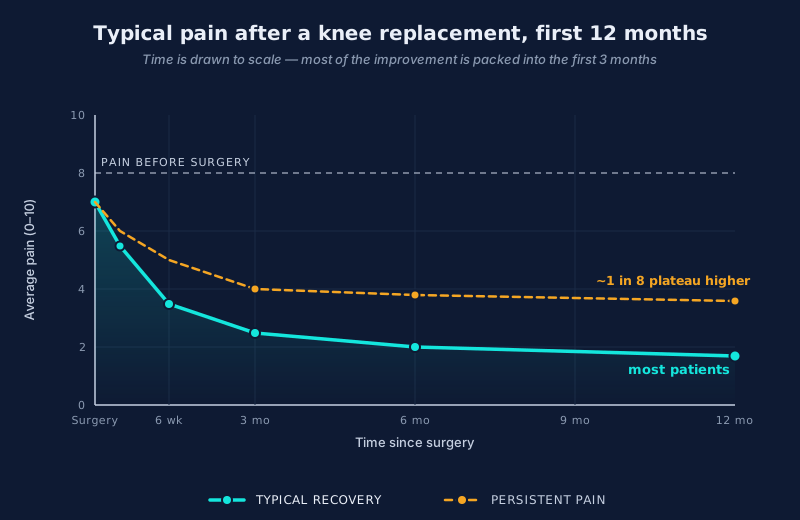
The short answer: most of the intense, early pain after a knee replacement eases within about 6 weeks, and most of the day-to-day pain settles by around 3 months. From there, the knee keeps improving more gradually — strength, endurance, and that last bit of stiffness — out to about a year. A minority of people, roughly 1 in 8, still have some meaningful pain at the one-year mark.1 None of this is a fixed schedule — it's the pattern most knees follow, and the milestones below tell you what's normal at each stage.
| Timeframe | What most people feel | What to focus on |
|---|---|---|
| First 1–2 weeks | Swelling and surgical soreness are the main pain — different in character from the old arthritic pain. This is the hardest stretch. | Ice, elevation, prescribed medication, and starting to move the knee early. |
| Weeks 2–6 | The sharp pain fades. Stiffness and an end-of-day ache take over. Sleep starts to improve. | Physical therapy and regaining motion — the most important work of recovery. |
| 6 weeks–3 months | Most day-to-day pain settles. Back to light activities and most driving and errands. | Building strength; expect flares after busy days — they're normal. |
| 3–6 months | Pain is low and occasional. The knee may still feel “not quite yours” — tight, a little warm, or clicky. | Strength, endurance, and returning to most of your activities. |
| 6–12 months | Slow final gains. Residual warmth, swelling, and tightness keep fading. | Patience — soft tissue and the knee's “feel” are still maturing. |
| Beyond 12 months | Most people are comfortable. About 1 in 8 still have lingering pain worth a proper look. | Don't accept unexplained or worsening pain — have it evaluated. |
Represented on a graph, the typical pain curve for the majority shows early rapid improvement in the first 3 months, followed by a more gentle, gradual recovery thereafter. There are a few, however, whose pain plateaus higher and the effects are not as profound — but still represent a greater than 50% benefit in pain reduction.
Why the first three months carry most of the recovery
If you take one idea away, make it this: the great majority of your improvement happens in the first three months. That's not a rule of thumb — it's what the data show. A well-run UK cohort study (the ADAPT study) tracked patients' pain and function before surgery and again at 3 and 12 months. For the knee, the improvement was front-loaded: most of the gain in both pain and function had already happened by 3 months, with only modest further change between 3 and 12 months.2
Two practical things follow from that. First, the work you put into physical therapy in those first months is doing the heavy lifting — this is the window where effort pays off most. Second, if at three months your knee feels roughly 80% of the way there, that's on track, not a disappointment — the last stretch is real but slower, and it's normal for it to take the rest of the year.
The pain you feel early is not the pain you came in with
A point that surprises a lot of patients: the pain in the first couple of weeks is surgical pain — swelling, healing tissue, the knee waking up — not the grinding arthritic pain you had before. Many patients tell me within the first week or two that even though the knee is sore, they can already feel that the old, deep, bone-on-bone ache is simply gone. Naming that distinction helps: you're feeling the recovery, not the arthritis.
What the honest long-term numbers are
Knee replacement is one of the most successful operations in medicine, and the satisfaction numbers are genuinely high — but a good article won't hide the part patients most deserve to hear straight. A 2025 systematic review pooled 68 studies and nearly 600,000 knee replacements to answer exactly this question: what share of people have ongoing pain, and when?1 The pooled figures:
- About 22% report meaningful pain at 3 months.
- About 14% at 6 months.
- About 13% at 12 months.
- About 15% at 2 years.
So roughly one in five knees is still sore at three months — which is why three months is a checkpoint, not a finish line — easing to roughly one in eight by a year, where it largely levels off. That tracks with older work: a 2012 review of unselected patients found an unfavorable long-term pain outcome in about 1 in 5 people after knee replacement.3 These numbers have been remarkably stable across a decade of research, and any surgeon who tells you the figure is zero isn't leveling with you.
Pain and satisfaction are not the same thing
Here's the nuance those numbers hide: many people who report some residual pain are still glad they had the surgery. The review's authors make the point directly — pain and satisfaction are distinct.1 A knee that used to keep you up at night and now only twinges after a long day can be a life-changing trade even if it isn't literally pain-free. “Better” and “perfect” are different goals, and it's worth being clear with yourself about which one you're measuring against.
What about pain medication — how long will I need it?
Most patients need prescription pain medication for a relatively short window — typically the first few weeks — and then step down to over-the-counter options as the surgical pain fades. The modern approach uses several non-opioid tools together (anti-inflammatories, acetaminophen, nerve blocks at surgery, ice, and elevation) specifically so that opioids can be used at the lowest dose for the shortest time.
Being straight about the risk: a meaningful minority of patients end up using opioids longer than they should, and the single biggest predictor of that is having been on opioids before surgery.4 If that's you, it's worth a candid conversation before the operation about a plan to manage it — not a source of shame, just a known risk to get ahead of. For most opioid-naive patients, the goal and the usual reality is weaning off narcotics within the first several weeks, using the surgical pain settling as the signal to step down.
When pain is not just part of recovery
Most post-op pain is ordinary and improving. But recovery pain has a shape — it trends downward, and it responds to rest, ice, and time. Pain that breaks that pattern deserves a call to your surgeon's office rather than a wait-and-see. The signs I want my patients to act on:
- Pain that is escalating rather than easing after the first couple of weeks, especially with new redness, spreading warmth, or drainage from the incision — possible signs of infection.
- New calf pain or swelling, or shortness of breath — these can signal a blood clot and shouldn't wait.
- Fever beyond the first day or two, particularly with a warm, angry-looking knee.
- A sudden change — a pop, giving way, or a jump in pain after you'd been improving.
Clicking, warmth, mild swelling that's improving, and an end-of-day ache after you've been active are, by contrast, expected parts of the process and not causes for alarm. The rule of thumb: improving = normal; escalating = call.
What I tell my patients
When someone asks me “how long until this stops hurting,” here's the honest version I give them.
1. Judge it in months, not days
The day-to-day can be noisy — a great day, then a sore one after you overdid it. Zoom out. Compare this week to a month ago, not to yesterday. The trend over weeks is what tells the truth.
2. The first three months are where you earn the result
This is the window where physical therapy and regaining motion matter most, because it's where most of the improvement is available.2 A knee that stiffens up early is harder to loosen later. The effort is unglamorous and it's worth it.
3. Expect the last stretch to be slow — and that's normal
Between 3 and 12 months the gains are real but gradual: the last bit of stiffness, the residual warmth, the feeling that the knee is finally “yours.” If you're at six months and still not 100%, you are almost certainly still on the normal curve.
4. Don't quietly accept pain that isn't improving
Most residual soreness is benign. But if your pain plateaus high or worsens, that's worth investigating — not enduring. There are treatable causes, and the people in that “1 in 8” group deserve a real evaluation rather than being told to live with it.
5. The technique and the plan matter
Precise implant placement and a well-run recovery both shape how the knee feels afterward. In my practice I use robotic-arm-assisted technique to fit the implant to your anatomy, paired with a multi-part pain plan and early physical therapy — all aimed at making the timeline above go as smoothly as it can. See our recovery walkthrough for what the first weeks look like day to day.
The bottom line for the layperson
- The intense early pain usually eases within about 6 weeks; most day-to-day pain settles by around 3 months; the knee keeps improving more gradually out to about a year.
- Most of your improvement happens in the first three months — that's the window where physical therapy pays off most, so put the work in there.
- The honest long-term numbers: about 1 in 5 knees is still sore at three months, easing to about 1 in 8 by a year. That's not failure — and many people with a little residual pain are still very glad they did it.
- Most patients wean off strong pain medication within the first few weeks. The biggest risk factor for needing it longer is having been on opioids before surgery — worth planning for in advance.
- Recovery pain improves; call your surgeon for pain that escalates, new calf swelling or shortness of breath, fever, or a sudden change. Improving is normal; escalating is a phone call.
If you're weighing a knee replacement, or you're in recovery and wondering whether what you're feeling is normal, those questions are exactly the ones worth asking directly. You can read about how long a knee replacement lasts, whether it's even time for surgery yet, or request a visit to talk through your knee and your timeline.
Sources
- Cheng HY, Beswick AD, Bertram W, et al. “What proportion of people have long-term pain after total hip or knee replacement? An update of a systematic review and meta-analysis.” BMJ Open. 2025;15(5):e088975. DOI: 10.1136/bmjopen-2024-088975
- Lenguerrand E, Wylde V, Gooberman-Hill R, et al. “Trajectories of Pain and Function after Primary Hip and Knee Arthroplasty: The ADAPT Cohort Study.” PLoS One. 2016;11(2):e0149306. DOI: 10.1371/journal.pone.0149306
- Beswick AD, Wylde V, Gooberman-Hill R, Blom A, Dieppe P. “What proportion of patients report long-term pain after total hip or knee replacement for osteoarthritis? A systematic review of prospective studies in unselected patients.” BMJ Open. 2012;2(1):e000435. DOI: 10.1136/bmjopen-2011-000435
- Bedard NA, Pugely AJ, Westermann RW, Duchman KR, Glass NA, Callaghan JJ. “Opioid Use After Total Knee Arthroplasty: Trends and Risk Factors for Prolonged Use.” J Arthroplasty. 2017;32(8):2390–2394. DOI: 10.1016/j.arth.2017.03.014
This article reflects Dr. Dewan's reading of the cited evidence at the time of publication. It is educational content, not medical advice. Your specific case may differ — schedule a consultation to discuss your imaging and history.