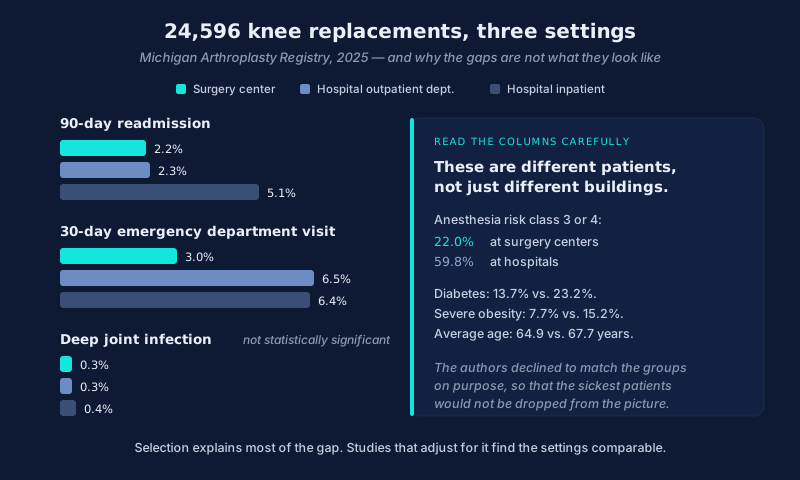
In March 2025, Arthroplasty Today published an analysis of 24,596 knee replacements from Michigan's statewide arthroplasty registry, sorted by where the operation was done. Ninety-day readmission was 2.2% at ambulatory surgery centers, 2.3% at hospital outpatient departments, and 5.1% among hospital inpatients.1
Read quickly, that looks like surgery centers are more than twice as safe as hospitals. Read the rest of the paper and it looks like something else entirely: 22% of the surgery-center patients were in the two highest anesthesia risk classes, against 59.8% of the hospital patients.1 The two columns are not comparing two buildings. They are comparing two different groups of people.
That gap between what the numbers appear to say and what they can actually support is the whole subject of this article.
Why this matters to you
Knee replacement used to happen in hospitals, full stop. Medicare removed total knee replacement from its inpatient-only list in 2018 and added it to the list of procedures it will pay for in a freestanding ambulatory surgery center in 2020. Since then a growing share of knee replacements have moved out of hospitals altogether, and patients are increasingly being offered a choice of setting — or simply told where their operation will be, without much explanation of what the difference is.
So it is worth knowing what genuinely changes when the address changes, and what does not. The short version: the surgeon, the implant, the technique and the anesthetic are the same. What differs is what is in the building if the day does not go according to plan.
What a surgery center actually is
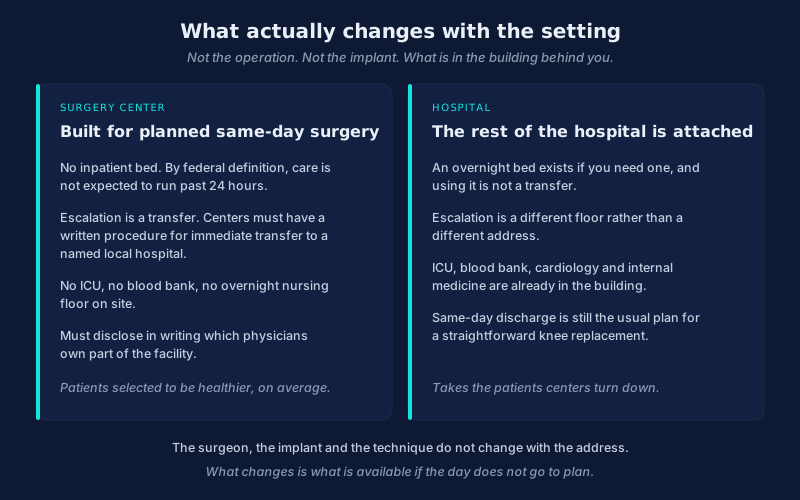
An ambulatory surgery center is not a small hospital. It is a separate category of facility with its own federal definition: an entity that operates exclusively to provide surgery to patients who do not require hospitalization, where care is not expected to run past 24 hours.2 There is no inpatient floor, because by definition there cannot be one.
That definition drives everything else. A few rules are worth knowing by name, because they answer the questions patients actually ask:
- What happens if something goes wrong? Every Medicare-participating surgery center must have "an effective procedure for the immediate transfer, to a hospital, of patients requiring emergency medical care beyond the capabilities of the ASC," and that hospital has to be a specific, local, Medicare-participating one. The center is also required to keep that hospital informed, in writing, about what it does and which patients it treats.2 Escalation is not improvised. It is a named arrangement with a named building.
- Who owns the place? Many surgery centers are partly owned by the surgeons who operate in them. Federal rules require the center to disclose, in writing, which physicians hold a financial interest in it.3 Ask for that disclosure if you are not offered it. Ownership is not by itself a problem — but you are entitled to know about it before you decide.
- Can you go home alone? Surgery centers must discharge patients "in the company of a responsible adult," unless the operating physician specifically exempts you.4 This is a rule, not a suggestion, and it is one of the more common reasons a planned surgery-center case has to be rearranged.
What the comparison data show
Three studies do most of the useful work here, and they point the same direction once you account for who is in each group.
The registry picture. The Michigan analysis covered 41,696 hip and knee replacements across surgery centers, hospital outpatient departments and hospital inpatient care. For knees, 30-day readmission was 1.3%, 1.4% and 3.1% respectively; deep joint infection was 0.3%, 0.3% and 0.4%, a difference that did not reach statistical significance.1 The authors were unusually direct about the limits of their own data: they deliberately chose not to statistically match the groups, because matching would have meant discarding the sickest patients — the ones whose experience matters most to the question.1
The adjusted picture. A 2026 analysis in The Journal of Arthroplasty compared 615 outpatient joint replacements at a surgery center with 624 at a hospital outpatient department from the same institution, adjusting for sex, body mass index, comorbidity score and procedure type. Ninety-day medical complications: 1.1% versus 1.9%. Surgical complications: 3.3% versus 2.9%. Deep joint infection: 0.8% versus 0.5%. Readmission: 2.8% versus 4.0%. None of those differences were statistically significant.5 When you compare like with like, the settings look alike.
The picture from the other direction. The most quietly useful study is a 2025 paper from Duke, which asked whether the sicker patients who get sent to the hospital do worse. Of 449 same-day knee replacements, 284 were done at a surgery center and 165 at a university hospital — and 93.9% of the hospital patients had failed at least one surgery-center eligibility criterion. The hospital group was heavier, had higher comorbidity scores, more anesthesia risk class 3, and worse pain and function before surgery. At one year, the two groups had the same pain scores, the same function scores, the same rate of meaningful improvement, and the same reoperation-free and revision-free survival at two years.6
That finding deserves more attention than it gets. It says the patients who don't qualify for a surgery center are not thereby consigned to a worse result. They are simply having the same operation somewhere with more behind it.
What happens when something does go wrong
This is the question patients most want answered and the one marketing material usually skips.
A 2026 review from a very high-volume arthroplasty practice tracked every hip and knee replacement done at their surgery centers from 2012 through July 2025 — 6,379 cases — and counted same-day transfers to a hospital. There were seven, or 0.1%.7
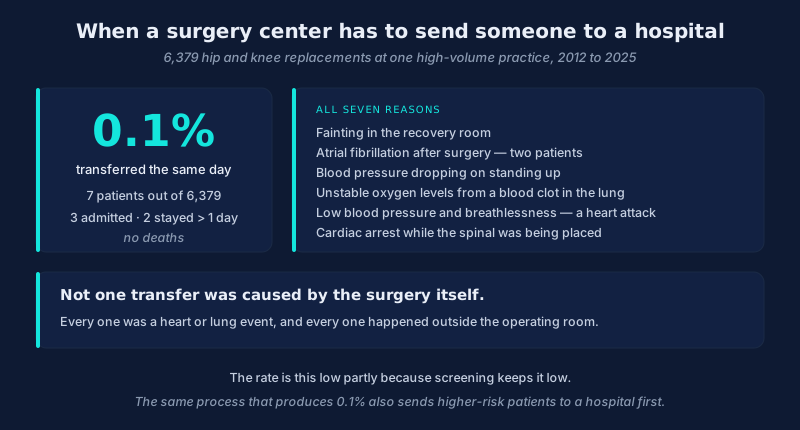
Three details in that paper matter more than the headline rate. First, not one transfer was caused by a surgical problem — all seven were cardiac or pulmonary events, and all seven happened outside the operating room. Second, three of the seven were admitted, two stayed longer than a day, and none died.7 Third, and most important: six of the seven transfers occurred in 2023 or later, in a practice that had been steadily widening who it took at its centers.7
A 0.1% transfer rate is genuinely reassuring. It is also a rate produced by careful screening, at a practice doing enormous volume, with protocol-driven selection. It is not a property of surgery centers in general.
Where I would push back
- Nobody has randomized this, and nobody is going to. There is no trial that assigned knee replacement patients to a surgery center or a hospital. Every number in this article comes from comparing groups that were sorted by someone's judgment — and the thing being studied is exactly that judgment. Statistical adjustment handles what was written down. It does not handle the surgeon's read of a patient in clinic, which is often the deciding factor.
- Registry comparisons get quoted without their caveats. The Michigan authors could not have been clearer that their groups were not comparable, and that the differences "preclude direct comparison of outcomes."1 Those numbers still circulate as evidence that surgery centers are safer. They are not evidence of that. They are evidence that healthier patients do better, which was already known.
- The published surgery-center data come from the best surgery centers. The transfer study came from a practice performing tens of thousands of joint replacements; the comparison studies come from academic centers and mature programs. A new, low-volume center is not represented in any of this, and the professional societies specifically caution low-volume programs to evaluate whether they should be doing arthroplasty at all.8
- An ownership stake is a real consideration, not a scandal. Surgeon-owned centers can be efficient, well-run and genuinely better places to have surgery. They also give the person recommending the setting a financial interest in the answer. Federal law requires written disclosure for a reason.3 The right response is to ask, not to assume the worst.
- Opening a surgery center changes the hospital, too. One health system compared its hospital-based joint replacements before and after opening an adjacent surgery center. The hospital population got older (66.8 to 69.8 years), sicker (anesthesia class 3 or higher rose from 41.7% to 50.6%) and more complex — while 30-day readmissions held steady at about 2%.9 Both things are true at once: surgery centers concentrate the straightforward cases, and the hospital that absorbs everything else can still deliver the same result.
- Follow-up is short nearly everywhere. Most of these comparisons stop at 90 days. The Duke study is the exception, reaching two years.6 Whether the setting influences how a knee feels at five or ten years is not a question this literature has attempted, and I would not claim an answer either way.
How I think about this in my practice
I perform knee replacements at Houston Methodist Sugar Land Hospital, and the large majority of my patients still go home the same day. Being in a hospital and going home in the afternoon are not opposites — that is the single most common misunderstanding I hear about this topic. The Duke data make the same point with numbers: a same-day discharge from a hospital and a same-day discharge from a surgery center produced the same one-year outcomes, even though the hospital patients were meaningfully sicker.6
Where the surgery-center evidence likely fits. A patient with well-controlled medical conditions, no significant heart or lung disease, a normal airway, a body mass index in a workable range, and a capable adult at home. For that patient the comparative data show no safety penalty, the transfer risk is on the order of one in a thousand, and the cost is usually lower. If a surgery center is where their surgeon operates, the evidence gives no reason to object.
Where it likely does not fit. A patient with several active medical problems, an elevated hemoglobin A1c, chronic anticoagulation, sleep apnea requiring treatment, significant cardiac or pulmonary disease, or no reliable help at home. Every one of the seven transfers in the largest series was a cardiac or pulmonary event.7 Those are precisely the patients for whom having the rest of a hospital attached is not a formality.
What I would not do is let the setting carry more weight than it deserves. The evidence does not show that one address produces better knees. It shows that both settings produce good results in the patients they are each selecting for, and that the selection is doing most of the work. When a patient asks me where their operation should happen, the more useful conversation is almost always about their heart, their lungs, their blood sugar and who is driving them home — not about the building.
And if you are being offered a choice of setting, two questions are worth asking out loud: which hospital does this center transfer to, and does anyone recommending this setting own part of it? Both have documented answers. You are entitled to them.
The bottom line for the layperson
- For well-selected patients, surgery centers and hospitals produce comparable results — studies that adjust for how healthy the patients are find no significant difference in complications, infection or readmission.
- The raw numbers favoring surgery centers are mostly selection, not safety. Hospital patients in the largest registry were far sicker, and the study's own authors said the groups could not be directly compared.
- Same-day transfer from a surgery center to a hospital is rare — about 1 in 1,000 in the largest series — and every transfer in that series was a heart or lung event, not a surgical one.
- Not qualifying for a surgery center does not mean a worse outcome. Sicker patients discharged the same day from a hospital had the same pain, function and reoperation rates at one and two years.
- Two questions are worth asking: which hospital does this center transfer to, and does anyone recommending it have an ownership stake? Federal rules require both to have a written answer.
If you're weighing a knee replacement and want to understand where your own medical history puts you, that's a conversation worth having in person. You can request a visit or call the office at (281) 690-4678. You may also want to read whether you're a candidate for outpatient knee replacement and what the same-day safety data actually show.
Sources
- Puri S, Weaver M, Chen L, Kim T, Dailey E, Markel DC. “Assessment of 90-Day Outcomes Following Total Joint Arthroplasty in Ambulatory Surgery Centers, Hospital Outpatient Departments, and Hospitals: A Michigan Arthroplasty Registry Collaborative Quality Initiative Analysis.” Arthroplast Today. 2025;32:101659. DOI: 10.1016/j.artd.2025.101659 (PMID: 40123734)
- 42 CFR § 416.2 (definition of an ambulatory surgical center) and § 416.41(b) (Condition for coverage — Hospitalization). Code of Federal Regulations, Title 42, Part 416.
- 42 CFR § 416.50(b) (Standard: Disclosure of physician financial interest or ownership). Code of Federal Regulations, Title 42, Part 416.
- 42 CFR § 416.52(c) (Standard: Discharge). Code of Federal Regulations, Title 42, Part 416.
- Potluri AS, Yadav AS, Acuña AJ, Majji I, Forlenza EM, Gerlinger TL, Della Valle CJ. “Comparable Outcomes of Total Joint Arthroplasty Performed at Ambulatory Surgery Centers and Hospital Outpatient Departments.” J Arthroplasty. 2026 Mar 13 (online ahead of print). DOI: 10.1016/j.arth.2026.03.011 (PMID: 41833842)
- Leal J, Kugelman DN, Seyler TM, Jiranek WA, Wellman SS, Bolognesi MP, Ryan SP. “Same-Day Discharge Total Knee Arthroplasty: Hospital Demonstrates Similar Outcomes to Ambulatory Surgery Center in a More Complex Patient Population.” J Arthroplasty. 2025;40(2):392–399. DOI: 10.1016/j.arth.2024.07.037 (PMID: 39089395)
- Jaicks CM, Ray JR, Olson NR, Fricka KB, Hamilton WG, Sershon RA. “Incidence and Reasons for Direct Transfers Among Hip and Knee Arthroplasties Performed at Ambulatory Surgical Centers.” Arthroplast Today. 2026;39:101994. DOI: 10.1016/j.artd.2026.101994 (PMID: 41947827)
- AAHKS — “Position Statement on Outpatient Joint Replacement” (2024), issued with the Hip Society, the Knee Society and the AAOS.
- Johnson AH, Brennan JC, Perkins SB, Turcotte JJ, King PJ. “The Effect of a New Ambulatory Surgery Center on Patient Acuity and Outcomes of Hospital-Based Total Joint Arthroplasty.” J Am Acad Orthop Surg Glob Res Rev. 2025;9(4):e24.00262. DOI: 10.5435/JAAOSGlobal-D-24-00262 (PMID: 40257832)
This article reflects Dr. Dewan's reading of the cited evidence at the time of publication. It is educational content, not medical advice. Your specific case may differ — schedule a consultation to discuss your imaging and history.