Yes — almost every patient leaves a knee replacement with some form of clot prevention, and that part is not in dispute. What is in dispute is which drug. Many surgeons now use plain aspirin for most patients; others prefer a stronger anticoagulant such as rivaroxaban (Xarelto), apixaban (Eliquis), or enoxaparin (Lovenox) injections. A study published this month in the Bone & Joint Journal, covering 476,620 joint replacements, found that 1.6% of knee replacement patients were diagnosed with a blood clot within six months — and that more than 30% of those clots were recorded only in family-doctor records, invisible to hospital-based studies.1
That number is low enough that most patients will never have a clot, and high enough that the choice of drug matters. The two largest randomized trials of aspirin reached different conclusions, and the reason they differ is the most useful thing a patient can understand about this decision.
Why this matters to you
Clot prevention is one of the few parts of knee replacement recovery that a patient carries out alone, at home, every day for two weeks or more. Patients ask about it constantly: whether aspirin is really strong enough, why a friend was sent home on injections, and whether the drug they are taking for their heart already counts. The answer depends on weighing two kinds of harm against each other — clots on one side, bleeding and its downstream effects on the other — and on the individual patient's risk of each.
What a clot after knee replacement actually is
A deep vein thrombosis (DVT) is a blood clot that forms in the deep veins of the leg. Surgery raises the risk for a few weeks: the leg is less mobile, the blood clots more readily as part of normal healing, and the veins around the knee are handled during the operation. Most clots after knee replacement form in the calf, below the knee. A smaller number form in the larger veins of the thigh, above the knee.
The complication that makes clots dangerous is a pulmonary embolism (PE), in which a piece of clot travels to the lungs. Clots above the knee carry a meaningfully higher risk of doing this than calf clots do. That distinction matters later in this article, because the headline difference between aspirin and a stronger drug in the largest trial was made up mostly of calf clots.
What the two main trials did
The Australian trial: aspirin from day one
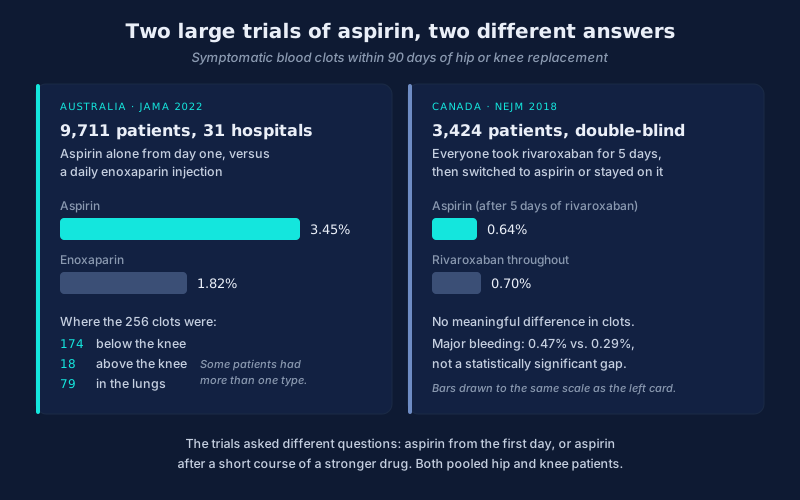
The CRISTAL trial enrolled 9,711 hip and knee replacement patients across 31 Australian hospitals.2 Rather than randomizing individual patients, it randomized whole hospitals: each hospital gave all its patients either aspirin 100 mg a day or enoxaparin 40 mg by daily injection, then switched to the other drug partway through. Knee replacement patients took their assigned drug for 14 days. Patients already on a blood thinner before surgery were excluded. The outcome was any clot that caused symptoms within 90 days.
The Canadian trial: aspirin after a short course of something stronger
The Canadian trial, published in the New England Journal of Medicine, enrolled 3,424 patients, 1,620 of them having a knee replacement.3 Every patient took rivaroxaban for the first five days. Only then were they randomized, in a double-blind design, to switch to aspirin 81 mg or continue rivaroxaban — for another nine days after a knee replacement.
What they found
In the Australian trial, symptomatic clots occurred in 3.45% of the aspirin group and 1.82% of the enoxaparin group. Aspirin failed the test the trial was designed around — showing it was no worse — and the injection was statistically superior. The trial was stopped early, at 62% of its planned enrollment, once that difference became clear. Put in absolute terms, roughly one additional patient in every 50 to 60 had a symptomatic clot on aspirin.
The detail that shapes how I read this result is where the clots were. Of the 256 patients with a clot, 174 had a clot below the knee, 18 above the knee, and 79 in the lungs (some had more than one). None of the six secondary outcomes, which included death and major bleeding, was significantly better with the injection. A later analysis of more than 23,000 CRISTAL patients found no difference in 90-day mortality: 1.67% on aspirin and 1.53% on enoxaparin.4
In the Canadian trial, clots occurred in 0.64% of the aspirin group and 0.70% of the rivaroxaban group — no meaningful difference. Major bleeding was 0.47% versus 0.29%, a gap too small to be statistically reliable.
The two trials do not contradict each other as much as they first appear to. The Canadian trial tested aspirin after five days of a stronger drug had covered the period of highest risk. The Australian trial tested aspirin alone from the first day. Both results can be true at once.
The knee-only evidence
Both main trials pooled hip and knee patients. A 2025 meta-analysis in the Journal of Arthroplasty looked only at knee replacement, combining seven randomized trials and 2,323 patients comparing aspirin with oral anticoagulants.5 It found no statistically significant difference in clots (risk ratio 1.29, with a confidence range from 0.78 to 2.14), in bleeding, in wound problems, or in death. That confidence range is wide: it is compatible with aspirin being somewhat better or somewhat worse. It does not show that aspirin is equivalent. It shows that the knee-specific trials have not been large enough to detect a difference of the size CRISTAL found.
The other side of the ledger: bleeding and stiffness
Stronger blood thinners prevent clots by interfering with the blood's ability to clot everywhere, including around a fresh surgical wound. That trade-off shows up in several ways.
An umbrella review published in January, which pooled 19 earlier systematic reviews, found bleeding complications in 0.33% of patients on aspirin against 1.05% on other anticoagulants, with no statistically significant difference in clots in the legs or lungs.6
Two 2026 studies looked at outcomes patients care about beyond bleeding. A US insurance database of 462,869 knee replacements found that, compared with aspirin, patients on stronger drugs had higher odds of needing a manipulation under anesthesia — a procedure in which the surgeon bends a stiff knee while the patient is asleep — and higher odds of a hematoma, a collection of blood around the new joint.7 Aspirin was not associated with more clots in the same data. A single-institution study of 14,216 knee replacements found that patients on stronger anticoagulants used substantially more opioid pain medication over 90 days, stayed about 12 hours longer in the hospital, and had 1.45 times the odds of a manipulation, again with no difference in clots.8
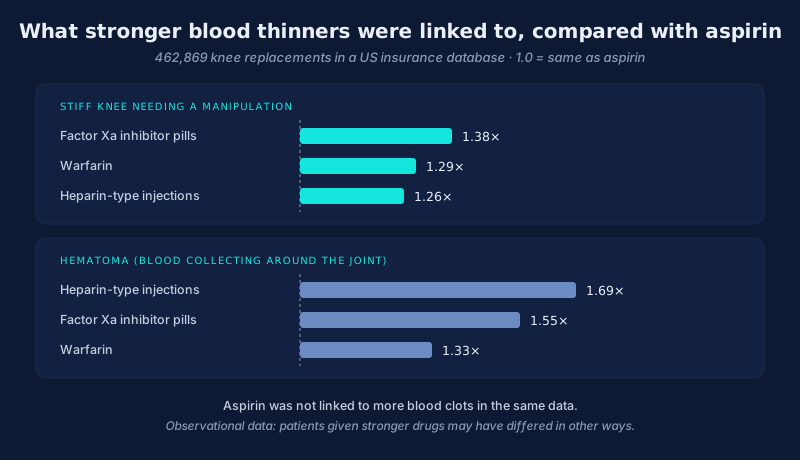
The mechanism is plausible. A knee that is swollen with blood is painful to bend, and a knee that is not bent in the first weeks is at risk of stiffening. That is the reason clot prevention is not a question of simply choosing the strongest drug available.
Who may need more than aspirin
The guideline from the American Society of Hematology recommends either aspirin or an anticoagulant after knee replacement, as a conditional recommendation.9 That wording reflects the evidence: neither choice is right for everyone. Some patients sit at higher risk of a clot, and for them the balance can shift. A 2025 database study of 20,097 knee replacement patients all given aspirin alone found no increase in clots in patients with a body mass index between 30 and 40, but 2.74 times the odds of a pulmonary embolism within 90 days in patients with a body mass index of 40 or higher.10 A personal history of a clot, active cancer, a known clotting disorder, and very limited mobility after surgery are the other factors that typically enter this conversation.
Patients who already take an anticoagulant — for atrial fibrillation, a mechanical heart valve, or a prior clot — are a separate group. They were excluded from CRISTAL, and their plan is built around the medication they already take, coordinated with the doctor who prescribes it.
Strengths of this evidence
- Two large randomized trials. Nearly 10,000 patients in one and more than 3,400 in the other, both measuring clots that caused symptoms rather than clots found only on routine screening scans.
- CRISTAL was built into a national joint registry. Follow-up drew on the registry's own data, which makes it harder for events to go uncounted, and 95% of patients completed the trial.
- The Canadian trial was double-blind. Neither patients nor doctors knew which drug was being taken, which removes a common source of bias in how symptoms get investigated.
- The newest population data are unusually complete. By linking hospital records with family-doctor records, the 2026 UK study found more than 30% of clots that hospital data alone would have missed.1
Where I'd push back
1. The CRISTAL difference was mostly calf clots
Symptomatic calf clots are real and worth preventing, but they carry less risk than clots in the thigh or lungs, and a meaningful share resolve with treatment without further trouble. When a trial's headline difference is driven mostly by its least serious component, the headline overstates the clinical gap. Mortality and major bleeding did not differ.24
2. Hospitals were randomized, not patients
A cluster design is practical for a trial this size, but hospitals differ in ways a randomization of 31 units cannot fully balance — how readily they order leg ultrasounds, how quickly they mobilize patients, and how they define a clot worth recording. Not every hospital had crossed over to the second drug when the trial stopped.
3. The trial was stopped early
Trials halted at an interim analysis because a difference has appeared tend, on average, to overestimate that difference. That does not make the finding wrong. It is a reason to treat 1.6 percentage points as an upper-leaning estimate rather than a settled figure.
4. The stiffness data cannot establish cause
The database studies showing more manipulations and more pain on stronger drugs are observational. Surgeons give stronger drugs to patients they consider higher risk, and those patients may be heavier, less mobile, or less healthy — all of which independently affect stiffness and recovery. Adjustment helps but does not eliminate this.78
5. The population numbers reflect a different era and country
The 2026 UK study covers surgeries from 2007 to 2019, before many current practices — same-day discharge, walking within hours of surgery, shorter operations — became routine. It also found that the national guidelines introduced during that period did not measurably change clot rates after knee replacement, while rates were declining anyway. Clot risk appears to be falling for reasons beyond the choice of drug.1
What this means in my practice
Taken together, I read this evidence as saying that clot prevention should be matched to the patient rather than applied as a single protocol.
Every patient leaves with a clot-prevention plan
No study here supports skipping prevention. The debate is about intensity, not whether to prevent clots at all. Getting up and walking early after surgery, and doing the ankle pumps we teach before discharge, are part of that plan in every case, regardless of which drug is chosen.
For a healthy patient at average risk, aspirin is a defensible choice
The Canadian trial, the knee-only meta-analysis, and the bleeding and stiffness data all point toward aspirin being a reasonable option for most patients at ordinary risk. CRISTAL is the strongest argument against it, and I take that trial seriously — it is why I do not describe aspirin as equivalent to stronger drugs in every respect. What CRISTAL mostly prevented were calf clots, at the cost of injections and the bleeding-related trade-offs described above. Patients should discuss with me how that balance applies to them.
Some patients warrant something stronger
A prior clot, a very high body mass index, active cancer, a known clotting disorder, or a recovery in which walking will be limited all shift the balance toward a stronger anticoagulant. So does a patient's own strong preference after understanding the trade-offs. Patients who already take a blood thinner stay on a plan built around that medication, arranged with their cardiologist or primary care doctor.
What I ask patients to watch for
New swelling, tenderness, or tightness in the calf that is getting worse rather than better, especially on one side, warrants a call to the office the same day. Sudden shortness of breath, chest pain that is worse on a deep breath, or coughing up blood warrants a call to 911. Some calf swelling after a knee replacement is normal; our article on what's normal after a knee replacement explains how to tell the expected pattern from one that needs attention.
The bottom line for the layperson
- Almost everyone gets clot prevention after a knee replacement; the question is which drug, not whether to use one.
- About 1.6% of knee replacement patients in the newest large study were diagnosed with a clot within six months, so most patients never have one.
- In the largest trial, aspirin alone allowed about one extra symptomatic clot per 50 to 60 patients compared with injections — mostly calf clots, with no difference in deaths or major bleeding.
- Stronger blood thinners are linked to more bleeding around the joint and more stiffness procedures, which is why the strongest drug is not automatically the best choice.
- A prior clot, a very high body weight, cancer, or limited mobility can make a stronger drug the better choice — ask where you fall.
If you are planning a knee replacement and want to talk through how clot prevention would work for you, you can request a visit or call the office at (281) 690-4678. You may also want to read the companion pieces on the safety data on same-day knee replacement and how long pain lasts after a knee replacement, and our overview of robotic knee replacement.
Sources
- Swain S, Leith N, Brown S, Wright Drakesmith C, Rees JL, Bankhead C, Powell J. “Risk of venous thromboembolism after knee, hip, or shoulder arthroplasty: a retrospective cohort study of 476,620 procedures using linked hospital and primary care data.” Bone Joint J. 2026;108-B(9):1138–1146. DOI: 10.1302/0301-620X.108B9.BJJ-2025-1018.R2 (PMID: 42674584)
- CRISTAL Study Group; Sidhu VS, Kelly TL, Pratt N, et al. “Effect of Aspirin vs Enoxaparin on Symptomatic Venous Thromboembolism in Patients Undergoing Hip or Knee Arthroplasty: The CRISTAL Randomized Trial.” JAMA. 2022;328(8):719–727. DOI: 10.1001/jama.2022.13416 (PMID: 35997730)
- Anderson DR, Dunbar M, Murnaghan J, et al. “Aspirin or Rivaroxaban for VTE Prophylaxis after Hip or Knee Arthroplasty.” N Engl J Med. 2018;378(8):699–707. DOI: 10.1056/NEJMoa1712746 (PMID: 29466159)
- CRISTAL Study Group; Sidhu VS, Kelly TL, Pratt N, et al. “Effect of Aspirin vs Enoxaparin on 90-Day Mortality in Patients Undergoing Hip or Knee Arthroplasty: A Secondary Analysis of the CRISTAL Cluster Randomized Trial.” JAMA Netw Open. 2023;6(6):e2317838. DOI: 10.1001/jamanetworkopen.2023.17838 (PMID: 37294566)
- Ren Y, Peng JB, Su YW, et al. “Aspirin Is as Effective as Oral Anticoagulants for Venous Thromboembolism Prophylaxis After Knee Arthroplasty: A Systematic Review and Meta-Analysis of Randomized Controlled Trials.” J Arthroplasty. 2025;40(9):2478–2487. DOI: 10.1016/j.arth.2025.02.052 (PMID: 40015383)
- Borazjani R, Khorram R, Ghorbani M, et al. “Aspirin Versus Other Anticoagulants for the Initial Prevention of Venous Thromboembolism Following Elective Total Hip and Knee Arthroplasty: An Umbrella Review and Meta-Analysis.” J Arthroplasty. 2026;41(1):225–237. DOI: 10.1016/j.arth.2025.06.032 (PMID: 40513910)
- Crowley B, Hollimon M, Joaquin T, Lawrence J, Levine BR. “The Impact of Anticoagulant Choice on Rates of Manipulation Under Anesthesia, Hematoma Formation, and Venous Thromboembolic Events.” J Arthroplasty. 2026;41(7S1):S368–S372. DOI: 10.1016/j.arth.2026.02.037 (PMID: 42373147)
- Gonzalez AG, Anatone AJ, Logsdail ES, et al. “Aspirin Versus Potent Venous Thromboembolism Chemoprophylaxis in Total Knee Arthroplasty: Reduced Postoperative Pain and Complications With Aspirin Use.” J Arthroplasty. 2026;41(S1):S373–S379. DOI: 10.1016/j.arth.2026.03.049 (PMID: 41963221)
- Anderson DR, Morgano GP, Bennett C, et al. “American Society of Hematology 2019 guidelines for management of venous thromboembolism: prevention of venous thromboembolism in surgical hospitalized patients.” Blood Adv. 2019;3(23):3898–3944. DOI: 10.1182/bloodadvances.2019000975 (PMID: 31794602)
- Alqazzaz A, Zhuang T, Smith WE, et al. “Higher Pulmonary Embolism Risk in Morbidly Obese Patients on Aspirin Monotherapy after Total Knee Arthroplasty: A Claims Database Analysis.” J Arthroplasty. 2025;40(7 Suppl 1):S201–S207.e2. DOI: 10.1016/j.arth.2025.03.046 (PMID: 40132696)
This article reflects Dr. Dewan's reading of the cited evidence at the time of publication. It is educational content, not medical advice. Your specific case may differ — schedule a consultation to discuss your imaging and history.