
In the largest multicenter study of its kind — 12,809 joint replacements across 40 locations, published in The Journal of Arthroplasty in 2025 — 34% of patients went home the same day.3 In my own practice the figure is closer to 90%.
That gap is not a disagreement about the evidence. A number pooled across 40 hospitals and surgery centers averages programs built around same-day discharge together with programs that do it occasionally, and it reflects how a practice is organized — the anesthetic, the pain plan, when therapy starts, what the patient is told to expect beforehand — at least as much as it reflects who is medically eligible. Read the 34% as a snapshot of how varied practice was, not as a ceiling on who qualifies.
For a medically well-controlled patient having a straightforward knee replacement, going home the same day is the ordinary plan rather than a privilege reserved for the unusually fit. So the useful question is not whether you fall into some lucky fraction. It is whether anything in your particular case argues for staying — and that question has a real evidence base behind it.
What "outpatient" actually means
The word causes more confusion than almost any other term in this conversation, because it carries two different meanings depending on who is using it.
Clinically, outpatient means same-day discharge: you have surgery in the morning, you meet a set of defined recovery milestones — you can walk with a walker, your pain is controlled on oral medication, you can empty your bladder, your vital signs are stable — and you go home that afternoon or evening.
To an insurance company, "outpatient" is a billing status. Medicare removed total knee replacement from its inpatient-only list in 2018, which means the operation can now be billed as an outpatient procedure even when the patient stays overnight in a hospital bed. A patient can be classified as an outpatient, spend the night, and go home the next morning.
Those two definitions come apart in ways that matter, and I will come back to that gap later, because it is the part of this subject where I have the strongest opinion.
Why this matters to you
Same-day discharge is not a convenience feature. For the right patient it is associated with less time in a bed, earlier walking, fewer catheters and lines, less sleep disruption, and less exposure to the organisms that live in hospitals. For the wrong patient it is a readmission, a fall, an unplanned emergency-department visit, or a night of uncontrolled pain with nobody to call.
The outcome difference between those two scenarios comes down almost entirely to selection. Which is why the research worth reading is not about the surgery — it is about the screening.
How surgeons actually decide
The most-studied tool for this decision is the Outpatient Arthroplasty Risk Assessment, or OARA score. It was developed at Indiana University by an arthroplasty surgeon and a perioperative internal medicine physician working together, and it was built deliberately to be conservative — to err toward keeping a borderline patient rather than sending them home.1
The score works through nine categories of medical history — cardiac, pulmonary, endocrine, gastrointestinal, neurologic, renal, hematologic, infectious disease, and general health including body mass index and prior opioid use. Each condition contributes points based on how likely it is to cause a problem in the first 24 hours after surgery. Higher score, more medical risk.
The original 2017 study reviewed 1,120 consecutive joint replacements and compared the OARA score against the two risk measures surgeons had been using: the American Society of Anesthesiologists physical status classification and the Charlson comorbidity index. The OARA score correctly predicted same-day or next-day discharge 81.6% of the time, compared with 56.4% for the anesthesia classification and 70.3% for the Charlson index.1
A 2019 update in 2,051 joint replacements refined the threshold. Patients scoring 0 to 79 points were successfully discharged same-day with a positive predictive value of 98.8% and a false positive rate of 0.7%.2 In plain terms: when the score said a patient was medically ready to go home, it was almost always right.
Both of those studies came from the group that invented the score, in one health system, which is the obvious weakness. The 2025 multicenter study addressed it directly — 12,809 primary joint replacements across 40 locations from 2017 to 2023, none of them the developing institution.3
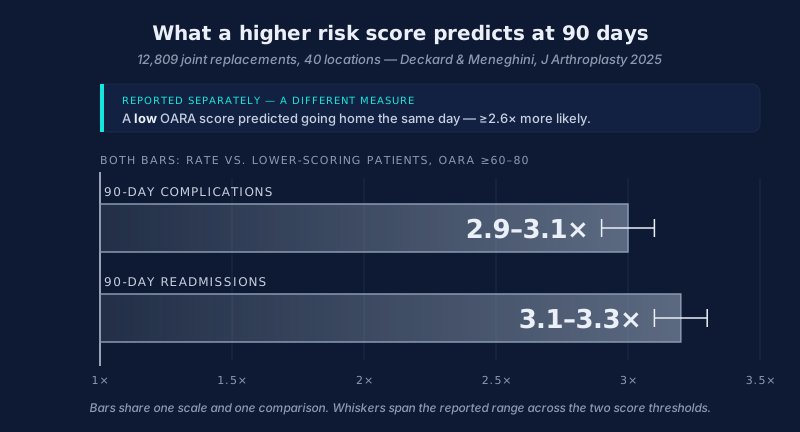
Patients scoring below the thresholds were at least 2.6 times more likely to be discharged on the day of surgery. More important, a lower score also tracked with fewer problems afterward: patients scoring 60 or above had 2.9 to 3.1 times the rate of 90-day complications and 3.1 to 3.3 times the rate of 90-day readmissions.3
That second finding is the one patients should hold onto. The score is not simply sorting people by how fast they can get out of bed. It is identifying who is medically fragile enough that the first three months carry real risk — and those are the same patients who should not be driving home four hours after an operation.
The four gates you have to clear
A risk score answers one of four questions. The 2024 position statement from the American Association of Hip and Knee Surgeons, the Hip Society, the Knee Society, and the American Academy of Orthopaedic Surgeons frames the decision as a shared one between surgeon and patient after a full risk-benefit discussion, and it explicitly flags medical comorbidity, procedural complexity, and social support as separate considerations.7
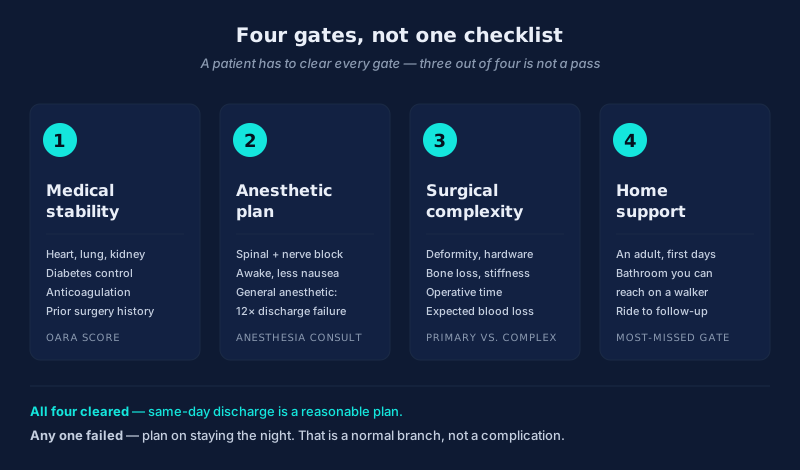
Gate one — medical stability. Heart failure, poorly controlled arrhythmia, significant coronary disease, chronic lung disease requiring oxygen, chronic kidney disease, poorly controlled diabetes, a history of blood clots requiring anticoagulation, or a recent stroke. This is the gate the OARA score measures.
Gate two — the anesthetic plan. Spinal anesthesia with a regional nerve block is what makes same-day discharge realistic, because it lets you wake up alert, without the nausea and grogginess of a general anesthetic. In the sleep apnea study discussed below, needing a general anesthetic raised the odds of failing same-day discharge by roughly twelvefold.4 If your anatomy, your spine, or your anticoagulation makes a spinal impractical, that changes the calculation.
Gate three — surgical complexity. Severe deformity, prior hardware from an old fracture, significant bone loss, or a stiff knee that will need extensive release all lengthen the operation and increase blood loss. A straightforward primary knee is a different proposition from a complex one.
Gate four — home support. A competent adult at home for the first several days, a bathroom and a bed you can reach, and a plan for who drives you to your first follow-up. This is the gate patients most often assume they can improvise around, and it is the one that most often fails. It deserves its own discussion, and it will get one in a future article.
What no longer automatically disqualifies you
Two conditions used to be near-automatic exclusions and no longer are.
Sleep apnea. Up to a quarter of patients needing a knee or hip replacement have it, and they were historically excluded from outpatient programs outright. A 2024 matched case-control study of 156 patients found no meaningful difference in same-day discharge failure — 7.7% among patients with sleep apnea versus 6.4% among matched controls — and no difference in 30-day readmissions, unexpected visits, or complications.4
The important caveat is who was allowed into that study: mild sleep apnea, moderate sleep apnea with a body mass index under 35, or sleep apnea of any severity already treated with CPAP. Severe untreated sleep apnea was not tested. If you have sleep apnea and use your machine, that is a materially different situation from having sleep apnea and having never filled the prescription.
Obesity. A study of 5,988 outpatient arthroplasty procedures compared patients with a body mass index of 40 or above against those below it. The patients with severe obesity were more likely to need an unplanned overnight stay — 9.1% versus 5.4%, with breathing and sleep apnea problems the leading reason — but showed no significant increase in 90-day medical complications, emergency visits, or readmissions.5
Read that carefully, because the two halves say different things. Higher body mass index raises the odds that the same-day plan does not work out. It does not appear to make the operation itself more dangerous in this setting. Those are separate risks, and conflating them is how patients end up either wrongly excluded or wrongly reassured.
Who should still plan on staying
The exclusions are more useful than a list of green lights, and they describe the minority of patients rather than the majority. Same-day discharge is generally the wrong plan if you have:
- Significant cardiac or pulmonary disease — heart failure, an arrhythmia needing monitoring, coronary disease with recent symptoms, or lung disease requiring supplemental oxygen.
- Chronic anticoagulation that needs bridging or close monitoring around surgery.
- Poorly controlled diabetes, particularly with an elevated hemoglobin A1c, which raises both infection risk and the odds of a rocky first night.
- Severe untreated sleep apnea, or sleep apnea in a patient who does not use their CPAP machine.
- A history of significant postoperative nausea, difficult pain control, or opioid tolerance from prior surgery.
- No reliable adult at home for the first several days, or a home you cannot navigate on a walker.
- A complex knee — severe deformity, retained hardware, prior infection, or substantial bone loss.
None of these means you cannot have a knee replacement. They mean the safe version of your operation includes a night in a bed with a nurse in the building.
Where I would push back
- Nearly all of this evidence is observational, and the selection is the whole point. Patients who go home the same day do well partly because they were chosen for it. Comparing outpatient and inpatient groups will always flatter the outpatient arm, because the healthier patients were sorted into it on purpose. This is not a flaw in the studies so much as a permanent limit on what they can tell you.
- The OARA score is not externally validated the way patients might assume. The 2025 multicenter study is a real advance and it does support the score. But it is a Level III retrospective database study, and roughly half of the 12,809 cases had usable complication data. The score has never been tested in a randomized trial against surgeon judgment alone.
- Sample sizes in the exclusion research are small. The sleep apnea study included 78 patients with sleep apnea. Finding no difference in a group that size means the study could not detect anything but a large difference. "No signal found" and "no risk exists" are not the same statement.
- The biggest problem in this field right now is not clinical, it is administrative. A 2022 study from the Hospital for Special Surgery reviewed 709 patients preauthorized for outpatient knee replacement and split them by who made the call. When the surgeon's criteria designated a patient outpatient, the prediction held 92.0% of the time. When the insurer overruled a surgeon's inpatient designation and mandated outpatient status, the prediction held 81.3% of the time, and those patients were 2.2 times more likely to need conversion to an inpatient stay.6 A body mass index above 35 independently raised the odds of conversion by 82%.
- That study is the one I would want every patient to know about. If your surgeon says you should stay overnight and your insurance card says otherwise, the published data are on your surgeon's side. The authors' conclusion was blunt: insurers should leave admission status to the patient and the surgeon.6
How I think about this in my practice
I do not decide discharge plans in the operating room. The conversation happens weeks earlier, at the preoperative visit, and it involves the same four gates above — with your medical history, your medication list, your anesthesia consultation, and a direct question about who is going to be in your house on night one. Most patients clear all four, which is why the large majority of mine go home the same day. The purpose of the gates is to find the ones who should not.
Where the evidence likely fits. A patient in their fifties or sixties, medically well-controlled, with a straightforward primary knee, a spinal anesthetic planned, a spouse or adult child at home for the first week, and a real motivation to sleep in their own bed. Evidence suggests that patient does as well going home the same day as staying, and the multicenter data support planning for it.
Where it likely does not fit. A patient in their eighties living alone in a two-story house with the only full bathroom upstairs, on anticoagulation, with a knee that has been stiff for a decade. Everything about that operation can go perfectly and the discharge plan can still fail, because the risk in that case is not in the knee.
What I ask of patients is that the discharge plan be decided before the day of surgery, not on it. Same-day discharge works when the whole system is built around it in advance — the anesthetic, the pain plan, the therapy visit, the phone number you call at 9 p.m. It works badly when it is improvised because a bed was unavailable or a payer changed its mind.
And if the plan changes on the day and you need to stay, that is not a complication or a failure. Roughly 5 to 9% of patients in the outpatient literature needed an unplanned overnight, and their 90-day outcomes were no different.5 Staying a night is a normal branch of a good plan.
The bottom line for the layperson
- Going home the same day is the ordinary plan, not a rare exception — roughly 90% of my knee replacement patients do, and for well-selected patients the published outcomes are comparable to staying.
- Candidacy is a medical question, not a motivation question — the OARA score sorts patients on cardiac, lung, kidney, endocrine and other conditions, and a higher score also predicts more complications in the first 90 days.
- You have to clear four separate gates: medical stability, a workable spinal anesthetic, a straightforward knee, and someone at home. Failing any one of them means planning to stay.
- Sleep apnea and obesity are no longer automatic disqualifiers, but severe untreated sleep apnea and a body mass index above 40 both raise the odds you end up staying the night anyway.
- If your surgeon says stay and your insurer says go home, the data favor your surgeon — insurer-mandated outpatient patients were more than twice as likely to need conversion to an inpatient stay.
If you're weighing a knee replacement and want to know whether same-day discharge is realistic in your case, that's a conversation worth having in person. You can request a visit or call the office at (281) 690-4678. You may also want to read why most patients go home instead of to a rehab facility and whether you need a knee replacement at all.
Sources
- Meneghini RM, Ziemba-Davis M, Ishmael MK, Kuzma AL, Caccavallo P. “Safe Selection of Outpatient Joint Arthroplasty Patients With Medical Risk Stratification: the ‘Outpatient Arthroplasty Risk Assessment Score’.” J Arthroplasty. 2017;32(8):2325–2331. DOI: 10.1016/j.arth.2017.03.004 (PMID: 28390881)
- Ziemba-Davis M, Caccavallo P, Meneghini RM. “Outpatient Joint Arthroplasty — Patient Selection: Update on the Outpatient Arthroplasty Risk Assessment Score.” J Arthroplasty. 2019;34(7S):S40–S43. DOI: 10.1016/j.arth.2019.01.007 (PMID: 30738619)
- Deckard ER, Meneghini RM. “The ‘Outpatient Arthroplasty Risk Assessment’ Score for Same Day Outpatient Primary Total Joint Arthroplasty: A Multicenter Study.” J Arthroplasty. 2025;40(11):2859–2865. DOI: 10.1016/j.arth.2025.05.048 (PMID: 40398580)
- Hardy A, Belzile EL, Roy V, Pageau-Bleau J, Tremblay F, Dartus J, Germain G, Pelet S. “Sleep Apnea is Not an Obstacle for Outpatient Hip and Knee Arthroplasty.” J Arthroplasty. 2024;39(8):1982–1987.e1. DOI: 10.1016/j.arth.2024.02.020 (PMID: 38355063)
- Crawford DA, Hurst JM, Morris MJ, Hobbs GR, Lombardi AV Jr, Berend KR. “Impact of Morbid Obesity on Overnight Stay and Early Complications With Outpatient Arthroplasty.” J Arthroplasty. 2020;35(9):2418–2422. DOI: 10.1016/j.arth.2020.04.098 (PMID: 32487499)
- Rodriguez S, Lebrun DG, Shen TS, Rodriguez JG, Della Valle AG, Rodriguez JA, Ast MP. “Predicting Total Knee Arthroplasty Outpatient Discharge: Surgeons versus Insurance Companies.” J Arthroplasty. 2022;37(8S):S766–S770. DOI: 10.1016/j.arth.2022.03.037 (PMID: 35341926)
- AAHKS — “Position Statement on Outpatient Joint Replacement” (2024), issued with the Hip Society, the Knee Society and the AAOS.
This article reflects Dr. Dewan's reading of the cited evidence at the time of publication. It is educational content, not medical advice. Your specific case may differ — schedule a consultation to discuss your imaging and history.