In 2019, British Journal of Anaesthesia published an international consensus review that pooled 94 studies of hip and knee replacement and found spinal anesthesia associated with lower odds of almost every complication measured — death, lung complications, kidney failure, blood clots, infection and transfusion. The consensus group recommended spinal over general anesthesia for both joints.1
In the same document, the group graded the quality of its own evidence for knee replacement as "low" and labeled its recommendation "weak."1
Both of those things are true at once, and the distance between them is the reason this article exists. Spinal anesthesia is very likely the better default for a knee replacement. The reasons are not the ones patients are usually given.
Why this matters to you
Anesthesia is the part of a knee replacement patients most often feel they have no say in, and the part they are most anxious about. It is also the technical decision that most directly shapes the first twelve hours after surgery: whether you feel sick, how much opioid you need, how soon you can stand, and whether the plan to go home the same day actually works.
It rarely changes whether the operation succeeds. It very often changes how the day goes.
What the two options actually are
Most of the anxiety here comes from a misunderstanding of the word "awake."
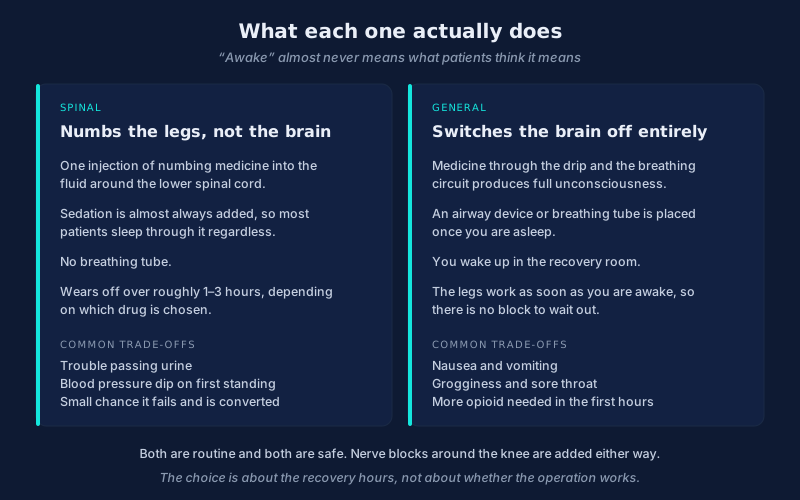
A spinal anesthetic is a single injection of numbing medicine into the fluid surrounding the lower spinal cord. It blocks sensation and movement from roughly the waist down for one to three hours. Your brain is not affected by it at all — which is why patients picture themselves listening to the operation.
In practice, almost nobody does. Sedation is given alongside the spinal, and the large majority of patients sleep through the procedure and remember nothing of it. The difference from general anesthesia is that you are sedated rather than rendered unconscious, and you are breathing on your own without a tube.
A general anesthetic switches the brain off entirely. An airway device or breathing tube is placed after you are asleep and removed before you wake. Modern general anesthesia for a knee replacement is short, well controlled and very safe.
One point that gets lost: in either case, your surgeon and anesthesiologist will also use nerve blocks around the knee itself — most commonly an adductor canal block, which numbs the sensory nerves to the front of the knee while sparing the quadriceps muscle so you can still walk. Those blocks do much of the early pain control, and they are not what is being decided here.
What the evidence shows, and how strong it is
The literature splits cleanly into two halves that disagree with each other, and knowing which half a claim comes from tells you most of what you need.
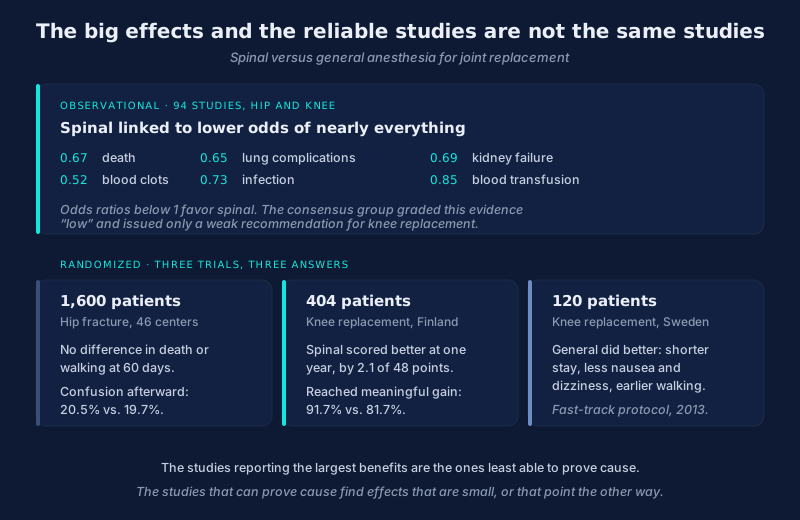
The observational half is large and consistent. The consensus review found odds ratios of 0.67 for death, 0.65 for lung complications, 0.52 for deep vein thrombosis and 0.73 for infection, all favoring spinal.1 A 2025 pooled analysis of 522,080 knee replacements found spinal associated with 42% lower odds of blood transfusion and 41% lower odds of 30-day complications.2 That is an enormous amount of data pointing the same way.
It is also data in which nobody was randomly assigned anything. When a patient receives general anesthesia for a knee replacement, there is usually a reason — a spine that can't be accessed, anticoagulation, a previous failed block, a patient who refused. Those reasons predict complications independently of the anesthetic. The 2025 pooled analysis included zero randomized trials, and its authors said so plainly.2
The randomized half is smaller and does not agree with itself. Three trials are worth knowing:
- The largest randomized comparison found nothing. The REGAIN trial assigned 1,600 older adults having hip fracture surgery at 46 hospitals to spinal or general anesthesia. Death or inability to walk at 60 days: 18.5% with spinal, 18.0% with general. Death at 60 days: 3.9% versus 4.1%. Delirium: 20.5% versus 19.7%.3 Hip fracture is a different operation in a frailer population, so this does not transfer directly — but it is by far the best-powered randomized test of the underlying idea, and it found no advantage at all.
- The best knee-specific trial favors spinal, modestly. A Finnish trial randomized 404 knee replacement patients to spinal or general, with and without a tourniquet. At one year, the spinal group improved 2.13 points more on the 48-point Oxford Knee Score — statistically significant, and below what most researchers consider a meaningful change for one patient. The more persuasive number is the proportion reaching a meaningful improvement at all: 91.7% with spinal versus 81.7% with general. Adverse events were no different.4
- One trial favors general, and it is rarely cited. A Swedish fast-track trial randomized 120 knee replacement patients and found general anesthesia produced a shorter stay (46 versus 52 hours), less nausea and vomiting, less dizziness, less morphine use, and earlier walking. Spinal patients hurt less in the first two hours and more after six. Patients who got the spinal were more likely to say they'd want a different method next time.5
The part that matters most for going home the same day
If your plan is to leave on the day of surgery, the anesthetic choice stops being abstract.
A 2024 meta-analysis pooled 3,492 hip and knee replacement patients to ask why planned same-day discharges fail. Spinal anesthesia was associated with 1.62 times the odds of getting home successfully; general anesthesia with 0.58 times the odds.6
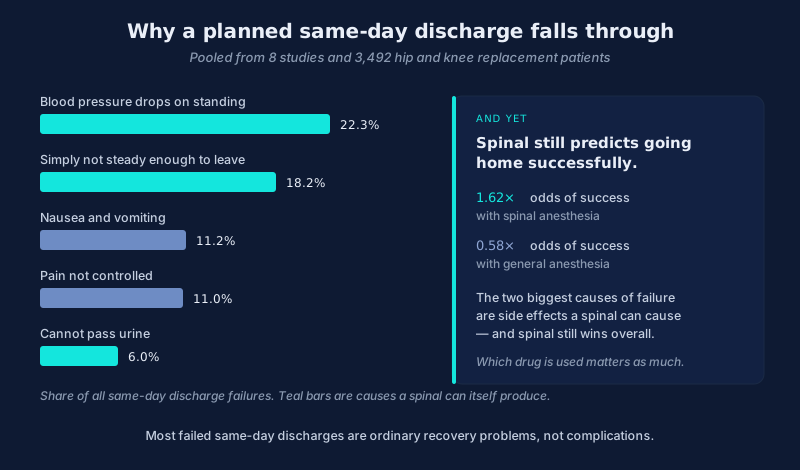
Look at the causes of failure and something odd emerges. The top cause is a drop in blood pressure on standing, at 22.3%. The fifth is inability to pass urine, at 6.0%.6 Both are classic side effects of a spinal. The technique most likely to get you home is also the technique causing two of the five reasons people don't get home.
Which is why the specific drug matters as much as the category. A 2025 comparison of 178 same-day knee replacements at a surgery center found that chloroprocaine, a very short-acting spinal agent, produced discharge readiness in 3.7 hours against 4.2 for mepivacaine, with urinary retention of 3.5% versus 15.6% and residual numbness in recovery of 19.3% versus 39.1%.7 Same technique, different molecule, a fourfold difference in the complication that keeps people overnight.
Where I would push back
- The effect sizes everyone quotes come from studies that cannot establish cause. A 33% reduction in mortality from an anesthetic technique in elective knee replacement — where mortality is already well under 1% — should be treated with suspicion. It is far more likely that sicker patients received general anesthesia than that the anesthetic saved lives at that rate.
- "Statistically significant" and "you will notice it" are not the same. The 2.13-point Oxford Knee Score difference in the Finnish trial is real and reproducible, and it is below the threshold at which one patient would perceive a difference.4 The proportion reaching meaningful improvement is the number worth quoting; the mean difference is the number that gets quoted.
- The one trial that favors general anesthesia is mostly ignored. The Swedish study was randomized, published in a leading anesthesia journal, and found the opposite of the consensus. Whether its total-intravenous protocol explains the result is a fair question. Leaving it out of the discussion is not.5
- Even the consensus group hedged on knees. Their recommendation for hip replacement was "strong"; for knee replacement it was explicitly "weak," on "low" quality evidence.1 That distinction has largely disappeared in how the recommendation gets repeated.
- Follow-up is short almost everywhere. The 2025 pooled analysis was limited to 90 days and its authors flagged that they could say nothing about long-term function or persistent pain.2 Whether the anesthetic influences how a knee feels at two years is unanswered.
- A spinal sometimes does not work. In REGAIN, 16.2% of patients assigned to spinal did not end up receiving one.3 Previous spine surgery, scoliosis and body habitus all make placement harder. This is a normal, manageable event, and it is worth knowing it can happen rather than hearing about it on the day.
How I think about this in my practice
Anesthesia is chosen by the anesthesiologist, in conversation with the patient, not by me. I do not select it and I would not want to imply otherwise. What I can do is describe how the evidence reads and what I see in recovery.
Spinal is the usual approach for my knee replacement patients, and the reasons I find most convincing are the practical ones rather than the dramatic ones. Less nausea. Less opioid in the first hours. No sore throat. A patient who is alert enough to eat lunch and work with physical therapy in the afternoon, which is what actually determines whether the plan to go home holds together.6
Where the spinal evidence likely fits. A patient having a straightforward primary knee replacement who plans to go home the same day, has a spine that can be accessed, is not on anticoagulation that prohibits it, and gets nauseated easily. For that patient the practical advantages are consistent across nearly every study, weak evidence grade notwithstanding.
Where it likely does not fit. A patient with prior lumbar fusion or severe spinal deformity, someone on anticoagulation that cannot be safely interrupted, someone with a fixed cardiac condition for whom a sudden drop in blood pressure is genuinely dangerous, or someone who has had a distressing experience with a spinal before and does not want another. In those situations general anesthesia is not a compromise. REGAIN randomized 1,600 patients and could not find a survival or recovery penalty for it.3
The thing I would most like patients to take from this is that the choice is far less consequential than the anxiety around it suggests. What is worth asking about is narrower and more useful: which short-acting drug the anesthesiologist plans to use for the spinal, and what the plan is if the block does not take. Both of those have documented effects on how your afternoon goes. Whether you were technically unconscious or merely asleep, in my experience, is not the part patients remember.
The bottom line for the layperson
- A spinal does not mean being awake for your surgery — sedation is given alongside it, and most patients sleep through the operation and remember nothing.
- Spinal is the reasonable default for knee replacement, mainly because of less nausea, less opioid and a better chance of getting home the same day.
- The dramatic claims are weaker than they sound. The largest randomized trial, in 1,600 patients, found no difference in survival, walking or confusion.
- General anesthesia is a legitimate choice, not a fallback — and for some spines, some medications and some previous experiences, it is the right one.
- Ask which spinal drug will be used. A short-acting agent cut the rate of being unable to pass urine from about 16% to under 4% in one same-day series.
If you're planning a knee replacement and want to talk through how your own history affects this, that's a conversation worth having in person — and one worth having with your anesthesiologist as well. You can request a visit or call the office at (281) 690-4678. You may also want to read what the same-day discharge safety data show and how long pain really lasts after a knee replacement.
Sources
- Memtsoudis SG, Cozowicz C, Bekeris J, et al. “Anaesthetic care of patients undergoing primary hip and knee arthroplasty: consensus recommendations from the International Consensus on Anaesthesia-Related Outcomes after Surgery group (ICAROS) based on a systematic review and meta-analysis.” Br J Anaesth. 2019;123(3):269–287. DOI: 10.1016/j.bja.2019.05.042 (PMID: 31351590)
- Elsenosy AM, Hassan E, Yousef AS, Al-Alawi M, Elbagory W. “Impact of Regional Versus General Anaesthesia on Outcomes Following Total Knee Replacement: A Systematic Review and Meta-Analysis.” Cureus. 2025;17(10):e95445. DOI: 10.7759/cureus.95445 (PMID: 41311745)
- Neuman MD, Feng R, Carson JL, et al. (REGAIN Investigators). “Spinal Anesthesia or General Anesthesia for Hip Surgery in Older Adults.” N Engl J Med. 2021;385(22):2025–2035. DOI: 10.1056/NEJMoa2113514 (PMID: 34623788)
- Rantasalo M, Palanne R, Vakkuri A, Olkkola KT, Madanat R, Skants N. “Use of a Tourniquet and Spinal Anesthesia Increases Satisfactory Outcomes After Total Knee Arthroplasty: A Randomized Study.” J Bone Joint Surg Am. 2021;103(20):1890–1899. DOI: 10.2106/JBJS.20.02080 (PMID: 34129541)
- Harsten A, Kehlet H, Toksvig-Larsen S. “Recovery after total intravenous general anaesthesia or spinal anaesthesia for total knee arthroplasty: a randomized trial.” Br J Anaesth. 2013;111(3):391–399. DOI: 10.1093/bja/aet104 (PMID: 23578860)
- Lamo-Espinosa JM, Mariscal G, Gómez-Álvarez J, Benlloch M, San-Julián M. “Causes and risk factors for same-day discharge failure after total hip and knee arthroplasty: a meta-analysis.” Sci Rep. 2024;14:12627. DOI: 10.1038/s41598-024-63353-9 (PMID: 38824204)
- Gilreath N, Liu J, Thomson C, et al. “Retrospective comparison of chloroprocaine and mepivacaine in spinal anesthesia for same-day discharge TKA.” Knee Surg Relat Res. 2025;37:33. DOI: 10.1186/s43019-025-00283-4 (PMID: 40775385)
- AAHKS — “Position Statement on Outpatient Joint Replacement” (2024), issued with the Hip Society, the Knee Society and the AAOS, which describes spinal anesthesia and adductor canal blocks as standard components of rapid-recovery protocols.
This article reflects Dr. Dewan's reading of the cited evidence at the time of publication. It is educational content, not medical advice. Your specific case may differ — schedule a consultation to discuss your imaging and history.