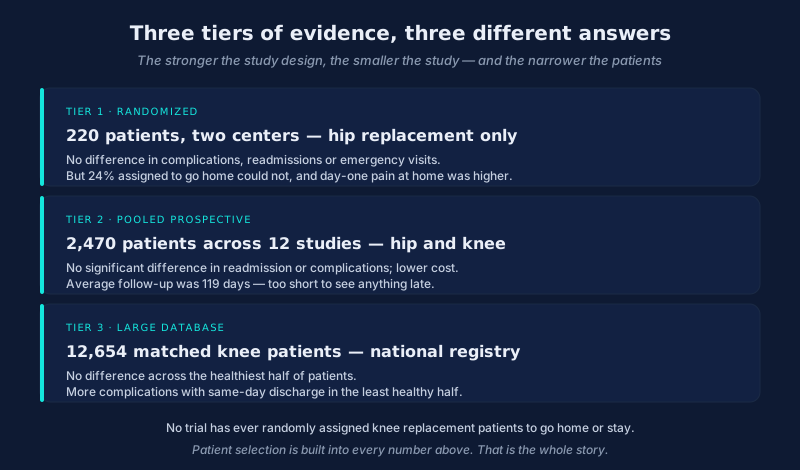
In April 2025, BMC Musculoskeletal Disorders published a systematic review that pooled 12 studies and 2,470 patients comparing outpatient with inpatient hip and knee replacement. Readmissions: no significant difference. Complications: no significant difference. Cost: substantially lower for outpatient care.1
That is the headline, and it is a fair one. It is also incomplete in a way that matters to the person actually deciding. Because a different set of studies, looking at a different slice of patients, finds that same-day discharge is not equivalent — and the patients where it stops being equivalent are exactly the ones who most need to know.
This article is about that gap.
Why this matters to you
Same-day discharge after knee replacement went from unusual to routine in under a decade. When Medicare removed total knee replacement from its inpatient-only list on January 1, 2018, the volume of outpatient knee replacement in one national database went from 2,074 cases across 2015 to 2017 to 46,480 cases across 2018 to 2020 — a more than twentyfold increase in three years. The patients having them also got older, from an average of 64.4 to 67.0 years.2
A change that large, that fast, driven partly by a payment rule, deserves scrutiny rather than assumption. The question is not whether same-day discharge can be safe. It plainly can. The question is for whom, and how confidently anyone can say so.
What "safe" has to mean here
Three separate things get bundled under the word, and separating them is most of the work:
- Did the discharge plan work? Whether you actually left on the day of surgery, or ended up staying because your pain was uncontrolled, your blood pressure dropped when you stood, or you could not empty your bladder.
- Did something go wrong afterward? Readmissions, emergency-department visits, blood clots, infections, reoperations within 30 or 90 days.
- Did the knee end up in the same place? Function, pain relief, and implant survival a year or more out.
Most of what gets reported as "outpatient knee replacement is safe" addresses the second item, in the short term. The first item is a logistics question that patients care about a great deal. The third is barely studied at all in this comparison, because the follow-up in the randomized and prospective work is measured in weeks.
What the pooled evidence shows
The 2025 systematic review is the best single summary available. Its authors deliberately restricted the primary safety comparisons to prospective and randomized studies rather than throwing every retrospective database into the pot — a real methodological choice that most reviews in this space do not make.1
Across those studies:
- Readmission — pooled odds ratio 0.66 favoring outpatient care, not statistically significant. In the knee-only subgroup, odds ratio 0.67, also not significant.
- Complications — pooled odds ratio 0.77 favoring outpatient care, again not statistically significant.
- Cost — significantly lower for outpatient care, and this was the one result that was not close.
Read those numbers carefully. "Not statistically significant" here means the study could not distinguish the two approaches, not that outpatient care was proven better. The point estimates all lean toward outpatient, and none of the intervals were tight enough to say so with confidence. What the data support is narrower: no signal of harm, in these patients, over this follow-up.
That last clause is doing real work. Mean follow-up in the pooled studies was 119 days.1 Anything that takes longer than four months to show up would not appear in this data at all.
The only randomized evidence, and what it cost to get
There is exactly one well-known randomized trial that assigned patients to go home the same day or stay overnight. It was published in Clinical Orthopaedics and Related Research in 2017, it enrolled 220 patients at two high-volume centers, and it studied hip replacement, not knee replacement.3
It is worth knowing anyway, for three reasons.
First, it found what the pooled data find: no difference in reoperations, readmissions, emergency-department visits, or acute office visits between the two groups.
Second, it put a number on the failure rate. Of 112 patients randomly assigned to go home the same day, 27 could not — 24%. Twenty-six stayed one night and one stayed two. That was in an already narrowly screened group: under 75 years old, walking without a walker beforehand, not on chronic opioids, body mass index under 40, all operated on by senior surgeons at high-volume centers. The authors' own conclusion was that facilities need to be able to accommodate an overnight stay.3
Third, it found one difference that patients rarely hear about. On the first day after surgery, patients who went home reported higher pain than patients who stayed — 3.7 versus 2.8 on a ten-point scale, a difference of 0.9 points that reached statistical significance.3 That is a modest gap, below what most people would call a meaningful change on its own. But it is a real one, it points in the direction you would expect, and no one should be told that going home is free of any trade-off.
Where the difference does show up
The most useful study in this whole literature is not the one with the best design. It is a 2023 analysis in The Journal of Arthroplasty that took 6,327 knee replacement patients who were discharged the same day and matched each one to a patient who stayed one or two nights — matched on a composite score built from demographics, comorbid conditions, and laboratory values.4
Then, instead of comparing the two groups as a whole, the authors split them into four quartiles by how medically healthy the patients were, and compared within each quartile.
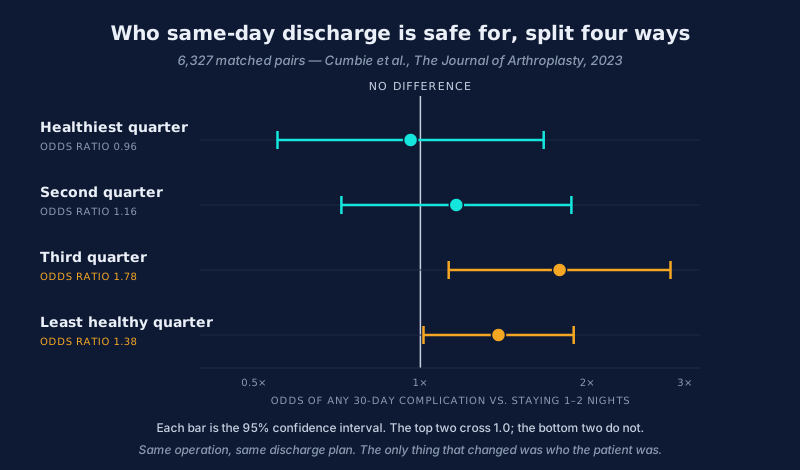
In the healthiest quarter, same-day discharge made no difference to complications (odds ratio 0.96). In the second quarter, no difference (1.16). In the third quarter, same-day patients had 1.78 times the odds of any complication. In the least healthy quarter, 1.38 times the odds of any complication and 1.71 times the odds of a major one.4
The authors' conclusion was pointed: the unhealthiest half of these patients were at increased risk, which calls into question how patient selection was actually being done.4
This is the result that should shape how a patient reads everything else. The pooled "no difference" finding is not wrong. It is an average, and averaging across a population hides a difference that only exists in part of it.
What happens at the edges
Two findings sit against that caution, and both deserve their place.
Age by itself is not the problem. A study of patients aged 80 and above matched 709 same-day discharges against 709 inpatient stays on age, sex, race, body mass index, anesthesia classification, functional status, smoking, and medical conditions. Thirty-day readmission was identical at 3.5% in both groups. Major complications, 2.0% versus 2.7%. Reoperations, 0.8% versus 1.3%. Mortality, 0.3% in both.5 A well-selected 82-year-old is not automatically a worse candidate than a poorly selected 62-year-old.
The plan usually works. Ontario's provincial database captured every planned outpatient hip and knee replacement between 2016 and 2022 — 2,776 knee cases. The proportion of joint replacements planned as same-day rose from 0.6% in 2016 to 23.8% in 2021, and 11.3% of planned same-day knee patients failed to go home that day.6 Nearly nine in ten made it, across an entire province rather than a handful of showcase centers.
That study also found something no one has fully explained: after matching on age, joint, comorbidity score, institution type, and year, female patients were meaningfully more likely to fail same-day discharge than male patients. Frailty and medical conditions were the other predictors.6 The authors called for programs to be evaluated specifically to make sure they are accessible to women.
Where I would push back
- Every comparison in this field is contaminated by selection, and no amount of statistics fixes it. Propensity matching adjusts for what was recorded. It cannot adjust for the surgeon's judgment on the day, the patient's own confidence, or whether someone was waiting in the parking lot to drive them home. Those unmeasured factors are precisely what sorted patients into the two groups in the first place.
- The follow-up is too short to answer the question patients actually ask. A mean of 119 days in the pooled prospective data tells you about the recovery. It tells you nothing about whether the knee moves as well at two years, or whether an implant placed in a setting optimized for rapid discharge lasts as long. I am not suggesting it does not — I am pointing out that nobody has shown it does.
- The one randomized trial is in the wrong joint. Hip replacement and knee replacement have genuinely different early recovery courses. Knees hurt more in the first week, swell more, and are harder to mobilize. Borrowing the hip result to reassure a knee patient is a reasonable working assumption, not evidence.
- "No significant difference" in small studies is a weak claim. The knee-only readmission subgroup in the 2025 review pooled three studies, 192 outpatients against 222 inpatients.1 A comparison that size can only detect a large difference. It found none, which is reassuring, and which is not the same as showing equivalence.
- The quartile finding has not been widely acted on. The 2023 quartile analysis was published three years ago in the field's leading journal, and outpatient knee replacement has continued to expand into older and sicker patients since. If the least healthy half genuinely carry higher complication odds with same-day discharge, that should be narrowing selection in those groups, not widening it.
- Payment rules moved faster than the evidence. The twentyfold rise in outpatient volume followed a Medicare reimbursement change, not a trial result.2 The safety data have largely been reassuring, which is fortunate, but the sequence was backwards.
How I think about this in my practice
Roughly nine in ten of my knee replacement patients go home the same day, and I plan for it from the preoperative visit rather than deciding on the morning of surgery. The evidence above is why I am comfortable with that, and it is also why the plan is made in advance rather than assumed.
Where the evidence likely fits. A patient whose heart, lungs, kidneys and diabetes are all well controlled, having a straightforward primary knee replacement under a spinal anesthetic, with someone at home. For that patient the pooled data, the randomized hip data, and the healthiest-quartile data all point the same way, and the remaining question is logistics rather than safety.
Where it likely does not fit. A patient who would land in the bottom half of that quartile analysis — several active medical conditions, an elevated hemoglobin A1c, chronic anticoagulation, significant heart or lung disease. Evidence suggests those patients carry measurably higher complication odds with same-day discharge, and I would rather they spend a night somewhere with a nurse in the building than treat the discharge plan as a default.
What I try to avoid is the framing that going home the same day is the good outcome and staying is the bad one. Around one in nine planned same-day patients in a whole-province database stayed the night, and their outcomes were not different for it.6 If your pain is not controlled at 6 p.m., staying is the plan working, not the plan failing.
The other thing I ask patients to weigh is the first-night pain finding from the randomized trial. A 0.9-point difference on a ten-point scale is small on paper. At two in the morning in your own bedroom, with nobody to press a call button for, it can feel considerably larger than that — which is less an argument for staying than an argument for having a real pain plan, a real phone number, and a real person in the house.
The bottom line for the layperson
- For healthy, well-selected patients, going home the same day appears as safe as staying — pooled prospective data found no significant difference in readmissions or complications.
- That average hides a real difference. When patients were split into four groups by health, the healthiest half showed no difference and the least healthy half had higher complication rates with same-day discharge.
- Age alone is not a disqualifier — matched patients over 80 had identical 30-day readmission and mortality rates whether they went home or stayed.
- About one in nine planned same-day knee patients ends up staying the night, and that is a normal branch of a good plan, not a complication.
- Expect slightly more pain on the first day at home than you would have had in a hospital bed — which is a reason to have a pain plan and a person in the house, not a reason to stay.
If you're weighing a knee replacement and want to know where you sit in that picture, that's a conversation worth having in person. You can request a visit or call the office at (281) 690-4678. You may also want to read whether you're a candidate for outpatient knee replacement and whether you need a caretaker at home afterward.
Sources
- Ponugoti N, Magill H. “Safety, efficacy and cost-effectiveness of outpatient versus inpatient joint arthroplasty: a systematic review and meta-analysis.” BMC Musculoskelet Disord. 2025;26:349. DOI: 10.1186/s12891-025-08510-5 (PMID: 40200196)
- Cochrane NH, Kim BI, Jiranek WA, Seyler TM, Bolognesi MP, Ryan SP. “The Removal of Total Knee Arthroplasty From the Inpatient-Only List has Improved Patient Optimization.” J Am Acad Orthop Surg. 2024;32(21):981–988. DOI: 10.5435/JAAOS-D-22-01132 (PMID: 38684134)
- Goyal N, Chen AF, Padgett SE, Tan TL, Kheir MM, Hopper RH Jr, Hamilton WG, Hozack WJ. “Otto Aufranc Award: A Multicenter, Randomized Study of Outpatient versus Inpatient Total Hip Arthroplasty.” Clin Orthop Relat Res. 2017;475(2):364–372. DOI: 10.1007/s11999-016-4915-z (PMID: 27287858)
- Cumbie WG, Warren JA, Demyan BL, Molloy RM, Bloomfield MR, Higuera CA, McLaughlin JP. “Are Patients Being Appropriately Selected for Same-Day Discharge Total Knee Arthroplasty?” J Arthroplasty. 2023;38(3):437–442. DOI: 10.1016/j.arth.2022.09.024 (PMID: 36162708)
- Varady NH, Amen TB, Rudisill SS, Adcock K, Bovonratwet P, Ast MP. “Same-Day Discharge Total Knee Arthroplasty in Octogenarians.” J Arthroplasty. 2023;38(1):96–100. DOI: 10.1016/j.arth.2022.08.013 (PMID: 35985540)
- Ekhtiari S, Pincus D, Lex JR, Tomescu S, Paterson JM, Ravi B. “Safety of Same-Day Total Joint Replacement: A Population-Based Cohort Study.” J Am Acad Orthop Surg. 2025;33(21):e1288–e1296. DOI: 10.5435/JAAOS-D-24-00865 (PMID: 40279561)
- AAHKS — “Position Statement on Outpatient Joint Replacement” (2024), issued with the Hip Society, the Knee Society and the AAOS.
This article reflects Dr. Dewan's reading of the cited evidence at the time of publication. It is educational content, not medical advice. Your specific case may differ — schedule a consultation to discuss your imaging and history.