Before a knee replacement, I ask patients to see their dentist because an active infection or untreated decay in the mouth is a source of bacteria that can travel through the bloodstream and settle on a new joint. A dental check finds something that needs treatment before surgery in roughly 1 in 20 to 1 in 3 joint replacement candidates, depending on the study.1,2 The evidence that routine screening lowers the infection rate is mixed. In its 2024 guideline, the American Academy of Orthopaedic Surgeons (AAOS) and the American Association of Hip and Knee Surgeons (AAHKS) concluded that routine dental screening “may not reduce” the risk of joint infection, while also advising that an active dental infection be treated before surgery.3
This article explains why dental health matters for a joint replacement, what the studies show, how to time dental work before and after surgery, whether you need antibiotics at the dentist afterward, and how I handle dental clearance with patients.
Why this matters to you
Patients often hear about dental clearance for the first time a few weeks before surgery, and it can feel like an unrelated hurdle. Some are told they need a tooth pulled and worry it will push their surgery date back. Others hear from friends that their surgeon never asked about teeth at all, or that they must take antibiotics before every cleaning for the rest of their life. The advice on patient forums contradicts itself. Knowing why the step exists, and how strong the evidence is, makes it easier to plan dental work so it does not delay your knee.
How the mouth and a new joint are connected
An infection around a joint replacement, called a periprosthetic joint infection, is one of the most serious complications of the operation. In the studies discussed below, it occurred after roughly 0.3% to 1.8% of hip and knee replacements, and treating it usually means more surgery and sometimes removing and replacing the implant. Bacteria reach the joint in two main ways: during the operation itself, or later through the bloodstream from an infection elsewhere in the body.
The mouth carries a large and varied population of bacteria. Chewing, brushing and dental procedures can release small numbers of them into the blood for a short time, usually no more than a few hours, which the body clears on its own.3 An abscessed tooth or advanced gum disease is different: it is an ongoing infection that can release bacteria repeatedly. A new implant has no blood supply of its own, so bacteria that reach its surface are harder for the immune system to clear. The aim of dental clearance is to find and treat an active infection before the implant goes in.
What dental screening finds
Several studies have sent every joint replacement candidate to a dentist and counted how many needed treatment first.
- A Finnish study of 731 patients found that 29.4% failed dental clearance. In all, 432 teeth were extracted, and the authors could not identify a large enough low-risk group to safely skip the exam.1
- A US study of 511 patients found that 18.5% needed an invasive dental procedure, such as an extraction, root canal or abscess drainage, before surgery. Current smokers had about 3.6 times the odds of failing.4
- A study of 300 patients found that 12% failed. Among patients who did not use tobacco or opioid pain medication and had seen a dentist in the past year, the rate was 6%.5
- Two earlier US studies found that 23% and 8.8% of patients needed dental treatment before they were cleared for surgery.6,7
- A 2026 study of 648 patients found that 4.9% had an active infection in the mouth with no symptoms at all. Most were treated with an extraction and antibiotics, and clearance took an average of about eight days.2
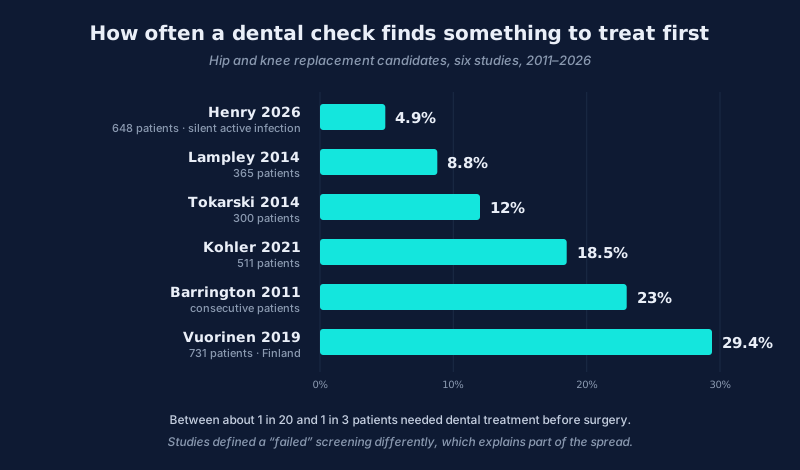
What this means for you: a meaningful share of people who feel fine have a dental problem that needs attention, and patients who smoke, have had a root canal or have not seen a dentist recently are more likely to be among them. Seeing your dentist early, rather than in the last week before surgery, leaves time to treat anything that turns up.
Does screening lower the infection rate?
This is where the evidence is weakest. No randomized trial has compared joint replacement patients who had dental screening with those who did not. The available studies compare groups of patients treated at different hospitals or in different years, and they disagree.
Studies that found no difference
The largest is a 2023 US study that matched 8,654 patients who had routine dental clearance with 8,654 who did not. Joint infection within 90 days occurred in 0.30% of the screened patients and 0.24% of the unscreened patients, a difference too small to be meaningful. The bacteria causing the infections that did occur were similar in both groups.8 Two smaller US studies also found no link between dental evaluation or extraction and infection: one of 2,457 joint replacements, and one that compared 365 screened elective patients with 218 unscreened patients having a joint replacement for a hip fracture.9,7
A study that found a benefit
A German hospital began referring every joint replacement patient to their own dentist with a standard form in 2020. Comparing 1,227 patients after the change with 1,333 before it, early joint infection in the first month fell from 1.8% to 0.8%.10 That is about one infection prevented for every 100 patients screened. The study measured only the first four weeks, and other changes at the hospital over those years could have contributed.
Pooling the studies
A 2024 analysis combined five studies with 23,175 patients. Screening was associated with a slightly lower infection rate, but the result was not statistically reliable. The authors estimated a 69% probability that screening reduces infection and concluded that it remains unknown whether it helps.11
What this means for you: the research has not proven that a routine dental check prevents joint infections, and it has not proven that it doesn’t. Because infection after joint replacement is uncommon, a study would need tens of thousands of patients to settle the question, and the studies done so far were not designed to do so.
What the 2024 guideline says
In November 2024, the AAOS and AAHKS adopted a guideline on dental care and hip and knee replacement, developed with dental specialists.3 Its main points are:
- Dental screening: routine screening before surgery “may not reduce” the risk of joint infection. The guideline rates the evidence as low quality and the statement as a limited-strength option, not a firm recommendation.
- Antibiotics before dental work after a joint replacement: routine antibiotics “may not reduce” the risk of infection, also based on low-quality evidence.
- Antiseptic mouth rinse: not necessary before dental work.
- Timing: how long to wait between dental work and joint replacement depends on how invasive the dental procedure is and whether there is an active infection. These intervals are the expert panel’s opinion, since no study has tested them.
How to time dental work
The guideline’s timing table is the most practical part for patients. A routine cleaning, filling, crown or root canal can be done as late as the day before surgery. A deep cleaning (scaling and root planing) should be finished at least a week before. An extraction or other oral surgery, including dental implants, should be done at least three weeks before, to give the gums time to heal. If you have an active dental infection, the knee replacement should wait until at least three weeks after the infection has resolved.3
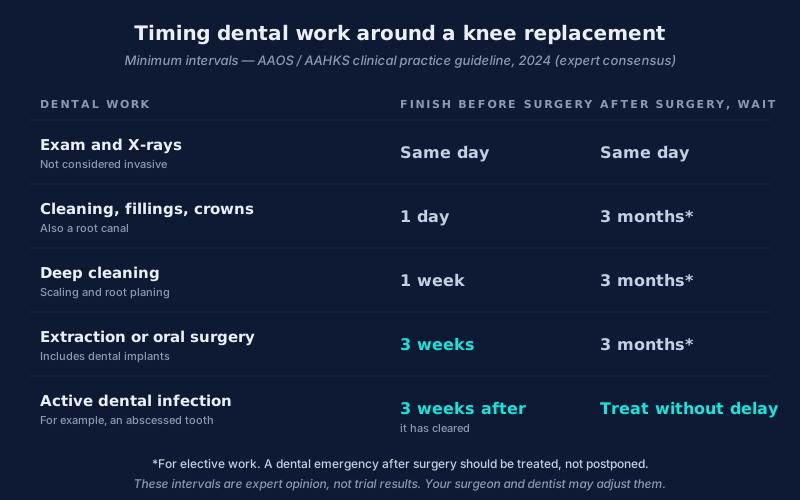
After surgery, the guideline suggests waiting about three months before elective dental work, because the risk of bacteria seeding a new joint appears highest in the first few months. A dental infection or emergency after surgery should be treated promptly rather than postponed.3
What this means for you: if your dentist recommends an extraction, schedule it at least three weeks before your surgery date. Get your routine cleaning done before surgery, and plan the next one for about three months afterward.
Do I need antibiotics at the dentist after my knee replacement?
For most patients, the major guidelines say no. In 2015, the American Dental Association concluded that “in general,” antibiotics are not recommended before dental procedures for patients with joint implants, while noting that some medical circumstances may warrant them.12 The 2024 orthopedic guideline reached a similar conclusion.3
The research behind this is consistent. A Mayo Clinic study compared 339 patients with a hip or knee infection with 339 joint replacement patients without one, and found that dental procedures were not a risk factor for infection, and that antibiotics before dental work did not lower the risk.13 A 2026 analysis of four studies with 157,466 patients found no reduction in joint infection with antibiotics before dental work, and noted the risks of unnecessary antibiotics, including side effects and resistance.14
There are exceptions. A 2025 AAOS appropriate use tool rates whether antibiotics make sense in several different patient scenarios, so that surgeons and dentists can decide case by case.15 If you take medications that suppress the immune system, have had a joint infection before, or have other serious medical conditions, ask your surgeon and dentist whether you are one of those exceptions.
What this means for you: many patients were told years ago to take antibiotics before every dental visit for life. That advice has changed for most people. Check with your surgeon rather than assuming either way.
Strengths of this evidence
- The guideline was developed with dentists. The AAOS and AAHKS panel included dental specialists, and its conclusions on antibiotics agree with the American Dental Association’s.
- The screening studies count real findings. The percentages of patients with dental problems come from dentists examining every patient, not from questionnaires.
- The antibiotic question has a large evidence base. A prospective case-control study and a pooled analysis of more than 150,000 patients point in the same direction.
Where I’d push back on the data
- “May not reduce” is not “does not reduce.” The guideline’s screening statement rests on low-quality studies. It describes the absence of proof, not proof of no effect.
- The studies are underpowered for a rare outcome. With joint infection rates well under 2%, a study of a few thousand patients can easily miss a real reduction of a third or a half.
- Unscreened groups are not untreated mouths. Patients in the “no clearance” groups were not necessarily without dental care. Many may see a dentist regularly anyway, which would narrow any difference the studies can detect.
- The guideline agrees on the main point. Even while questioning routine screening, the guideline advises treating an active dental infection before surgery. An infection with no symptoms, found in about 1 in 20 patients in the 2026 study, can only be treated if someone looks for it.2
- Screening has costs. A dental visit, X-rays and any needed treatment cost time and money, and an extraction close to the surgery date can delay the operation. These costs are real and worth weighing.
What this means in my practice
I expect dental clearance before a joint replacement, because active decay or a bacterial infection in the mouth can raise the risk of joint infection. The guideline’s own advice to treat active infections first supports that step, and the screening studies show that these problems are common in people who feel well.
1. See your dentist early
When we schedule a knee replacement, I encourage patients to book a dental visit right away rather than close to the surgery date. If you need an extraction, that leaves the three weeks of healing the guideline suggests without moving your surgery.
2. Your dentist confirms there is no active infection
Dental clearance usually means a note from your own dentist that your mouth has no active infection or untreated decay that needs attention before surgery. A routine cleaning is helpful but is not what clearance is about.
3. Dental care continues after surgery
Good dental health protects the new joint for its whole life, not just before the operation. Plan your next routine cleaning for about three months after surgery, and do not put off treatment if a tooth becomes infected. Ask about antibiotics before dental work based on your own health, not on older blanket rules.
Who this evidence fits, and who it doesn’t
Closest fit: a patient having a first knee or hip replacement who is otherwise in reasonable health.
Less certain fit: patients with a weakened immune system, a previous joint infection, a revision replacement or poorly controlled diabetes, for whom the guidelines offer less certainty and the decision is more individual.
The bottom line for the layperson
- An active infection in the mouth can send bacteria to a new joint, so it should be treated before a knee replacement.
- A dental check finds a problem needing treatment in roughly 1 in 20 to 1 in 3 people preparing for joint replacement.
- Studies have not settled whether routine screening lowers infection rates, but the guideline agrees that active infections should be treated first.
- If you need a tooth pulled, have it done at least three weeks before surgery, and wait about three months after surgery for routine dental work.
- Most people no longer need antibiotics before dental work after a joint replacement, but ask your surgeon whether you are an exception.
If you are preparing for a knee replacement, you can read more about the top questions patients ask and what’s normal after a knee replacement, or request a visit to start planning.
Sources
- Vuorinen M, Mäkinen T, Rantasalo M, et al. “Incidence and risk factors for dental pathology in patients planned for elective total hip or knee arthroplasty.” Scand J Surg. 2019;108(4):338–342. DOI: 10.1177/1457496918816911 (PMID: 30501477)
- Henry JP, Giordano J, Huyke-Hernandez FA, et al. “Safety of Total Joint Arthroplasty Following Treatment of Asymptomatic Dental Infections.” J Knee Surg. Published online April 21, 2026. DOI: 10.1055/a-2851-0983 (PMID: 42013875)
- Fillingham YA, Hannon CP, Jevsevar DS, et al. “AAOS Clinical Practice Guideline Summary: Prevention of Total Hip and Knee Arthroplasty Periprosthetic Joint Infection in Patients Undergoing Dental Procedures.” J Am Acad Orthop Surg. 2025;33(21):e1260–e1267. DOI: 10.5435/JAAOS-D-25-00458 (PMID: 40743492). Full guideline adopted by the AAOS and AAHKS, November 18, 2024.
- Kohler JG, Holte AJ, Glass NA, et al. “Dental Screening in Elective Total Joint Arthroplasty: Risk Factors for Failure.” J Arthroplasty. 2021;36(5):1548–1550. DOI: 10.1016/j.arth.2020.12.026 (PMID: 33478892)
- Tokarski AT, Patel RG, Parvizi J, Deirmengian GK. “Dental clearance prior to elective arthroplasty may not be needed for everyone.” J Arthroplasty. 2014;29(9):1729–1732. DOI: 10.1016/j.arth.2014.04.018 (PMID: 24851786)
- Barrington JW, Barrington TA. “What is the true incidence of dental pathology in the total joint arthroplasty population?” J Arthroplasty. 2011;26(6 Suppl):88–91. DOI: 10.1016/j.arth.2011.03.036 (PMID: 21723698)
- Lampley A, Huang RC, Arnold WV, Parvizi J. “Total joint arthroplasty: should patients have preoperative dental clearance?” J Arthroplasty. 2014;29(6):1087–1090. DOI: 10.1016/j.arth.2013.11.019 (PMID: 24418769)
- Kwan SA, Lau V, Fliegel BE, et al. “Routine Preoperative Dental Clearance for Total Joint Arthroplasty: Is There a Benefit?” Cureus. 2023;15(7):e41352. DOI: 10.7759/cureus.41352 (PMID: 37546155)
- Sonn KA, Larsen CG, Adams W, Brown NM, McAsey CJ. “Effect of Preoperative Dental Extraction on Postoperative Complications After Total Joint Arthroplasty.” J Arthroplasty. 2019;34(9):2080–2084. DOI: 10.1016/j.arth.2019.04.056 (PMID: 31138503)
- Fenske F, Kujat B, Krause L, et al. “Preoperative dental screening can reduce periprosthetic infections of hip and knee endoprostheses in the first month after surgery: results of a cohort study.” Infection. 2024;52(2):535–543. DOI: 10.1007/s15010-023-02128-2 (PMID: 38060067)
- Putowski Z, Miłobędzka M, Kisiołek M, et al. “Preoperative dental assessment for the reduction of periprosthetic joint infections in patients undergoing total joint replacement: a systematic review and meta-analysis.” Anaesthesiol Intensive Ther. 2024;56(4):217–223. DOI: 10.5114/ait.2024.145278 (PMID: 39917967)
- Sollecito TP, Abt E, Lockhart PB, et al. “The use of prophylactic antibiotics prior to dental procedures in patients with prosthetic joints: Evidence-based clinical practice guideline for dental practitioners — a report of the American Dental Association Council on Scientific Affairs.” J Am Dent Assoc. 2015;146(1):11–16.e8. DOI: 10.1016/j.adaj.2014.11.012 (PMID: 25569493)
- Berbari EF, Osmon DR, Carr A, et al. “Dental procedures as risk factors for prosthetic hip or knee infection: a hospital-based prospective case-control study.” Clin Infect Dis. 2010;50(1):8–16. DOI: 10.1086/648676 (PMID: 19951109)
- Mullen MT, Urvater MK, Hillis E, et al. “Antibiotic Prophylaxis for Dental Procedures Following Total Joint Arthroplasty: A Systematic Review and Meta-Analysis.” J Arthroplasty. 2026;41(5):1590–1596. DOI: 10.1016/j.arth.2025.08.079 (PMID: 40935345)
- Grosso MJ, Patton LL, Nelson SB, et al. “American Academy of Orthopaedic Surgeons Appropriate Use Criteria: Prevention of Orthopaedic Implant Infection in Patients Undergoing Dental Procedures.” J Am Acad Orthop Surg. 2026;34(19):e2631–e2637. DOI: 10.5435/JAAOS-D-25-01335 (PMID: 42228903)
This article reflects Dr. Dewan's reading of the cited evidence at the time of publication. It is educational content, not medical advice. Your specific case may differ — schedule a consultation to discuss your imaging and history.