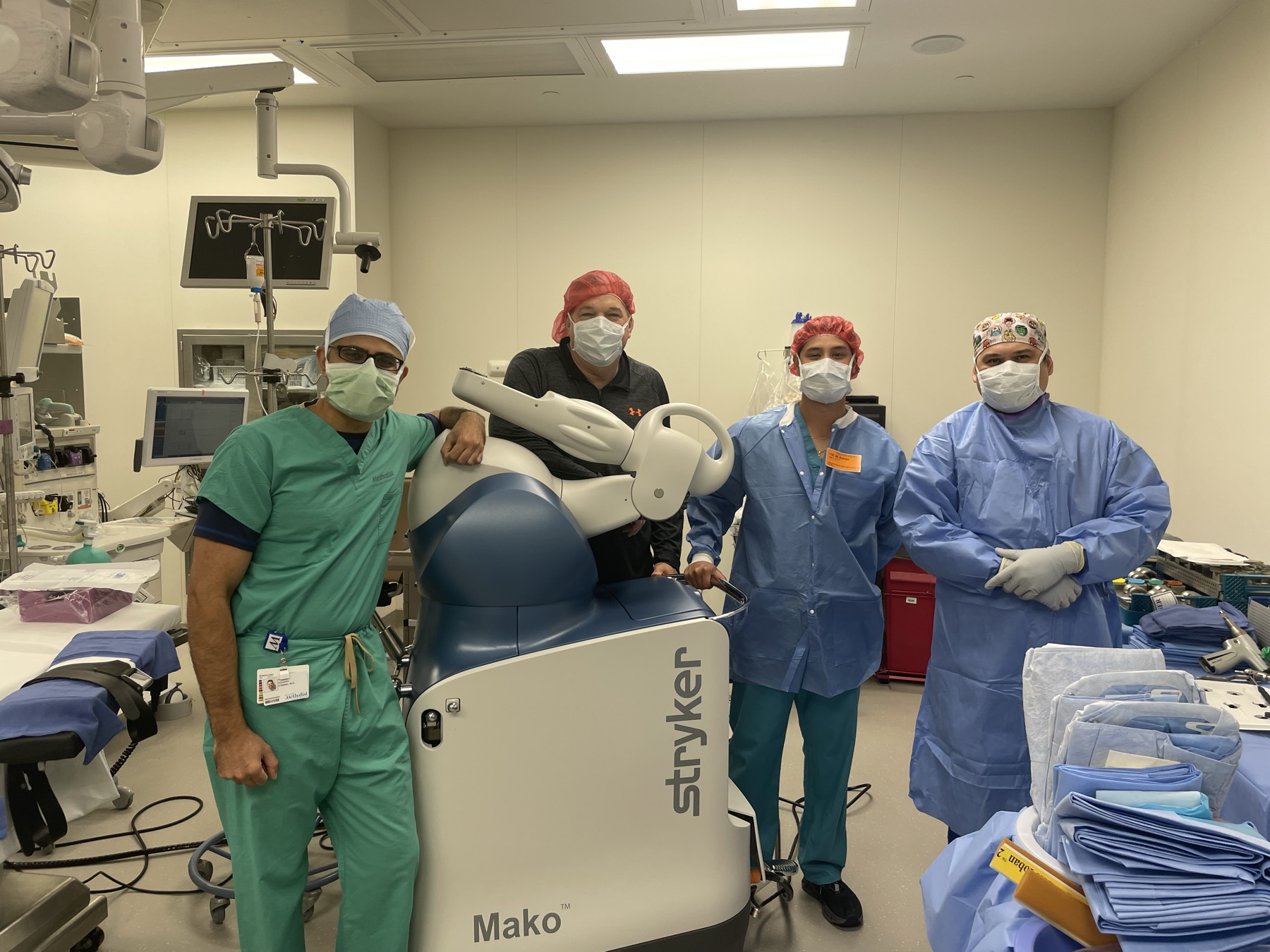
For most patients, the brand of robot matters much less than the surgeon using it. The major knee replacement robots (Mako, ROSA, VELYS and CORI) differ in how they map your knee and how they guide the bone cuts. The studies that compare them directly find small differences in how closely each system matches its own plan, and no difference in pain, function or satisfaction that lasts beyond the first few months. Two large studies published in the past two months make the point more broadly. A UK national registry analysis in the BMJ on September 30 found the same five-year implant survival for robotic and conventional knee replacement,1 and the RACER-Knee trial in The Lancet found no meaningful difference in how patients rated their knee a year after surgery.2
This article explains how the systems differ, what the planning CT scan for Mako is for, what the head-to-head studies show, and what questions are more useful to ask than which robot a surgeon uses.
Why this matters to you
Patients researching knee replacement now see robot brand names in hospital advertising, on surgeon websites and in online forums. It is natural to assume that one robot must be the best, and to choose a surgeon or hospital on that basis. Some patients are also told they need a CT scan before surgery and want to know why a friend who had a robotic knee replacement elsewhere did not. These are reasonable questions, and the evidence gives a clearer answer than the marketing does.
What a knee replacement robot does
A robot does not perform the operation. In every system on the US market, the surgeon makes the incision, exposes the joint, balances the ligaments and places the implants. The robot helps with two things: building a precise map of your knee, and keeping the bone cuts within the plan the surgeon sets from that map. The implant itself is the same type of metal and plastic knee replacement used without a robot.
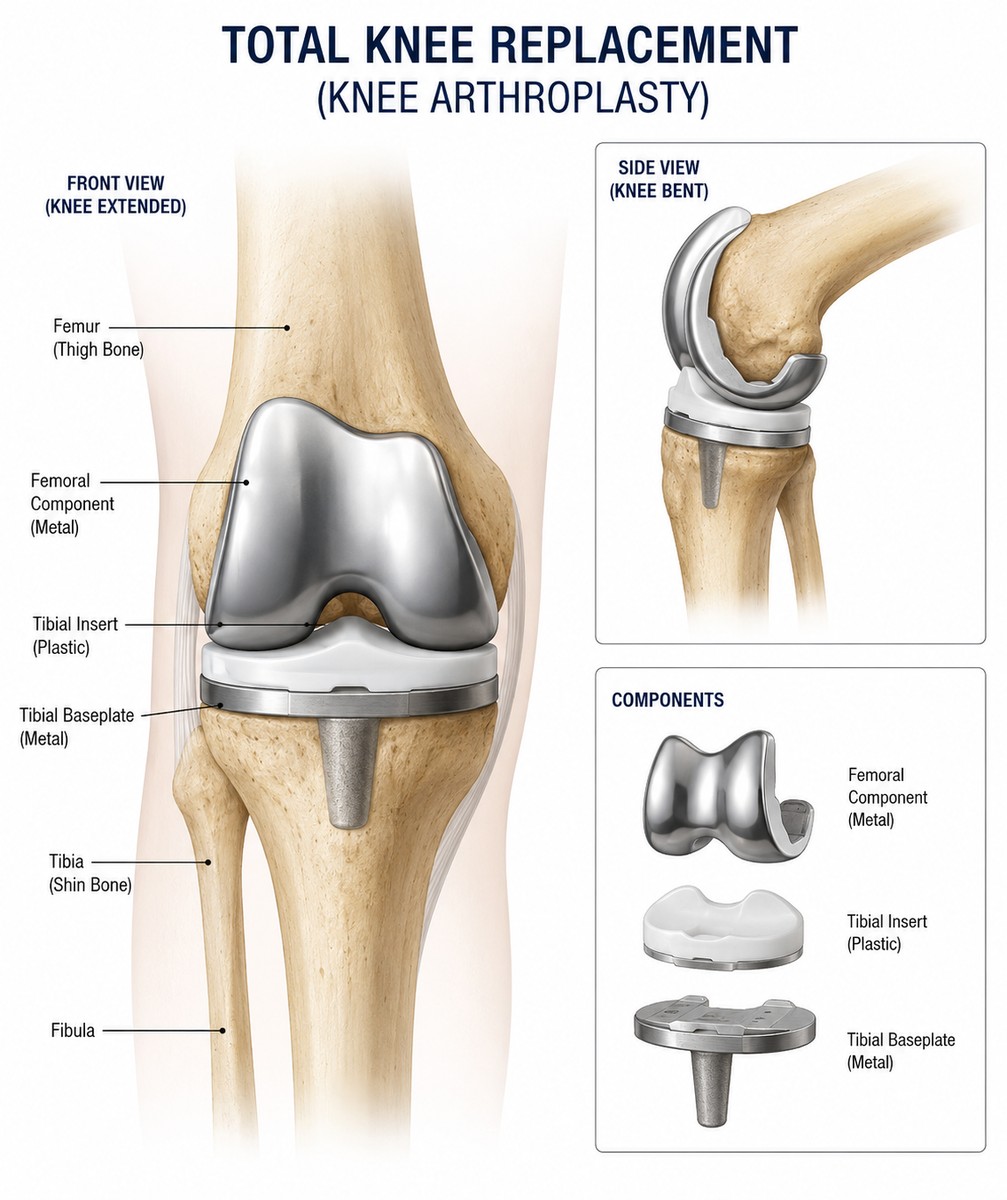
Each robot is also designed to work with its own manufacturer’s knee implants. Choosing a robot usually means choosing an implant family as well, and those implants have their own track records in joint registries.
How the systems differ
Reviews of robotic knee surgery group the systems by two features: whether they need a scan before surgery, and how they guide the cut.3,4
CT-based: Mako
The Mako system (Stryker) uses a CT scan of your leg taken a few weeks before surgery. The scan is turned into a 3D model of your bones, and the surgeon plans implant size and position on that model before the operation. During surgery, the robotic arm holds the saw and creates a boundary, so the blade stops if it moves outside the planned cut. Reviews describe this boundary as keeping bone removal within about half a millimeter of the plan.3
Imageless or X-ray based: ROSA and VELYS
ROSA (Zimmer Biomet) and VELYS (DePuy Synthes) do not need a CT scan. The surgeon maps the knee during the operation by touching points on the bone with a tracked pointer, and the system builds its model from those points. ROSA can also use a set of standard X-rays before surgery. The ROSA arm positions a cutting guide, and the surgeon makes the cut through that guide. VELYS is described in the literature as an imageless system in which a table-mounted unit guides the saw.3,5
Handheld: CORI
CORI (Smith+Nephew) is a handheld tool rather than an arm. The knee is mapped during surgery, and a handheld burr shaves bone, retracting or stopping when it reaches the edge of the planned area.3
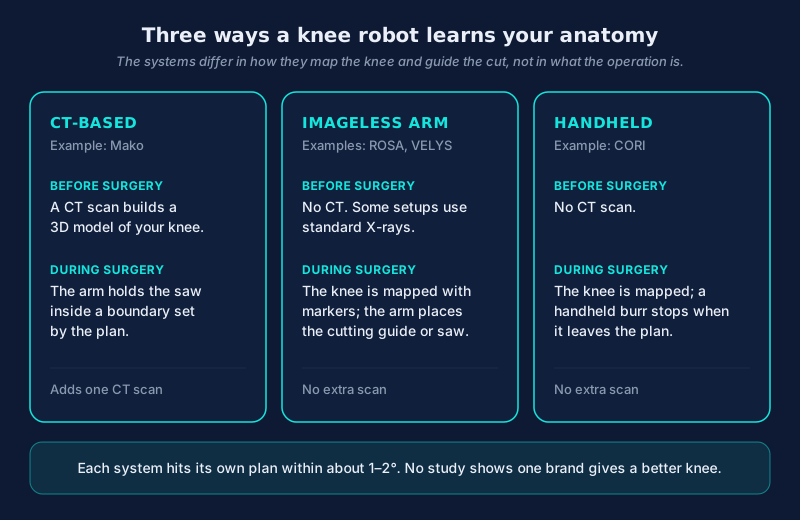
What this means for you: the choice between systems is mainly a choice about whether a CT scan is part of the planning, and how the cut is controlled. All of them are used to perform the same operation.
The planning CT scan: what it is for, and the radiation
If your surgeon uses Mako, you will have a CT scan of the hip, knee and ankle before surgery. The scan lets the surgeon see the shape of your bones in three dimensions, including rotation and the slope of the shin bone, which are harder to judge on standard X-rays. A 2026 overview of image-based and imageless systems found that both types are similarly accurate for the side-to-side alignment of the leg, and that image-based systems may define rotation and tibial slope more precisely.4
The CT scan does involve radiation. The most widely cited measurement comes from 236 planning scans for robotic partial knee replacement, published in 2015, which found an average effective dose of 4.8 millisieverts, with a threefold difference between hospitals depending on how the scanner was set up.6 In that study, about one patient in four needed at least one repeat scan. Scanning protocols have been refined since, and dose depends on the scanner and the protocol each imaging center uses. For most adults having a knee replacement this is a modest, one-time exposure, but it is a real difference between the systems, and it is reasonable to ask about it.
What this means for you: the CT scan is part of the planning, not a separate test for a separate problem. If you have had a recent CT of the same leg, or have concerns about radiation, raise it before the scan is scheduled.
What the head-to-head studies show
No randomized trial has compared one robot brand with another. The evidence comes from smaller comparative studies at single hospitals and from pooled analyses.
Accuracy
The largest direct comparison of cut accuracy, published in March 2026, studied 161 Mako and 110 ROSA knee replacements at one hospital in Singapore.7 It compared each implant’s position on X-rays at three months with the plan made during surgery. The thigh-bone (femoral) component landed within 1 degree of the plan in 62% of Mako knees compared with 37% of ROSA knees. There was no difference for the shin-bone component. The authors noted that the average gap between plan and result was under half a degree for both systems, and that whether this matters clinically is unknown.
A randomized trial published in June compared two ways of using the same robot: ROSA without any imaging and ROSA with X-ray-based planning, in 95 patients.8 Both reached the plan with the same accuracy, and patients recovered the same way over the first 12 weeks.
A 2025 meta-analysis pooled five studies that compared image-based robots with image-free robots.9 It found no significant difference in alignment outliers (knees that land well off target) or in complications, and no study in the review showed better patient-reported results with image-based systems.
Patient outcomes
A 2026 network meta-analysis compared nine robotic systems and conventional surgery across 36 studies and 2,841 patients.10 The rankings were scattered. Mako ranked highest on one function score, CORI on range of motion, ROSA on another knee score, and a different system on leg alignment. Conventional surgery was the fastest. No system ranked best across the board, which is the pattern you would expect if the differences between brands are small.
Small single-center studies comparing Mako and ROSA have found either a modest early difference in a function score at six months that was gone by one and two years, or no difference in function at one year.12,13 Mako operations took somewhat longer than ROSA operations in one small study, though a pooled analysis of three studies found the difference was not statistically reliable.13,14
VELYS and CORI
VELYS is the newest of the major systems, cleared in the US in 2021. A 2026 scoping review of 22 VELYS studies found no randomized trials, no long-term data and evidence of moderate to poor quality. In 64% of those studies, at least one author reported a financial relationship with the manufacturer.5 That does not mean the system performs poorly. It means there is not yet enough independent evidence to compare it fairly with older systems.
A 2023 systematic review made the same point more broadly: the amount and quality of evidence differ widely by system, only a few systems have published complication and revision data, and each robot “must be assessed for its own value” rather than grouped under the single word “robotic.”11
The bigger question: robot or no robot
Comparisons between brands sit inside a larger question that I cover in a separate article: is robotic knee replacement better than conventional surgery at all? The two newest large studies point the same way. In the UK national registry study, 22,111 robotic knee replacements were matched with conventional ones; five-year implant survival was 98.6% with robotic surgery and 98.5% without.1 In RACER-Knee, 339 patients were randomly assigned to Mako or conventional surgery without knowing which they had, and their scores for how natural the knee felt at one year were essentially the same.2
If the robot as a category has not been shown to produce a better knee a year or five years later, it is unlikely that the choice between one robot and another will. Robotic systems do reliably improve how consistently the implants are placed, and that is a reasonable reason for a surgeon to use one. It is not, on current evidence, a reason for a patient to choose one brand over another.
Strengths of this evidence
- The large comparisons are independent. The UK registry study declared no outside funding, and RACER-Knee was funded by the UK National Institute for Health and Care Research. Neither was paid for by a robot manufacturer.
- The ROSA trial was randomized and double-blinded. Comparing imaging and no imaging on the same robot isolates the effect of the CT question from the effect of the brand.
- The accuracy findings are consistent. Every comparison finds each system reaching its plan within about 1 to 2 degrees, regardless of brand.
Where I’d push back on the data
- Accuracy is measured against each robot’s own plan. A system can match its plan closely and still have been given a plan that was not ideal. None of these studies measures whether the plan itself was right for the patient.
- The head-to-head studies are small and come from single centers. The largest has 271 patients at one hospital. Differences in surgeon experience, implant design and learning curve are mixed in with differences between the robots.
- Brand comparisons also compare implants. Because each robot uses its own maker’s implants, a difference in outcome could come from the implant rather than the robot. The studies cannot separate the two.
- The registry data do not break results down by brand. The UK and US registry studies treat “robotic” as one group. Brand-specific long-term survival data do not yet exist.
- The radiation figure is dated. The 4.8 millisievert average comes from 2015 partial-knee scans. A more recent comparison of radiation across robotic systems reported dose in different units, and no study has published a current measurement of an optimized Mako protocol in effective dose.
What this means in my practice
I perform robotic-arm-assisted knee replacement with the Mako system and have used it since 2016. Mako is a CT-based system, so I plan implant size, position and rotation on a 3D model of each patient’s own bones before surgery. That reflects how this system works, not a claim that patients of surgeons using other systems do worse. The evidence above does not support that claim, and surgeons using ROSA, VELYS or CORI achieve accurate results.
Two practical points come up often. I do not charge a robotic upgrade fee; robotic assistance is part of how I perform the operation. The planning CT scan is billed to your health insurance like other imaging, so the usual deductible or coinsurance can apply.
Questions more useful than “which robot?”
When patients ask which robot I use, I encourage them to ask every surgeon they see the following as well:
- How many knee replacements do you perform each year, with or without a robot?
- How long have you used this system?
- Which implant will you use, and how has it performed in the joint registries?
- Will I need a CT scan, and is there any extra charge for robotic assistance?
- What does recovery look like in your practice, and who do I call if something seems wrong?
Who this evidence fits, and who it doesn’t
It fits a patient with typical knee arthritis comparing surgeons who use different robots. For that patient, the surgeon’s experience and the overall care plan matter more than the brand.
It fits less well a patient with unusual anatomy, such as a significant deformity, prior fracture or hardware in the leg. In those cases, detailed preoperative imaging may help the surgeon plan, and it is worth asking how your surgeon will handle the specific problem in your knee.
The bottom line for the layperson
- Mako, ROSA, VELYS and CORI differ in how they map the knee and guide the cut, but they all help the surgeon perform the same operation.
- Mako uses a CT scan before surgery; the others map the knee during surgery and do not need one.
- Studies comparing brands find small differences in accuracy and no lasting difference in pain, function or satisfaction.
- Large new studies show robotic and conventional knee replacements last about the same, so the brand is unlikely to change your long-term result.
- Ask about your surgeon’s experience, the implant, the CT scan and any extra fees rather than choosing by robot brand.
If you are weighing robotic knee replacement, you can read more about what the robot does and does not improve and how I perform robotic knee replacement, or request a visit to go over your own imaging.
Sources
- Mohammad HR, Judge A, Griffin XL, Murray DW. “Early national comparison of robotic versus conventional knee replacements for arthritis using National Joint Registry data: target trial emulation study.” BMJ. 2026;394:e100691. DOI: 10.1136/bmj-2026-100691 (PMID: 42815981)
- Parsons H, Metcalfe A, Griffin J, et al. “Robotic-arm-assisted versus conventional total knee replacement (RACER-Knee): a pragmatic, multicentre, participant-masked and assessor-masked, superiority, randomised controlled trial.” Lancet. 2026;408(10558):924–934. DOI: 10.1016/S0140-6736(26)00986-4 (PMID: 42624811)
- St Mart JP, Goh EL. “The current state of robotics in total knee arthroplasty.” EFORT Open Rev. 2021;6(4):270–279. DOI: 10.1302/2058-5241.6.200052 (PMID: 34040804)
- Vermue H, Batailler C, Lustig S. “Differences between image-based and imageless robotics for total knee arthroplasty – an overview.” J Orthop. 2026;71:23–28. DOI: 10.1016/j.jor.2025.08.045 (PMID: 41089350)
- Morrison SR, Hall AJ, Clement ND, et al. “Use of the VELYS Robotic-Assisted Solution in knee arthroplasty: A scoping review.” J Exp Orthop. 2026;13(2):e70726. DOI: 10.1002/jeo2.70726 (PMID: 42016448)
- Ponzio DY, Lonner JH. “Preoperative Mapping in Unicompartmental Knee Arthroplasty Using Computed Tomography Scans Is Associated with Radiation Exposure and Carries High Cost.” J Arthroplasty. 2015;30(6):964–967. DOI: 10.1016/j.arth.2014.10.039 (PMID: 25840872)
- Liong SS, Lee WC, Khoo SKM, et al. “A comparative study between two commonly used robotic systems on the accuracy of the intraoperative cuts in total knee arthroplasty.” Musculoskelet Surg. Published online March 8, 2026. DOI: 10.1007/s12306-026-00950-z (PMID: 41796279)
- Narkbunnam R, Chorunchan Y, Chareancholvanich K, et al. “Imageless and image-based robotic-assisted total knee arthroplasty achieve equivalent radiographic accuracy: A randomised controlled trial.” Knee Surg Sports Traumatol Arthrosc. 2026;34(6):2167–2179. DOI: 10.1002/ksa.70123 (PMID: 41123580)
- Saeed AZ, Faraz A, Davies PSE, et al. “Do image-based robotic TKR systems improve radiological or clinical outcomes compared to image-free systems? A systematic review and meta-analysis.” J Robot Surg. 2025;20(1):87. DOI: 10.1007/s11701-025-03005-w (PMID: 41392220)
- Yong J, Li H, Wu Z, et al. “Safety and efficacy of robot-assisted total knee arthroplasty: a network meta-analysis and systematic review.” J Orthop Surg Res. 2026;21(1):377. DOI: 10.1186/s13018-026-06889-y (PMID: 42070047)
- Vermue H, Batailler C, Monk P, et al. “The evolution of robotic systems for total knee arthroplasty, each system must be assessed for its own value: a systematic review of clinical evidence and meta-analysis.” Arch Orthop Trauma Surg. 2023;143(6):3369–3381. DOI: 10.1007/s00402-022-04632-w (PMID: 36153769)
- Sherif B, Baek G, Lee JW, et al. “Multiple Robotic-Assisted Systems Versus Conventional Total Knee Arthroplasty: A Comparison of Two-Year Clinical Outcomes.” Cureus. 2026;18(3):e105795. DOI: 10.7759/cureus.105795 (PMID: 42037930)
- Zhou G, Wang X, Geng X, et al. “Comparison of Alignment Accuracy and Clinical Outcomes between a CT-Based, Saw Cutting Robotic System and a CT-Free, Jig-guided Robotic System for Total Knee Arthroplasty.” Orthop Surg. 2024;16(5):1168–1174. DOI: 10.1111/os.14055 (PMID: 38584130)
- Weissman B, Ma TY, Shen K, et al. “A Comparison of Operative Time Between Robotic Surgical Assistant (ROSA) and MAKO Robotic-Assisted Total Knee Arthroplasty: A Meta-Analysis.” Cureus. 2025;17(9):e92933. DOI: 10.7759/cureus.92933 (PMID: 41133086)
This article reflects Dr. Dewan's reading of the cited evidence at the time of publication. It is educational content, not medical advice. Your specific case may differ — schedule a consultation to discuss your imaging and history.