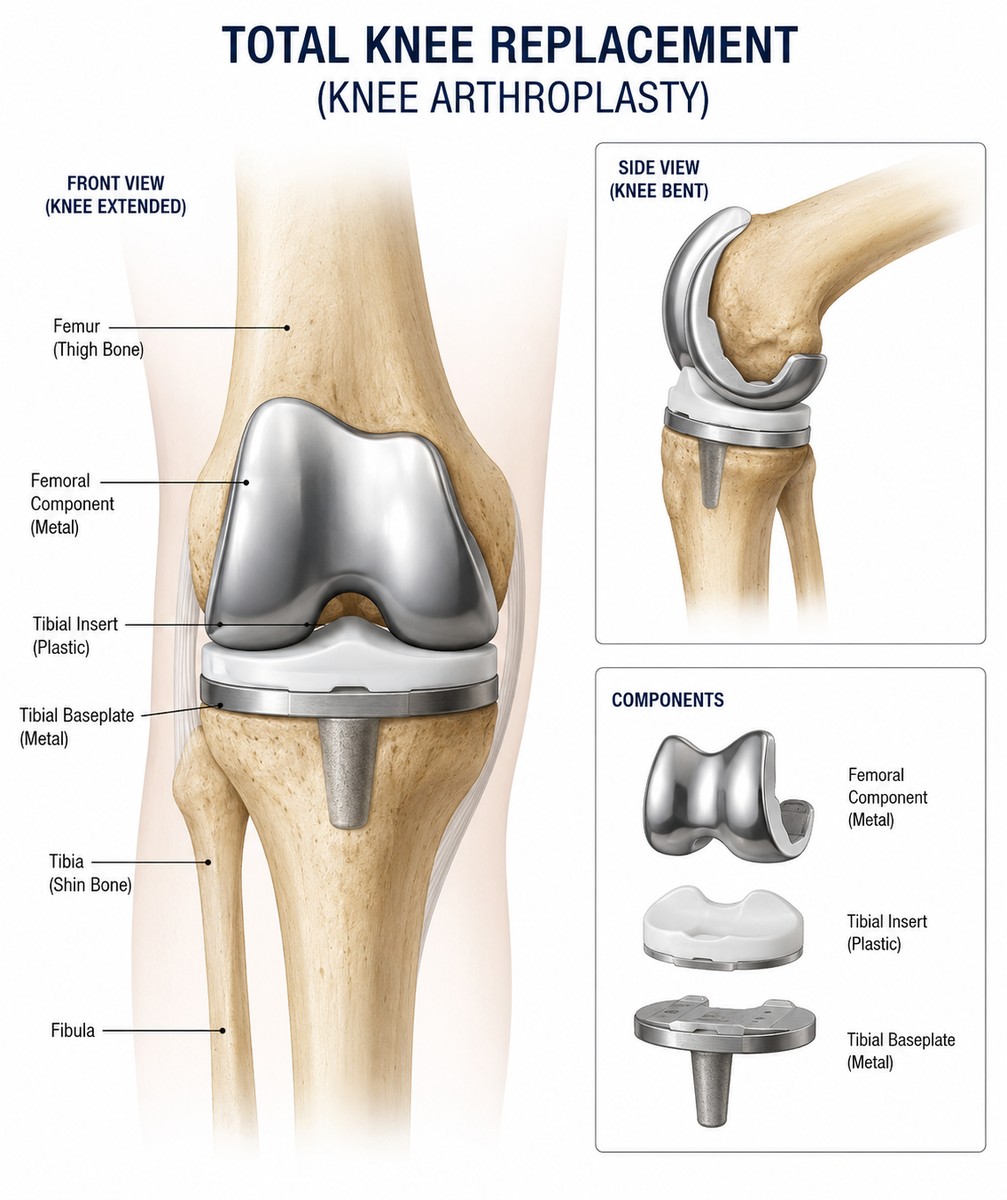
Total knee replacement (or total knee arthroplasty) is one of the most common operations I perform. Every patient has unique concerns, but five questions come up in nearly every consult. Here’s how I answer them.
Do I really need a total knee replacement?
It’s elective — you should only have it when your quality of life is suffering and non-operative care has been exhausted.
A total knee replacement is an elective surgery performed on arthritic knees, considered only once you’ve exhausted other means of managing your pain. If the pain from your arthritis has progressed to the point that your quality of life is suffering, then total knee replacement may be an option for you.
With rare exception, no one has to have a total knee replacement (and don’t let anyone else tell you otherwise). When you’re ready, I tell my patients, you’ll know.
While total knee replacement is very effective at improving function and eliminating pain — more than 95% of patients report excellent outcomes — it is still a major surgery. The complications, while uncommon, can be devastating and shouldn’t be ignored.
How soon after surgery can I walk?
The evening of surgery. Most patients feel ‘comfortable’ walking again at 3 – 6 months.
Total knee replacement is a major surgery — complete recovery can take anywhere from 6 months to a year. Walking, however, is integral to that recovery, and we encourage it as early as the evening after surgery.
Initial walking will be difficult due to the expected pain and discomfort. But walking is important: it strengthens the muscles surrounding the knee, prevents stiffness, and reduces swelling. The first few months are particularly challenging as knee strength and coordination recover. Most patients report somewhere between 3 and 6 months until they begin feeling “comfortable” walking again.
How long will I need rehab?
Plan for 4 – 6 months of formal PT. Participation in the first 8 weeks is directly correlated with outcome.
Rehabilitation and physical therapy are essential for a successful outcome. While individual requirements vary, on average expect at least 4 – 6 months of physical therapy after the surgery.
Immediately after surgery we initiate an aggressive protocol — twice-daily sessions of structured rehab. Therapists and case managers assess your needs and determine whether you’ll benefit from a course of inpatient rehab, home physical therapy, or outpatient PT.
Participation in physical therapy in the first 8 weeks is directly correlated with a successful outcome — no pain, no gain. I try to mentally prepare every patient for the grueling rehabilitation that comes after surgery. Ignoring the rehab could be disastrous and potentially compromise the entire outcome.
When will my knee feel “normal” again?
It won’t feel like your pre-arthritis knee. But the pain reduction transforms function and quality of life.
Despite advancements in implant design, your knee will never feel perfectly “normal” after a total knee replacement. The implant cannot exactly replicate the way a healthy knee moves. You can anticipate knee flexion of about 110 – 120° after surgery, whereas a healthy knee bends up to 130° in some patients. Many manufacturers market high-flexion knee designs that promise greater bend, but in independent studies surgeons have not been able to reproduce those results in actual patients.
So while a knee replacement won’t feel like the knee you had before arthritis, it does accomplish a major reduction in pain — and that translates into better function and quality of life.
Can I play sports after a total knee replacement?
Low-impact activities yes; high-impact (running, cutting) likely shortens implant life.
There are inherent limitations. The implant is made of metal and plastic components that mechanically wear over time. Studies show an appropriately implanted total knee replacement can last 15 – 20 years without problems.
High-impact activities — running, jumping, cutting sports — could theoretically reduce the lifespan of the implant. Lower-impact sports are considered safer: swimming, cycling, golf, bowling, hiking, hunting, and rowing all fit comfortably in that category.
These are the five questions I hear most often. Every case is different, though, and the fastest path to answers specific to your knee is a consult. We also host a monthly free half-day total knee replacement course at the Joint Replacement Center at Houston Methodist Sugar Land Hospital — open to anyone considering surgery.
Sources