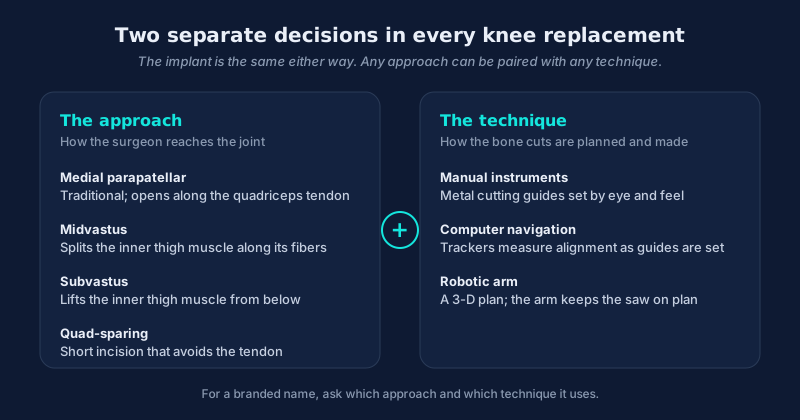
They are not competing options, so neither is better than the other in general. Every knee replacement involves two separate decisions. The first is the approach: the path the surgeon takes through the muscles and tendons to reach the joint. The second is the technique: how the bone cuts are planned and made once the joint is exposed. “Quad-sparing” is an approach. “Robotic” is a technique. A surgeon chooses one of each, so a robotic knee replacement can be done through a muscle-sparing approach.
This article covers each decision in turn: the four approaches, the three techniques, what the studies show about each, and which questions are worth asking your surgeon. A meta-analysis published in the Journal of Arthroplasty in November 2026 reviewed 35 studies of the subvastus approach. It found that a muscle-sparing approach can help patients get moving a day or two sooner, with results at one month to one year similar to the traditional approach.1
Why this matters to you
Patients researching knee replacement see many names in advertising and online forums: quad-sparing, subvastus, mini-incision, muscle-sparing, robotic, and branded names such as “Jiffy.” It is easy to assume these are rival operations and that one must be best. In fact, every total knee replacement involves the same core steps: the worn surfaces of the thigh bone and shin bone are removed and replaced with metal and plastic implants. The names describe one of the two decisions made along the way. Knowing which decision a name refers to makes it easier to compare surgeons and to ask useful questions.
The first decision: the approach
The knee joint sits behind the kneecap, under the quadriceps, the large muscle group at the front of the thigh that straightens the knee. The quadriceps connects to the kneecap through the quadriceps tendon. To replace the joint, the surgeon has to get past this muscle and tendon and move the kneecap aside. There are four main ways to do that.
- Medial parapatellar. The traditional approach, used for decades. The surgeon opens along the inner edge of the quadriceps tendon and kneecap. It gives the widest view of the joint and is the approach most surgeons trained on.
- Midvastus. Instead of cutting along the tendon, the surgeon separates the fibers of the vastus medialis, the inner part of the quadriceps, in the direction they run.
- Subvastus. The surgeon lifts the vastus medialis from underneath, leaving the muscle and the quadriceps tendon intact.
- Quad-sparing. A short incision that avoids the quadriceps tendon and muscle as much as possible. The view of the joint is the most limited of the four.
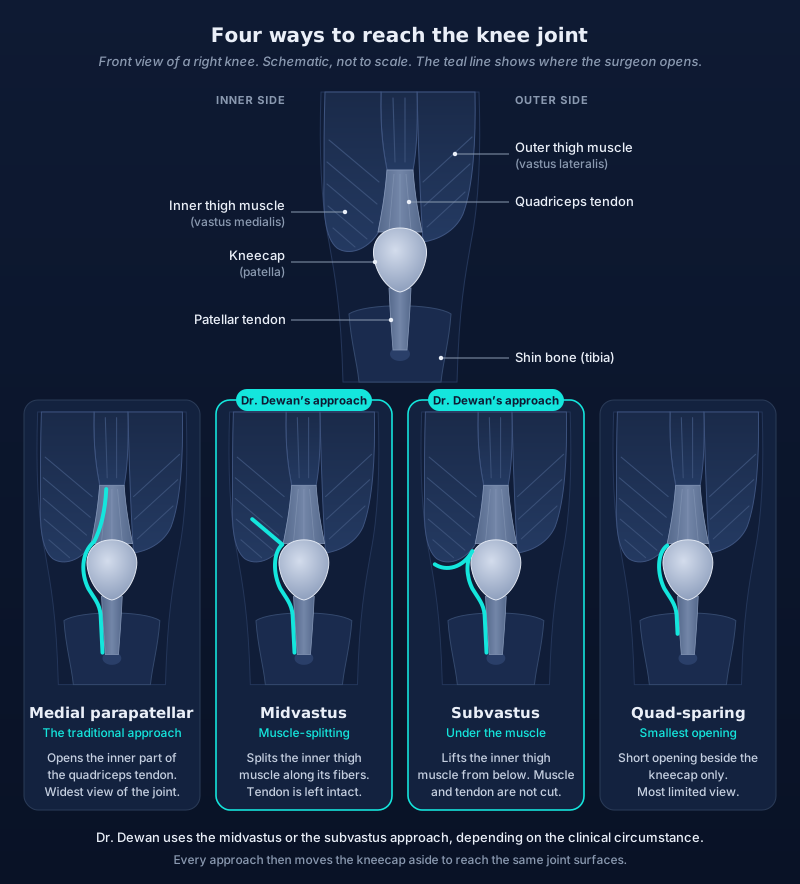
Any of these can be performed through a shorter skin incision. “Mini-incision” and “minimally invasive” usually describe the length of the skin cut and the use of smaller instruments, not a separate approach.
The second decision: the technique
Once the joint is exposed, the worn bone is cut so the implants fit and the leg is aligned. The technique is the method used to plan those cuts and carry them out. There are three main techniques.
- Manual instruments. Metal cutting guides are positioned on the bone using alignment rods, measurements from X-rays and the surgeon’s judgment. This is the conventional technique and was used for most knee replacements in the long-term studies.
- Computer navigation. Trackers attached to the bones let a computer measure the leg’s alignment while the surgeon sets the cutting guides.
- Robotic arm. A 3-D plan of the knee is made before or during surgery, and a robotic arm keeps the saw within the planned boundaries. With the Mako system, the plan is built from a CT scan. Our review of robotic knee replacement covers the evidence on accuracy and long-term outcomes in detail.
The technique does not determine the approach. Each of the three techniques can be used through any of the four approaches, and the implant is the same type in every case.
Where branded names fit: the “Jiffy” knee
Some practices give their method a brand name. The “Jiffy Knee” is the one patients ask about most often. Practices that offer it describe a muscle-sparing method in which the quadriceps muscle and tendon are not cut and the surgeon works underneath the muscle. In the terms used in this article, that is an approach, and it is a version of the subvastus approach. The name does not specify the technique for the bone cuts.
No published studies show that it produces different results from other subvastus surgery, so the evidence that applies to it is the subvastus research covered in the next section.
What this means for you: when you hear a name, ask whether it describes the approach, the technique or both. “Quad-sparing versus robotic” is a comparison of two different things.
What the studies show about the approach
Muscle-sparing and small-incision approaches have been studied in dozens of randomized trials since the early 2000s. The pattern across them is consistent: a modest early benefit, similar results by the first year, and some trade-offs.
A faster start
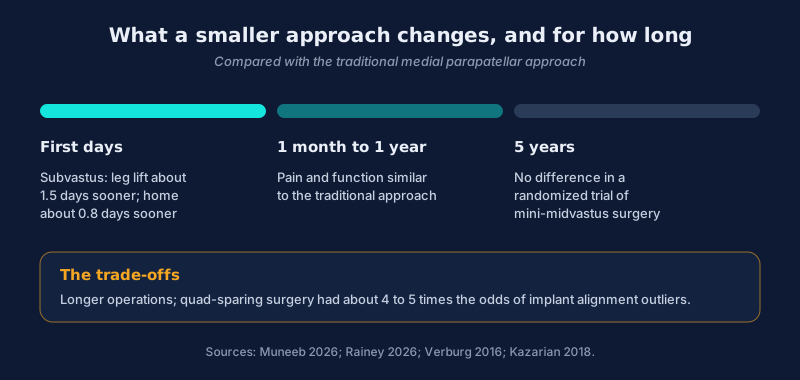
The November 2026 meta-analysis combined 35 studies with 3,392 knees comparing the subvastus approach with the traditional approach.1 Two benefits held up across study types: patients were able to lift the straightened leg off the bed about 1.5 days sooner, and they went home about 0.8 days sooner. The pooled data also favored subvastus for early pain, blood loss and knee scores at three months, but most of those differences were not significant when only randomized trials were counted. Operations took longer with the subvastus approach.
A network meta-analysis published in March 2026, which ranked approaches across 42 randomized trials, reached a similar conclusion: minimally invasive approaches ranked best for early pain and range of motion, while conventional approaches and the subvastus approach ranked best for avoiding complications.2
Similar results after the first months
The early advantage does not last. In the 2026 meta-analysis, outcomes from one month to one year were similar between approaches.1 A systematic review published in August 2026 looked only at high-quality randomized trials from 2010 to 2024. Of 25 trials that measured knee motion, 18 found no difference between approaches. Of 26 that measured patient-reported function, 19 found no difference. The authors concluded that no single approach consistently outperforms the others.3
The longest randomized follow-up comes from a Dutch trial of 100 knees comparing a mini-midvastus approach with the traditional approach.4 The incision was on average 2.5 cm shorter, and the operation took about 6 minutes longer. Function scores were the same at 6 weeks and at one, two and five years. The authors described the advantage of the shorter incision as cosmetic.
The trade-offs
A smaller window into the joint makes the operation technically harder. The concern is malalignment, meaning implants placed outside the target angles, which is linked to earlier wear and loosening in some studies.
- Alignment with quad-sparing surgery. A meta-analysis of 8 randomized trials with 579 knees found that the quad-sparing approach had about 4 to 5 times the odds of thigh bone, shin bone and overall leg alignment falling outside the target range. Operations took longer, and the small gains in function were below the threshold patients would notice. The authors recommended against routine use of the quad-sparing approach.5
- Early warnings with mini-incisions. A 2005 comparison of 30 mini-incision and 30 full-incision knees found that early advantages in pain medication use and motion were gone by three months, while 4 of the 30 mini-incision knees had a shin bone component tilted outside the target range, compared with none of the full-incision knees.6
- Problems from working through a smaller opening. In the Dutch trial, the mini-midvastus group had two small fractures of the thigh bone and one partial tear of the kneecap tendon during surgery, and seven patients developed skin blisters. All seven had relatively large implants, and four were large men.4
What this means for you: a muscle-sparing approach may get you on your feet a day or so sooner. It does not appear to change how your knee works a year later, and the smallest incisions carry a higher risk of imperfect implant placement.
What the studies show about the robotic technique
The robotic technique addresses a different question from the approach: how accurately the bone cuts and implants match the plan. It may also reduce trauma to the tissues around the knee, even through a traditional incision. In a London study of 30 conventional and 30 robotic knee replacements by one surgeon, the robotic knees had less injury to the soft tissues on the inner side of the knee and cleaner bone cuts, judged from photographs taken during surgery.7 A companion study of 40 conventional and 40 robotic knee replacements, all through the traditional medial parapatellar approach, found that the robotic patients had less pain, lifted the straight leg sooner and went home sooner: a median of 77 hours compared with 105 hours.8
The robotic technique can also be paired with a muscle-sparing approach. One series from India describes 120 robotic knee replacements done through a modified subvastus approach, with most patients able to lift the straight leg by the second or third day.9 It had no comparison group, so it shows the combination is feasible rather than that it is better.
What this means for you: the robotic technique is about where the implant ends up. It does not dictate the length of the incision, and it can be combined with either a traditional or a muscle-sparing approach.
Strengths of this evidence
- Many randomized trials. The approach question has been tested in dozens of randomized trials, which is unusual in surgery and allows reliable conclusions about early recovery.
- The findings are consistent. Three reviews published in 2026, using different methods, reach the same picture: a small early benefit for muscle-sparing approaches and similar results after the first months.
- Long-term data exist. The five-year Dutch trial shows that the early differences do not turn into lasting ones.
Where I’d push back on the data
- The robotic tissue-trauma studies are small and not randomized. The London studies included 60 and 80 patients, treated in sequence by one surgeon, and at least one author received benefits from a company with an interest in the subject.8 Patients in the later robotic group may also have benefited from improving recovery protocols.
- Surgeon experience is hard to separate from the approach. Muscle-sparing approaches have a learning curve, and many trials were run by surgeons who specialize in them. Results in other hands may differ.
- Early recovery measures depend on hospital routines. Length of stay and time to straight-leg raise reflect therapy schedules and discharge policies as much as the operation. With today’s rapid-recovery and same-day programs, a one-day difference in hospital stay may matter less than it did in older trials.
- Many trials predate modern protocols. Nerve blocks, numbing medication injected around the joint during surgery, and early walking have narrowed the gap between approaches in the first days.
- The November 2026 meta-analysis mixes study types. Several of its pooled benefits disappeared when only randomized trials were analyzed, so only the hospital-stay and straight-leg-raise findings should be considered reliable.1
What this means in my practice
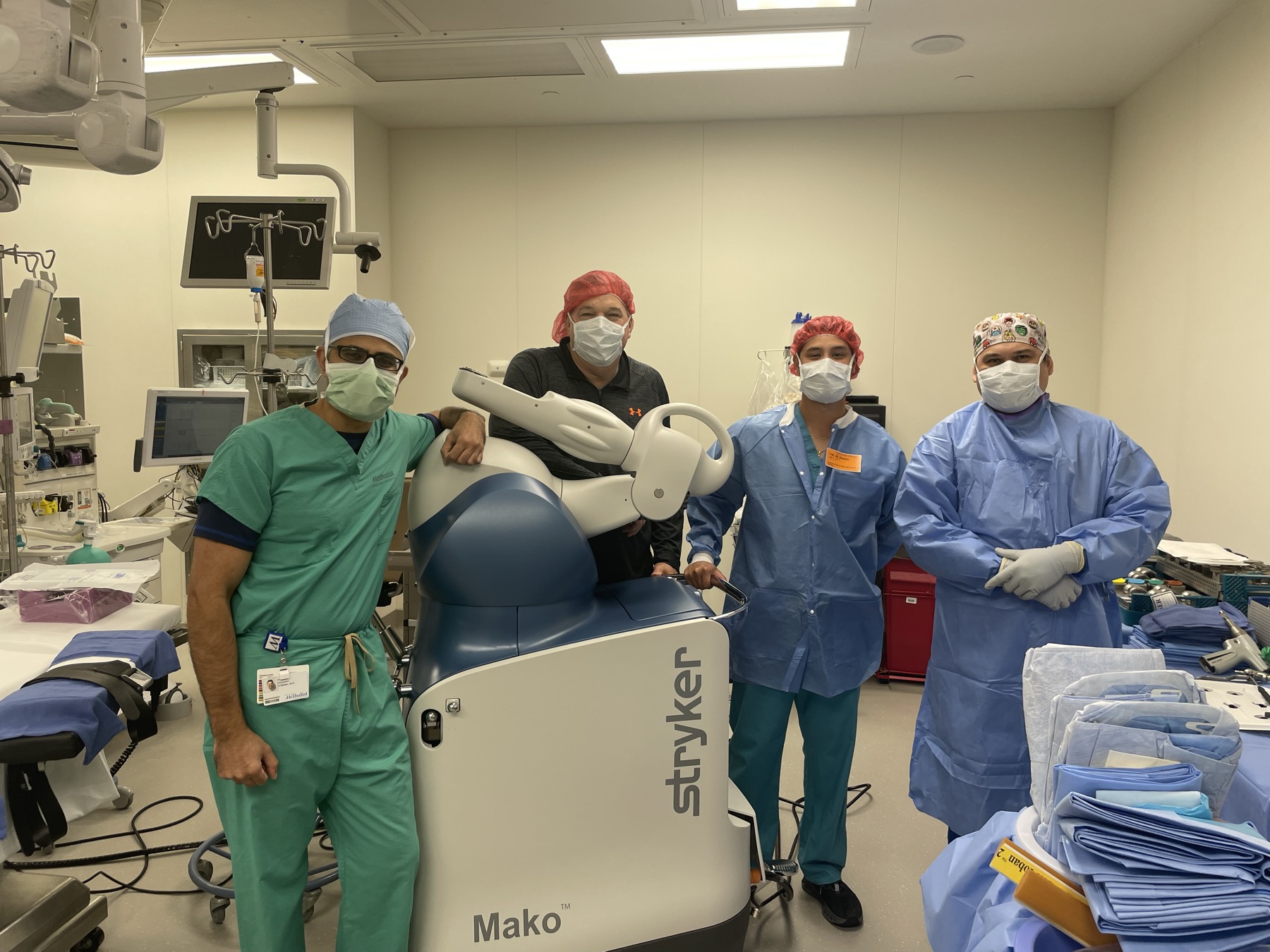
I perform robotic-arm assisted knee replacement with the Mako system through either a midvastus or a subvastus approach, depending on the clinical circumstances of each knee. Both leave the quadriceps tendon intact, and both give enough exposure to place the implants as planned. The evidence suggests that accurate implant placement matters more for the long-term result than the length of the incision, and that is the priority I weigh most heavily when planning the operation.
Questions more useful than the name
- Which approach will you use, and why for my knee? A knee with severe deformity, prior surgery, stiffness or a large thigh may need a wider view than a straightforward knee.
- Which technique will you use for the bone cuts? Manual instruments, navigation or a robotic arm, and what the surgeon’s experience is with that method.
- What does recovery look like in your program? Pain control, therapy and the plan for going home affect your first weeks as much as the incision does.
- How many of these operations do you do? Experience with an approach and a technique matters more than what they are called.
Who this evidence fits, and who it doesn’t
Likely fits: patients having a first total knee replacement for arthritis who are comparing surgeons or the names of approaches and techniques they have seen online.
Likely doesn’t fit: patients needing a revision of a previous knee replacement, patients with major deformity or prior fractures around the knee, and patients considering a partial knee replacement, which is a different operation with its own evidence.
The bottom line for the layperson
- “Quad-sparing” and similar names describe how the surgeon reaches the knee; “robotic” describes the technique used to plan and make the bone cuts.
- The two are not alternatives, and a robotic knee replacement can be done through a traditional or a muscle-sparing approach.
- Muscle-sparing approaches may help you get moving a day or so sooner, but results are similar from about one month to five years.
- The smallest incisions carry a higher risk of implants being placed outside the target alignment.
- Ask which approach and which technique a surgeon uses, and why, rather than choosing by a name.
To learn more, read about whether robotic knee replacement is better and how the knee replacement robots differ, or request a visit to talk through which approach fits your knee.
Sources
- Muneeb M, Ahmad A, Haq IU, et al. “Comparison of Subvastus versus Medial Parapatellar Approach for Total Knee Arthroplasty: A GRADE Assessed Systematic Review and Meta-Analysis.” J Arthroplasty. Published online November 6, 2026. DOI: 10.1016/j.arth.2026.11.020 (PMID: 42994651)
- Huh MH, Kim HJ, Shin YS. “Comparison of conventional and minimally invasive approaches of primary total knee arthroplasty: a network meta-analysis of randomized controlled trials.” BMC Musculoskelet Disord. 2026;27(1):336. DOI: 10.1186/s12891-026-09712-1 (PMID: 41807933)
- Rainey JP, Radtke LE, Gililland JM, Mont MA. “The Influence of Total Knee Arthroplasty Surgical Approach on Range of Motion, Patient-Reported Outcome Measures, and Reoperation Rates: A Systematic Review of Randomized Controlled Trials.” J Arthroplasty. 2026;41(8):2548–2555. DOI: 10.1016/j.arth.2025.11.013 (PMID: 41240972)
- Verburg H, Mathijssen NM, Niesten DD, et al. “Comparison of Mini-Midvastus and Conventional Total Knee Arthroplasty with Clinical and Radiographic Evaluation: A Prospective Randomized Clinical Trial with 5-Year Follow-up.” J Bone Joint Surg Am. 2016;98(12):1014–1022. DOI: 10.2106/JBJS.15.00654 (PMID: 27307362)
- Kazarian GS, Siow MY, Chen AF, et al. “Comparison of Quadriceps-Sparing and Medial Parapatellar Approaches in Total Knee Arthroplasty: A Meta-Analysis of Randomized Controlled Trials.” J Arthroplasty. 2018;33(1):277–283. DOI: 10.1016/j.arth.2017.08.025 (PMID: 28947369)
- Dalury DF, Dennis DA. “Mini-incision total knee arthroplasty can increase risk of component malalignment.” Clin Orthop Relat Res. 2005;440:77–81. DOI: 10.1097/01.blo.0000185757.17401.7b (PMID: 16239787)
- Kayani B, Konan S, Pietrzak JRT, Haddad FS. “Iatrogenic Bone and Soft Tissue Trauma in Robotic-Arm Assisted Total Knee Arthroplasty Compared With Conventional Jig-Based Total Knee Arthroplasty: A Prospective Cohort Study and Validation of a New Classification System.” J Arthroplasty. 2018;33(8):2496–2501. DOI: 10.1016/j.arth.2018.03.042 (PMID: 29699827)
- Kayani B, Konan S, Tahmassebi J, et al. “Robotic-arm assisted total knee arthroplasty is associated with improved early functional recovery and reduced time to hospital discharge compared with conventional jig-based total knee arthroplasty: a prospective cohort study.” Bone Joint J. 2018;100-B(7):930–937. DOI: 10.1302/0301-620X.100B7.BJJ-2017-1449.R1 (PMID: 29954217)
- Prashanth BN, Sangani K, Reddy YM. “Robot-assisted total knee arthroplasty using modified sub-vastus approach: A series of 120 knees.” J Clin Orthop Trauma. 2025;68:103078. DOI: 10.1016/j.jcot.2025.103078 (PMID: 40524732)
This article reflects Dr. Dewan's reading of the cited evidence at the time of publication. It is educational content, not medical advice. Your specific case may differ — schedule a consultation to discuss your imaging and history.