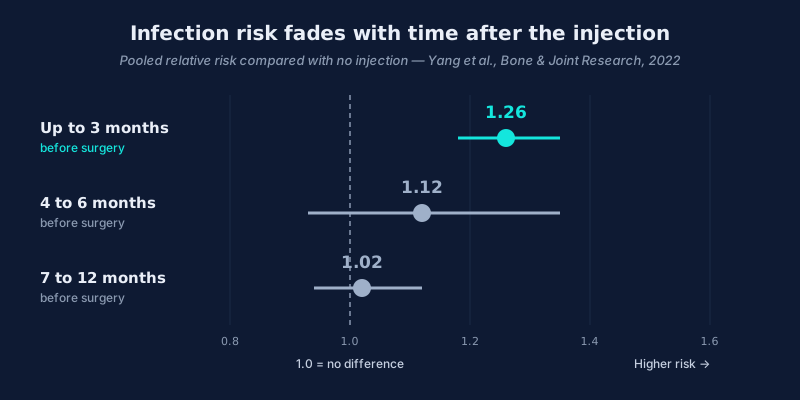
It can. Most large studies find that a cortisone shot in the same knee during the 3 months before a knee replacement is linked to a higher risk of infection in the new joint, and that the added risk fades after that point. For that reason, the authors of several of these studies recommend scheduling surgery at least 3 months after the last injection. The added risk is small in absolute terms, not every study finds it, and the same timing question applies to gel (hyaluronic acid) injections. A 2022 analysis in Bone & Joint Research pooled about 200,000 knee replacements and found a 26% higher relative risk of infection when an injection was given in the prior 3 months, with no significant increase beyond that.1
This article covers what the studies show, where they disagree, what they mean for gel shots and repeated shots, and how the timing fits into planning a knee replacement.
Why this matters to you
Cortisone shots are one of the most common treatments for knee arthritis, and many patients have one before they ever discuss surgery. In one insurance database of 58,337 knee replacements, 28.6% of patients had a cortisone shot in the year before surgery.2 In another, 11.8% had an injection or a fluid draw from the knee in the last 90 days.3
An infection around a new joint (a periprosthetic joint infection) is uncommon, but it is one of the most serious complications of a knee replacement and usually means more surgery and a long course of antibiotics. Patients also ask the question from the other direction: if I am in pain now, should I have a shot, try gel, or would waiting make things worse? The answer depends on how soon surgery is likely to happen.
Why a shot could affect infection risk
Researchers have proposed two mechanisms. A needle crosses the skin and the lining of the joint, which breaches the joint’s physical barrier. Cortisone also suppresses the local immune response while the medication remains in the knee.4 Neither mechanism has been directly proven as the cause in patients. The evidence on this question comes from comparing infection rates, not from measuring what happens inside the joint.
What the studies did
Nearly all of this evidence comes from insurance and hospital records. Researchers identify patients who had a knee replacement, check whether they had an injection in that knee beforehand and when, and compare infection rates with those of patients who had no injection. I could not find a randomized trial that assigned patients to different injection-to-surgery intervals. This limits how firmly any of the conclusions can be stated, a point I return to below.
What the studies found
The 3-month window
The study most often cited is a 2019 analysis in The Journal of Bone & Joint Surgery. After adjusting for age, sex and other health conditions, the odds of infection within 6 months of surgery were 1.21 times higher with a cortisone shot in the prior 3 months and 1.55 times higher with a gel shot. Injections given more than 3 months before surgery showed no added risk.2
Pooled analyses point the same way. Across 14 studies and about 370,000 patients, a cortisone shot within 3 months raised the odds of infection by 26%.5 An analysis of hip and knee replacements found a 39% rise within 3 months and no significant rise from 3 to 6 months.6 A European review reported a 52% rise within 3 months.7
What that means in absolute numbers
A 26% relative increase sounds larger than it is. If the baseline infection rate is about 1 in 100, a 26% increase raises it to about 1.26 in 100, or roughly one additional infection for every 400 knee replacements. That is my own arithmetic from the pooled figure, and the baseline rate varies widely across databases. One study with a low baseline reported a larger gap: 1.6% with a cortisone shot within 90 days compared with 0.41% without, or about one additional infection for every 85 patients.8 Even at the upper end of these estimates, the large majority of patients who had a recent shot did not develop an infection.
Is there a safe number of weeks?
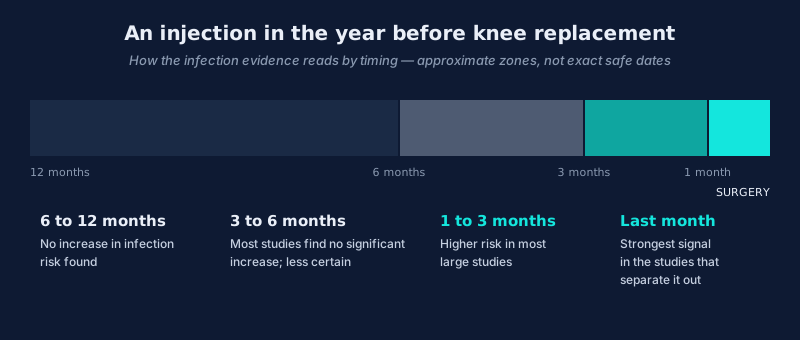
Three months is the most common cutoff, partly because researchers tend to group data into 3-month blocks. Within that window, the risk appears to be highest closest to surgery. One large database study found higher infection risk with an injection within 4 weeks of surgery, and no added risk in the group injected 4 to 6 weeks beforehand.9 Another study of gel shots found the highest risk within 1 month, some increase from 1 to 2 months, and no difference beyond 2 months.10
The studies that disagree
Not every study finds this link. A study of Medicare patients found 2-year infection rates of 0.75% with a cortisone shot within 3 months and 0.77% with no injection.11 A 2025 study of 43,219 patients found no significant difference with an injection in the prior 90 days,3 and a national cohort from England found no rise in complications after knee replacement in patients who had earlier cortisone shots.12 One 2023 meta-analysis found a link for hip replacement but none for knee replacement.13
Gel shots, repeat shots and the other knee
Gel shots do not appear to avoid the problem. In the 2019 study, gel shots within 3 months carried at least as much risk as cortisone.2 A 2025 study of 38,546 patients found three times the odds of infection at 3 months after surgery when a gel shot was given within 1 month.10
The medication may not be the only factor. A 2025 database study looked at procedures without cortisone, such as a fluid draw or a platelet-rich plasma (PRP) injection. Infections requiring surgery became more common the closer the procedure was to the knee replacement: 7.6% within 1 month, 4.6% within 3 months and 2.2% within 6 months, compared with 1.4% without one.4 These rates are higher than in most other studies, so I would not rely on the exact figures, but they suggest that the needle itself may matter.
The number of shots does not appear to matter as much as the timing. A Medicare study of 371,511 knee replacements found no link between the number of injections in the prior 2 years and infection within 90 days,14 and a smaller study found the same for injections given more than 90 days before surgery.15
A shot in the other knee is a different question. A 2026 study compared 195 patients who had a cortisone shot in the opposite knee on the day of their knee replacement with 195 who did not, and found no significant difference in complications.16 That group is too small to detect a difference in an event as rare as joint infection, but the finding is reassuring for patients with arthritis in both knees.
What this means for you: if a knee replacement is likely in the next few months, the timing of any injection is worth discussing before you have it. If you have already had a recent shot, the added risk is small, and you have time to plan around it.
Strengths of this evidence
- The sample sizes are large. Joint infection is rare, so a study needs tens of thousands of patients to detect a modest difference. These databases provide that.
- Several independent analyses reach a similar result. Different databases, countries and research groups have found a signal in the same 3-month window, and few have found one beyond 6 months.
- The pattern fits the timing. A risk that is highest near surgery and fades with time is what would be expected if the injection itself contributes.
Where I’d push back on the data
- These are associations, not proof of cause. A patient who needs a shot shortly before surgery may differ from one who does not, in ways that billing records do not capture. Propensity matching helps, but it cannot account for what was never recorded.
- The data cannot assess how the injection was given. Skin preparation and sterile technique are not in insurance records, and these factors could plausibly matter as much as the timing.
- Some conclusions go further than the data. One meta-analysis concludes that cortisone injection “is not a safe procedure” for patients expected to have a knee replacement, although its overall result (odds ratio 1.13) was of borderline significance and its signal was limited to the 3-month window.5 Conversely, the 2025 study reporting no added risk had 93.6% of its injections given 61 to 90 days before surgery, so it says little about injections in the last 2 months.3
- The 4-week finding is narrower than its headline. The study titled as showing no benefit from waiting past 4 weeks looked only as far as 4 to 6 weeks before surgery. It did not test a longer wait.9
- The type of steroid has not been settled. One study found significant increases with methylprednisolone and betamethasone but not with triamcinolone or dexamethasone.8 The dexamethasone group had only 54 patients. I would not choose a medication on the basis of this one study.
Does cortisone itself harm the knee?
A separate question is whether regular cortisone shots speed up arthritis. A randomized trial in JAMA gave 140 patients with knee arthritis either triamcinolone or saline every 12 weeks for 2 years. Those receiving cortisone lost slightly more cartilage (0.21 mm vs. 0.10 mm) and had no greater pain relief than those receiving saline.17 The difference in cartilage was small and its clinical importance is uncertain, and the schedule was more frequent and prolonged than many patients receive. An English national study found that a single injection was linked to a lower rate of knee replacement over 5 years in its main analysis, but its secondary analysis found the opposite, so that question remains open.12
What this means for you: a cortisone shot can relieve a flare, but it does not repair the joint or remove the need for surgery in a knee with advanced arthritis.
What this means in my practice
The evidence suggests that the timing of an injection should be part of the surgical plan. That is how I approach the conversation with patients who are weighing an injection against a knee replacement.
1. I ask about every injection
Patients often receive injections from more than one office. Before scheduling surgery, I need to know which knee was injected, what was injected and the date. This includes cortisone, gel, PRP and any fluid drawn from the knee. Your records from the other office are helpful, and an approximate date is better than none.
2. I ask how close you are to surgery before an injection
If a patient has reached the point of considering a knee replacement and expects to go ahead soon, a shot may buy a few weeks of relief and also push back the surgery date. If surgery is a year or more away, or may not be needed, an injection remains a reasonable part of non-surgical care, and these timing concerns carry much less weight.
3. We plan the months in between
When a patient has had a recent shot and is ready for surgery, the evidence favors a wait of about 3 months where that is practical. Physical therapy, activity changes and appropriate oral medication can help during that time. The individual decision also weighs how much pain and disability the patient has, and that discussion is specific to each patient and their other risk factors, such as dental health, diabetes and smoking. In the 4-week study, tobacco use further increased the risk of infection.9
Who this evidence fits, and who it doesn’t
Closest fit: a patient having a first total knee replacement who has had a cortisone or gel shot in the same knee and has flexibility in scheduling.
Less certain fit: a patient planning a partial knee replacement or a hip replacement, since these studies focused on total knee replacement or combined different joints; a patient whose shot was in the other knee; and a patient with a higher baseline risk of infection, for whom the same relative increase means more in absolute terms.
The bottom line for the layperson
- A cortisone or gel shot in the same knee within about 3 months of a knee replacement is linked to a higher risk of infection in most large studies.
- The added risk is small in absolute terms, and some studies do not find it at all.
- The risk appears highest in the weeks just before surgery and fades after about 3 months.
- Having had several shots appears to matter less than how recently you had the last one.
- If surgery may be coming soon, talk with your surgeon before your next injection and share the dates of any you have had.
If you are deciding what to do next for an arthritic knee, you can read more about when it is time for a knee replacement and how to prepare for surgery, or request a visit to talk it through.
Sources
- Yang X, Li L, Ren X, Nie L. “Do preoperative intra-articular injections of corticosteroids or hyaluronic acid increase the risk of infection after total knee arthroplasty? A meta-analysis.” Bone Joint Res. 2022;11(3):171–179. DOI: 10.1302/2046-3758.113.BJR-2021-0350.R1 (PMID: 35311571)
- Richardson SS, Schairer WW, Sculco TP, Sculco PK. “Comparison of infection risk with corticosteroid or hyaluronic acid injection prior to total knee arthroplasty.” J Bone Joint Surg Am. 2019;101(2):112–118. DOI: 10.2106/JBJS.18.00454 (PMID: 30653040)
- Nin DZ, Chen YW, Talmo CT, Hollenbeck BL, Mattingly D, Zvi Y, et al. “Joint injection or aspiration before total knee arthroplasty: does it increase the risk of periprosthetic joint infection?” J Knee Surg. 2025;38(4):195–200. DOI: 10.1055/a-2451-8845 (PMID: 39448052)
- Shahzad H, Krajcir CA, Meehan JP, Giordani MM, Khan SN, Lum ZC. “Does a simple needle stick from a preoperative knee aspiration or non-steroidal injection influence total knee arthroplasty infection risk? A retrospective database analysis.” J Arthroplasty. 2025;40(12):3285–3290.e1. DOI: 10.1016/j.arth.2025.05.095 (PMID: 40466921)
- Kim YM, Joo YB, Song JH. “Preoperative intra-articular steroid injections within 3 months increase the risk of periprosthetic joint infection in total knee arthroplasty: a systematic review and meta-analysis.” J Orthop Surg Res. 2023;18(1):148. DOI: 10.1186/s13018-023-03637-4 (PMID: 36855146)
- Lai Q, Cai K, Lin T, Zhou C, Chen Z, Zhang Q. “Prior intra-articular corticosteroid injection within 3 months may increase the risk of deep infection in subsequent joint arthroplasty: a meta-analysis.” Clin Orthop Relat Res. 2022;480(5):971–979. DOI: 10.1097/CORR.0000000000002055 (PMID: 34919065)
- Baums MH, Aquilina J, Pérez-Prieto D, Sleiman O, Geropoulos G, Totlis T. “Risk analysis of periprosthetic knee joint infection (PJI) in total knee arthroplasty after preoperative corticosteroid injection: a systematic review.” Arch Orthop Trauma Surg. 2023;143(5):2683–2691. DOI: 10.1007/s00402-022-04532-z (PMID: 35829737)
- Muffly BT, Ayeni AM, Jones CA, Heo KY, Guild GN, Premkumar A. “Periprosthetic joint infection risk after primary total knee arthroplasty: are all preoperative corticosteroid injections the same?” J Arthroplasty. 2024;39(5):1312–1316.e7. DOI: 10.1016/j.arth.2023.10.053 (PMID: 37924991)
- Bains SS, Chen Z, Sax OC, Naziri Q, Nace J, Delanois RE. “Delaying total knee arthroplasty more than 4 weeks after intra-articular knee injection does not further decrease risk of septic revision.” J Knee Surg. 2022;35(14):1511–1517. DOI: 10.1055/s-0042-1757596 (PMID: 36538938)
- Jones CM, Acuña AJ, Forlenza EM, Higgins JDD, Gerlinger T, Della Valle CJ. “Hyaluronic acid injections administered within two months prior to total knee arthroplasty increase the risk for periprosthetic joint infection.” Knee. 2025;53:103–107. DOI: 10.1016/j.knee.2024.12.003 (PMID: 39708558)
- Kurtz SM, Mont MA, Chen AF, Valle CD, Sodhi N, Lau E, et al. “Intra-articular corticosteroid or hyaluronic acid injections are not associated with periprosthetic joint infection risk following total knee arthroplasty.” J Knee Surg. 2022;35(9):983–996. DOI: 10.1055/s-0040-1721128 (PMID: 33389729)
- Hawley S, Prats-Uribe A, Matharu GS, Delmestri A, Prieto-Alhambra D, Judge A, et al. “Effect of intra-articular corticosteroid injections for knee osteoarthritis on the rates of subsequent knee replacement and post-operative outcomes: a national cohort study of England.” BMC Med. 2025;23(1):195. DOI: 10.1186/s12916-025-04000-6 (PMID: 40189536)
- Albanese J, Feltri P, Boffa A, Werner BC, Traina F, Filardo G. “Infection risk increases after total hip arthroplasty within 3 months following intra-articular corticosteroid injection. A meta-analysis on knee and hip arthroplasty.” J Arthroplasty. 2023;38(6):1184–1193.e2. DOI: 10.1016/j.arth.2022.12.038 (PMID: 36592824)
- Raymond HE, Barbera JP, Shah KC, Zubizarreta N, Huang HH, Poeran J, et al. “Risk of infection after total knee or hip arthroplasty after receipt of multiple corticosteroid or hyaluronic acid injections.” J Am Acad Orthop Surg. 2023;31(19):e868–e875. DOI: 10.5435/JAAOS-D-22-01177 (PMID: 37603685)
- Khan IA, Small I, Sutton RM, Goh GS, Sherman MB, Mazur DW, et al. “Cumulative intraarticular injections are not a risk factor for periprosthetic joint infection following total knee arthroplasty.” J Arthroplasty. 2022;37(6):1059–1063.e1. DOI: 10.1016/j.arth.2022.02.027 (PMID: 35189290)
- Jorgenson P, Rich J, Giese D, Webb J. “Outcomes of total knee arthroplasty with simultaneous contralateral knee intra-articular corticosteroid injection.” Arthroplast Today. 2026;41:102172. DOI: 10.1016/j.artd.2026.102172 (PMID: 42866287)
- McAlindon TE, LaValley MP, Harvey WF, Price LL, Driban JB, Zhang M, et al. “Effect of intra-articular triamcinolone vs saline on knee cartilage volume and pain in patients with knee osteoarthritis: a randomized clinical trial.” JAMA. 2017;317(19):1967–1975. DOI: 10.1001/jama.2017.5283 (PMID: 28510679)
This article reflects Dr. Dewan's reading of the cited evidence at the time of publication. It is educational content, not medical advice. Your specific case may differ — schedule a consultation to discuss your imaging and history.