Many patients with a body mass index (BMI) of 40 or higher are told they must lose weight before a knee replacement. The risk of some complications, especially infection, does rise at that level. The evidence behind any single cutoff is weaker than most patients are told, however. A 2018 study in The Journal of Bone & Joint Surgery found that a BMI limit of 40 would have turned away about 14 patients who would have had no major complication for every one complication it prevented.1 A 2025 study in the same journal found that the modest weight loss most patients achieve before surgery was not linked to fewer complications.2
This article covers why BMI limits exist, what the research shows about them, what weight loss before surgery does and does not accomplish, and how the decision can be approached when your BMI is high.
Why this matters to you
Body mass index is your weight in kilograms divided by the square of your height in meters. A BMI of 30 or more is classed as obesity, and 40 or more as class III (severe) obesity. For a person who is 5 feet 6 inches tall, a BMI of 40 corresponds to about 248 pounds. For a person who is 5 feet 10 inches, it is about 279 pounds.
Obesity and knee arthritis often occur together, because extra weight increases the load on the knee with every step. In one national database of more than 300,000 knee replacements, 14.7% of patients had a BMI of 40 or more.3 Being told that you are “too heavy” for surgery, while knee pain makes exercise harder, can feel like a trap. Understanding the actual size of the risk helps you and your surgeon make a plan rather than wait for a number.
Why BMI limits exist
Surgeons who use BMI limits are responding to real differences in risk. Operating through more soft tissue takes longer, the wound is under more tension, and blood sugar is more often poorly controlled. A study of 18,173 hip and knee replacements found that patients with a BMI of 40 or more had about three times the odds of a joint infection within 90 days compared with normal-weight patients. Patients with a BMI from 30 to 39.9 had no significant increase in that study.4
How weight multiplies the load on the knee
The force inside the knee is several times body weight, because the muscles that control the leg pull across the joint with every step. Knee implants fitted with sensors, which record that force directly, measured average peak forces of about 2.6 times body weight during level walking and 3.5 times body weight going down stairs.5 For a person who is 5 feet 8 inches tall, that is about 395 pounds through the knee with each step at a BMI of 23 (151 pounds), and about 720 pounds at a BMI of 42 (276 pounds). Going down stairs, the figures are about 525 and 955 pounds. The relationship works in the other direction too. In a trial of overweight and obese adults with knee arthritis, each pound of weight lost was associated with about 4 pounds less force on the knee with every step.6
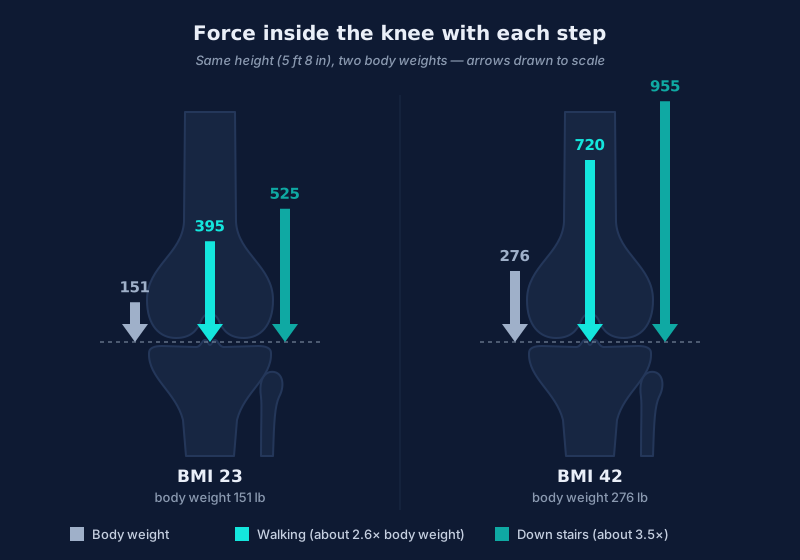
Over several thousand steps a day, that difference adds up. It is one reason weight affects how quickly arthritis progresses, and it is the load a new knee carries for the rest of its life. The complications behind most BMI limits, however, are infection and wound problems, which depend more on soft tissue and blood sugar than on load.
A joint infection after knee replacement (a periprosthetic joint infection) is uncommon, but it is one of the most serious complications, usually requiring more surgery and a long course of antibiotics. That is the main concern behind a BMI limit.
What the studies did
No randomized trial has assigned patients to different BMI limits. The evidence comes from three kinds of studies:
- Modeling studies take large groups of patients who had surgery and ask what would have happened if a BMI limit had been applied: how many complications would have been avoided, and how many complication-free operations would have been denied.1,3
- Follow-up studies track patients who were turned down because of BMI to see how many later lost enough weight to qualify.7
- Weight-change studies compare patients who lost weight before surgery with those who did not.2,8,9
One small randomized trial published in 2026 asked a related question: whether an intensive diet could replace surgery for patients with obesity and severe knee arthritis.10
What the studies found
A BMI limit denies many safe operations to prevent a few complications
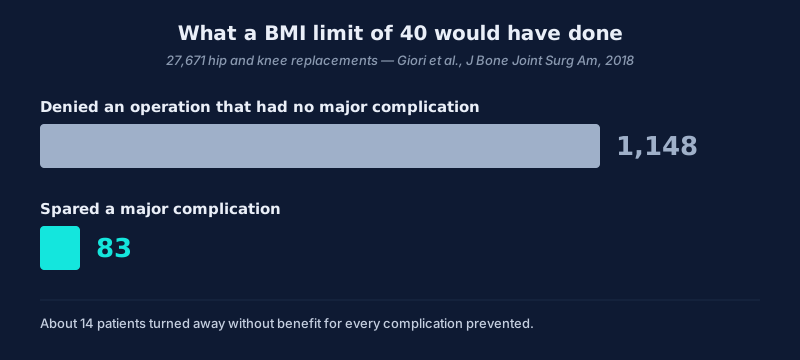
The 2018 study reviewed 27,671 hip and knee replacements in the Veterans Health Administration. If a BMI limit of 40 had been enforced, 1,148 patients would have been denied an operation that went without a major complication, and 83 patients would have avoided one. As a test for predicting who would have a major complication, a BMI of 40 or more was correct 6.7% of the time. The authors compared it with deciding by a coin flip, which would have been correct 5.1% of the time.1
A national study of 314,719 knee replacements reached a similar conclusion. A BMI limit of 40 would have prevented 17.3% of all complications within 30 days, while denying surgery to the 46,386 patients above the limit, most of whom had no complication. A limit of 50 would have prevented only 2.8%.3
The risk rises gradually
The 2018 infection study tested whether any BMI value cleanly separated patients who developed an infection from those who did not. None did. The authors concluded that infection risk increases gradually across the full range of BMI, without a threshold.4 A Mayo Clinic study of 25,160 knee replacements looked at infection risk over 15 years. For otherwise healthy patients, meaning no diabetes, kidney disease, immune suppression or smoking, the absolute risk of infection was 4% with a BMI of 40 or more and 3% at a normal weight.11 Other health conditions affected the risk as much as BMI did. Patients with two or more of those risk factors had a 5% to 6% risk across weight groups.
Most patients who are turned down do not reach the target
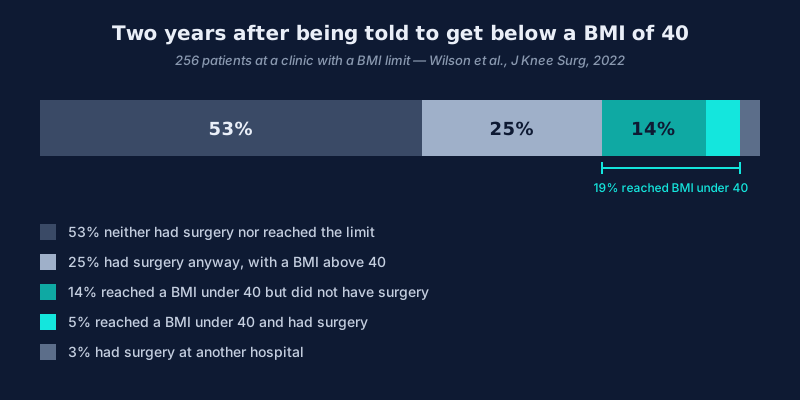
A study followed 256 patients with a BMI of 40 or more who were seen at a clinic with an institutional BMI limit. Within 2 years, only 19% had lost enough weight to get below 40, and most of those did not go on to have surgery. Just over half neither had surgery nor became eligible. A quarter had surgery anyway, at an average BMI of 42, which shows how inconsistently the limit was applied.7
Weight loss before surgery: the results are mixed
The largest study of this question followed 3,665 patients with obesity who had a knee replacement, for an average of 6 years. Only 9% lost 20 pounds or more before surgery. Losing 10 to 20 pounds was not linked to fewer complications, and in this group it was linked to a higher rate of infection. Gaining more than 5 pounds was linked to more complications.2
Other studies are more encouraging for larger amounts of weight loss. Among 203 patients with a BMI of 40 or more, those who lost at least 20 pounds had shorter hospital stays and were less likely to be discharged to a rehabilitation facility, although function after surgery was no better. Losing 5 or 10 pounds made no measurable difference.8 In a study of 464 knee replacements, patients who started with a BMI of 45 or more and got below 45 had an infection risk similar to the comparison group, while those who did not had a much higher risk. For patients who started between 40 and 45, weight loss made no measurable difference.9
Diet alone does not replace surgery for severe arthritis
The INKA trial, published in July 2026 in Osteoarthritis and Cartilage, randomly assigned 92 patients with obesity and knee arthritis severe enough for a knee replacement to either a 12-week low-calorie meal replacement program or surgery. The diet group lost an average of 11 kg (about 24 pounds), or 10% of body weight. Six months later, knee pain and function were clearly better in the surgery group: an Oxford Knee Score of 36.5 compared with 28.2 on a 48-point scale. Adverse events were similar in the two groups.10
Patients with a high BMI still benefit from surgery
A study of 633 knee replacement patients found that those with a BMI of 40 or more started with worse pain and function, improved more in the first 3 months, and reached similar levels of pain, function and satisfaction at 2 years as patients of lower weight.12
What this means for you: a high BMI raises the risk of some complications, but the increase is gradual, and patients above common cutoffs still gain about as much from surgery. Small amounts of weight loss before surgery have not been shown to lower risk. Larger losses may help, especially at the highest BMI levels.
Strengths of this evidence
- The modeling studies are large. The two main analyses included more than 27,000 and more than 300,000 operations, enough to measure uncommon complications with some precision.
- They report both sides of the trade-off. Instead of only showing that risk is higher, they count the operations that would have been denied, which is the number that matters to a patient being turned away.
- The weight-loss study has long follow-up. It followed patients for 6 years on average and used weights recorded before and at the time of surgery.2
- INKA is a randomized trial. Randomized evidence is rare in this area, and it directly compares a weight-loss program with surgery.10
Where I’d push back on the data
- The modeling studies only count short-term complications. They look at 30 days or a few months. Some problems linked to obesity, such as late infection and implant loosening, take years to appear, so these studies may understate the long-term cost of operating at a very high BMI.
- The patients who had surgery were already selected. Surgeons operated on the patients above BMI 40 whom they judged healthy enough. The modeling studies therefore describe a selected group, not every patient with a high BMI.
- Weight records do not show why someone lost weight. Unplanned weight loss can reflect illness, which could itself raise the risk of infection. That may explain part of the surprising result for patients who lost 10 to 20 pounds,2 and it means the study does not show that deliberate weight loss is harmful.
- INKA is small and short. The trial aimed for 200 patients and enrolled 92. It followed patients for 6 months, after only 12 weeks of dieting, and it did not test weight-loss medications. It shows that a short diet program does not match surgery for severe arthritis. It does not show that weight loss is unhelpful.10
- BMI does not describe where weight is carried. Two patients with the same BMI can differ greatly in the thickness of tissue around the knee, muscle mass and blood sugar control. A single number cannot capture those differences.
Who is affected by BMI limits
Because obesity is not evenly distributed, a fixed limit affects some groups more than others. An analysis of national health survey data found that a BMI limit of 35 would make Black adults, women and people with lower incomes less likely to qualify for joint replacement.13 A survey of surgeons found that their use of BMI limits varies with their reading of the evidence, the resources of their hospital and their own experience. The authors noted that practice guidelines advise against hard BMI criteria.14 Hospitals, surgery centers and insurers may still set their own limits, which can differ from one setting to another.
What this means in my practice
The evidence suggests that BMI should be one part of a broader risk assessment rather than a single yes-or-no test. That is how I approach the conversation with patients who have been told their weight is a barrier.
1. I look at the whole risk picture
BMI is considered together with blood sugar control, smoking, kidney function, skin condition around the knee, dental health and how severe the arthritis is on imaging. Several of these are easier to change than weight, and in the long-term data they mattered as much as BMI did.11 A patient with a BMI of 42 and no other risk factors can have a very different risk from a patient with the same BMI and poorly controlled diabetes.
2. We set goals that are realistic and meaningful
The evidence suggests that a loss of a few pounds before surgery does not change the risk, and larger losses may help most at the highest BMI levels. When weight loss is part of the plan, a specific target and timeline is more useful than an open-ended instruction to lose weight. That plan is coordinated with the patient’s primary care physician or a weight-management specialist. For some patients that includes a GLP-1 medication such as semaglutide, prescribed and monitored by the appropriate physician.
3. We plan the surgery and the weight loss together
For a patient with bone-on-bone arthritis, waiting indefinitely for a weight target carries its own costs: more pain, less activity, and weaker muscles going into surgery. The INKA trial supports what many patients already know: a diet program improves symptoms somewhat, but it does not replace a knee replacement when the arthritis is severe.10 The goal is a plan with a defined endpoint, so that weight loss and surgical timing work together.
Who this evidence fits, and who it doesn’t
Closest fit: a patient with severe knee arthritis and a BMI in the high 30s to mid 40s who has been told to lose weight before surgery.
Less certain fit: a patient with a BMI well above 50, for whom the risks are higher and the data are thinner; a patient with several other risk factors such as poorly controlled diabetes; and a patient considering a partial knee replacement or an outpatient operation, where different criteria may apply.
The bottom line for the layperson
- A BMI of 40 or more raises the risk of some complications after knee replacement, especially infection, but the increase is gradual rather than a sudden jump at one number.
- Strict BMI limits turn away many patients who would have done well in order to prevent a smaller number of complications.
- Losing a few pounds before surgery has not been shown to lower risk, while larger losses may help at the highest BMI levels.
- Patients with a high BMI who have a knee replacement still gain about as much pain relief and function as other patients.
- Ask your surgeon for a plan with a specific goal and timeline, and work on blood sugar, smoking and other risk factors alongside weight.
If you are weighing your next step, you can read more about when it is time for a knee replacement and weight-loss medications and knee arthritis, or request a visit to talk it through.
Sources
- Giori NJ, Amanatullah DF, Gupta S, Bowe T, Harris AHS. “Risk reduction compared with access to care: quantifying the trade-off of enforcing a body mass index eligibility criterion for joint replacement.” J Bone Joint Surg Am. 2018;100(7):539–545. DOI: 10.2106/JBJS.17.00120 (PMID: 29613922)
- Seward MW, Grimm JA, Hannon CP, Bedard NA, Berry DJ, Abdel MP. “Weight loss before total knee arthroplasty was not associated with decreased postoperative risks.” J Bone Joint Surg Am. 2025;107(18):2085–2093. DOI: 10.2106/JBJS.25.00061 (PMID: 40788982)
- DeMik DE, Muffly SA, Carender CN, Glass NA, Brown TS, Bedard NA. “What is the impact of body mass index cutoffs on total knee arthroplasty complications?” J Arthroplasty. 2022;37(4):683–687.e1. DOI: 10.1016/j.arth.2021.12.024 (PMID: 34954020)
- Shohat N, Fleischman A, Tarabichi M, Tan TL, Parvizi J. “Weighing in on body mass index and infection after total joint arthroplasty: is there evidence for a body mass index threshold?” Clin Orthop Relat Res. 2018;476(10):1964–1969. DOI: 10.1007/s11999.0000000000000141 (PMID: 30794240)
- Kutzner I, Heinlein B, Graichen F, Bender A, Rohlmann A, Halder A, et al. “Loading of the knee joint during activities of daily living measured in vivo in five subjects.” J Biomech. 2010;43(11):2164–2173. DOI: 10.1016/j.jbiomech.2010.03.046 (PMID: 20537336)
- Messier SP, Gutekunst DJ, Davis C, DeVita P. “Weight loss reduces knee-joint loads in overweight and obese older adults with knee osteoarthritis.” Arthritis Rheum. 2005;52(7):2026–2032. DOI: 10.1002/art.21139 (PMID: 15986358)
- Wilson CD, Lundquist KF, Baruch NH, Gaddipati R, Hammonds KAP, Allen BC. “Clinical pathways of patients denied total knee arthroplasty due to an institutional BMI cutoff.” J Knee Surg. 2022;35(12):1364–1369. DOI: 10.1055/s-0041-1723969 (PMID: 33607678)
- Keeney BJ, Austin DC, Jevsevar DS. “Preoperative weight loss for morbidly obese patients undergoing total knee arthroplasty: determining the necessary amount.” J Bone Joint Surg Am. 2019;101(16):1440–1450. DOI: 10.2106/JBJS.18.01136 (PMID: 31436651)
- Spezia MC, Stitgen A, Walz JW, Leary EV, Patel A, Keeney JA. “Body mass index improvement reduces total knee arthroplasty complications among patients who have extreme, but not severe, obesity.” J Arthroplasty. 2025;40(3):632–636. DOI: 10.1016/j.arth.2024.08.054 (PMID: 39233104)
- Henriksen M, Christensen R, Poulsen AS, Bunyoz KI, Aljuboori SM, Nielsen CT, et al. “Intensive diet or knee arthroplasty for severe knee osteoarthritis: the INKA randomised trial.” Osteoarthritis Cartilage. Published online July 10, 2026. DOI: 10.1016/j.joca.2026.07.004 (PMID: 42431586)
- Carender CN, Fruth KM, Lewallen DG, Berry DJ, Abdel MP, Bedard NA. “Obesity and primary total knee arthroplasty: the absolute versus relative risk of periprosthetic joint infection at 15 years.” J Arthroplasty. 2025;40(5):1204–1209.e4. DOI: 10.1016/j.arth.2024.10.064 (PMID: 39442895)
- Collins JE, Donnell-Fink LA, Yang HY, Usiskin IM, Lape EC, Wright J, et al. “Effect of obesity on pain and functional recovery following total knee arthroplasty.” J Bone Joint Surg Am. 2017;99(21):1812–1818. DOI: 10.2106/JBJS.17.00022 (PMID: 29088035)
- Wang AY, Wong MS, Humbyrd CJ. “Eligibility criteria for lower extremity joint replacement may worsen racial and socioeconomic disparities.” Clin Orthop Relat Res. 2018;476(12):2301–2308. DOI: 10.1097/CORR.0000000000000511 (PMID: 30303879)
- Godziuk K, Fast A, Righolt CH, Giori NJ, Harris AHS, Bohm ER. “Consistent factors influence body mass index thresholds for total joint arthroplasty across health-care systems: a qualitative study.” J Bone Joint Surg Am. 2024;106(12):1076–1090. DOI: 10.2106/JBJS.23.01081 (PMID: 38704647)
This article reflects Dr. Dewan's reading of the cited evidence at the time of publication. It is educational content, not medical advice. Your specific case may differ — schedule a consultation to discuss your imaging and history.