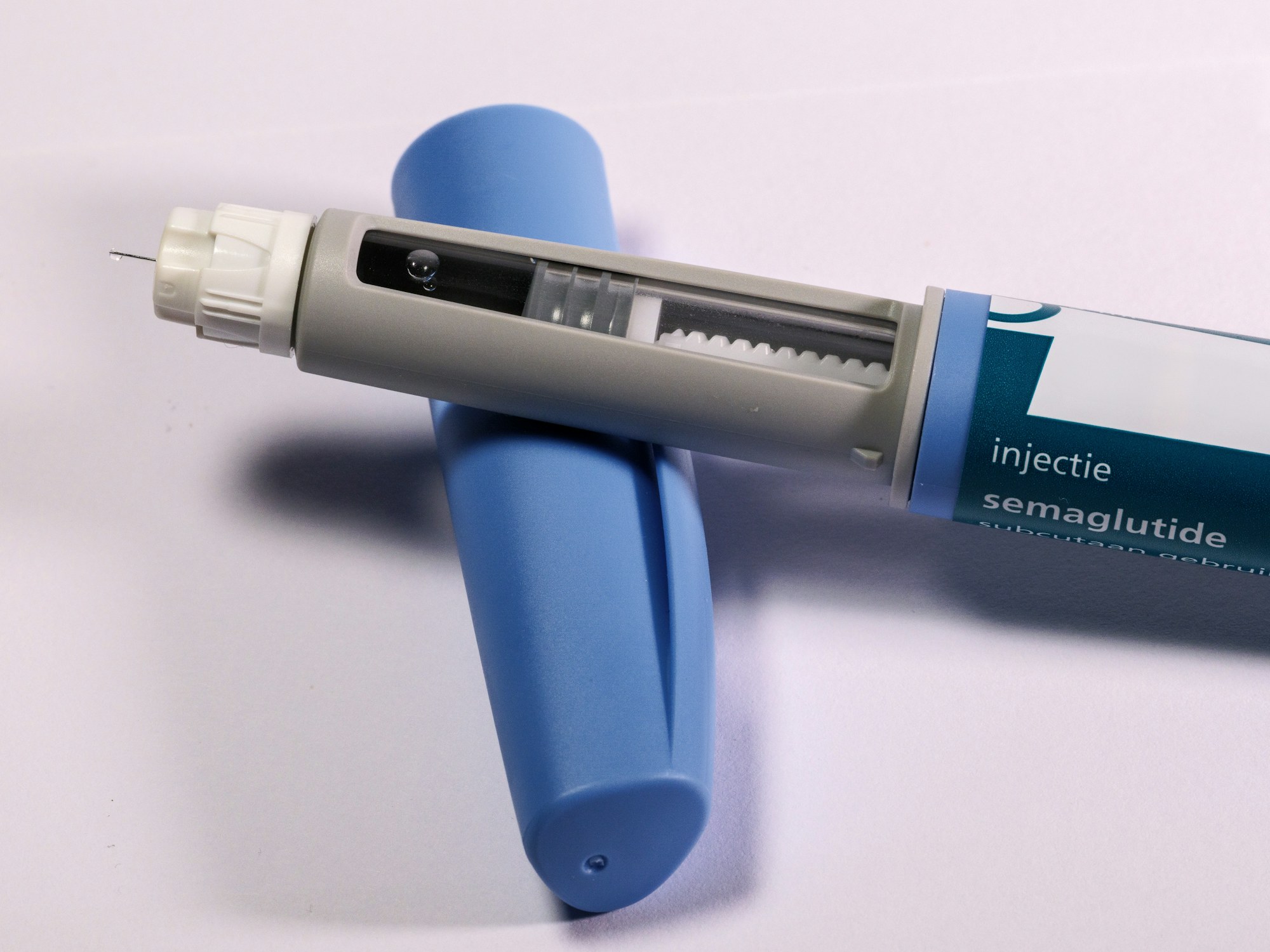
In June 2026, Regional Anesthesia and Pain Medicine published a database analysis of adults with knee osteoarthritis that reported something patients have been asking me about for two years: people taking GLP-1 receptor agonists — the drug class that includes semaglutide (Ozempic, Wegovy) and tirzepatide (Mounjaro, Zepbound) — went on to have knee replacements less often than matched patients who did not take them. Three years of exposure to the newer agents was associated with a 4.7 percentage point lower cumulative rate of knee replacement at eight years.1
That finding landed in the same year as a separate body of work suggesting these drugs also make the operation itself safer for the patients who do end up needing it.2 Two useful signals, pointing the same direction. Neither one is a randomized trial, and the gap between "associated with" and "causes" is where most of the patient conversation actually belongs.
Why this matters to you
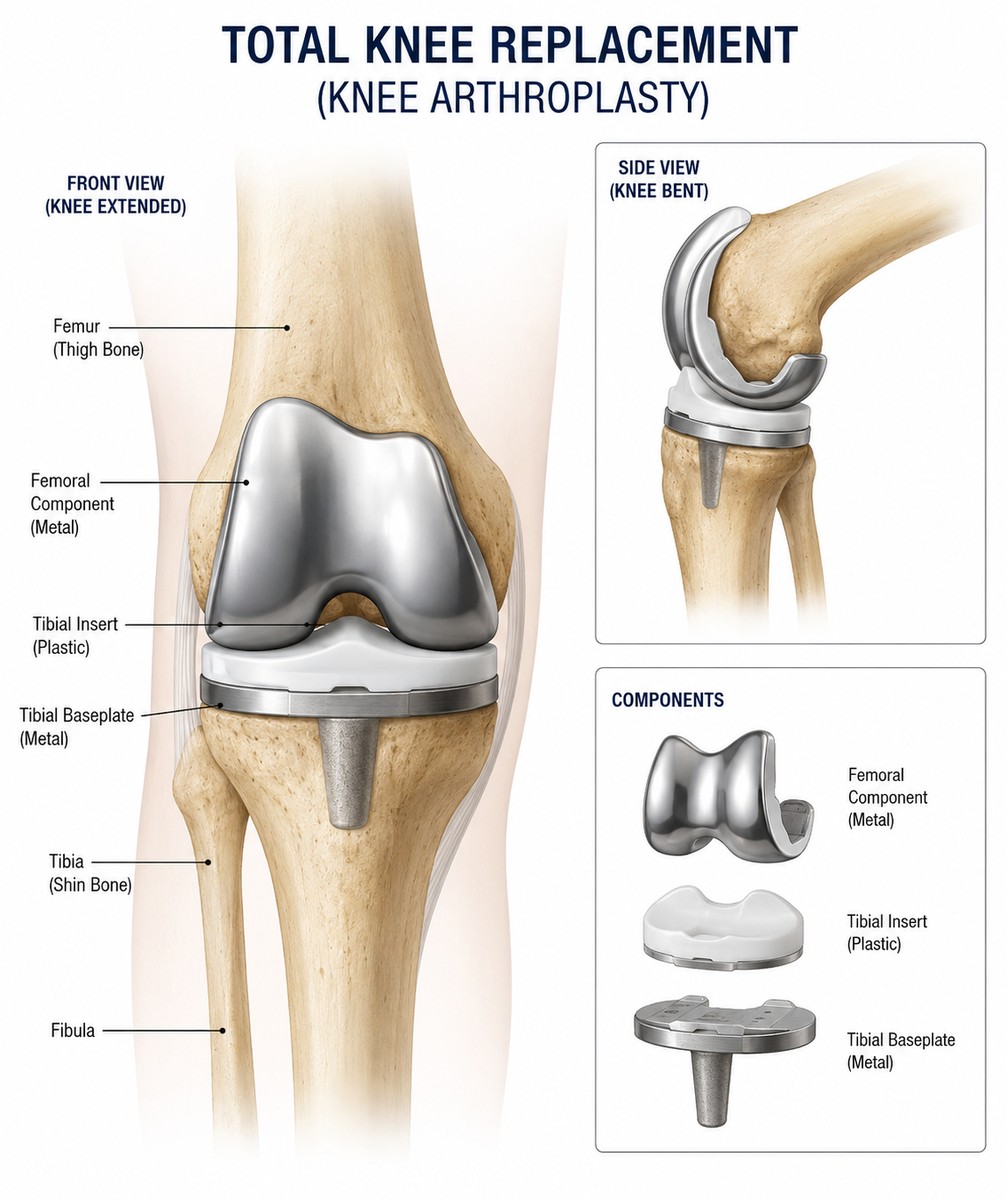
Roughly two out of every five patients I evaluate for knee arthritis are also being treated for obesity, type 2 diabetes, or both. A large share of them are now on a GLP-1 medication prescribed by their primary care physician or endocrinologist. That creates two practical questions that arrive in clinic almost every week: Could this drug help me avoid the operation? and Do I have to stop it before surgery?
Both questions now have real evidence behind them. Neither has a clean, one-word answer.
What the studies did
The avoidance question. Carter and colleagues used the TriNetX Global Research Network — a pooled electronic health record database — to identify adults diagnosed with knee osteoarthritis between 2010 and 2024. They sorted patients by which GLP-1 agent they were on and for how long, then used propensity score matching to build comparison groups balanced for age, sex, body mass index, diabetes, and other measured factors. Matched cohorts ranged from about 13,000 to about 42,000 patients per arm. The outcome was simple and hard to fudge: did the patient go on to have a total knee replacement, measured at one, three, five, and eight years after the arthritis diagnosis?1
The surgical safety question. Seddio and colleagues, publishing in The Journal of Arthroplasty, took a different angle. They looked at patients with type 2 diabetes who went on to have a knee replacement, and sorted them by how long they had been on semaglutide beforehand — under one month, one to two months, two to three months, three to six months, six to twelve months — each compared against matched patients not on the drug. The outcomes were 90-day postoperative adverse events, split into minor complications (wound problems, urinary tract infection, pneumonia) and severe ones (deep infection, pulmonary embolism, cardiac events, death).2
What they found
On avoiding the operation: one year of exposure to any GLP-1 agent was associated with a 2.8 percentage point lower cumulative rate of knee replacement at eight years (hazard ratio 0.90, 95% CI 0.83–0.98). Three years of exposure to semaglutide or tirzepatide specifically was associated with a 4.7 percentage point reduction (hazard ratio 0.72, 95% CI 0.67–0.78). Longer exposure and newer agents both tracked with larger effects.1
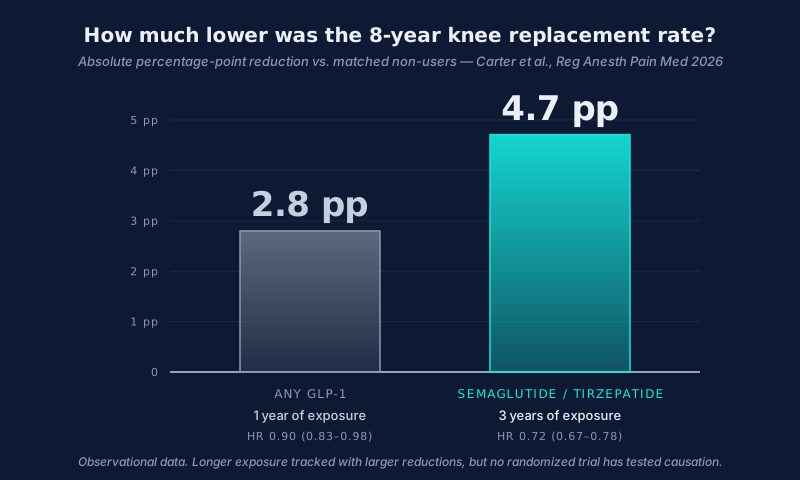
Put those percentages in terms you can use. A 4.7 percentage point absolute reduction means roughly 21 patients would need to be treated for three years to prevent one knee replacement over eight years. That is a meaningful population-level effect. It is not a promise to any individual person that the medication will keep them out of the operating room.
On surgical safety: patients who started semaglutide less than a month before surgery had markedly lower odds of minor adverse events (odds ratio 0.16). Reduced odds of severe adverse events reached statistical significance once patients had at least two to three months of exposure before the operation (odds ratio 0.25). The authors' conclusion was that about three months of preoperative semaglutide appears sufficient to reduce both categories.2
And on the aspiration worry that drove a lot of early anxiety about these drugs and anesthesia: a 2025 single-institution series of 83 patients on consistent GLP-1 therapy going into total joint replacement found no cases of intraoperative pulmonary aspiration. One patient — in the dose-escalation phase — was found to have a full stomach requiring decompression.3
What is genuinely strong in this evidence
- The sample sizes are large and the matching is real. Tens of thousands of patients per arm, with propensity score matching on the variables that matter most for both arthritis progression and surgical risk. This is not a case series.
- The dose-response pattern is the most persuasive part. Longer exposure tracked with larger reductions, and the newer, more potent agents outperformed the older ones. Confounding can produce an association; it produces a clean dose-response gradient less often.
- Two independent questions, two independent datasets, consistent direction. One study says fewer people reach the operation. A different study, different database, different population, says the operation goes better for those who do. Neither depends on the other being right.
- The aspiration signal has been reassuring in practice. The theoretical concern — these drugs slow gastric emptying, and a full stomach under anesthesia is dangerous — was legitimate. The accumulating clinical data have not borne out the worst version of it.
Where I would push back
- None of this is randomized. Every number above comes from observational data. Patients who fill GLP-1 prescriptions and stay on them for three years differ systematically from those who don't — in insurance coverage, in engagement with medical care, in the ability to tolerate the side effects, in baseline motivation to manage their health. Propensity matching can only balance what the database recorded.
- The authors' most interesting claim is also their least supported. Carter and colleagues suggest the effect may reflect "potential disease modifying activity beyond weight loss alone" — that is, the drug acting on joint inflammation directly rather than just taking load off the knee. That is a genuinely interesting hypothesis. This study design cannot test it. The database does not record how much weight each patient lost, so weight loss cannot be separated out as the mechanism.
- "Fewer knee replacements" is not the same as "less arthritis." A knee replacement is a decision, not a biological event. Patients on GLP-1 drugs may be having fewer operations partly because they feel better, partly because they weigh less and load the joint less — and partly because surgeons and patients defer surgery while a weight-loss plan is underway. Some of the measured effect is likely delay rather than prevention. Eight years of follow-up cannot distinguish those.
- The safety data are strongest where the confounding is worst. An odds ratio of 0.16 for minor complications in patients on the drug for less than one month is implausibly large as a biological effect. A month of semaglutide does not remodel a patient's surgical risk profile that dramatically. The far more likely explanation is that patients who were recently started on semaglutide were healthier, better optimized, and more closely followed to begin with.
- There is a musculoskeletal safety signal that deserves watching. An abstract presented at the 2026 AAOS Annual Meeting, using matched electronic medical record cohorts of about 73,000 patients per group, reported higher five-year rates of osteoporosis (4.1% vs. 3.2%), gout (7.4% vs. 6.6%), and osteomalacia (2% vs. 0.1%) among GLP-1 users with type 2 diabetes and obesity.4 That work is a conference abstract, not a peer-reviewed publication, and rapid weight loss from any cause carries bone-density risk. It is not a reason to avoid these medications. It is a reason for anyone on one long-term to have bone health on their physician's list.
The preoperative question patients get wrong most often
Patients frequently arrive having been told — sometimes by a well-meaning friend, sometimes by an out-of-date handout — that they must stop their GLP-1 medication two weeks before surgery. That guidance reflects an early 2023 position that has since been revised.
The 2024 multisociety guidance, developed jointly by the American Society of Anesthesiologists, the American Gastroenterological Association, and three other societies, recommends that most patients continue their GLP-1 receptor agonist through the perioperative period if they are at low risk for delayed gastric emptying and aspiration. Patients at higher risk are advised to shift to a liquid diet for 24 hours before the procedure rather than to stop the drug outright. The guidance explicitly weighs the harms of stopping — loss of glycemic control, cost, insurance barriers to restarting — against a risk that has proved smaller than feared.5
This decision belongs to your anesthesiologist and your prescribing physician, not to your orthopedic surgeon acting alone. What I ask of patients is that the medication is on the list they bring to the preoperative visit, with the dose and the date it was started, so the anesthesia team can make that call with complete information.
How I think about this in my practice
When a patient comes in with knee arthritis and is already on a GLP-1 medication, my read is that this is favorable — for the arthritis, for the operation if we get there, and for the recovery afterward. Weight is one of the few genuinely modifiable factors in both the progression of knee osteoarthritis and the risk profile of knee replacement surgery. A patient who has lost meaningful weight before surgery is a patient with lower infection risk, easier exposure in the operating room, and less load on the implant for the life of the reconstruction.
Where the evidence likely fits. A patient in their fifties or sixties with mild-to-moderate radiographic arthritis, elevated BMI, symptoms that are real but not yet dominating daily life, and an appetite for trying non-operative measures first. For that patient, evidence suggests a GLP-1 medication — prescribed and monitored by the appropriate physician — is a reasonable part of a plan that also includes structured physical therapy, activity modification, and an injection trial. Some of those patients will not need me to operate for years, and some may not need it at all.
Where it likely does not fit. A patient with bone-on-bone tricompartmental arthritis, significant deformity, night pain, and a knee that has stopped responding to anything. Starting a weight-loss medication does not regrow cartilage that is gone. I have seen patients delay a needed operation for a year or more waiting for a medication to resolve mechanical, end-stage disease, and arrive with more stiffness and more deconditioning than they started with. If you are already at that stage, the medication is worth pursuing alongside planning the operation — not instead of it.
I do not prescribe these medications. My role is to read the imaging, tell a patient where they actually sit on the arthritis spectrum, and coordinate with the physician managing the medication so that the timing of surgery and the timing of weight loss work together rather than against each other.
Bottom line for the layperson
- GLP-1 drugs are associated with fewer knee replacements over eight years — about 4.7 percentage points lower after three years on the newer agents, which works out to roughly 1 operation prevented for every 21 patients treated.
- The evidence is observational, not randomized, so it establishes a strong association rather than proof that the drug is what caused the difference.
- If you do need a knee replacement, being on semaglutide beforehand is associated with fewer complications, with about three months of exposure appearing sufficient in the published data.
- Do not stop your GLP-1 medication before surgery on your own. Current multisociety guidance says most patients should continue it — bring the drug and dose to your preoperative visit and let the anesthesia team decide.
- These medications do not reverse end-stage arthritis. If your knee is bone-on-bone, pursue the weight-loss plan and the surgical plan together rather than delaying one for the other.
References
- Carter V, Desverreaux E, Amin I, Fogarty AE, Hussain N, D'Souza R, Karri J. Glucagon-like peptide 1 receptor agonist use and risk of arthroplasty for knee osteoarthritis: retrospective database analysis. Regional Anesthesia and Pain Medicine. Published online June 2, 2026. doi:10.1136/rapm-2026-107658 (PMID 42229941)
- Seddio AE, Vasudevan RS, Gouzoulis MJ, Ansah-Twum JK, Grauer JN, Rubin LE. As Few as Three Months of Preoperative Semaglutide Exposure Prior to Total Knee Arthroplasty Is Associated With Reduced Postoperative Adverse Events in Patients Who Have Type II Diabetes. The Journal of Arthroplasty. 2025;40(12):3089–3096.e1. doi:10.1016/j.arth.2025.08.003 (PMID 40784425)
- Palmer RC, Telang SS, Kistler NM, Mayfield CK, Hong K, Gucev G, Lieberman JR, Heckmann ND. GLP-1 receptor agonist utilization is associated with a low risk of anesthesia-related complications prior to total joint arthroplasty. European Journal of Orthopaedic Surgery & Traumatology. 2025;36(1):37. doi:10.1007/s00590-025-04604-x (PMID 41351714)
- Wajahath M, et al. GLP Receptor Agonist Use is Associated with Increased Risk of Osteoporosis, Gout and Osteomalacia in Adults with Type 2 Diabetes and Obesity. Presented at the AAOS 2026 Annual Meeting. Conference abstract — not yet peer-reviewed. AAOS 2026 Annual Meeting press kit
- Kindel TL, Wang AY, Wadhwa A, Schulman AR, Sharaiha RZ, Kroh M, et al. Multisociety Clinical Practice Guidance for the Safe Use of Glucagon-like Peptide-1 Receptor Agonists in the Perioperative Period. Clinical Gastroenterology and Hepatology. 2025;23(12):2083–2085. doi:10.1016/j.cgh.2024.10.003 (PMID 39480373)
This article reflects Dr. Dewan's reading of the cited evidence at the time of publication. It is educational content, not medical advice. Your specific case may differ — schedule a consultation to discuss your imaging and history.