It is one of the most common questions I hear once the swelling settles and a patient starts thinking about real life again: “Will I be able to kneel?” Sometimes it is about gardening. Sometimes it is about getting down on the floor to play with a grandchild, or laying tile, or — for a lot of my patients in this community — being able to kneel comfortably for prayer.
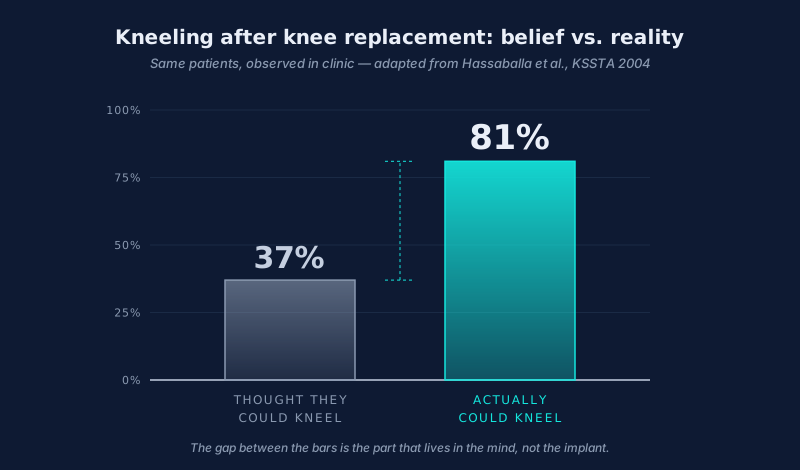
Here is the headline, and it is more encouraging than most patients expect. Kneeling is consistently the worst-rated activity after a total knee replacement — but a careful read of the literature shows that the barrier is mostly in the mind and the skin, not in the implant. Across multiple studies, far more patients are physically able to kneel than believe they can. The most-cited number comes from a study where only 37% of patients thought they could kneel, yet 81% actually could when simply asked to try.1
Why this question matters more than it sounds
Surgeons spend a lot of time measuring range of motion, X-ray alignment, and how far someone can walk. Patients care about those things too — but they also measure success by whether they can rejoin the specific parts of their life that the bad knee took away. For a great many people that means getting down to the floor: tending a garden bed, bathing a child, working a trade, kneeling in worship. When a patient tells me a replacement “worked” but they still can't kneel, they don't feel all the way better. So this is not a trivial or cosmetic concern. It is one of the activities that most defines whether someone feels their knee belongs to them again.
What the studies actually did
The most useful evidence here is not a single dramatic trial — it is a cluster of studies that all did something simple and revealing: instead of just asking patients on a questionnaire whether they can kneel, they asked them to actually try, under supervision, and recorded what happened.
The perception-versus-reality studies
In the most-cited of these, Hassaballa and colleagues studied 122 patients after knee replacement of various types and had each one attempt to kneel on a chair and on the floor.1 An earlier study by Schai and colleagues did the same with 70 patients (100 knee replacements between them).2 Both compared what patients predicted they could do against what they were observed to do moments later.
The bigger reviews
Two systematic reviews then pooled this kind of data across the whole field. A 2021 meta-analysis by Nadeem and colleagues gathered 36 studies on kneeling after knee replacement and looked at which surgical factors actually moved the needle.3 A 2023 review by Shah and colleagues pulled together 8 studies covering more than 24,000 patients to ask one specific question: does resurfacing the kneecap (putting a plastic button on the back of the patella) change whether patients can kneel?4
What they found
Most patients who “can't” kneel actually can
This is the central finding, and it repeats across studies. When Schai's team observed their patients, every one of them was able to kneel under supervision, even though only 31% had described kneeling as easy and 14% had said they couldn't do it at all.2 Among the patients who avoided kneeling, fear of harming the implant and simple lack of information accounted for roughly half of the cases. In plain terms: a large share of people who believe their replacement won't let them kneel are stopped by worry and habit, not by the joint itself.
It improves with time
The proportion of patients who kneel climbs the further out from surgery you look. Nadeem's meta-analysis found about 37% kneeling at one year, rising to about 48% by three or more years.3 Some of that is the surgical scar becoming less tender; some of it is confidence returning as people test the knee and nothing bad happens.
The kneecap button is not the answer people hope it is
A lot of patients (and some surgeons) assume that whether the kneecap is resurfaced must be the key to kneeling. The 24,000-patient review could not support that. The studies were inconsistent — of the few that found a statistically significant difference, one favored resurfacing and another favored leaving the kneecap alone — and the review concluded there is no clear consensus that resurfacing improves kneeling either way.4 Surgical details like the incision and the type of bearing showed small signals in the larger meta-analysis,3 but none of them rival the size of the gap between what patients believe and what they can do.
What these studies do well
Two things make this body of evidence genuinely useful to a patient.
They measured behavior, not just opinions
Most of what we know about recovery comes from questionnaires, which capture how a patient feels about an activity. By actually watching patients attempt to kneel, these studies separated “I can't” from “I won't,” and exposed how large that difference is. That is an unusually honest way to study a functional outcome.
The numbers are consistent and the samples are large
The perception-versus-reality gap shows up in independent studies a decade apart, and the pooled reviews run to tens of thousands of patients. When small studies and big reviews point the same direction, you can lean on the conclusion.
Where I'd push back on an over-simple reading
This is the part the cheerful headlines skip. “You can kneel — it's all in your head” is too glib, and it isn't quite what the data say.
“Able to kneel” is not the same as “comfortable kneeling”
Being able to get into a kneeling position once, in a clinic, is a low bar. It does not mean kneeling feels normal, or that you'd want to do it to weed a flowerbed for twenty minutes. Many patients describe the kneecap area as numb, tight, or oddly tender — a real sensation, not imagined — even when they can physically do it.
The discomfort often comes from the skin, not the joint
The incision runs right over the front of the knee, and the small nerves in that skin are cut during any knee replacement. The result is a patch of numbness or pins-and-needles over the kneecap that can make kneeling feel strange for months. That is a skin-sensation problem, not a sign that the implant is failing — but it is a genuine reason kneeling is unpleasant, and it deserves to be named rather than waved away.
Sometimes it really is the other knee
When researchers asked pre-educated patients why they still didn't kneel, the single most common reason was not the replaced knee at all — it was pain in the opposite knee.5 A replacement can only fix the joint it replaced. If the other knee is arthritic, kneeling will still hurt on that side.
These are observational studies
None of this comes from the kind of blinded, randomized trial we'd want for a drug. The studies watch and measure rather than randomize, and “kneeling” is defined differently from paper to paper. The direction of the evidence is consistent and believable, but it tells you what tends to happen across groups, not a guarantee for any one person.
What this means in my practice
When a patient asks me whether they'll kneel again, I try to give them the honest, two-part answer the evidence supports rather than a reflexive yes or no.
1. There is no evidence that kneeling damages a well-fixed replacement
This is the reassurance most patients are really fishing for, and I give it plainly: once the incision is fully healed and the knee is no longer swollen, kneeling on a modern, well-fixed implant has not been shown to harm it. The metal and plastic are built to take far more load than kneeling applies. The widespread belief that kneeling will “wear it out faster” or “knock it loose” is not supported by the data — and that belief, left unaddressed, is one of the main reasons people never try.
2. Expect it to feel strange before it feels normal
I tell patients the front of the knee will likely feel numb or tender when they first kneel, and that this is the cut skin nerves, not the implant. Naming it ahead of time changes how people interpret it. A sensation you were warned about reads as “expected,” not “something is wrong.”
3. Retrain the knee gradually
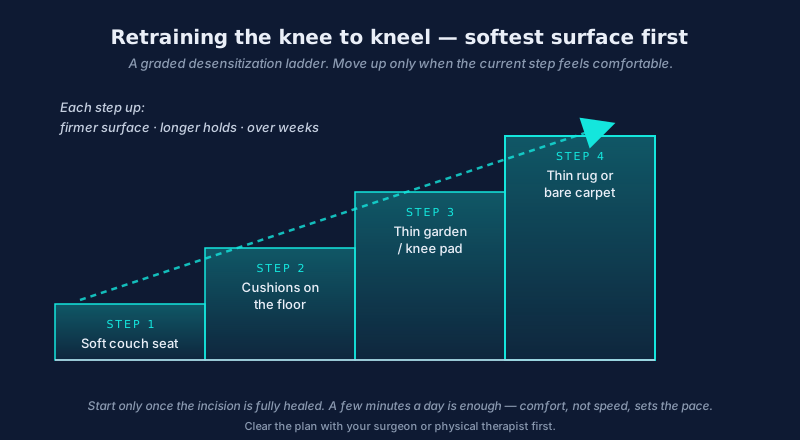
I generally suggest waiting until the wound is completely healed — no scabs, no drainage — which is usually somewhere around the six-week mark, and then starting soft. Kneel on a couch cushion, then cushions on the floor, then a thin garden pad, then a rug, a few minutes at a time, moving up only as comfort allows. This kind of graded desensitization is exactly how we coax sensitive skin and a cautious mind back to a normal activity. The figure above lays out the ladder. I always ask patients to clear the specifics with their physical therapist, because timing varies.
4. Where the robotic and alignment details fit — and where they don't
I perform knee replacement with robotic-arm assistance (see robotic knee replacement), and precise component positioning and patellar tracking are things I care about a great deal — they matter for how a knee feels and moves overall. But I want to be straight about the limits of the evidence: the kneeling barrier in these studies was driven far more by skin sensation, fear, and the state of the other knee than by the surgical variables anyone has measured. I'd be overselling my own tools if I told you the robot is what determines whether you'll kneel. What it does is give you the best-tracking, best-aligned knee I can, and then your skin, your time, and your willingness to retrain do the rest.
5. When kneeling pain is worth a second look
Not all of this is “just get used to it.” If kneeling is sharply painful in a way that is getting worse rather than better, or comes with new swelling, warmth, instability, or a clunk, that is not the expected skin-numbness story, and I want to see that patient and get X-rays. Evidence suggests most kneeling difficulty is benign and improvable — but the job of a good follow-up is to separate the common, harmless version from the uncommon one that needs attention.
The bottom line for the layperson
- Kneeling is the activity patients struggle with most after a knee replacement — but in studies, roughly twice as many people can kneel as believe they can.
- There is no good evidence that kneeling damages a healed, well-fixed implant. The most common reason people don't kneel is fear of harming it, and that fear is misplaced.
- The front of your knee will likely feel numb or tender at first. That is the cut skin nerves healing, not the implant failing.
- Kneeling tends to get easier over months and years. Retrain it gradually — softest surface first, a few minutes at a time, once the wound is fully healed.
- If kneeling pain is sharp, worsening, or comes with swelling, warmth, or instability, that's different — have it checked rather than pushing through.
If you've had a knee replacement and you're not sure whether it's safe to start kneeling again — or you're weighing surgery and this is one of the things holding you back — that's a reasonable conversation to have in person. You can request a visit or call the office at (281) 690-4678.
Sources
- Hassaballa MA, Porteous AJ, Newman JH. “Observed kneeling ability after total, unicompartmental and patellofemoral knee arthroplasty: perception versus reality.” Knee Surg Sports Traumatol Arthrosc. 2004;12(2):136–139. DOI: 10.1007/s00167-003-0376-5 (PMID: 12897983)
- Schai PA, Gibbon AJ, Scott RD. “Kneeling ability after total knee arthroplasty. Perception and reality.” Clin Orthop Relat Res. 1999;(367):195–200. PMID: 10546615
- Nadeem S, Mundi R, Chaudhry H. “Surgery-related predictors of kneeling ability following total knee arthroplasty: a systematic review and meta-analysis.” Knee Surg Relat Res. 2021;33(1):36. DOI: 10.1186/s43019-021-00117-z (PMID: 34600595)
- Shah OA, Spence C, Kader D, Clement ND, Asopa V, Sochart DH. “Patellar resurfacing and kneeling ability after total knee arthroplasty: a systematic review.” Arthroplasty. 2023;5(1):32. DOI: 10.1186/s42836-023-00184-5
- White L, Stockwell T, Hartnell N, Hennessy M, Mullan J. “Factors preventing kneeling in a group of pre-educated patients post total knee arthroplasty.” J Orthop Traumatol. 2016;17(4):333–338. DOI: 10.1007/s10195-016-0411-1 (PMID: 27234004)
- AAOS OrthoInfo — Activities After Knee Replacement
This article reflects Dr. Dewan's reading of the cited evidence at the time of publication. It is educational content, not medical advice. Your specific case may differ — schedule a consultation to discuss your imaging and history.