
The first question almost every patient asks after a kneecap dislocation is some version of the same thing: is this going to happen again? It is the right question, and for years the answer patients got was unsatisfying — a shrug, a brace, and a course of physical therapy. What has changed is that we can now put a reasonably specific number on that risk for an individual knee, and a randomized trial published in the American Journal of Sports Medicine in 2026 has given us three-year data on what surgery does for the people who have already dislocated more than once.1 Those two things together — a risk number and a treatment effect — are what turn this from a shrug into a decision.
Why this matters more than it sounds
A kneecap that dislocates does more than hurt. Each dislocation can shear cartilage off the back of the patella or the end of the femur, and that damage does not grow back. It is also a confidence injury: patients who have had two or three episodes start avoiding stairs, pivoting sports, and eventually anything that puts the knee in a vulnerable position. So the recurrence question is not academic. If your personal risk of a second dislocation is under 10%, a course of physical therapy is a very reasonable plan. If it is close to 80%, spending a year waiting for the next one to happen — and for it to take another piece of cartilage with it — is a harder plan to defend.
Four things decide your risk
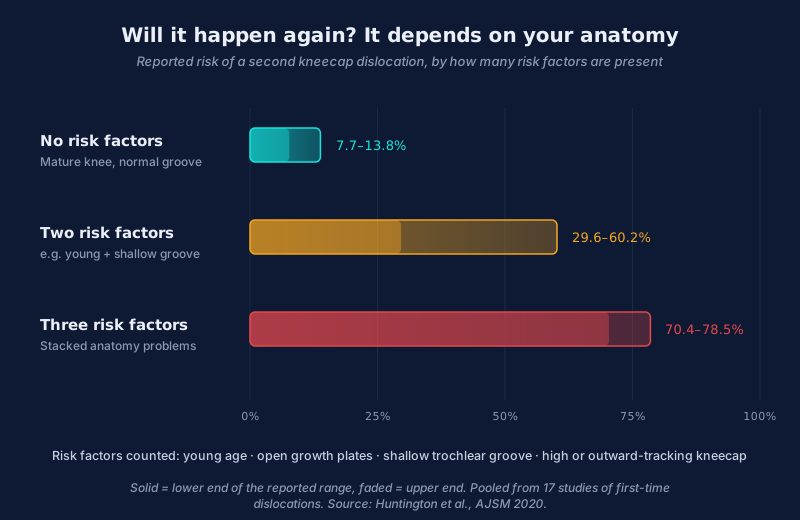
The most useful piece of work on this question is a meta-analysis that pooled 17 studies of people who had suffered a first-time dislocation and tracked what happened next.2 Across the pooled population, about one in three went on to dislocate again — a 33.6% recurrence rate. That average is a poor guide for any individual patient, though, because the same analysis showed the risk is driven almost entirely by four features:
- Younger age — roughly two and a half times the odds of recurrence.
- Open growth plates (a skeleton still growing) — a similar effect.
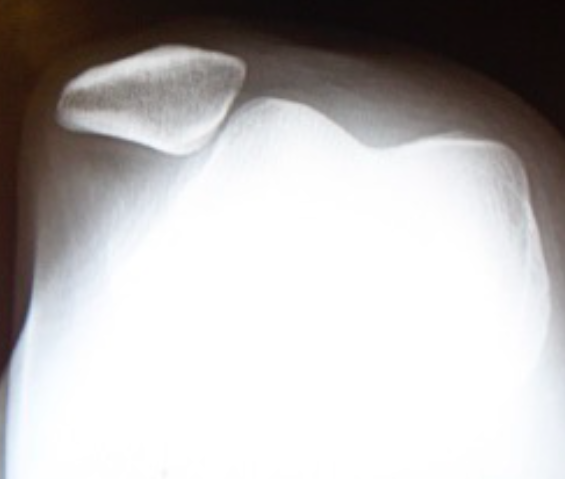
- Trochlear dysplasia — a shallow or flat groove at the end of the femur, which more than quadruples the odds. This is the single strongest factor.
- A kneecap that sits high or tracks too far to the outside — measured on imaging as patella alta and an increased TT–TG distance. Each roughly doubles to triples the odds.
These stack. A patient with none of them has a reported recurrence risk in the range of 7.7% to 13.8%. Two of them raises it to between 29.6% and 60.2%. Three of them raises it again, to between 70.4% and 78.5%.
A group at Mayo Clinic turned this idea into a formal calculator — the Recurrent Instability of the Patella (RIP) score — using age, skeletal maturity, trochlear dysplasia, and how far the kneecap tracks to the outside. Following first-time dislocators for about a decade, they found their low-, intermediate-, and high-risk groups had 10-year recurrence rates of 0%, 30.6%, and 79.2% respectively.3 The same injury carried three very different long-term outlooks, separated by anatomy that was present before the knee ever dislocated.
The new trial: what surgery does after you've already dislocated twice
The risk numbers above describe people after one dislocation. A different question applies once instability has become a pattern: does reconstructing the torn ligament actually stop it? The medial patellofemoral ligament (MPFL) is the short band on the inner side of the knee that serves as the main restraint holding the kneecap against sliding outward, and it tears in essentially every lateral dislocation.
The 2026 trial randomized 61 patients aged 12 to 30 with recurrent lateral patellar dislocation into two groups.1 Both had a knee arthroscopy and both did the same structured rehabilitation program afterward. The only difference was that one group also had an isolated MPFL reconstruction — the ligament rebuilt with a tendon graft. The researchers then asked, at three years, a deliberately patient-centered question: do you still feel that your kneecap is unstable?
What it found
The gap was large. 16.7% of the reconstruction group still reported instability at three years, versus 53.6% of those who had rehabilitation alone — an odds ratio of 5.8 (95% CI, 1.7–19.4; P = .003). In plain terms, roughly one in six reconstructed knees still felt unstable, compared with more than half of the knees managed without reconstruction.
A second finding received much less attention and deserves equal weight: both groups improved substantially on their patient-reported outcome scores, and there was no significant difference between them. Pain, function, and daily quality-of-life measures ended up in approximately the same place either way. In this trial, reconstruction reduced instability without producing better scores for how the knee felt day to day.
Strengths of the study
- It is a genuine randomized trial in a field that mostly runs on case series. Patellar instability research is dominated by retrospective reviews of one surgeon's patients. A randomized comparison is a meaningful step up in evidence quality.
- Both arms got an arthroscopy. That is an unusually rigorous design choice — it means the comparison isolates the effect of the reconstruction itself, rather than the effect of “having an operation.”
- Three years of follow-up. Instability recurrence is not a 6-month phenomenon; short studies systematically flatter nonoperative treatment.
- The primary outcome is the one patients care about. Not a laxity measurement on an exam table — whether the person feels their kneecap is going to give way.
Where I'd push back
This is a good study, and it moves my thinking. It is not the last word, and a few things temper how far I'd carry it.
1. Sixty-one patients is a small trial
The confidence interval around that odds ratio runs from 1.7 to 19.4. The direction of the effect is convincing; the size of it is not pinned down. A treatment effect that could plausibly be anywhere from modest to enormous is still an argument for surgery in the right patient — but it should be quoted with that width attached, not as a single impressive number.
2. The primary outcome was subjective, and nobody was blinded
Patients knew whether they had received a reconstruction, and the outcome was their own report of whether the knee felt unstable. That is the right question to ask, but it is also exactly the setup in which expectation influences the answer. Someone who knows their ligament was rebuilt may reasonably feel more secure on the same knee. Objectively documented redislocation rates are the more reliable measure, and a larger trial reporting those as its primary endpoint would settle the question.
3. The age range tells you who this applies to
The trial enrolled patients aged 12 to 30, and about three-quarters were female — which mirrors who actually gets this injury. It also means the findings speak to adolescents and young adults, not to a 45-year-old whose kneecap dislocated for the first time on a ski slope. Care for a still-growing skeleton is its own specialty with its own considerations, and nothing here should be read across to it.
4. “Isolated” reconstruction is a real limit
Every patient in the surgical arm had an MPFL reconstruction alone. But the strongest risk factor for recurrence — a shallow trochlear groove — is a bone-shape problem, and a soft-tissue reconstruction does not change bone shape. The ESSKA consensus panel makes the same point: combining reconstruction with correction of significant bony risk factors may further reduce recurrence, though the thresholds for when to do that remain debated.4 Patients with severe dysplasia may be the ones for whom an isolated reconstruction underperforms, and this trial was not built to find that out.
5. It studied recurrent dislocators — not first-timers
This is the most common misreading I expect to see. The trial's patients had already dislocated repeatedly. It is not evidence that everyone should have surgery after their first episode. On that separate question, the 2024 ESSKA consensus lands where I do: treatment should be individualized by risk, nonoperative care remains appropriate for a mature knee with low recurrence risk and no cartilage damage, and surgery deserves serious first-line consideration when several risk factors stack up.4
What this means in my practice
When someone comes in after a kneecap dislocation, the first thing I want is not a treatment plan — it is an accurate picture of the knee's anatomy. That means imaging that lets me see the depth of the trochlear groove, how high the kneecap rides, how far it tracks to the outside, and whether a piece of cartilage came off during the episode. Until I have that, any prediction about recurrence is guesswork.
Who I expect to do well without surgery
A skeletally mature patient with a normally shaped groove, a normally positioned kneecap, no loose cartilage fragment, and one dislocation is someone I would treat with a focused rehabilitation program and expect to do well. The published risk in that group sits under about 14%, and the ESSKA panel is clear that bracing adds nothing to the long-term outcome — it is the strengthening, motion, and neuromuscular retraining that matter.4 That patient should not be talked into an operation by a statistic drawn from a higher-risk group.
Where the conversation changes
It changes when risk factors stack, and it changes when instability has already proved itself. A patient with a dysplastic groove and a high-riding patella who has dislocated twice is a different problem, and the evidence now suggests reconstruction offers a real reduction in ongoing instability for that person.1 I would want them to understand the trade honestly: the strong signal in the data is about stability, and the trial did not show better pain or function scores than rehabilitation alone. If someone's chief complaint is aching at the front of the knee rather than the kneecap giving way, an MPFL reconstruction is aimed at the wrong target.
Loose cartilage changes the timeline
One finding overrides the whole risk calculation: if a dislocation knocked a fragment of cartilage or bone loose in the joint, that is a reason to operate on its own schedule, not on the recurrence math. Those fragments are sometimes repairable if addressed early, and they cause mechanical problems if left in place.
What I tell patients about the number
Patients are usually relieved to learn that recurrence risk can be estimated rather than guessed at. When someone's anatomy places them in the low-risk group, that is genuinely reassuring information, and it allows them to stop anticipating the next episode. When the anatomy points the other way, knowing it early allows a stabilization to be planned deliberately rather than after a third dislocation has damaged more cartilage. In either case the estimate is worth having, and it comes from imaging and a physical exam rather than from how severe the injury felt.
The bottom line for the layperson
- About a third of people redislocate after a first kneecap dislocation — but your personal risk depends far more on your anatomy than on that average.
- Four features drive the risk: young age, still-growing bones, a shallow groove at the end of the thigh bone, and a kneecap that sits high or tracks to the outside. With none of them, risk is under about 14%; with three, it can exceed 70%.
- A 2026 randomized trial found that in patients who had already dislocated repeatedly, rebuilding the MPFL left 16.7% still feeling unstable at three years, compared with 53.6% treated with rehabilitation alone.
- That same trial found no difference between the groups in pain and function scores — reconstruction reduced instability without producing a better-feeling knee overall.
- If your kneecap has dislocated, ask for imaging that measures groove depth and kneecap position. Those measurements, rather than how severe the episode felt, are what should drive the decision.
If your kneecap has dislocated and you're trying to decide whether to strengthen it or stabilize it, that decision should be based on your own imaging. You can request a visit or call the office at (281) 690-4678. You may also want to read the companion pieces on why kneecaps dislocate in the first place and what the J-sign tells your surgeon.
Sources
- Straume-Næsheim TM, Randsborg PH, Nilsgård TL, Årøen A. “Medial Patellofemoral Ligament Reconstruction vs Nonoperative Treatment for Recurrent Lateral Patellar Dislocation: Three-Year Results From a Randomized Controlled Trial.” Am J Sports Med. 2026;54(4):773–779. DOI: 10.1177/03635465261416931 (PMID: 41655186)
- Huntington LS, Webster KE, Devitt BM, Scanlon JP, Feller JA. “Factors Associated With an Increased Risk of Recurrence After a First-Time Patellar Dislocation: A Systematic Review and Meta-analysis.” Am J Sports Med. 2020;48(10):2552–2562. DOI: 10.1177/0363546519888467 (PMID: 31825650)
- Hevesi M, Heidenreich MJ, Camp CL, Hewett TE, Stuart MJ, Dahm DL, Krych AJ. “The Recurrent Instability of the Patella Score: A Statistically Based Model for Prediction of Long-Term Recurrence Risk After First-Time Dislocation.” Arthroscopy. 2019. DOI: 10.1016/j.arthro.2018.09.017 (PMID: 30612768)
- Balcarek P, Blønd L, Beaufils P, et al. “Management of first-time patellar dislocation: The ESSKA 2024 formal consensus—Part 2.” Knee Surg Sports Traumatol Arthrosc. 2025;33(12):4197–4206. DOI: 10.1002/ksa.12637 (PMID: 40053919)
- AAOS OrthoInfo — Patellar (Kneecap) Instability (patient overview)
This article reflects Dr. Dewan's reading of the cited evidence at the time of publication. It is educational content, not medical advice. Your specific case may differ — schedule a consultation to discuss your imaging and history.