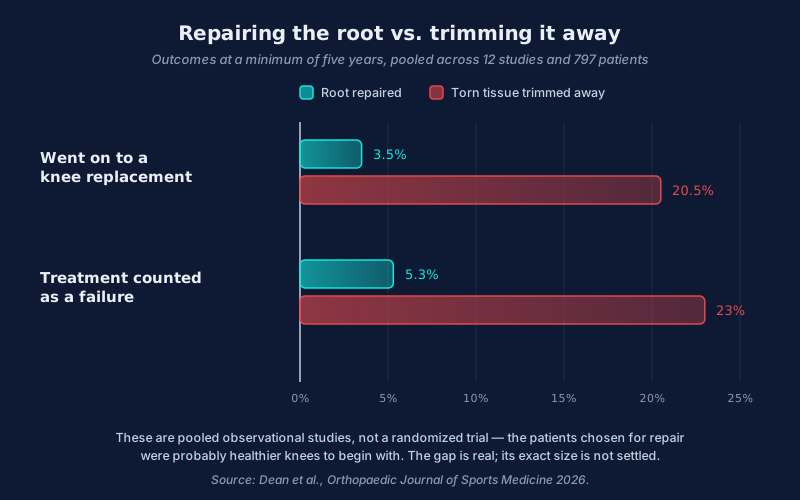
The message patients hear most often about meniscus tears — and the one this site has made repeatedly — is that surgery is usually unnecessary. For the common degenerative tear in a middle-aged knee, that holds up well against the randomized evidence. There is one tear pattern where the opposite appears to be true. It is called a posterior root tear, and it detaches the meniscus from the bone that anchors it. Pooled data covering nearly 800 patients followed a minimum of five years found that 3.5% of repaired root tears went on to a knee replacement, against 20.5% of those treated by trimming the tissue away.1
Those numbers come from observational research rather than a randomized trial, and that distinction carries real weight — a good part of this article is about why. The direction of the effect has now been reproduced by separate research groups across two decades of data, which is why a root tear deserves to be treated as a different diagnosis from the meniscus tear most patients are told they have.
Why this matters if you have just been handed an MRI report
A radiology report that says posterior root tear of the medial meniscus reads, to almost everyone, like any other meniscus tear. Patients then search the topic, find the well-publicized trials showing that arthroscopy does not beat physical therapy for degenerative meniscus tears, and reasonably conclude they should wait it out. Others are offered an arthroscopy, have the torn tissue trimmed away, feel better for a year or two, and then watch the knee deteriorate faster than they expected.
Both paths start by treating the words meniscus tear as one category. Mechanically they are not one category, and the difference is not subtle.
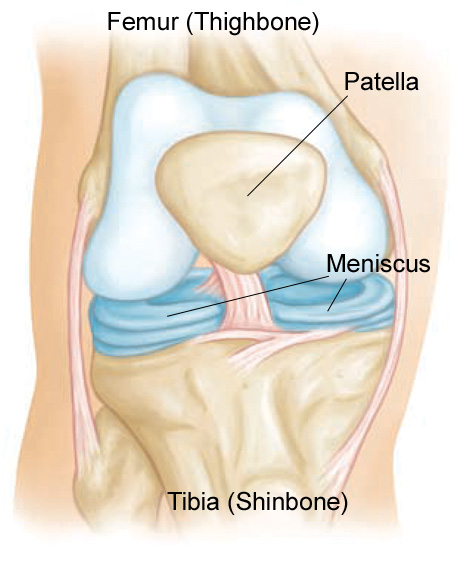
What a root tear actually is
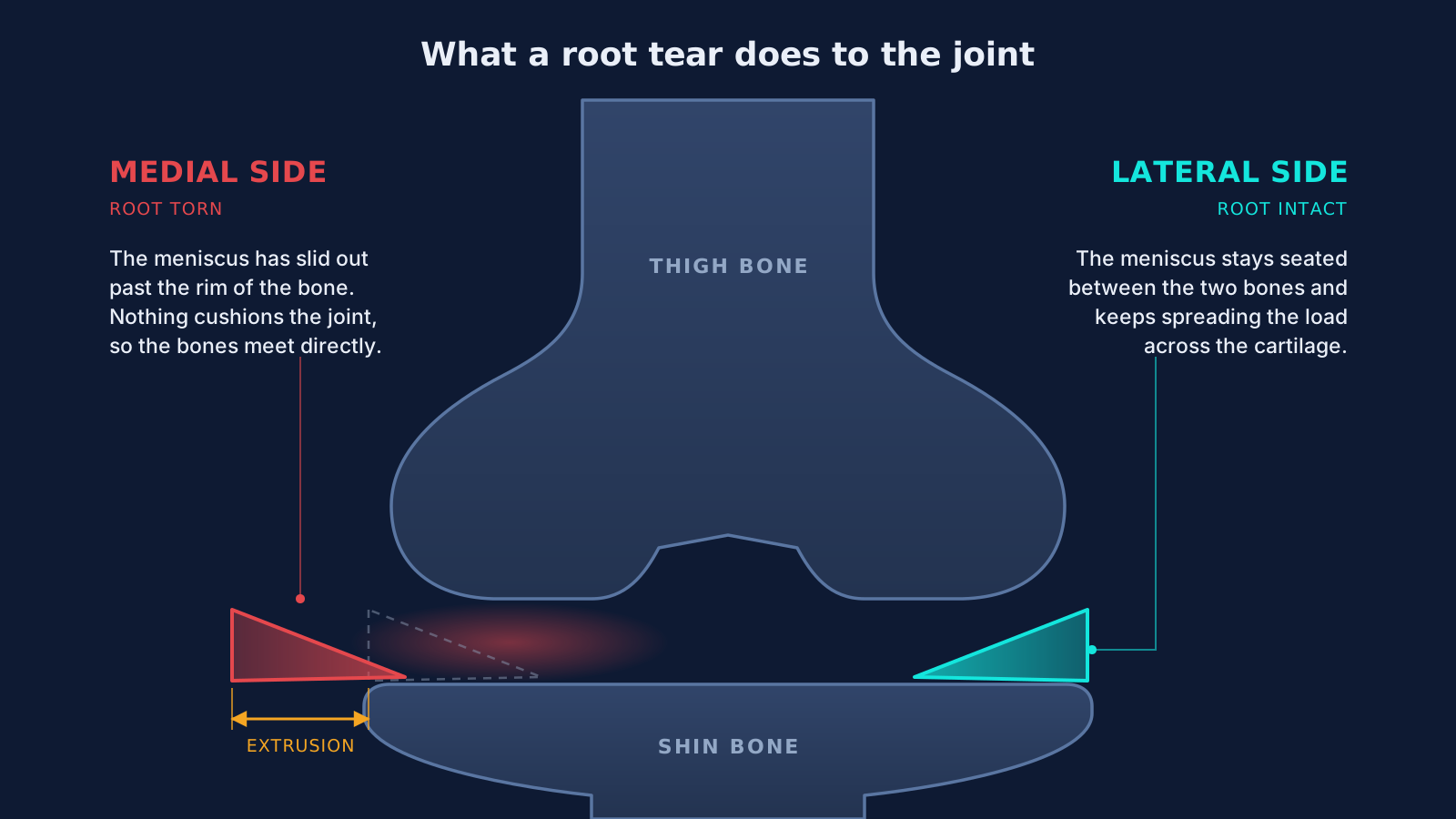
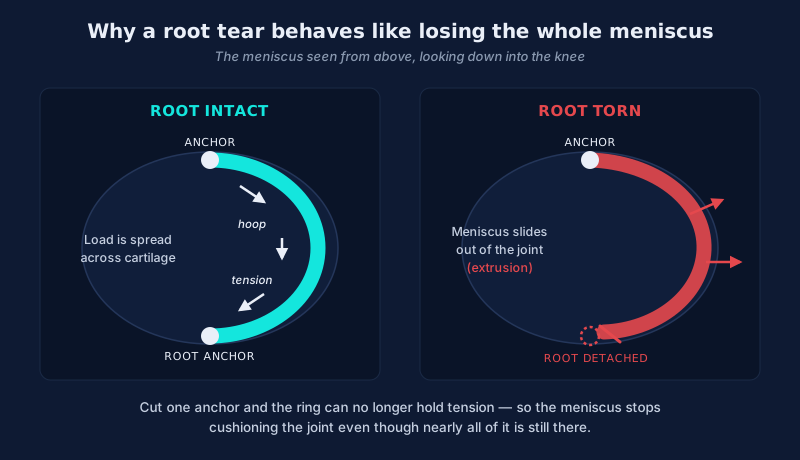
Each meniscus is a C-shaped wedge, and each end of that C attaches to the top of the shin bone through a short, dense band of tissue called a root. The roots are what convert a downward load into tension running around the ring of the meniscus. That circumferential tension — hoop stress — is the mechanism by which the meniscus spreads body weight across a wide surface instead of letting it concentrate on one point of cartilage.
When a root detaches, the ring can no longer hold tension. The meniscus slides sideways off the edge of the shin bone, a displacement visible on MRI as extrusion, and load transfers directly onto the cartilage underneath. Laboratory work has shown for years that the contact pressures in a knee with a detached root approximate the pressures in a knee with no meniscus at all. The tissue is still present on the scan; mechanically, it has been removed. That reframes the surgical question: the operation is not done to clear away a fragment of loose tissue, it is done to close the ring back up.
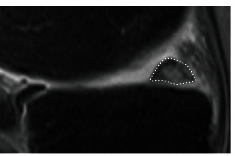
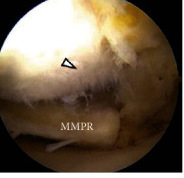
Clinical images from Okazaki et al., Case Reports in Orthopedics 2020, reproduced and cropped under CC BY 4.0.10
Most medial root tears are not sports injuries. The common story is a middle-aged patient who felt a pop while standing up from a squat, gardening, or stepping down awkwardly, followed by pain at the back inside corner of the knee that does not settle over several weeks. Many describe it as the worst knee pain they have had, which is a useful clue — ordinary degenerative tears rarely announce themselves that clearly.
What repair does compared with trimming
Three separate bodies of work point the same direction.
The largest and most recent is a 2026 systematic review and meta-analysis pooling 12 studies and 797 patients with a mean follow-up of seven years.1 Both repair and trimming improved function scores. The difference appeared in what happened to the joint over the following years: conversion to a knee replacement ran 3.5% after repair against 20.5% after trimming, and treatment was counted as a clinical failure in 5.3% versus 23%. Repaired knees also showed lower arthritis grades on X-ray.
An earlier meta-analysis in the American Journal of Sports Medicine, pooling studies with at least four years of follow-up, found the same ordering on a smaller sample: 9.8% of repaired knees converted to a replacement against 36% of trimmed knees, and arthritis progressed visibly in 22% versus 66%.2 Two independent pooled analyses, assembled from different studies a few years apart, landing on the same conclusion is worth more than either alone.
A Korean cohort followed patients for a minimum of ten years — the longest follow-up available.3 Using knee replacement as the definition of failure, survival at ten years was 79.6% after repair and 44.4% after trimming.
What happens if the tear is simply left alone
The comparisons above set repair against trimming. A Mayo Clinic group asked a question the others did not, and the answer is the single most useful finding in this literature for patients. They matched patients to one another by age, sex, and the arthritis already visible on X-ray, then compared three approaches: repair, trimming, and no surgery at all.4
At an average of about six years, none of the 15 repaired knees had gone on to a replacement. Four of 15 knees managed without surgery had. Nine of 15 trimmed knees had. Arthritis progression followed the same pattern: knees left alone and knees trimmed worsened at close to the same rate, while repaired knees changed least.
Doing nothing outperformed trimming, by a wide margin. That ordering makes mechanical sense. If the ring is already open and no longer holding tension, removing tissue restores nothing — it subtracts the cartilage that was still providing some coverage. The practical consequence is that the decision facing a patient with a root tear is not surgery or no surgery. It is closer to repair it or leave it alone, with trimming the option that looks worst over the long run while feeling entirely reasonable in the first year or two.
Does the timing matter?
This is the question patients ask immediately after the diagnosis, and the 2026 literature does not answer it with one voice.
A systematic review covering 11 studies and 366 patients found that repair improved function whenever it was performed, but that patients treated within three months gained the most — an IKDC improvement of 39.0 points, against 22.9 points when repair was delayed beyond six months.5 The authors concluded that early treatment should be pursued.
A cohort study published a few weeks later reached a more qualified position.6 Among 61 patients, those repaired late did show more arthritis progression on unadjusted comparison — but once the analysis accounted for the state of the knee before surgery, timing was no longer an independent predictor. What predicted progression was how far the meniscus had already extruded and how much joint space had already been lost. The authors' reading is that the degenerative burden already present drives the outcome, and that delay matters chiefly because it is a route to accumulating that burden.
Both papers point the same direction in practice: do not sit on this diagnosis. They differ on the mechanism, and the difference is not academic. If delay is harmful in itself, the clock starts at the injury. If delay is harmful because of what accumulates during it, then a knee that has not yet extruded or lost joint space may still be a good candidate several months in — and a knee that has already extruded badly may be a poor candidate at six weeks.
Two findings that change who gets offered a repair
Leg alignment matters more than most patients expect
A case-control study of 128 patients found that knees with 5 degrees or more of varus alignment — bow-leggedness, which shifts load onto the inner compartment — did substantially worse after root repair. Arthritis progressed in 53.3% of varus knees against 32.5% of normally aligned ones, repairs failed to heal far more often, and conversion to a knee replacement ran 15.6% versus 2.4%.7 Repairing the anchor does not help much when the leg keeps driving load through the compartment that tore.
Cartilage damage found during surgery is less decisive than expected
A separate cohort of 170 patients followed for five years compared repairs performed in knees with mild cartilage wear against those with advanced wear seen at the time of surgery. There was no significant difference in survival or clinical outcome. Both groups reached a median survival of 11 years, both were around 80% survival at eight years, and failure rates were nearly identical at 17.6%.8 The authors' conclusion is that cartilage grade found during the operation should not on its own dissuade a surgeon from repairing the root.
Strengths of this body of evidence
- The follow-up is long enough to be meaningful. Meniscus research is full of two-year studies. A mean of seven years in the largest pooled analysis, five years in the cohorts, and a minimum of ten in one series covers the period in which joint degeneration actually declares itself.
- The outcome that matters most is a hard one. Conversion to knee replacement is not a questionnaire score; it is a decision a patient and surgeon made because the knee was not working.
- The findings are consistent across independent groups. Different institutions, different countries, different techniques, and two separately assembled meta-analyses converge on repair outperforming trimming over time.
- One group matched patients before comparing them. Matching on age, sex, and existing arthritis grade is the most serious attempt anyone has made to control for the selection problem described below.4
- Two of the 2026 papers report results that cut against their authors' expectations — timing losing significance after adjustment, and cartilage grade not predicting failure. Findings that disappoint the people who ran the study are generally more trustworthy than findings that confirm them.
Where I'd push back
1. None of this is randomized, and selection bias could produce much of the gap
Every comparison above is observational. Surgeons repair the tears that look repairable: younger patients, healthier cartilage, straighter legs, tears that happened recently. They trim when the tissue is degenerate, the arthritis is advanced, or the knee is already bowed. Those are precisely the features that predict who ends up needing a knee replacement, independent of what was done to the meniscus. A study comparing better knees against worse knees will favor the treatment given to the better knees whether or not the treatment did anything. The matched cohort blunts this concern meaningfully, which is why I weight it heavily — but matching cannot capture tissue quality or the surgeon's impression in the operating room.4
2. The numbers are smaller than "meta-analysis" makes them sound
The word suggests a large evidence base. The earlier pooled arthritis outcome rests on 144 patients and its replacement outcome on 143.2 The striking result of zero replacements after repair comes from 15 people.4 With samples that small, a handful of patients landing differently would move the headline figures substantially. The 2026 analysis is the reassuring exception at 797 patients.1
3. The timing numbers in the systematic review are internally strange
That review reports arthritis progression of 24.2% in the early-treatment group against 4.8–10% in the delayed groups — the opposite of its own conclusion that earlier is better.5 The most likely explanation is that the early and delayed cohorts came from studies with different follow-up lengths and imaging protocols, not that waiting protects cartilage. It is a reminder that a pooled number is only as coherent as the studies feeding it, and it is why I read the adjusted cohort analysis as the more informative of the two.6
4. The repair may not restore what it is supposed to restore
A prospective multicenter study of 45 patients found excellent two-year results — knee scores nearly doubled and pain scores fell sharply. In the same patients, meniscus extrusion continued to worsen after repair, by about 0.7 mm on average.9 The case that supplied the images above shows the same thing more starkly: medial extrusion measured 4.3 mm before surgery and 7.0 mm afterward, in a patient who nonetheless did well clinically.10 If the purpose of the operation is to close the ring so it holds tension again, ongoing extrusion suggests the ring is not always holding as intended. Patients improve anyway, which is reassuring, but it means the mechanism behind the benefit is less settled than the confident biomechanical account implies.
5. Function did not separate as cleanly as structure
The earlier pooled analysis found no statistically significant difference in patient-reported knee scores between repair and trimming.2 The ten-year cohort did find one.3 The defensible version of the claim is that repair appears to protect the joint over the long run — not that it reliably makes the knee feel better than trimming does in the first few years. Those are different promises, and patients deserve the more modest one.
6. The cartilage-grade finding needs care in the retelling
A study showing that advanced cartilage wear did not predict failure is not a license to repair every root tear in every arthritic knee.8 Those patients were still selected for surgery by surgeons who thought repair was reasonable. It shifts the threshold; it does not remove it.
What this means in my practice
Taken together, I read this literature as a strong signal with soft edges. Here is how it shapes the conversation in clinic.
I treat a root tear as its own diagnosis
The general advice that most meniscus tears do not need surgery is sound, and I stand behind what we have written about meniscus tears and whether surgery is necessary. A root tear sits outside that generalization. When a report describes a root tear, or a radial tear at the back of the meniscus, particularly alongside extrusion, that deserves a dedicated conversation rather than being folded into the usual reassurance.
What I want to see before deciding
The imaging questions I want answered are how far the meniscus has extruded, how much joint space remains in that compartment, and what the mechanical alignment of the leg is on a standing full-length X-ray. Those three findings do more to predict how a repair will go than the tear itself does.
Who I expect to do well with a repair
A patient with a genuine root tear, reasonably preserved joint space, minimal extrusion, and neutral alignment is the person for whom the repair data look strongest. If that patient also has a clear injury story and pain that matches the tear, I want to move rather than watch, because the evidence points toward the state of the knee at the time of surgery being what governs the result.6
Where the conversation is different
Significant bow-legged alignment changes the discussion. Repairing a root into a compartment that the leg keeps overloading has a documented failure rate high enough that I would want to talk about whether the alignment itself needs addressing, or whether a different plan makes more sense for that knee.7 A knee with bone-on-bone changes in the inner compartment already has a different problem, and those knees belong in a discussion about arthritis management and, eventually, whether a knee replacement is the right step.
I am reluctant to trim a root tear
This is the conclusion I hold most firmly, because it is where the data are most consistent and where the intuition runs the other way. Removing tissue from a meniscus that has already lost its anchor takes away coverage without restoring function, and the five-year and ten-year figures for that approach are the least encouraging numbers in this literature.13 When repair is not a sensible option, the comparison worth making is against non-operative care, not against trimming.4 If a root tear genuinely cannot be repaired, that conclusion should follow an assessment of the specific knee, not the label on the MRI report.
The recovery is real, and it belongs in the decision
A root repair is not a quick arthroscopy. Protecting the repair typically means a meaningful period of restricted weight-bearing and a slower return to normal activity than patients expect from knee scope surgery. Someone who cannot realistically follow that protocol should factor it in before committing, because the long-term benefit depends on the repair actually healing.
What patients should ask
If a scan reports a root tear, two questions are worth asking directly: is this repairable in my knee, and what is my leg alignment? A surgeon who has looked at both is in a position to give a real answer about whether repair is likely to help.
The bottom line for the layperson
- A meniscus root tear detaches the meniscus from its anchor, so the cushion stops working even though nearly all the cartilage is still there. It is not the same as the typical meniscus tear that usually does not need surgery.
- Pooled data on 797 patients followed at least five years found 3.5% of repaired root tears went on to a knee replacement, against 20.5% of those treated by trimming. An earlier analysis found 9.8% versus 36%, and a ten-year series found 79.6% versus 44.4% survival.
- Leaving a root tear alone appears to do better than trimming it — in a matched comparison, 4 of 15 untreated knees needed a replacement against 9 of 15 trimmed knees, and none of 15 repaired knees did. The real choice is usually repair versus non-operative care, not surgery versus no surgery.
- None of this evidence is randomized, several of the studies are small, and surgeons chose who got repaired — so read it as a strong signal rather than proof.
- Timing matters, though the better evidence suggests it matters because of what accumulates while you wait — meniscus displacement and lost joint space — rather than because of the calendar itself.
- Bow-legged alignment substantially raises the chance a repair fails; ask for a standing full-length X-ray, not just the MRI, before deciding.
- A root repair asks more of you afterward than a routine knee scope, with a protected period of limited weight-bearing while the root heals to bone.
If your MRI report mentions a root tear, a radial tear at the back of the meniscus, or meniscal extrusion, that finding is worth reviewing carefully rather than filing under “meniscus tear.” You can request a visit or call the office at (281) 690-4678. You may also want to read the companion pieces on whether a meniscus tear needs surgery at all, what the 10-year FIDELITY data say about knee arthroscopy, and our overview of arthroscopic knee reconstruction.
Sources
- Dean RS, McNassor R, Krych AJ, Waterman BR. “Medial Meniscus Root Repair Is Associated With Superior Outcomes As Compared With Partial Medial Meniscectomy at Minimum 5 Years: A Systematic Review and Meta-analysis.” Orthop J Sports Med. 2026;14(6):23259671261453326. DOI: 10.1177/23259671261453326 (PMID: 42311344)
- Krivicich LM, Kunze KN, Parvaresh KC, et al. “Comparison of Long-term Radiographic Outcomes and Rate and Time for Conversion to Total Knee Arthroplasty Between Repair and Meniscectomy for Medial Meniscus Posterior Root Tears: A Systematic Review and Meta-analysis.” Am J Sports Med. 2022;50(7):2023–2031. DOI: 10.1177/03635465211017514 (PMID: 34251898)
- Chung KS, Ha JK, Ra HJ, Yu WJ, Kim JG. “Root Repair Versus Partial Meniscectomy for Medial Meniscus Posterior Root Tears: Comparison of Long-term Survivorship and Clinical Outcomes at Minimum 10-Year Follow-up.” Am J Sports Med. 2020;48(8):1937–1944. DOI: 10.1177/0363546520920561 (PMID: 32437216)
- Bernard CD, Kennedy NI, Tagliero AJ, et al. “Medial Meniscus Posterior Root Tear Treatment: A Matched Cohort Comparison of Nonoperative Management, Partial Meniscectomy, and Repair.” Am J Sports Med. 2020;48(1):128–132. DOI: 10.1177/0363546519888212 (PMID: 31765234)
- Moews LD, Thamrongskulsiri N, Morgan JT, et al. “Surgical Timing and Outcomes in Medial Meniscus Posterior Root Tear Repair: A Systematic Review.” Am J Sports Med. 2026;54(10):2560–2570. DOI: 10.1177/03635465261426366 (PMID: 41923442)
- Koluman AC, Dave U, Poulson T, et al. “Osteoarthritis Progression After Medial Meniscus Posterior Root Repair: An Analysis of Surgical Timing and Baseline Degenerative Severity.” Orthop J Sports Med. 2026;14(7):23259671261422729. DOI: 10.1177/23259671261422729 (PMID: 42465117)
- Dzidzishvili L, Casanova F, López-Torres II, et al. “Medial Meniscus Posterior Root Repair in Knees With ≥5° of Varus Alignment Is Associated With Greater Osteoarthritis Progression Compared With <5° Varus Alignment.” Am J Sports Med. 2026;54(7):1605–1617. DOI: 10.1177/03635465261444337 (PMID: 42099183)
- Grandberg C, Boduch AN, Bilodeau RE, et al. “Comparable Midterm Survival After Medial Meniscus Root Repair for High and Low Intraoperative Outerbridge Classification Grades.” Am J Sports Med. 2026;54(10):2446–2453. DOI: 10.1177/03635465261460747 (PMID: 42452835)
- Krych AJ, Song BM, Nauert RF 3rd, et al. “Prospective Consecutive Clinical Outcomes After Transtibial Root Repair for Posterior Meniscal Root Tears: A Multicenter Study.” Orthop J Sports Med. 2022;10(2):23259671221079794. DOI: 10.1177/23259671221079794 (PMID: 35237699)
- Okazaki Y, Furumatsu T, Kodama Y, Matsumoto Y, Takahashi M, Ozaki T. “Medial and Lateral Meniscus Posterior Root Tears with an Intact Anterior Cruciate Ligament.” Case Rep Orthop. 2020;2020:8842167. DOI: 10.1155/2020/8842167 (PMID: 32733729). MRI and arthroscopic images reproduced and cropped under CC BY 4.0.
- AAOS OrthoInfo — Meniscus Tears (patient overview)
This article reflects Dr. Dewan's reading of the cited evidence at the time of publication. It is educational content, not medical advice. Your specific case may differ — schedule a consultation to discuss your imaging and history.