
Many people do, at least on X-ray. Ten years after an ACL tear, some degree of arthritis is visible in a large share of injured knees, and reconstructing the ligament does not appear to prevent it. A randomized trial published in September 2026 in the Journal of ISAKOS followed 287 patients to 10 years after ACL reconstruction and found arthritis on X-ray in 45%.1 The same patients’ quality-of-life scores had improved substantially from before surgery and stayed there. Arthritis on an X-ray and a painful, limiting knee are not the same thing, and the most consistent predictor of arthritis is not the ACL itself but the meniscus.
That finding matches four decades of research. It also changes what patients should focus on: not whether the ACL is reconstructed, but what happens to the rest of the knee at the time of injury and afterward.
Why this matters to you
Most people who tear an ACL are in their teens, twenties or thirties. Ten years later they are still young, and they want to keep running, playing with their children, and working without a sore knee. Many patients assume that reconstruction restores the knee to its original state and removes the long-term risk. It restores stability, which matters, but the long-term risk of arthritis is set largely by the injury and by what happens to the cartilage and meniscus. Knowing that helps a patient weigh the decisions that do change the outlook.
What an ACL tear does to the knee
The anterior cruciate ligament (ACL) runs through the center of the knee and keeps the shin bone from sliding forward and rotating under the thigh bone. It usually tears during a pivot, a sudden stop, or an awkward landing.
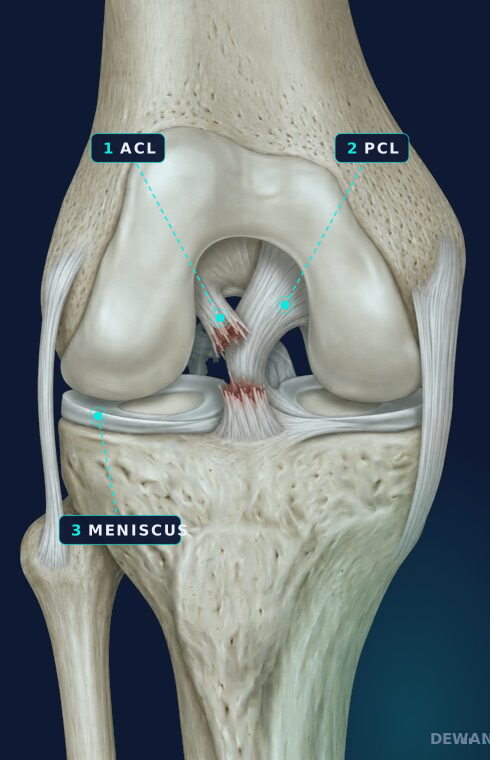
The injury that tears the ACL rarely affects the ligament alone. As the knee shifts out of place, the bones strike each other hard enough to bruise the bone and the articular cartilage, the smooth surface that covers the ends of the bones. The meniscus — the two C-shaped shock-absorbing cartilages between the thigh bone and shin bone — is often torn at the same time. And a knee left unstable can give way again, and each episode can tear the meniscus further. Arthritis is the gradual wear of the joint surface, and each of these injuries contributes to it.
What the new trial did
A Canadian group randomized 330 patients aged 14 to 50 with a torn ACL to one of three reconstruction techniques: a patellar tendon graft, a single-bundle hamstring graft, or a double-bundle hamstring graft.1 The average age at surgery was about 28. The main outcome was a validated ACL quality-of-life questionnaire scored from 0 to 100. A reviewer who did not know the treatment graded standing X-rays for arthritis in each of the three parts of the knee. The researchers reached 287 patients (87%) at an average of 10.2 years. The same trial had previously reported its two- and five-year results.2
The trial was designed to compare grafts, and that comparison is covered in our article on choosing an ACL graft. Its long follow-up also makes it one of the most complete randomized records of what happens to a reconstructed knee over a decade.
What it found
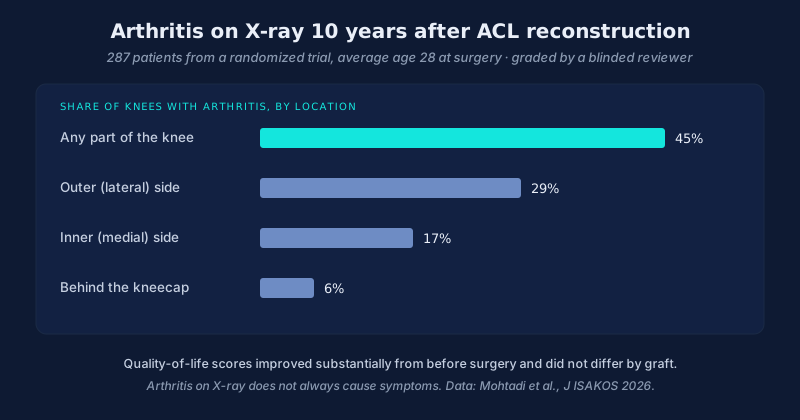
- Arthritis on X-ray: 45% of knees overall — 29% on the outer (lateral) side, 17% on the inner (medial) side, and 6% behind the kneecap.
- Quality of life: improved in all three groups and averaged about 76 to 78 out of 100 at 10 years, with no difference between grafts.
- Arthritis and symptoms: patients with arthritis on X-ray scored somewhat lower on quality of life than those without it.
- Who developed arthritis on the inner side: older patients, and those who had part of the inner meniscus removed, cartilage damage, or a later operation on the knee.
- Who developed arthritis on the outer side: patients who had part of the outer meniscus removed, those whose legs angled slightly knock-kneed, and those with a patellar tendon graft (42% against 23% with either hamstring graft).
- Re-injury: the patellar tendon graft had the fewest new injuries to the reconstructed knee (8% against 21–22%).
The authors noted that all the associations they found were small in size. The graft result is a trade-off rather than a clear winner: the graft with the lowest re-injury rate had more arthritis on the outer side of the knee.
The wider evidence
The injury raises the risk, with or without surgery
A 2019 analysis in the British Journal of Sports Medicine pooled 53 studies and found that an ACL injury raised the odds of knee arthritis about fourfold compared with an uninjured knee, and a combined ACL and meniscus injury about sixfold.7 A companion review of studies with more than 10 years of follow-up found arthritis rates ranging from under 1% to 80% in the higher-quality studies, and identified removal of meniscus tissue as the only consistent risk factor.6
Reconstruction has not been shown to prevent arthritis
The Swedish KANON trial randomized 121 young active adults with a new ACL tear to early reconstruction or to structured rehabilitation with the option of a later reconstruction.3 At 5 years, knee function and rates of arthritis on X-ray did not differ between the groups.4 At 11 years, 44% of injured knees showed arthritis on X-ray, knee-function scores remained similar, and the early-reconstruction group had slightly more arthritis features on X-ray than the rehabilitation-first group.5 About half of the rehabilitation-first group had eventually had a reconstruction.
A 2021 Dutch trial, COMPARE, found a modest advantage in knee function at two years for early reconstruction over rehabilitation first, though the authors were uncertain whether the difference was clinically important.11 It did not measure arthritis.
The meniscus is the most consistent predictor
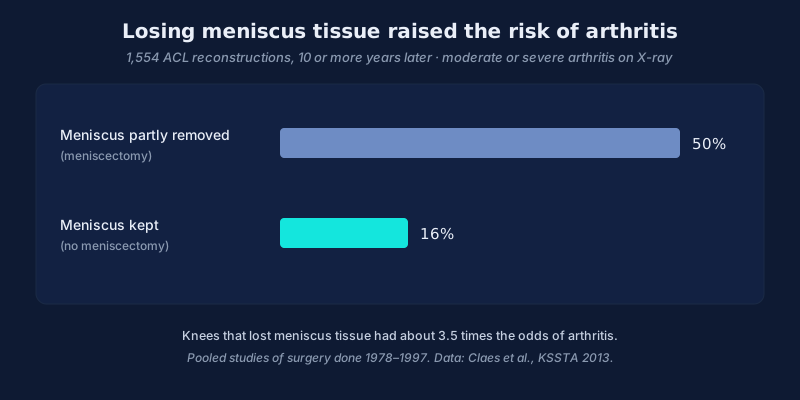
A pooled analysis of 1,554 ACL reconstructions followed for at least 10 years found moderate or severe arthritis in 50% of knees that had part of the meniscus removed, against 16% of knees where it was kept.8 A 2026 analysis of more than 46,000 patients in the American Journal of Sports Medicine confirmed meniscus removal, meniscus injury and cartilage damage as risk factors, along with older age, higher body weight, and a longer delay between injury and surgery.9
Timing matters because an unstable knee can keep injuring the meniscus. A 2019 review of 40 studies found that most reported more meniscus and cartilage damage the longer the knee went without reconstruction, with the inner meniscus most at risk after about six months.10 In the KANON trial, new or worsening damage to the inner meniscus was about twice as common with the rehabilitation-first strategy.12 The COMPARE trial, however, found no increase in meniscus operations with a delayed approach over two years.13
Over 20 years
A Norwegian study followed 168 patients to 20 years after ACL reconstruction. Arthritis on X-ray was present in 42% in the main joint and 21% behind the kneecap, rose modestly between 15 and 20 years, and was significantly more common in knees that had a combined injury than in those with an isolated ACL tear.14 Knee-function scores declined slightly, by amounts of uncertain importance to patients.
Strengths of this evidence
- The new trial is randomized and long. Ten years of follow-up with 87% of patients accounted for is unusual in surgical research, and the X-rays were graded by a reviewer who did not know the treatment.1
- It measured both X-rays and how patients felt. That allows a direct look at how much arthritis on X-ray matters to the patient.
- The surgery-versus-rehabilitation question has randomized data. KANON followed its patients for 11 years, which is rare for any orthopedic trial.5
- The meniscus finding is consistent. It appears in trials, long-term cohorts and pooled analyses across several decades and countries.689
Where I'd push back
1. “Arthritis” means different things in different studies
Each study uses its own X-ray scale and its own threshold. Some count the earliest changes, others count only moderate or severe narrowing. The 45% figure in the new trial and the 16% and 50% figures in the pooled analysis are not measuring the same thing. Reported rates range from under 1% to 100% across the literature, and much of that spread reflects definitions rather than biology.6
2. X-ray changes are not the same as a painful knee
Only two of the 41 studies in the 10-year review reported arthritis that caused symptoms separately from arthritis on X-ray.6 In the new trial, quality-of-life scores remained well above their starting point, and the difference between patients with and without arthritis on X-ray was modest. A patient reading “45% get arthritis” should not read it as “45% need a knee replacement.”
3. Much of the long-term data reflect older surgery
The pooled 10-year analysis covered reconstructions performed between 1978 and 1997, when graft placement and meniscus-repair techniques differed from today’s.8 Whether modern technique changes the arthritis rate will not be known for another decade.
4. The surgery-versus-rehabilitation trials were not built to answer the arthritis question
About half of the rehabilitation-first patients in KANON and COMPARE eventually had a reconstruction, which blurs the comparison. Neither trial was designed or large enough to detect a modest difference in arthritis. The absence of a difference is not proof that reconstruction has no effect on the joint.511
5. The meniscus findings are associations
A knee that needs part of its meniscus removed usually had a worse injury to begin with. Some of the extra arthritis in those knees may reflect the injury rather than the removal itself. The direction of the evidence is consistent, but the exact size of the benefit of saving the meniscus is uncertain.
What this means in my practice
I read this evidence as clear on one point and uncertain on another. It is clear that the meniscus and cartilage carry most of the long-term risk. It is uncertain whether reconstructing the ACL changes that risk by itself.
Reconstruction is for stability
When I talk with a patient about ACL reconstruction, the reason is a knee that gives way, or a patient who wants to return to cutting and pivoting sports, not a promise to prevent arthritis. The evidence does not support that promise, and patients deserve to make the decision on the benefits the surgery does provide. Our article on returning to sport after ACL surgery covers what that recovery involves.
Protecting the meniscus is part of the decision
The meniscus runs through every part of this evidence. When a torn ACL comes with a meniscus tear, whether that tear can be repaired rather than trimmed is one of the most important questions in the operation, and repairability depends on the tear’s pattern, location and tissue quality. Our article on meniscus tears explains the difference between repair and removal. For patients who choose rehabilitation first, the evidence suggests that repeated giving-way episodes put the meniscus at risk, so a knee that keeps buckling is a reason to revisit the decision rather than to keep waiting.
What patients can influence
Patients cannot change the injury they had, but some risk factors in the 2026 analysis, such as body weight, are modifiable.9 Completing rehabilitation and avoiding a second injury protect the knee as well. A patient who develops aching or swelling years after an ACL reconstruction should have it evaluated rather than assume it is inevitable, because the causes vary and so do the treatments.
The bottom line for the layperson
- Some arthritis shows up on X-ray in close to half of knees 10 years after an ACL tear, whether or not the ligament is reconstructed.
- Arthritis on an X-ray is not the same as a painful knee, and most patients in the new trial reported good quality of life at 10 years.
- Reconstruction restores stability; the evidence does not show that it prevents arthritis.
- Losing meniscus tissue is the most consistent predictor of arthritis after an ACL injury, so protecting and repairing the meniscus matters.
- A knee that keeps giving way risks further meniscus damage, which is a reason to revisit the treatment plan.
If you have torn your ACL and want to talk through your options and your long-term outlook, you can request a visit or call the office at (281) 690-4678. You may also want to read what ACL reconstruction involves, how to choose an ACL graft, and our overview of arthroscopic knee reconstruction.
Sources
- Mohtadi N, Chan D, Hunter D, Bertiche P, Marmura H, Bryant D. “Quality-of-life outcomes and osteoarthritis development at 10-years after anterior cruciate ligament reconstruction: A large randomized clinical trial comparing patellar tendon, hamstring tendon and double-bundle grafts.” J ISAKOS. Published online September 19, 2026:101220. DOI: 10.1016/j.jisako.2026.101220 (PMID: 42762953)
- Mohtadi NG, Chan DS. “A Randomized Clinical Trial Comparing Patellar Tendon, Hamstring Tendon, and Double-Bundle ACL Reconstructions: Patient-Reported and Clinical Outcomes at 5-Year Follow-up.” J Bone Joint Surg Am. 2019;101(11):949–960. DOI: 10.2106/JBJS.18.01322 (PMID: 31169571)
- Frobell RB, Roos EM, Roos HP, Ranstam J, et al. “A randomized trial of treatment for acute anterior cruciate ligament tears.” N Engl J Med. 2010;363(4):331–342. DOI: 10.1056/NEJMoa0907797 (PMID: 20660401)
- Frobell RB, Roos HP, Roos EM, Roemer FW, et al. “Treatment for acute anterior cruciate ligament tear: five year outcome of randomised trial.” BMJ. 2013;346:f232. DOI: 10.1136/bmj.f232 (PMID: 23349407)
- Lohmander LS, Roemer FW, Frobell RB, Roos EM, et al. “Treatment for Acute Anterior Cruciate Ligament Tear in Young Active Adults.” NEJM Evid. 2023;2(8):EVIDoa2200287. DOI: 10.1056/EVIDoa2200287 (PMID: 38320141)
- Lie MM, Risberg MA, Storheim K, Engebretsen L, et al. “What’s the rate of knee osteoarthritis 10 years after anterior cruciate ligament injury? An updated systematic review.” Br J Sports Med. 2019;53(18):1162–1167. DOI: 10.1136/bjsports-2018-099751 (PMID: 30936063)
- Poulsen E, Goncalves GH, Bricca A, Roos EM, et al. “Knee osteoarthritis risk is increased 4-6 fold after knee injury – a systematic review and meta-analysis.” Br J Sports Med. 2019;53(23):1454–1463. DOI: 10.1136/bjsports-2018-100022 (PMID: 31072840)
- Claes S, Hermie L, Verdonk R, Bellemans J, et al. “Is osteoarthritis an inevitable consequence of anterior cruciate ligament reconstruction? A meta-analysis.” Knee Surg Sports Traumatol Arthrosc. 2013;21(9):1967–1976. DOI: 10.1007/s00167-012-2251-8 (PMID: 23100047)
- Zhang L, Xu T, Xiong Q, Hu Y, et al. “Risk Factors for Knee Osteoarthritis After Anterior Cruciate Ligament Reconstruction: A Systematic Review and Meta-analysis.” Am J Sports Med. 2026;54(4):955–968. DOI: 10.1177/03635465251380285 (PMID: 41521732)
- Mehl J, Otto A, Baldino JB, Achtnich A, et al. “The ACL-deficient knee and the prevalence of meniscus and cartilage lesions: a systematic review and meta-analysis (CRD42017076897).” Arch Orthop Trauma Surg. 2019;139(6):819–841. DOI: 10.1007/s00402-019-03128-4 (PMID: 30758661)
- Reijman M, Eggerding V, van Es E, van Arkel E, et al. “Early surgical reconstruction versus rehabilitation with elective delayed reconstruction for patients with anterior cruciate ligament rupture: COMPARE randomised controlled trial.” BMJ. 2021;372:n375. DOI: 10.1136/bmj.n375 (PMID: 33687926)
- Snoeker BA, Roemer FW, Turkiewicz A, Lohmander S, et al. Br J Sports Med. 2020;54(10):612–617 (KANON trial secondary analysis of meniscal damage at 5 years). DOI: 10.1136/bjsports-2019-101125 (PMID: 31653779)
- van der Graaff SJA, Reijman M, van Es EM, Bierma-Zeinstra SMA, et al. “Meniscal procedures are not increased with delayed ACL reconstruction and rehabilitation: results from a randomised controlled trial.” Br J Sports Med. 2023;57(2):78–82. DOI: 10.1136/bjsports-2021-105235 (PMID: 36137731)
- Risberg MA, Oiestad BE, Gunderson R, Aune AK, et al. “Changes in Knee Osteoarthritis, Symptoms, and Function After Anterior Cruciate Ligament Reconstruction: A 20-Year Prospective Follow-up Study.” Am J Sports Med. 2016;44(5):1215–1224. DOI: 10.1177/0363546515626539 (PMID: 26912282)
This article reflects Dr. Dewan's reading of the cited evidence at the time of publication. It is educational content, not medical advice. Your specific case may differ — schedule a consultation to discuss your imaging and history.