Few words in an orthopedic consultation land harder than irreparable. Patients hear it as a verdict on the shoulder, and it is not one — it is a description of the tendon. A tendon that cannot be reattached to bone still sits in a shoulder that has several treatment routes available, and the useful question is which of those routes has evidence behind it. That question has a sharper answer than it did a few years ago, largely because one of the options was finally tested against a blinded control and did not survive the test.1
Why this matters
Massive rotator cuff tears are common in people past 65, and the market of procedures offered for them has grown considerably faster than the evidence supporting those procedures. Patients are routinely presented with a menu — a spacer, a graft, a tendon transfer, a joint replacement — without being told that the items on that menu are supported by very different grades of proof. Knowing which is which changes what a reasonable person would choose.
What "irreparable" actually means
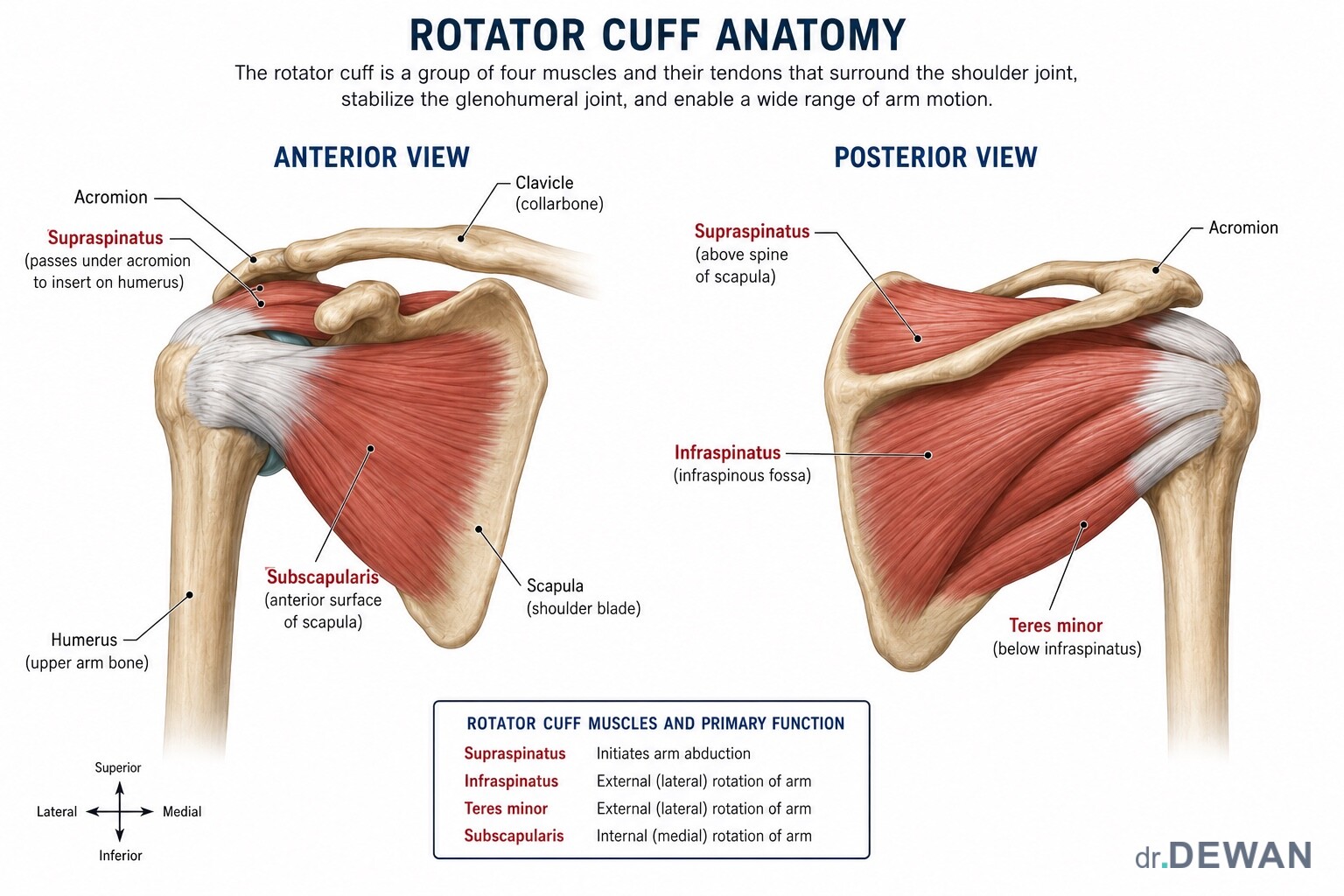
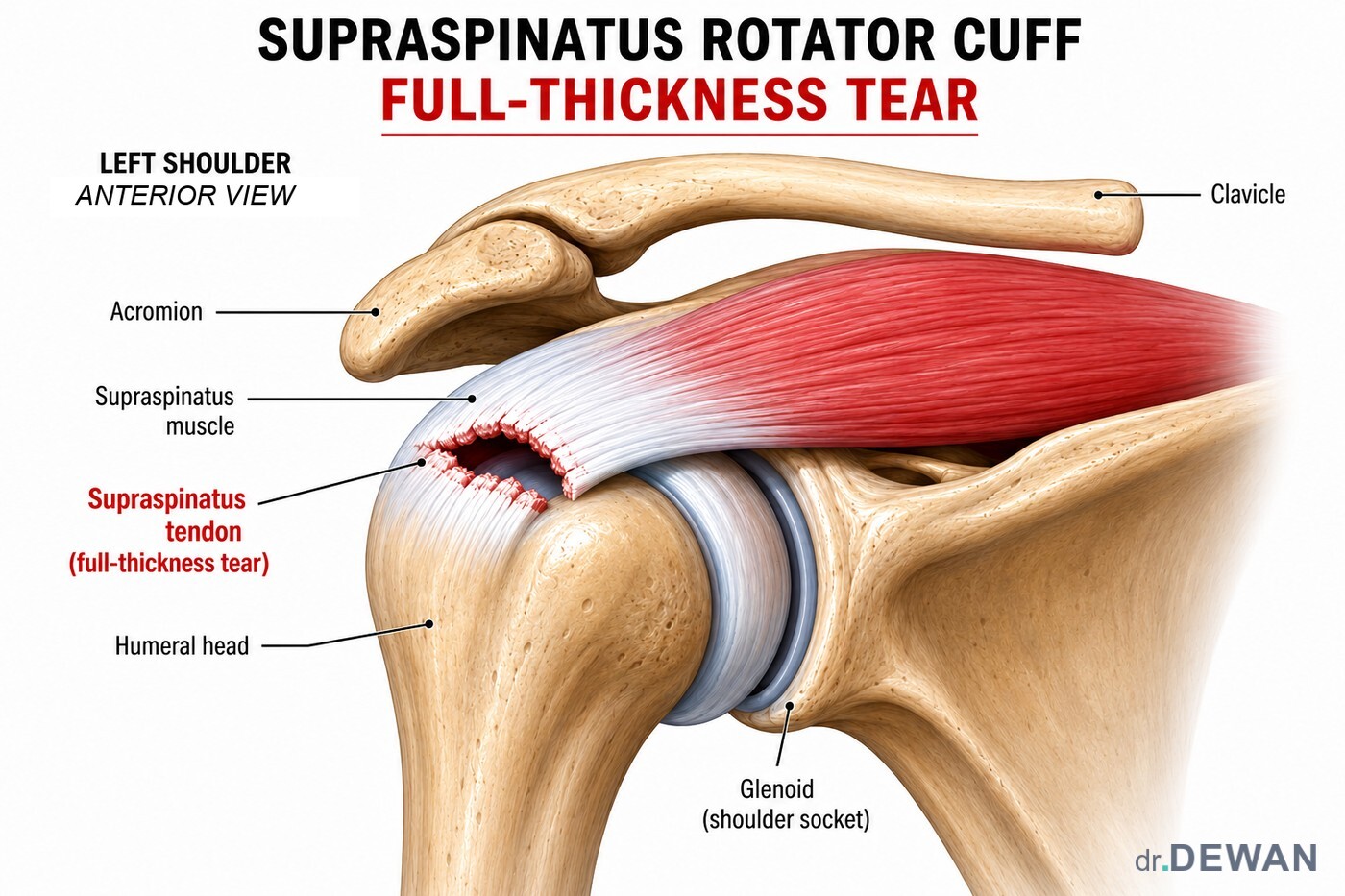
A tear is called irreparable when the torn tendon cannot be brought back to its attachment on the bone and held there under reasonable tension. Three findings usually drive that conclusion: the tendon has retracted far from where it belongs, the muscle behind it has thinned and been replaced by fat over months or years, and the remaining tissue is too poor to hold stitches. The relevant point for patients is that this describes the tissue's condition, not the severity of symptoms.
Surgeons also use the phrase functionally irreparable, which is a slightly different idea: the tendon might be stitched down technically, but the muscle behind it has degenerated to the point where reattaching it would not restore function and the repair would likely fail. Both usages appear in the literature and it is fair to ask a surgeon which one they mean.
Not every irreparable tear needs an operation
A substantial number of people carry a massive cuff tear and function well. The remaining tendons compensate, the shoulder finds a balance, and the arm still elevates. When that is the case and pain is controlled, there is no urgency to operate, and structured physical therapy aimed at the deltoid and the remaining cuff is a legitimate long-term plan rather than a holding pattern. Surgery becomes the discussion when pain persists despite genuine nonoperative treatment, or when the arm can no longer be raised.
The five options, and what stands behind each
Cleaning out the joint, with or without a partial repair
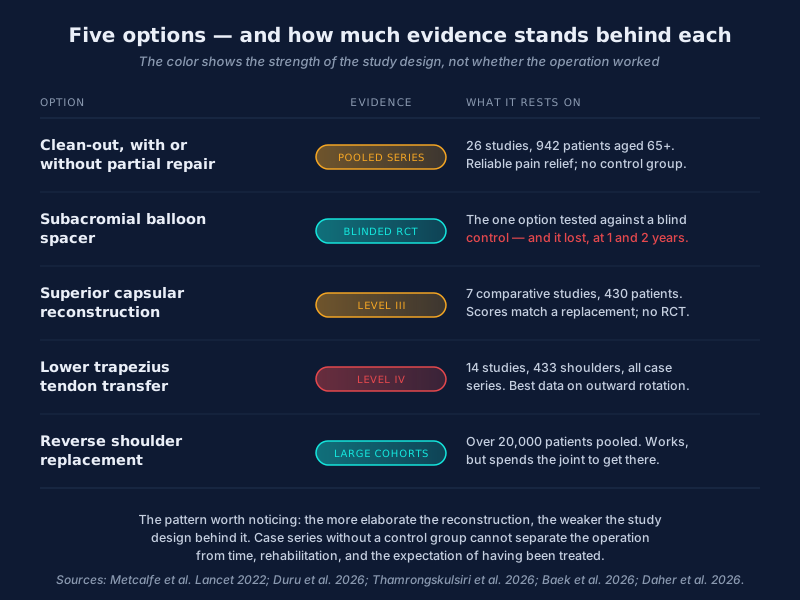
The simplest operation removes inflamed tissue, addresses the biceps tendon if it is a pain source, and repairs whatever portion of the cuff can be repaired. A 2026 systematic review of 26 studies and 942 patients aged 65 and over found meaningful improvement from both debridement and partial repair — pain scores improved by 2.0 to 5.8 points with partial repair and 4.0 to 6.5 points with debridement alone.3 Retear rates after partial repair were high, between 41.7% and 87.3%, and those retears were not consistently associated with worse symptoms. Conversion to a shoulder replacement was low.
The subacromial balloon spacer
A biodegradable balloon is inserted between the ball of the shoulder and the bone above it, on the theory that it restores spacing and improves mechanics. It is the only option on this list to have been tested in a double-blind randomized trial, and the result is the most informative single piece of evidence in this whole area.
The START:REACTS trial randomized 117 patients across 24 UK hospitals to arthroscopic debridement with biceps tenotomy, or the same operation plus the balloon.1 Patients and assessors were blinded, incisions were identical, operative notes were masked, and both groups did the same rehabilitation. At 12 months the Oxford Shoulder Score was 34.3 in the debridement-only group and 30.3 in the balloon group — a difference of 4.2 points favoring no balloon. The trial stopped early at a predefined boundary. Two-year follow-up published in 2025 found the debridement group still ahead.2 The investigators' recommendation was unambiguous: they do not recommend the device for irreparable cuff tears.
Superior capsular reconstruction
A graft is anchored between the socket and the top of the humerus to act as a restraint holding the ball down in the socket. A 2026 meta-analysis pooled seven comparative studies — 257 reconstruction patients and 173 reverse-replacement patients — and found no statistically significant difference in shoulder scores or pain between the two, with a lower overall complication rate for reconstruction (3.5% versus 10.8%).4 Every included study was level III. There is no randomized comparison against doing less.
Lower trapezius tendon transfer
A tendon from the back is rerouted to restore outward rotation, aimed at patients who cannot rotate the arm away from the body. A 2026 meta-analysis of 14 studies and 433 shoulders reported outward rotation improving by 27.9 degrees, forward elevation by 37.0 degrees, and pain scores falling by 4.2 points, with graft healing at 89.4% and complications in 3.7%.5 A 2025 systematic review of 15 studies found the same direction of effect with wider ranges.6 Both syntheses drew entirely on case series with no control group.
Reverse shoulder replacement
The ball and socket are swapped so the deltoid, rather than the cuff, raises the arm. It works whether or not the cuff exists, which is why it was invented for exactly this problem. A 2026 meta-analysis of 20,924 patients does show a cost: patients receiving a reverse replacement for a cuff-deficient shoulder had higher rates of revision, overall complications, infection, instability, and acromial stress fracture than patients receiving the same implant for arthritis with an intact cuff.7 Reliable is not the same as risk-free, and a replacement is not reversible.
Strengths of this evidence
- START:REACTS is an exceptional piece of surgical research. Blinding patients and assessors to which operation they received is rare and difficult in surgery, and it is the only way to separate a device's effect from the effect of having been operated on.
- It reported a negative result and published it plainly. That is worth something in a field where new devices usually arrive accompanied by favorable case series.
- The two-year follow-up did not soften the finding. Longer follow-up frequently narrows early differences; here it did not.2
- The pooled data on simpler surgery are reassuring about the floor. Nearly a thousand older patients across 26 studies improved meaningfully from modest operations, which sets a realistic baseline against which the elaborate reconstructions have to justify themselves.3
Where I'd push back
1. One negative trial of one device is not a verdict on the concept
START:REACTS tested a specific balloon in a specific population against a specific comparator. It is strong evidence against that device in that setting, and it is not evidence that every biologic or mechanical adjunct is futile. The right conclusion is narrower than the internet version of it.
2. The comparison in every other option is missing
The superior capsular reconstruction meta-analysis compares reconstruction against reverse replacement, and finds them similar.4 Neither arm was compared against a clean-out. Given that patients aged 65 and over improve substantially from a clean-out alone, the untested question is whether the graft is contributing anything beyond it.3 That is precisely the question the balloon trial was built to answer for the balloon, and precisely the question no one has answered for the graft.
3. Tendon transfer results come from the surgeons who champion the procedure
Lower trapezius transfer is technically demanding and performed at a small number of centers by surgeons with a professional investment in it. Reported outcomes from those centers are the best-case scenario, not the average one. The reported complication rate of 3.7% in the 2026 meta-analysis sits well below the 0–19% retear and 0–13% infection ranges in the 2025 systematic review of overlapping studies.56 When two syntheses of largely the same literature disagree that much, the wider range is usually closer to the truth.
4. "Improvement" in an uncontrolled series overstates the operation
Shoulders improve after surgery for reasons that have nothing to do with the specific reconstruction: the passage of time, rehabilitation, activity modification, and the well-documented effect of having been treated. START:REACTS is the demonstration — the balloon group improved substantially from baseline, and still did worse than the control.1 A before-and-after number in a case series cannot distinguish those things.
5. Complication rates are being compared across very different operations
Reporting that superior capsular reconstruction has a 3.5% complication rate against 10.8% for reverse replacement is accurate and slightly misleading, because the reconstruction's failures are graft failures that leave the shoulder roughly where it started, while a replacement's failures involve an implant. Those are different kinds of events counted in the same column.4
What this means in my practice
The first thing I want to establish is what the shoulder can still do, because it separates two quite different problems. A patient who has pain but can raise the arm has a pain problem. A patient who cannot raise the arm at all has a mechanical problem. The evidence points to different answers for each, and treating them as one condition called "massive cuff tear" is how patients end up with operations aimed at the wrong target.
When the arm still works
For a patient over 65 with pain and preserved elevation, the pooled data supporting a modest arthroscopic operation are as good as the data for anything more elaborate, and the recovery is easier.3 I would want to be confident that genuine nonoperative treatment had been tried first — a real course of therapy, not a handout of exercises.
When the arm cannot be raised
Loss of active elevation is a different situation, and in an older patient with cuff tear arthropathy a reverse replacement is the option with the most predictable outcome. The 2026 pooled complication data are worth discussing honestly beforehand, because the risks in a cuff-deficient shoulder are meaningfully higher than the figures quoted for a routine shoulder replacement.7
Where I stay cautious
I am cautious about the joint-preserving reconstructions in patients who have not yet tried anything simpler. Evidence suggests they can produce good results in selected patients, and patients considering one should discuss with their surgeon what specifically it is expected to achieve in their shoulder that a smaller operation would not — and on what evidence. If someone has a well-defined deficit in outward rotation and has already failed reasonable treatment, a tendon transfer is a considered choice. Offered as a first move to a patient who has not completed therapy, it is a large operation resting on thin data.
On the balloon
The evidence available is a blinded randomized trial in which the device performed worse than the operation it was added to, at one year and again at two.12 If a patient is offered one, that trial is the thing to ask about by name.
The word itself
Patients told their tear is irreparable often assume nothing further is available. What the word means is that one specific operation — stitching that tendon back to that bone — is off the table. Pain relief, restored motion, and durable function are all still reachable. The choice among the routes to them should be made on the strength of the evidence for each, and those strengths differ more than the way the options are usually presented would suggest.
The bottom line for the layperson
- "Irreparable" describes the tendon — that it cannot be stitched back to bone — not the shoulder, and not your prospects.
- Many people with a massive cuff tear function well without surgery; a real course of physical therapy is a legitimate plan, not a delay tactic.
- In patients over 65, a modest arthroscopic clean-out with or without partial repair produced meaningful pain relief across 26 studies and 942 patients.
- The subacromial balloon spacer is the only option tested against a blinded control, and it performed worse than the operation alone at both one and two years.
- Graft reconstructions and tendon transfers rest on case series without control groups; a reverse shoulder replacement is the most predictable option when the arm can no longer be raised, but it carries higher complication rates in a cuff-deficient shoulder than in a normal one.
If you've been told your rotator cuff tear can't be repaired and you want to understand which options genuinely apply to your shoulder, that depends on your imaging and on what your arm can still do. You can request a visit or call the office at (281) 690-4678. You may also want to read the companion pieces on whether a rotator cuff tear needs repair at all and how reverse and anatomic shoulder replacements differ.
Sources
- Metcalfe A, Parsons H, Parsons N, et al. “Subacromial balloon spacer for irreparable rotator cuff tears of the shoulder (START:REACTS): a group-sequential, double-blind, multicentre randomised controlled trial.” Lancet. 2022;399(10339):1954–1963. DOI: 10.1016/S0140-6736(22)00652-3 (PMID: 35461618)
- Haque A, Parsons H, Parsons N, et al. “Two-Year Follow-up of a Group-Sequential, Multicenter Randomized Controlled Trial of a Subacromial Balloon Spacer for Irreparable Rotator Cuff Tears of the Shoulder (START:REACTS).” Am J Sports Med. 2025;53(6):1291–1298. DOI: 10.1177/03635465251326891 (PMID: 40156172)
- Duru DO, Zhou AK, Geetala R, Metcalfe A, Chaudhury S. “Arthroscopic Partial Repair and Arthroscopic Debridement Improve Pain and Functional Outcomes in Older Patients With Massive Irreparable Rotator Cuff Tears: A Systematic Review.” Arthrosc Sports Med Rehabil. 2026. DOI: 10.1002/ars2.70030 (PMID: 42500136)
- Thamrongskulsiri N, Limskul D, Tanpowpong T, Kuptniratsaikul S, Itthipanichpong T. “Clinical Outcomes and Complications of Superior Capsular Reconstruction Versus Reverse Shoulder Arthroplasty for Massive Rotator Cuff Tears: A Meta-Analysis.” Clin Orthop Surg. 2026;18(3):485–497. DOI: 10.4055/cios25259 (PMID: 42226776)
- Baek CH, Kim JG, Kim BT, Lim C. “The meta-analysis and systematic review of arthroscopic lower trapezius tendon transfer for massive irreparable rotator cuff tears.” Shoulder Elbow. 2026. DOI: 10.1177/17585732261455827 (PMID: 42255992)
- Lauck BJ, Reynolds AW, van der List JP, Trasolini NA, Waterman BR. “Lower Trapezius Tendon Transfer Improves Range of Motion, Functional Outcomes, and Pain for Irreparable Rotator Cuff Tears: A Systematic Review.” Arthroscopy. 2025;41(11):4818–4825.e4. DOI: 10.1016/j.arthro.2025.04.026 (PMID: 40349800)
- Daher M, Ashkar I, Parmar T, et al. “The impact of an intact rotator cuff on the outcomes of reverse shoulder arthroplasty: a meta-analysis of 20,924 patients.” J Shoulder Elbow Surg. 2026. DOI: 10.1016/j.jse.2026.03.023 (PMID: 41966468)
- AAOS OrthoInfo — Rotator Cuff Tears (patient overview)
This article reflects Dr. Dewan's reading of the cited evidence at the time of publication. It is educational content, not medical advice. Your specific case may differ — schedule a consultation to discuss your imaging and history.