
Not always. For a large share of people, a first shoulder dislocation is also the last. For young, active adults, though, the randomized evidence is lopsided, and a trial published last year gave it its longest follow-up yet. In the American Journal of Sports Medicine, a French group reported six-year results for adults aged 18 to 25 who were randomized after a first dislocation to an arthroscopic repair within two weeks or to a sling and physical therapy. The shoulder became unstable again in 27.8% of the repair group and 89.5% of the sling group.1
Those numbers come from 40 patients, and the size of the trial matters for how much weight they carry. They also sit on top of four decades of research that point the same way. The practical question is not whether surgery reduces re-dislocation — it clearly does — but who gains enough from that reduction to justify an operation they might never have needed.
Why the timing of this decision matters
Most orthopedic decisions can wait. This one has a window. Early repair, in the trials that support it, means an operation within a few weeks of the injury, before the torn tissue scars in a displaced position. Each further dislocation can also wear away the front edge of the socket bone. When enough bone is lost, a soft-tissue repair alone becomes less reliable and a larger bone-block operation may be needed instead — a trade-off we discuss in labral repair versus the Latarjet procedure. A patient who waits to see whether the shoulder dislocates again is making a reasonable choice, but not one without consequences if it does.
What a dislocation does to the shoulder
The shoulder is a ball-and-socket joint with a very shallow socket, which is what lets the arm move through such a wide range. Much of its stability comes from the labrum — a rim of firm cartilage that runs around the edge of the socket, deepening it and anchoring the ligaments that hold the ball in place.
Almost all dislocations are anterior: the ball is forced out the front of the socket, typically with the arm raised and pulled backward — a tackle, a fall on an outstretched arm, a blocked spike. As the ball leaves, it usually tears the front-lower part of the labrum off the bone. That injury is called a Bankart lesion. The labrum does not reliably heal back to the bone on its own in the correct position, and without it, the ball has less holding it in. That is the mechanical reason a first dislocation so often leads to a second.
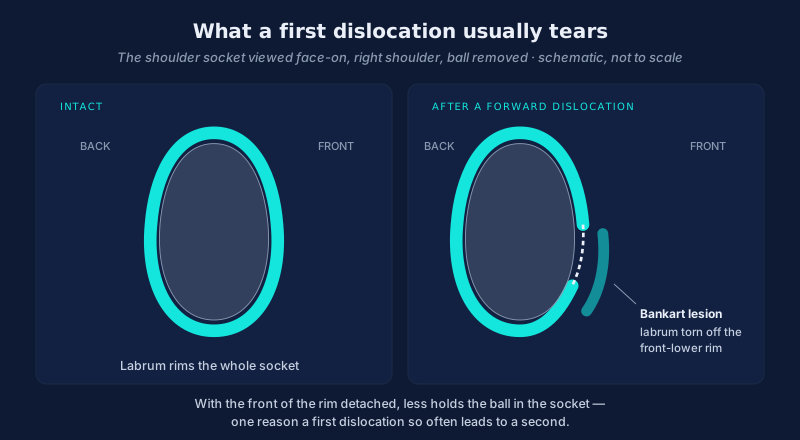
An arthroscopic Bankart repair reattaches the labrum to the socket rim through small incisions, using a camera and small suture anchors placed in the bone. It is the operation tested in the trials below.
What happens without surgery
The most useful counterweight to the surgical trials is the longest natural-history study available. A Swedish group followed 229 shoulders for 25 years after a first dislocation treated without surgery, in patients aged 12 to 40.2
- 43% never dislocated again, and another 7% dislocated only once more.
- 14.4% dislocated repeatedly for a while and then became stable on their own.
- 27% eventually had surgery for instability.
- Excluding shoulders with a fracture, 38% of patients aged 12 to 25 at the first dislocation went on to surgery, against 18% of those aged 26 to 40.
- Whether the arm was immobilized after the first dislocation made no difference to the long-term outcome.
The authors' summary was that half of the young shoulders treated without surgery had either not recurred or had become stable by 25 years. That is the strongest argument against operating on everyone: a policy of early surgery for all young patients would include a large number who would have done well without it. Age is the single most consistent predictor across this literature.
What the new trial did
The French trial enrolled 40 patients aged 18 to 25 after a first forward dislocation and randomized them evenly.1 One group had an arthroscopic Bankart repair within two weeks of the injury. The other was treated without surgery. Both groups wore a sling for three weeks and followed the same physical therapy program, so the only planned difference was the repair itself. The main outcome was any further instability — a dislocation needing to be put back or a partial slip, called a subluxation. The researchers reached 37 of the 40 patients at an average of 6.8 years.
What it found
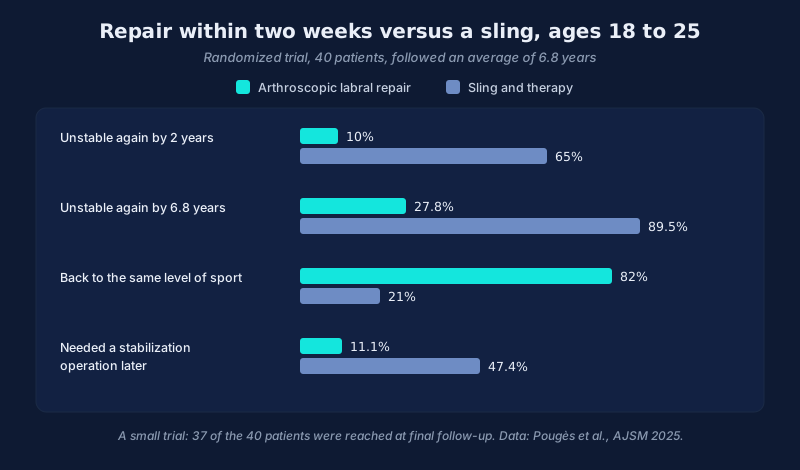
- Any further instability: 5 of 18 (27.8%) after repair against 17 of 19 (89.5%) with a sling.
- A full dislocation again: 22.2% against 79.0%.
- Back to the same or a higher level of sport: 82% against 21%.
- Needed a stabilization operation later: 11.1% after the early repair against 47.4% in the sling group.
- Function scores on three separate questionnaires were significantly better in the repair group.
One finding deserves more attention than it usually gets. At two years, instability had recurred in 10% of the repair group. By 6.8 years it was 27.8%, and every one of the repaired shoulders that dislocated again did so after the two-year mark. A repair lowers the risk substantially; it does not eliminate it, and shorter studies understate how much risk remains.
The wider evidence
Two recent pooled analyses reach the same conclusion from different directions. A 2025 network meta-analysis in Arthroscopy combined eight randomized trials with 439 participants under 40. Arthroscopic repair cut the risk of recurrence to about one-seventh of that with a sling (risk ratio 0.14).3 It also found no difference between slinging the arm across the body and the once-popular approach of bracing it rotated outward.
A 2025 position statement from the Arthroscopy Association of Canada pooled 11 comparative studies and 694 patients with an average age of about 22. Early repair sharply reduced further instability, re-dislocation, and later surgery, and gave patients nearly four times the odds of returning to the same level of sport.4 One result pointed the other way: the pooled score on the main shoulder-instability questionnaire did not differ significantly between the groups.
The older trials fit the same pattern. In young military athletes, 75% of shoulders treated without surgery became unstable again within about three years, against 11.1% after arthroscopic repair.5 A Danish trial of open repair found recurrence in more than half of patients treated without surgery against 3% with repair at two years, and ten-year results rated good or excellent in 72% of repaired shoulders.6 A Canadian trial followed patients for about six years and found a clear difference in re-dislocation but no significant difference on two general shoulder-function scores.7
If you choose not to have surgery
A large UK trial, ARTISAN, randomized 482 adults with an average age of 45 who were being treated without surgery. A full course of physical therapy was no better at six months than a single advice session with written materials and the option to book therapy later.8 For an older patient whose shoulder feels stable, a structured home program and a clear plan for what to do if it slips again appear to be as effective as scheduled therapy.
Strengths of this evidence
- Randomized trials exist, and they agree. Surgical research often relies on comparisons of patients whom surgeons chose to treat differently. Here, multiple randomized trials across several countries and decades point in the same direction on recurrence.
- The new trial isolated the operation. Both groups had the same three weeks in a sling and the same therapy, so the difference in outcome is attributable to the repair rather than to a different rehabilitation program.
- Follow-up is long enough to capture late failures. The six-year results show what two-year results would have missed: repaired shoulders keep accumulating some risk after the second year.
- A 25-year natural history exists. Few conditions in orthopedics have a study following untreated patients for a quarter century. It lets patients weigh surgery against a well-measured alternative rather than an imagined one.2
Where I'd push back
1. The trials are small
In the new trial, each patient in the repair group accounts for more than five percentage points. The gap between the groups is large enough that it would survive a few patients landing differently, but the precise figures — 27.8%, 82% — should be read as approximate. The pooled analyses help, yet even the network meta-analysis rests on 439 people.
2. Fewer re-dislocations did not always mean a better-functioning shoulder
Recurrence is the outcome surgery changes most reliably. On patient-reported function, the results are mixed: the new trial found clear differences, while the Canadian pooled analysis found no significant difference on the main instability questionnaire, and an earlier trial found none on two general function scores.47 Part of the explanation is that many patients in the non-surgical groups had a later stabilization and were then scored on a repaired shoulder. The defensible claim is that early repair prevents instability episodes and the time lost to them — not that it guarantees a better shoulder years later.
3. The patients studied are narrow
The pooled trials enrolled mostly young men, with an average age in the low twenties and only about one patient in seven female.4 Several of the older trials studied military cadets or competitive athletes. Applying these numbers to a 35-year-old office worker who dislocated a shoulder on a ski trip extrapolates well beyond the data.
4. A policy of early surgery treats some shoulders that would have been fine
In the new trial, two of the 19 patients in the sling group never had a further episode, and in the 25-year study, half of the young shoulders treated without surgery eventually stopped dislocating.12 That trade-off belongs in the conversation, particularly for a patient whose activities do not put the arm at risk.
5. Arthritis after repair is common, and the data cannot say whether surgery adds to it
A 2025 review of patients followed an average of more than ten years after arthroscopic Bankart repair found some arthritic change on X-ray in 60% and moderate-to-severe change in 28%, though it was generally not causing symptoms and was not associated with shoulder-function scores.9 Repeated dislocations also damage the joint, and the review had no untreated comparison group, so it cannot tell us whether repair lowers, raises, or leaves unchanged the long-term arthritis risk.
What this means in my practice
I read this evidence as strong on recurrence, weaker on long-term function, and highly dependent on who the patient is.
The first visit is about the whole shoulder, not just the labrum
After a first dislocation, I want to know how the injury happened, what the patient's work and sport ask of the shoulder, and whether the shoulder has felt loose since. An MRI shows the labral tear and other damage, and the front edge of the socket needs to be assessed for bone loss, because significant bone loss changes which operation makes sense. In patients over 40, a first dislocation becomes much more likely to tear the rotator cuff as well, and that injury follows a different decision path, covered in our article on rotator cuff tears and repair.
Where early repair makes the strongest case
For a patient in their late teens or twenties who plays a contact, collision, or overhead sport and wants to return to it, the evidence suggests early arthroscopic repair substantially lowers the chance of dislocating again and raises the chance of getting back to the same level. That is the group in which the trials were done and in which the difference was largest. For these patients, I raise early repair as an option at the first visit rather than waiting for a second dislocation, because the window for the simplest repair is limited.
Where a trial without surgery is reasonable
An older or less active patient, someone whose shoulder feels stable after the initial recovery, or someone who simply prefers to avoid surgery, can reasonably start with a short period in a sling and a structured rehabilitation program. The 25-year data show that many of these shoulders do well. The trade-off is that if the shoulder does dislocate again, the next conversation is usually about surgery, and possibly a larger operation if bone has been lost.
What I ask patients to weigh
The question I ask patients to consider is what a second dislocation would cost them — a missed season, a job that requires overhead work, a fall risk, a sport they are not willing to give up. When that cost is high, the evidence supports acting early. When it is low, waiting is a sound choice. Our article on rehabilitation after labral repair describes what recovery from the operation involves, which belongs in the decision as much as the recurrence numbers do.
The bottom line for the layperson
- A first shoulder dislocation usually tears the labrum off the front of the socket, and that tear is the main reason the shoulder may dislocate again.
- In young, active adults, early arthroscopic repair cut further instability from about 90% to about 28% over six years in the newest randomized trial.
- Repair lowers the risk of dislocating again but does not eliminate it, and patient-reported function scores do not always differ between surgery and a sling.
- Age matters most: in a 25-year study, far fewer people over 25 eventually needed surgery than those 25 and younger, and half of the young shoulders treated without surgery eventually settled down.
- The decision has a window of a few weeks, so it is worth having the conversation soon after the injury rather than after a second dislocation.
If you have dislocated your shoulder and want to talk through whether early repair makes sense for you, you can request a visit or call the office at (281) 690-4678. You may also want to read the companion pieces on how the shoulder labrum works and labral repair versus the Latarjet procedure, and our overview of arthroscopic shoulder reconstruction.
Sources
- Pougès C, Boutry M, Maynou C, Chantelot C, et al. “Arthroscopic Bankart Repair Versus Immobilization for a First Episode of an Anterior Shoulder Dislocation Before the Age of 25 Years: A Randomized Controlled Trial With 6-Year Follow-up.” Am J Sports Med. 2025;53(10):2289–2297. DOI: 10.1177/03635465251350151 (PMID: 40605377)
- Hovelius L, Olofsson A, Sandström B, et al. “Nonoperative treatment of primary anterior shoulder dislocation in patients forty years of age and younger. A prospective twenty-five-year follow-up.” J Bone Joint Surg Am. 2008;90(5):945–952. DOI: 10.2106/JBJS.G.00070 (PMID: 18451384)
- Jin H, Zhang G, Chen S, Tong Y, et al. “Surgical Treatment Is Superior to Conservative Options in Preventing Recurrence of First-Time Anterior Shoulder Dislocation in Adolescents and Adults Under 40 Years of Age: A Systematic Review and Network Meta-analysis.” Arthroscopy. 2025;41(12):5364–5377.e4. DOI: 10.1016/j.arthro.2025.07.044 (PMID: 40939903)
- Abdel Khalik H, Dagher D, Lameire DL, Gusnowski E, et al. “Management of First-Time Anterior Shoulder Dislocation—A Systematic Review and Meta-analysis: Arthroscopy Association of Canada Position Statement.” Orthop J Sports Med. 2025;13(2):23259671251316893. DOI: 10.1177/23259671251316893 (PMID: 39968414)
- Bottoni CR, Wilckens JH, DeBerardino TM, et al. “A prospective, randomized evaluation of arthroscopic stabilization versus nonoperative treatment in patients with acute, traumatic, first-time shoulder dislocations.” Am J Sports Med. 2002;30(4):576–580. DOI: 10.1177/03635465020300041801 (PMID: 12130413)
- Jakobsen BW, Johannsen HV, Suder P, Søjbjerg JO. “Primary repair versus conservative treatment of first-time traumatic anterior dislocation of the shoulder: a randomized study with 10-year follow-up.” Arthroscopy. 2007;23(2):118–123. DOI: 10.1016/j.arthro.2006.11.004 (PMID: 17276217)
- Kirkley A, Werstine R, Ratjek A, Griffin S. “Prospective randomized clinical trial comparing the effectiveness of immediate arthroscopic stabilization versus immobilization and rehabilitation in first traumatic anterior dislocations of the shoulder: long-term evaluation.” Arthroscopy. 2005;21(1):55–63. DOI: 10.1016/j.arthro.2004.09.018 (PMID: 15650667)
- Kearney RS, Ellard DR, Parsons H, et al. “Acute rehabilitation following traumatic anterior shoulder dislocation (ARTISAN): pragmatic, multicentre, randomised controlled trial.” BMJ. 2024;384:e076925. DOI: 10.1136/bmj-2023-076925 (PMID: 38233068)
- Yeo MHX, Seah SJS, Ang G, et al. “Prevalence and risk factors for the development of glenohumeral osteoarthritis following arthroscopic Bankart repair: a systematic review and meta-analysis of studies with minimum 5-years follow-up.” J Shoulder Elbow Surg. 2025;34(12):e1224–e1233. DOI: 10.1016/j.jse.2025.03.011 (PMID: 40262655)
- AAOS OrthoInfo — Dislocated Shoulder (patient overview)
This article reflects Dr. Dewan's reading of the cited evidence at the time of publication. It is educational content, not medical advice. Your specific case may differ — schedule a consultation to discuss your imaging and history.