
Most patients considering rotator cuff surgery come across the same statistic before their operation, and it is a difficult one to read: a meaningful share of rotator cuff repairs do not fully heal. The best pooled estimate available, from 38 high-quality studies covering 3,072 patients, puts the retear rate at 22.1% — roughly one in five.1
That number is accurate, and I would rather discuss it with patients directly than have them encounter it alone. It also does not mean what it appears to mean. A retear seen on an MRI and a failed operation are not the same thing, and the difference between them is widely misunderstood.
Why this matters more than it sounds
Patients make decisions with that 22% in their heads. Some decide against an operation that would have helped them, because a one-in-five chance of “failure” sounds unacceptably high. Others have a good result, get a scan two years later for an unrelated reason, see the word retear in the report, and spend months convinced their shoulder is broken when it is working fine. Both of those are avoidable, and both come from treating an imaging finding as if it were an outcome.
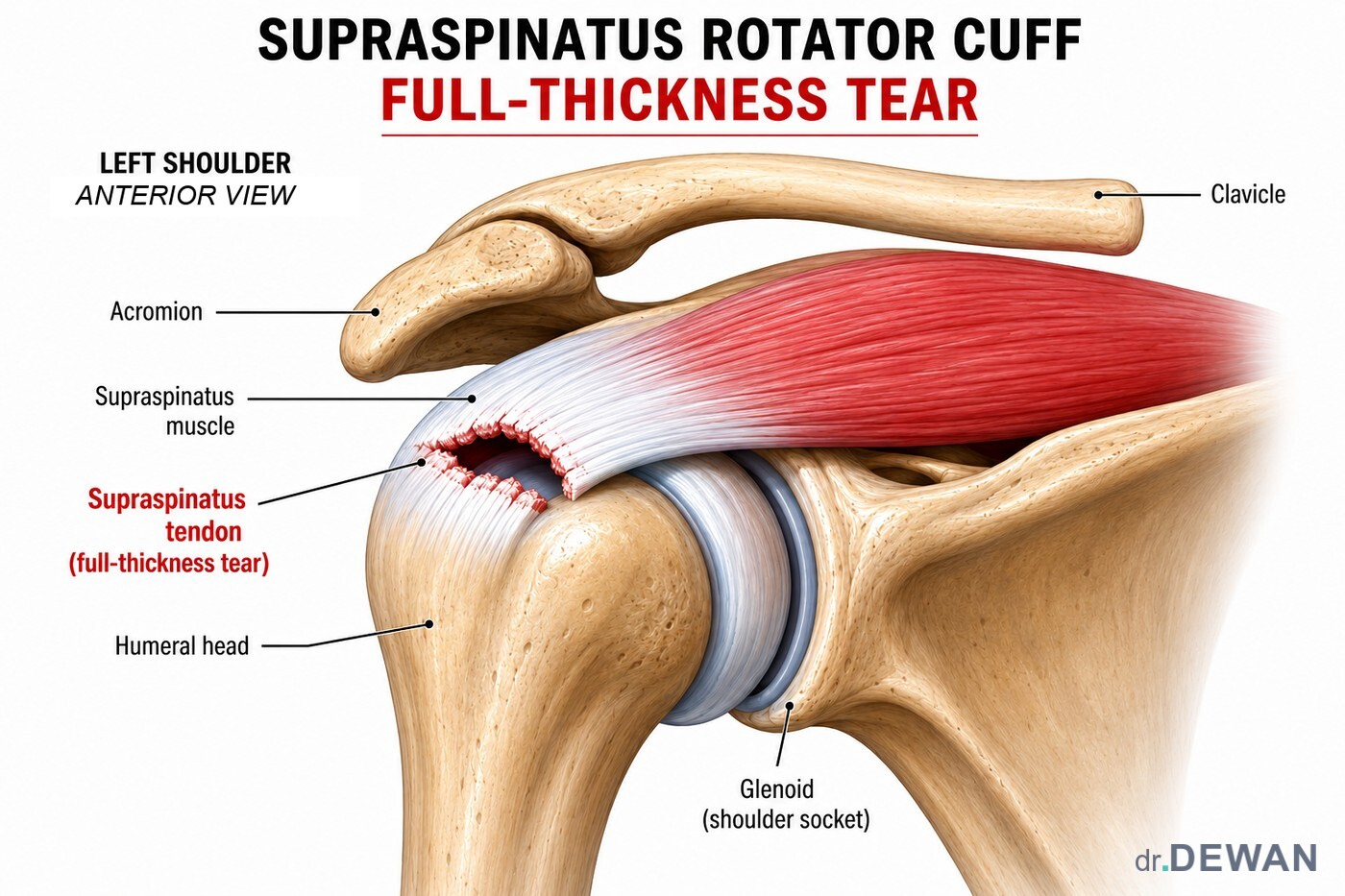
What a “retear” actually is
A rotator cuff repair restores the tendon mechanically. Healing it is a separate, biological process. During surgery the torn tendon edge is brought back to its attachment site on the bone and secured there with anchors and sutures, and that construct is sound from the day it is placed. Whether the tendon then forms a durable biological attachment to the bone over the following months depends on blood supply, tissue quality, age, and how carefully the repair is protected during recovery.
When follow-up imaging shows a defect at the repair site, it is reported as a retear. That single term covers a wide range of findings: a small gap at the edge of an otherwise well-attached tendon is recorded as a retear, and so is a tendon that has pulled completely off and retracted. Those are very different situations for the patient, and grouping them under one label is the first reason the 22% figure is misleading. Reported rates also depend on when the imaging is performed — a separate meta-analysis of 31 studies found rates ranging from roughly 15% to 21% across different follow-up intervals, which reflects imaging schedules as much as tendon biology.2
Age is the strongest predictor
The most consistent predictor of whether a repair heals is the age of the tendon. Pooling those 38 studies, each additional year of age carried about 5% higher odds of a retear, which compounds substantially over two decades. The reported risk runs near 15% at age 50 and above 30% by age 70 — roughly doubling across those twenty years.1
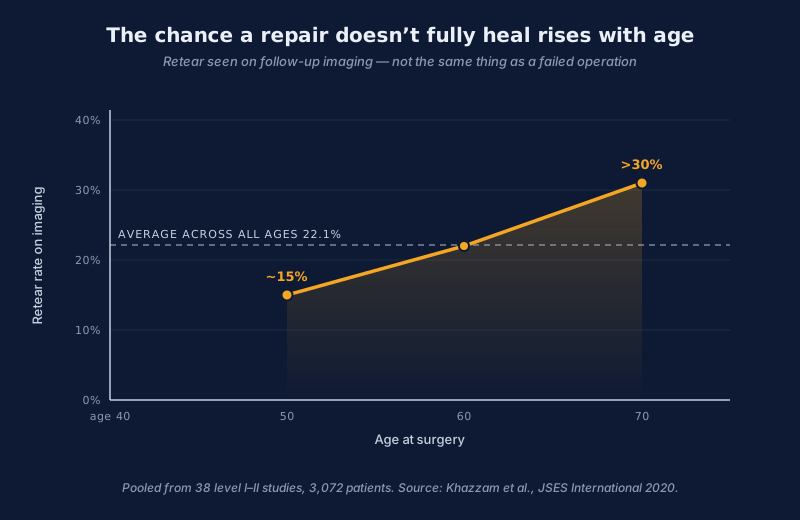
Other factors stack on top of age: larger tears fail more often than small ones, and fatty infiltration — where muscle that has been disconnected for a long time is gradually replaced by fat — is a strong marker of tissue that will struggle to heal.2 Smoking and poorly controlled diabetes both reduce the odds of healing. Surgical technique and the rehabilitation protocol also matter, and those are the parts of the equation your surgeon and your physical therapist control directly.
What the outcome data show
If a retear were straightforwardly bad, patients whose repairs retore would report clearly worse shoulders than patients whose repairs healed. That is not what the outcome data consistently show. A meta-analysis published in JBJS found that structural integrity after rotator cuff repair did not correlate with patient-reported function and pain: patients improved substantially in both, whether or not later imaging showed an intact tendon.3
That finding makes more sense once pain relief after cuff surgery is understood as coming from several sources rather than one. Addressing associated joint pathology, relieving pressure in the space above the tendon, reducing load on the injured tendon, and the gradual resolution of chronic inflammation all contribute, and they do so largely independently of whether the tendon fully heals to bone. The remaining intact cuff muscles can also compensate for a partial defect.
Where I'd push back on the reassurance
“Retears don't matter” has become a common line, and it is oversold. The most careful analysis of this question — 43 study arms, 3,350 patients, about a quarter of them with retears on imaging — found that the differences between healed and retorn repairs were statistically real, just small.4 Shoulder scores ran about 6 to 7 points apart on 100-point scales, favoring the healed group, which sits below the threshold most patients report as meaningful. The authors concluded that most patients can expect satisfactory outcomes despite a retear. I agree with that conclusion, and I would attach three qualifications to it.
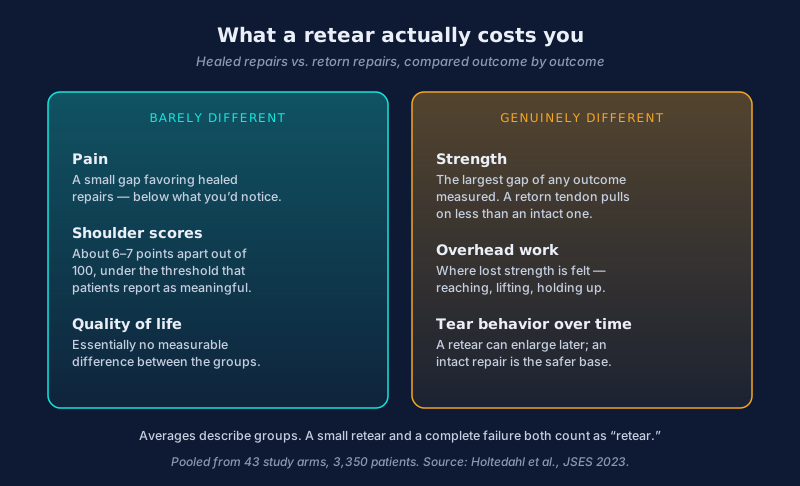
1. Strength is the exception, and the difference is substantial
In that same analysis, muscle strength showed the largest difference of any outcome measured between healed and retorn repairs.4 That is mechanically unsurprising: a tendon that is not attached cannot pull. For a patient whose goal is to sleep through the night and reach a cabinet, that strength gap may never surface. For a patient who frames a house or throws a ball, it is the whole point of the operation. Reassurance built on average pain scores does not transfer cleanly to someone whose demand is strength.
2. Averages hide the people who do badly
A mean difference of six points can be produced by a hundred patients who notice nothing alongside a handful who lose shoulder function entirely. Small retears with little clinical consequence are common, and they pull the average in a reassuring direction. Complete failure with a retracted tendon is uncommon but difficult to treat — revision repair delivers less reliable results than a first-time repair. Group averages are the right tool for deciding whether to offer an operation and the wrong tool for describing what a specific bad outcome looks like.
3. The follow-up windows are short for a lifelong question
The retear literature is largely built on imaging around 12 to 24 months.2,4 That captures early healing failure well. It says much less about how a shoulder with a small persistent defect behaves at the fifteen-year mark, or whether such a defect enlarges over time. When someone asks me whether a retear will matter eventually, the accurate answer is that the published evidence does not extend far enough to say.
What this means in my practice
The way I use these numbers has changed over time, and it comes down to separating two questions that patients tend to merge: will the tendon heal? and will I be better off?
1. I quote the retear rate that fits the patient, not the population
Quoting 22% to everyone is close to meaningless. A 52-year-old with a small traumatic tear in healthy tissue and a 71-year-old with a large chronic tear and fatty change in the muscle are not in the same conversation, and the published data support telling them different things.1 I would rather give someone a number shaped by their own MRI than a number shaped by everyone else's.
2. A higher retear risk is not automatically a reason not to operate
This is the point patients find most surprising. Since pain and function improve substantially even in shoulders where imaging later shows a defect,3 a somewhat elevated retear risk does not, by itself, take repair off the table — particularly when the main complaint is pain and night pain. What an elevated risk does change is what I promise. I set expectations around pain relief and function rather than around a perfect scan.
3. For strength-driven goals, I weigh healing much more heavily
When someone's goal is overhead work — a trade, a sport, a job that requires holding a load away from the body — the strength gap between a healed and a retorn repair moves from academic to central. Those are the conversations where tissue quality, tear size, and the factors that predict healing carry the most weight in deciding whether, when, and how to repair.
4. The modifiable factors deserve real attention
Age and tear size are fixed by the time someone reaches my office. Smoking, blood sugar control, and protecting the repair during the early healing window are not.2 I spend more time on those than patients expect, because they are the only levers either of us can still pull. The sling and the early restrictions are not arbitrary caution — they exist because the repair is mechanically strongest on the day it is done and biologically weakest a few weeks later.
5. A retear on a scan is not a reason to panic
If someone is doing well and a scan shows a defect, the imaging finding does not outweigh how the shoulder is actually functioning. Most cuff retears are tolerated well and do not require another operation. The findings that change my thinking are clinical: strength that is going backward, pain that returns after having settled, or a new mechanical problem — not the report alone.
The bottom line for the layperson
- About 1 in 5 rotator cuff repairs shows a retear on follow-up imaging — but a retear on a scan is not the same as a failed operation.
- Age is the strongest predictor: retear risk runs near 15% at age 50 and above 30% by age 70. Larger tears, fatty muscle change, smoking, and diabetes add to it.
- Patients whose repairs retear still improve substantially in pain and function, and most report satisfactory outcomes — the measured gap in pain and shoulder scores is small.
- Strength is the exception. It is where a retear shows up most clearly, which matters a lot if your goals involve overhead or heavy work.
- A higher retear risk is not automatically a reason to skip surgery. It is a reason to have a specific conversation about what the operation is expected to deliver for you.
If you're weighing rotator cuff surgery and want a retear estimate based on your own MRI rather than a population average, that's a conversation worth having in person. You can request a visit or call the office at (281) 690-4678. You may also want to read whether you need rotator cuff surgery at all and what recovery sleep really looks like.
Sources
- Khazzam M, Sager B, Box HN, Wallace SB. “The effect of age on risk of retear after rotator cuff repair: a systematic review and meta-analysis.” JSES Int. 2020;4(3):625–631. DOI: 10.1016/j.jseint.2020.03.014 (PMID: 32939497)
- Longo UG, Carnevale A, Piergentili I, Berton A, Candela V, Schena E, Denaro V. “Retear rates after rotator cuff surgery: a systematic review and meta-analysis.” BMC Musculoskelet Disord. 2021;22(1):749. DOI: 10.1186/s12891-021-04634-6 (PMID: 34465332)
- Russell RD, Knight JR, Mulligan E, Khazzam MS. “Structural integrity after rotator cuff repair does not correlate with patient function and pain: a meta-analysis.” J Bone Joint Surg Am. 2014. DOI: 10.2106/JBJS.M.00265 (PMID: 24553881)
- Holtedahl R, Bøe B, Brox JI. “The clinical impact of retears after repair of posterosuperior rotator cuff tears: a systematic review and meta-analysis.” J Shoulder Elbow Surg. 2023;32(6):1333–1346. DOI: 10.1016/j.jse.2023.01.014 (PMID: 36796715)
- AAOS OrthoInfo — Rotator Cuff Tears (patient overview)
This article reflects Dr. Dewan's reading of the cited evidence at the time of publication. It is educational content, not medical advice. Your specific case may differ — schedule a consultation to discuss your imaging and history.